The role of artificial intelligence within corporate managed travel programs continues to transition from novelty to necessity, less than four years after ChatGPT was unveiled to the public. But a new BTN survey of business travel managers on their organizations' use of AI shows that deployment has been a work in progress, with the vast majority of respondents at least experimenting with AI but few yet embedding it into workflows or documenting quantifiable return on investment.
The survey results, taken as a whole, paint a picture of an industry intrigued by the technology and its possibilities, interested in investigating use cases and open to suppliers' utilization of AI for travel-related functions, but not ready for widescale strategic deployment.
Compared with broader research into corporate AI initiatives, the BTN survey shows travel management as something of a microcosm of enterprisewide strategy and rollouts, with a heavy emphasis on productivity improvement with broader applications still on the horizon. It also suggests travel management's AI evolution more or less mirrors that of other functions, with no real evidence corporate investment has been directed elsewhere.
How Are Buyers Using AI in Corporate Travel?
BTN's survey shows that a significant majority of respondent companies are using AI in some fashion in their corporate travel operations, but very few have scaled up the technology to a strategic or pervasive level.
Still, only about one-quarter of respondents indicated they aren't using AI for travel management at all. That three-quarters are using AI at all is perhaps a noteworthy milestone for a technology introduced so recently.
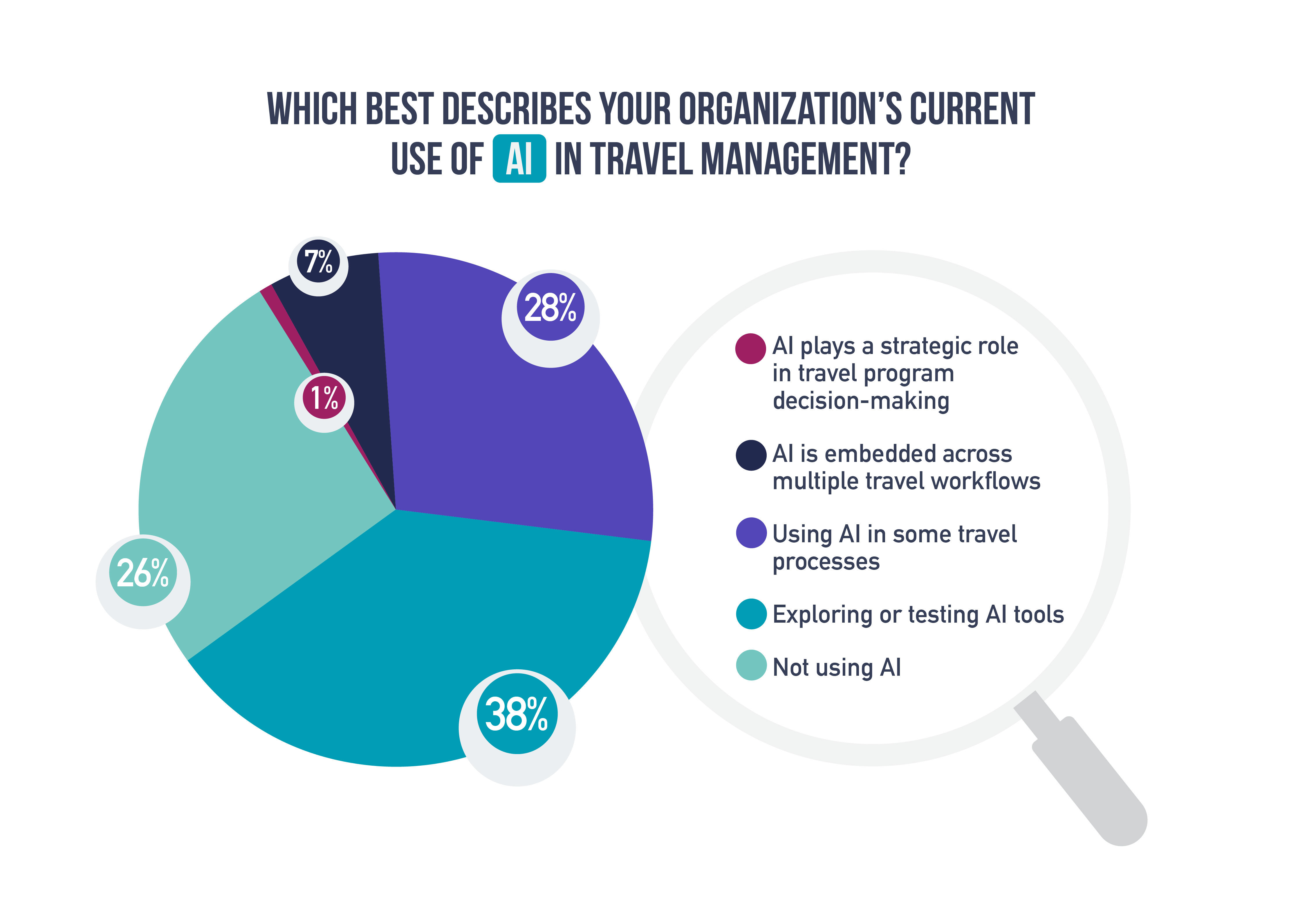
Of those respondents who are using AI in travel, most report surface-level adoption. A bit more than half of them, and 38 percent overall, report they are only exploring or testing AI applications, while more than a third of them (28 percent overall) note they're using AI in some travel processes. Fewer than 10 percent overall report that AI is embedded in more than one organizational travel management workflow, and just a handful of respondents said AI plays a strategic role in decision-making.
Is that Typical?
Every industry is grappling with the changes and possibilities brought forth by AI, of course, as is each department within the corporate structure, from human resources to marketing to sales and legal. Organizations everywhere are wrestling with AI-related decisions: Should an enterprisewide rollout be considered? How best to direct AI investment? Should customer-facing applications be prioritized?
In that environment, it's natural to examine that state of AI in travel management versus that of other organizational functions. Is travel behind the curve in adoption? And if so, what would that say about the future of the discipline?
To answer the first question, we can look at recent surveys of enterprisewide AI rollouts and implementation philosophies. And the verdict is: AI implementation in travel management probably is not notably behind that of other disciplines. Consider:
• According to a November 2025 McKinsey & Co. report on corporate AI implementation, about 88 percent of global business managers (just shy of 2,000 surveyed in summer 2025) indicated their organizations use AI for at least one business function. But only 70 percent noted they use it for at least two functions, and only 51 percent use for at least three. That's at worst consistent with BTN findings and arguably suggests deploying AI in travel management isn't a low corporate priority.
• Meanwhile, in the same survey, 31 percent of respondents reported they were "scaling" AI—that is, growing the deployment or adoption of AI across the organization—and another 7 percent said they had completed doing so. But no more than 10 percent of respondents reported they were scaling AI in a particular corporate function, even IT.
• A 2025 survey of corporate decision-makers from the University of Pennsylvania's Wharton School showed that 82 percent of overall corporate decision-maker respondents were using generative AI on a regular basis, led not surprisingly by the IT department at 93 percent. About 88 percent of purchasing and procurement decision-maker respondents said they do so. Interestingly, only 68 percent of sales and marketing respondents were doing so, trailing the field. (For more from the Wharton survey, see this Q&A with study co-author Jeremy Korst.)
The Form and the Shape
Travel management as a discipline may fall in line with the experience of other corporate departments in terms of AI deployment, but how precisely are buyers rolling it out? After all, there's a big difference between a single user using ChatGPT, Gemini or Perplexity as a fancier Google to clarify a few industry definitions and a comprehensive departmental strategy to use it to create chatbots, instructional videos, forecasting models and expense report audits.
We'll cover use cases and satisfaction therein here. But the philosophy of AI deployment is inextricably tied to overall corporate attitudes on innovation, experimentation and openness. After all, the first step to developing an AI strategy is knowing you'll have the permission from higher-ups to do so.
It's not simple to put quantitative metrics on corporate culture, but some signals shine light on the willingness to pursue AI innovation.
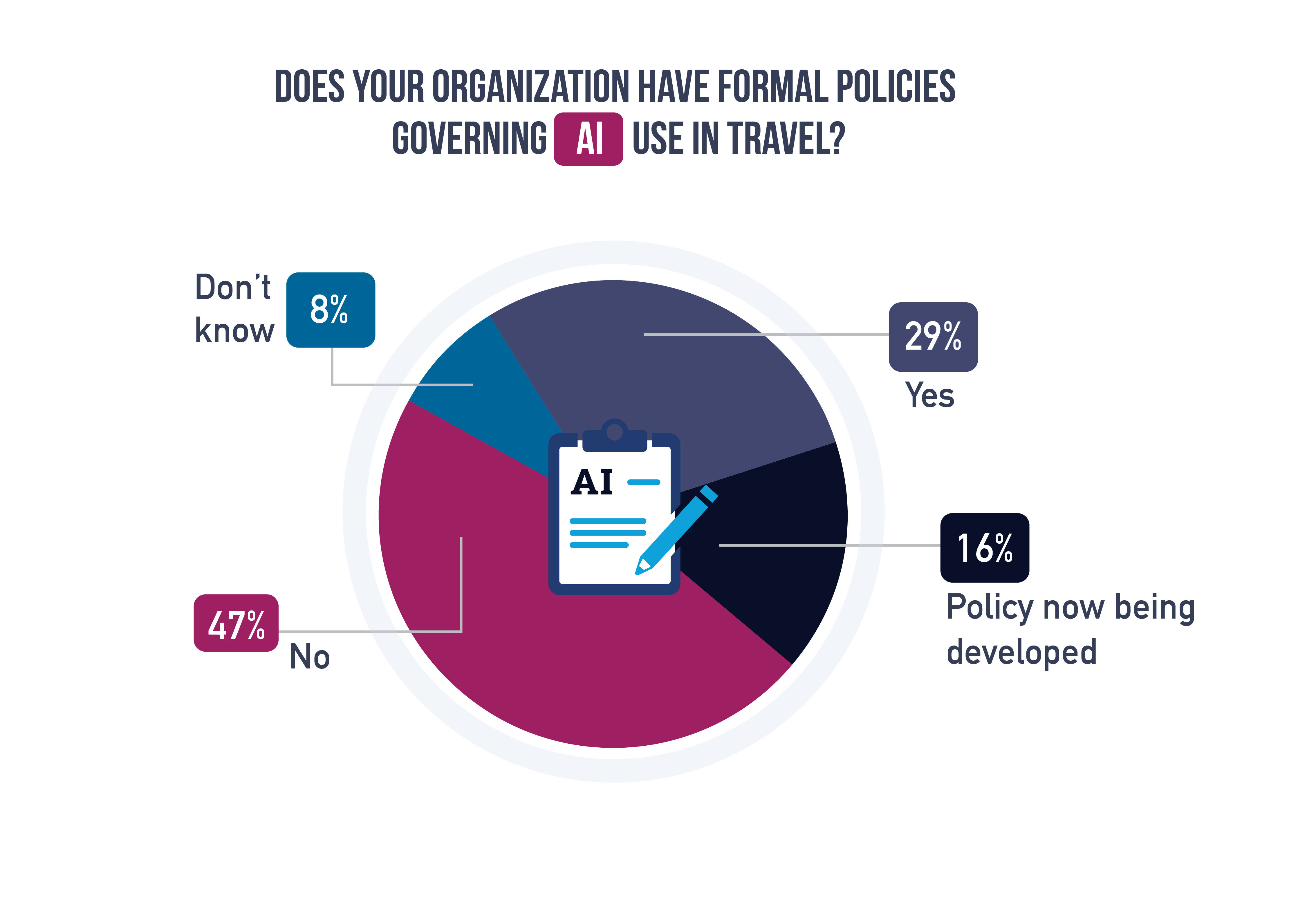
About 29 percent of respondents indicated their organizations have developed a formal policy governing AI use in travel, a move downstream of the recognition that the technology will play an important role in the discipline. Another 16 percent of respondents said their organizations are developing such a policy.
The existence of an AI policy correlates closely with travel budget size. More than 44 percent of those respondents whose organizations in 2025 spent more than $100 million globally on travel and entertainment have deployed such a policy, but less than 15 percent of respondents with less than $10 million have. No respondents with less than $1 million in travel spending have.
Measuring and Analyzing
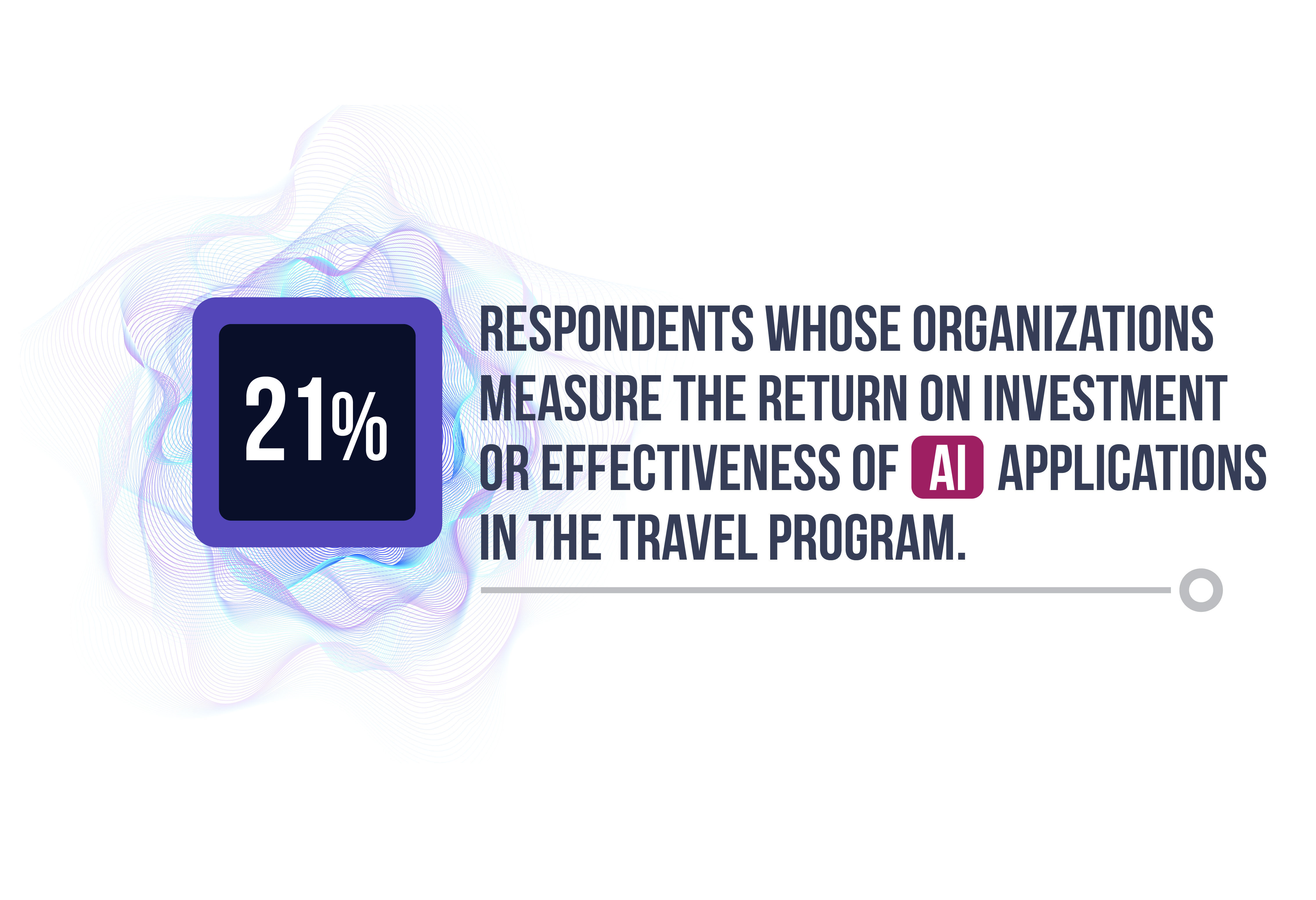
Formal policy development can, but doesn't always, go hand in hand with formal measurement and analysis. About 21 percent of all respondents said their organizations measure the return on investment or effectiveness of AI applications they've deployed in the travel program. About 43 percent said they do not, with the remainder unsure or citing no AI use.
Those figures also correlate with program size, although less directly than that of AI policy development: About 29 percent of respondents from organizations with at least $25 million in annual travel spending measure the ROI of AI applications. About 48 percent of those respondents whose companies have developed AI policy measure the effectiveness of the technology tools.
In this aspect of AI implementation, the travel management function appears to lag some other areas of the corporate structure.
In the Wharton survey, more than 70 of respondents indicated they already measure the ROI of generative AI tools consistently and using standardized methods. A bit more than half of them said their ROI measurements are "fully integrated, strategic and continually optimized."
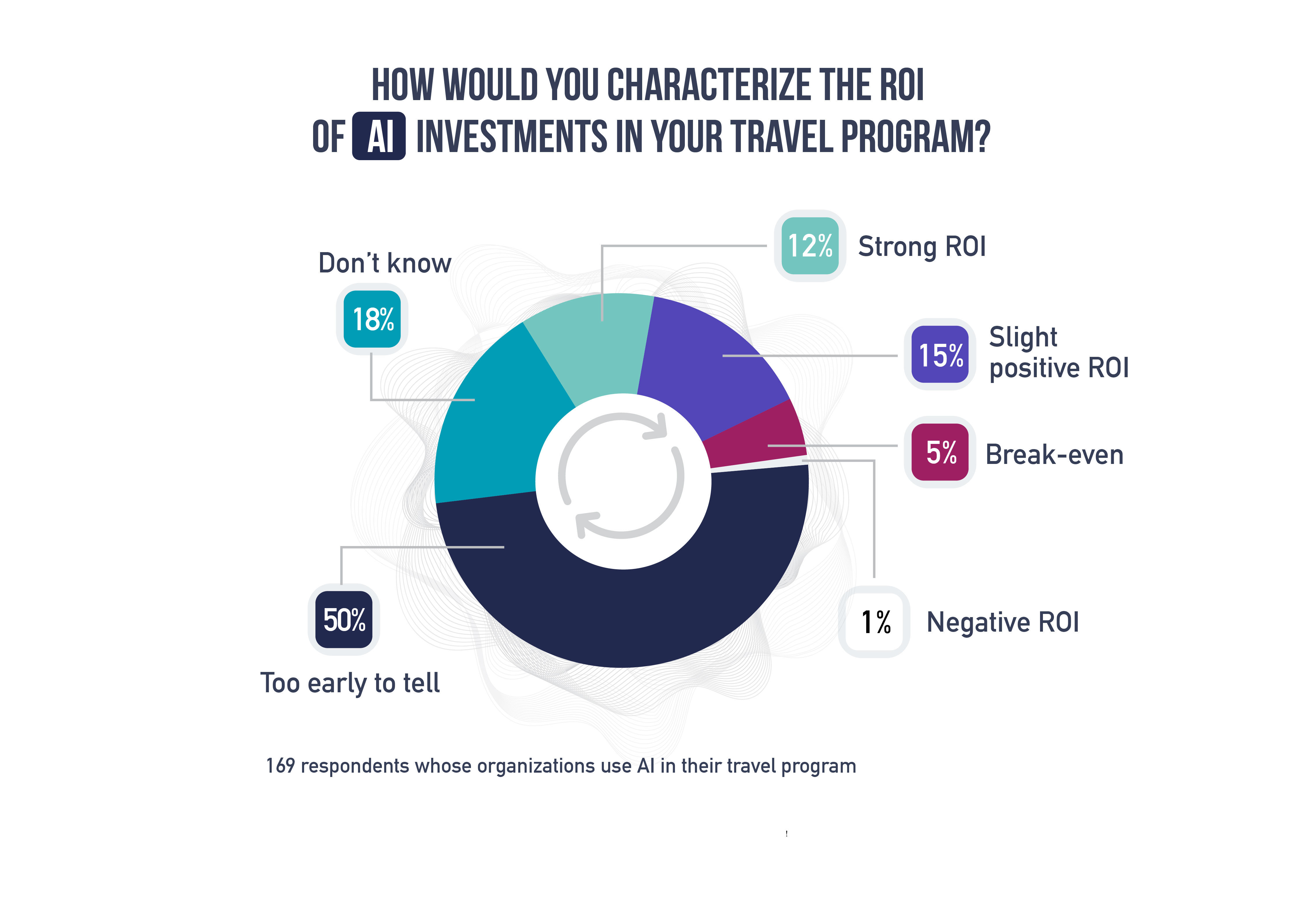
Formal or otherwise, half of BTN's respondents who have deployed AI tools suggested it's too soon to measure any return on investment. Of those who disagree and cited a return, almost 85 percent said the ROI of deployment was positive, and almost half said it was "strong."
Clearly, though, in travel management widespread formal quantitative measurement of AI tools is a way off.
Growth and Investment
In the meantime, what do travel managers expect about the pace of their organizations' AI deployment in travel in 2026? Most expect gradual growth.
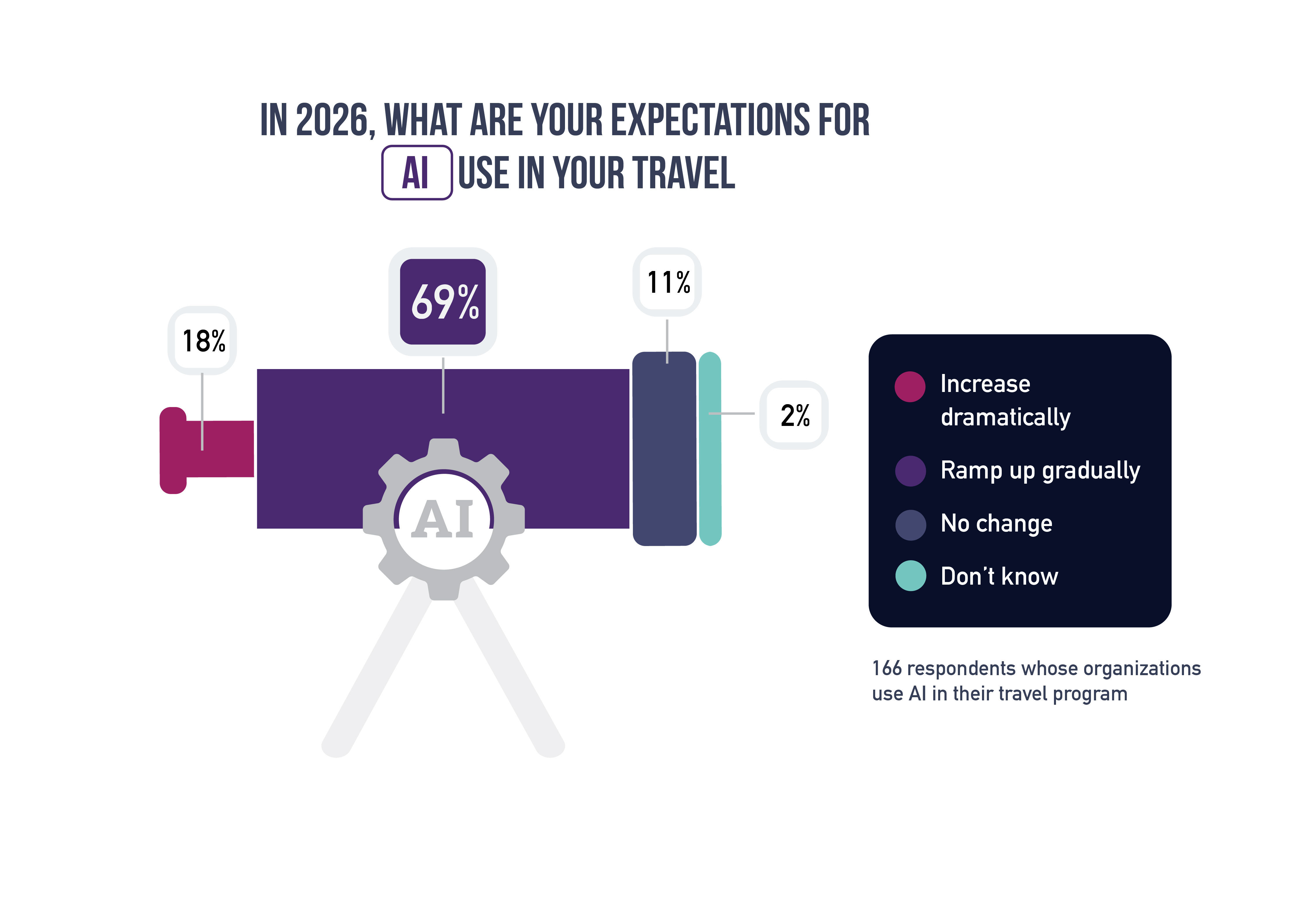
About one in five respondents expect their AI use in travel to increase dramatically, but that figure is dwarfed by the 69 percent who expect a gradual increase this year. About one in 10 don't expect much change at all.
Who thinks their organizations will dramatically increase use of AI in 2026?
• Mostly, those respondents whose companies already have deployed AI are the ones who expect a dramatic increase. Only 12 percent of those who said their AI experience is limited only to exploring or testing expect big hikes this year.
• More than 36 percent of respondent organizations with more than $250 million in global travel spending—the survey's highest band, which roughly correlates to BTN's Corporate Travel 100 list of biggest spenders—expect dramatic 2026 increase in travel AI use, the highest of any band.
• But expectations in other bands only somewhat correlate to spending bands. About 18 percent of respondents from organizations with between $25 million and $250 million in annual travel spending expect a dramatic AI increase, and so do 18 percent of those respondents with less than $1 million in spending.
Eyeing Suppliers
Travel managers, of course, are but one half of the AI implementation equation. Suppliers of all stripes have been developing and deploying AI tools in both public-facing and back-office roles, covering everything from operations to chatting to pricing development.
That last point has driven some recent controversy: Delta's disclosure that it was using AI pricing management tool Fetcherr drew federal scrutiny and spurred broad discussion of the role of AI in airfare development, even as the carrier clarified that the technology isn't being used for individualized fare targeting.
And that's hardly the only controversial aspect. Even as suppliers' use of AI can help buyers with minimizing travel disruption, product bundles, chatbot development and fraud detection, issues like personalized offers that could undermine corporate deals and data privacy have caused concern.
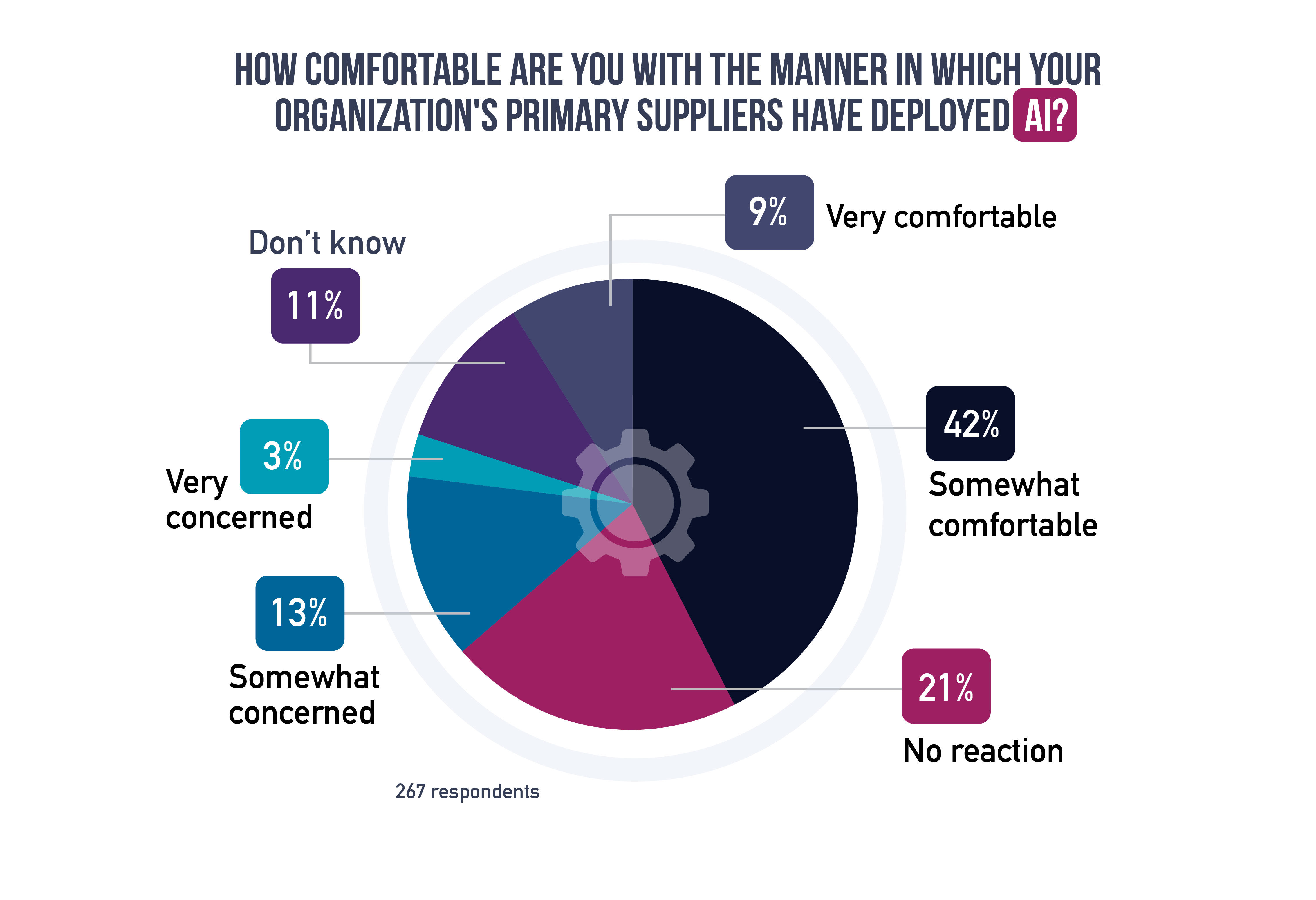
A bit more than half of all respondents to BTN's survey indicated they were comfortable with the manner in which their primary travel suppliers have deployed AI, about 20 percent of that group said they were very comfortable with it. About 16 percent of total respondents said they were very or somewhat concerned. The rest either didn't register an opinion or said they didn't know.
That's not too many respondents who expressed concern about supplier use of AI, but there are some outliers in their IDs. Respondents from small companies were more likely to express concern: 27 percent of those from companies with $500,00 to $3 million in annual travel spending did so. About 23 percent of those respondents who said their organizations' deployment of AI in travel was limited to testing or exploring expressed concern about suppliers' use of AI.
Changing the Role
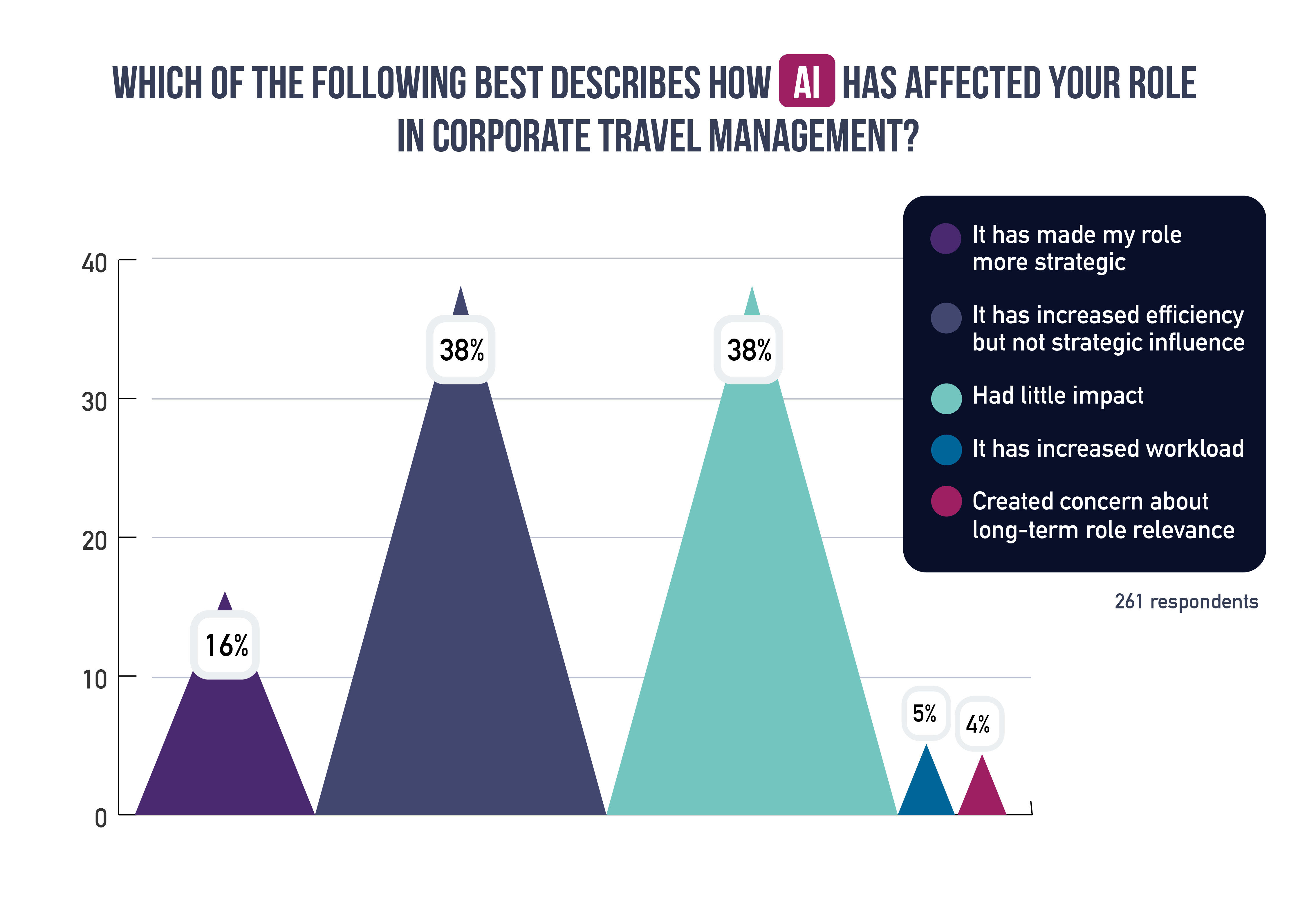
Are the robots coming for your job? That's been an underlying current in discussions of AI deployment, not only among travel managers but many other categories of white-collar knowledge workers. But survey respondents, at least for now, don't see the technology as a threat to their positions or a replacement for their skills, knowledge and experience.
Only 4 percent of respondents said current deployments of AI had caused them concern about the long-term relevance of their role. More than half of respondents, in fact, said AI already had made positive contributions to their role, and about 30 percent of that group said AI had enabled them to be more strategic.
BTN also allowed survey respondents some space for open-ended responses about misconceptions and the limitations of AI, and their volunteered answers were very consistent. They strongly rejected any notion that AI could replace them and noted the irreplaceability of human judgment in traveler care, irregular situations and in complex decision-making.
Respondents also noted the limitations of AI. Several said the technology is effective when dealing with structured or repetitive tasks but can founder in more complex situations.
Some examples of misconceptions:
•The biggest misconception about AI in corporate travel is that it will completely replace human decision-making and travel management teams.
•That AI will take our jobs. ... There will be no travel agents or OTAs ... Managed programs will not exist… it's all B.S.
•AI cannot replace human judgment, accountability and empathy in travel management, especially where duty of care and traveler wellbeing are concerned.
•The future is not AI vs humans. It is AI working under human leadership to create more efficient, safer and smarter travel programs.
•AI can automate routine tasks, but it cannot replace human emotional intelligence, especially during disruptions such as flight cancellations, emergencies or visa issues.
•The biggest misconception about AI in corporate travel today is the belief that it is a silver bullet—an instant solution that will automatically fix travel programs, reduce costs and elevate traveler experience.
Some examples of limitations:
•AI is great at automation and pattern detection, but it’s not ready for complex decisions or things that need empathy or context.
•AI cannot handle complex multiple trips [or] ticket change requests. Still need human to take on.
•AI can process data, but it cannot navigate the political sensitivities of a high-level mission.
•Corporate travel management relies on relationships in order to get stuff done. AI cannot master relationships.
Very little disagreement among the respondents on this topic, but they've also found any number of use cases for AI to have effectively demonstrated its value. The survey as a whole illustrates today's deployment of AI as nascent and centered on productivity-related tasks, but with a more strategic future on the horizon.