The entire travel industry is invested in artificial
intelligence—financially, technologically even psychologically, it seems. Some
of the most intriguing areas of AI development are happening in the itinerary
search and discovery phases, understanding traveler intent in natural language
conversations and pinpointing personalization opportunities. Much of this work
is happening on the consumer side of travel, though some parts—especially the natural
language interactions—have gained a foothold in business travel management. For
the most part, travel management companies until this point have focused on more
foundational work: enhancing workflows, increasing agent productivity, juicing
up travel data and reporting capabilities and intervening in airline IROPs,
i.e. delays and cancellations.
This is according to ongoing research from Business Travel
News’ media portfolio mate The Beat, which is conducting an analogous survey of
travel management companies’ current AI strategies and initiatives as BTN has
surveyed the buyers’ side of the business travel equation.
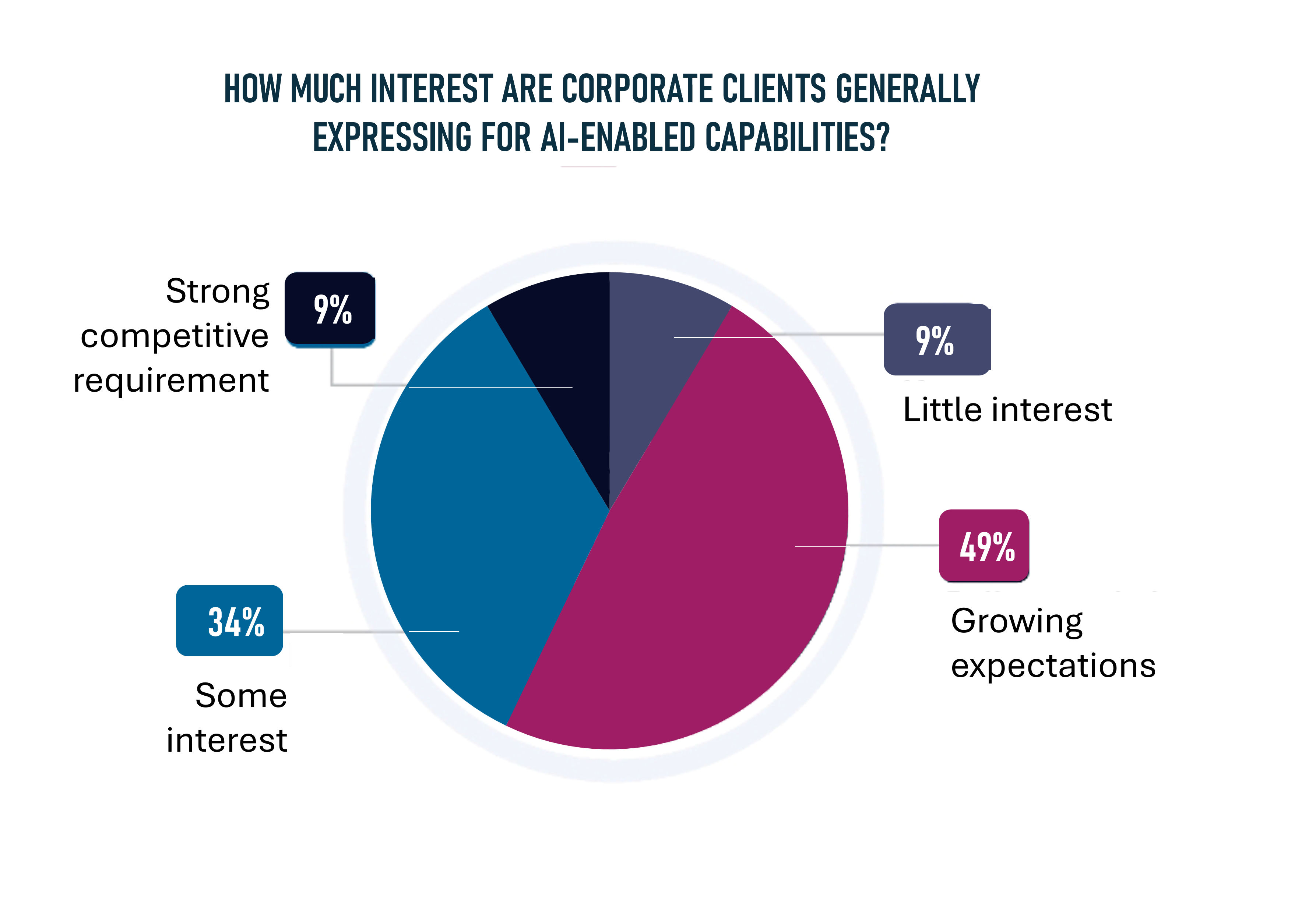
TMCs report that AI, to date, has not been a major
differentiator to travel buyers when it comes to competitive bids. Just 9
percent said AI had been positioned as a strong competitive requirement for
buyers, although nearly half of TMCs said buyers have expressed a growing interest in their AI-enabled capabilities. About one-third had received limited, but noticeable interest from buyers,
while another 9 percent said buyers had not been particularly interested to date
in AI-powered technologies or processes at the TMC level.
Even with what looks like contained enthusiasm on the part
of the travel buyer, TMCs have not sat on their laurels when it comes to
pursuing AI advances.
Some of these efforts may not be at the eye-level of the
average travel buyer—but that doesn’t mean travel programs won’t benefit from
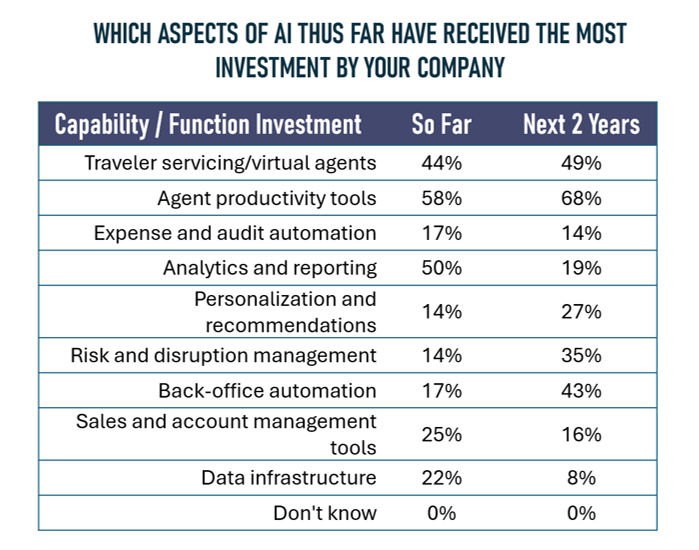
them. More than half of the TMCs surveyed by The Beat said they had focused AI
investments on agent productivity tools, using AI-enabled systems to feed
travel advisors information on travel options, specific policy points and even
personalization tools that allow them to be more efficient and effective with
their clients whether they are calling, emailing or chatting into the agency.
Even more TMCs plan to invest in this area in the next two years—with some
doubling down on productivity investments and other TMCs just getting started
on their AI-assisted agent journeys. Likewise, while only 17 percent of TMCs
had invested to date in back-office automation, 43 percent said they would be
doing so in the next two years—showing that agency operations is looking like a
huge opportunity for TMC executives.
Two major focus areas for AI investment have been among the
most forward-facing to the client.
Half of the agencies surveyed by The Beat have worked to
enhance data analytics and reporting with the help of artificial intelligence.
This has been happening for years, starting with machine learning capabilities
that TMCs began applying to their data processes nearly a decade ago. With generative
AI now in play, analytics and reporting capabilities have evolved to another level
with natural language queries across vast quantities of data to produce deeper insights
more quickly and with high confidence levels. Additional investment in data analytics
looks to be limited, with less than 20 percent of queried agencies planning future
work in this area.
Investment in traveler servicing via virtual agents and
chatbots is a different story. This has been a critical focal point for 44
percent of agencies so far, and that investment looks like it will be sustained
over the next couple of years—and even slightly increased—with 49 percent of
surveyed TMCs pushing forward with similar future investments. There
are hints throughout respondents’ open commentary, however, that
traveler servicing has been a challenge that
requires more evolution to realize meaningful gains.
One TMC executive took a dismissive tone on the subject, claiming “most
TMCs and suppliers are stuck in creating one more Q&A chatbot for their
traveler[s].” Another said that while servicing and personalization had been
hyped in terms of AI, it would take more time and effort to realize “any level
of scale or measurable impact.”
TMC Ambitions Awaiting Structural Traction
The business travel industry’s current approach to AI “is
best described as ambitious but fragmented,” according to one TMC executive
responding to The Beat’s survey. They cited clear momentum and proven value in
pockets, but with structural challenges that prevent full agency transformation.
“Fragmented” was a key word across agency
leaders, along with “tactical” and “not quite strategic” or with a more
positive spin, AI has “optimized on individual steps” but it has not reached a level of orchestration that agencies can visualize but have yet to operationalize
in an end-to-end process.
One executive described a dream state for AI:
"Smart organizations [see] a great opportunity to use
AI to transform their operation by integrating services and data into a smart
business layer. AI Agents connected to Salesforce, Outlook and the dozens of
tools used by travel agents and account managers every day to completely
transform how work is done. For example: gather traveler information scattered
across from five different systems from a chat interface and perform a price
check or profile update from that same interface and finally send an email from
that same chat. Another example is automating traveler conversation reviews
across phone/chat/email … to identify complaints or issues that, together,
indicate a larger emerging challenge. Then, automating a signal to the ops lead
and the account manager to manage clients proactively.”
While executives can put the vision together—and they are
clearly putting together the budgets—connecting disparate technologies via an
AI layer will take more than ChatGPT or Gemini. In most cases it will take a structural
rebuild, said one leader:
“Without fully redesigning the end-to-end operational model,
the risk is that AI becomes just an additional layer on top of already complex
workflows, rather than a true enabler of transformation. In my view, the real
value of AI in business travel emerges only when it is embedded within a
well-structured operating model. You need clear processes, standardized data
and defined service logics (SLA, channels, policy) before AI can scale
effectively. Otherwise, you simply automate inefficiencies.”
Is Business Travel Lagging?
One exec claimed “travel generally lags in terms of
technology” while others were more upbeat, citing successes across the industry
“embedding AI in booking, disruption management, expense processing and policy
compliance.” While some of that gestures to capabilities outside the TMC’s remit,
it remains evidence that AI has permeated major process areas across the managed
travel ecosystem.
According to the University of Pennsylvania’s Wharton
Business School, which for three years has conducted horizontal research across industries on their AI implementations and maturity levels, travel and travel agencies
may not be so far behind its peers. What could prove different is how realistic TMC tech executives may be
when it comes to understanding the challenges ahead of them. Will that realism
discourage innovation or accelerate it through pragmatism? It's too
early to tell, but check
out this interview with Wharton research co-author Jeremy Korst, to find out how travel businesses measure up to other industry peers when it comes to AI advancement. Korst is also a member of the Wharton executive advisory board and CEO of product
and marketing strategy firm GBK Collective.
______________________________
BTN thanks The Beat for extending BTN readers preview
results of its proprietary AI & Travel Management Companies research. The information
in this brief is a segment of the report The Beat will share later
this quarter. A paid subscription is required to access content from The Beat.