The role of artificial intelligence in our daily lives has shifted from novelty to established tools. It's already changed travel management processes, with the promise of further, maybe revolutionary, change to come. With so much attention—hype?—paid to AI, Business Travel News surveyed travel buyers about the ways they are using (or not using) the technology today, where they see the most value in it, and whether the AI use cases they've explored justify the investment.
BTN supplemented the survey with buyer, supplier and tech-expert interviews to provide context for managed travel’s AI practices and philosophies and to assess the industry’s maturity along the AI investment spectrum. BTN thanks all the readers and sources who took the time to take our survey and share their perspectives on this critical and evolving topic.
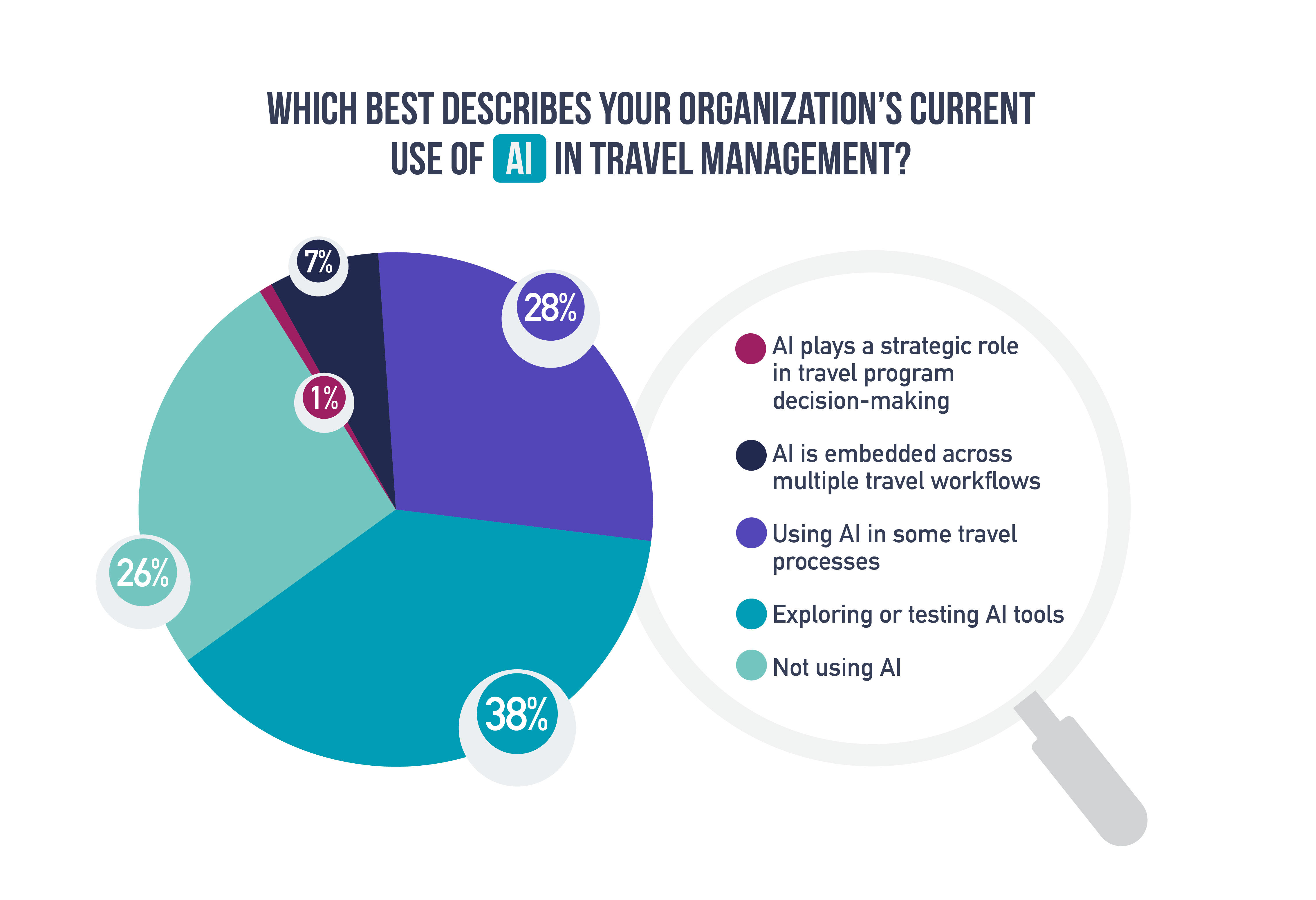
AI adoption is widespread, but shallow. About three-quarters of organizations are using AI in travel in some form, but fewer than 10 percent have embedded it into multiple workflows or strategic decision-making.
Most programs remain in testing mode. More than half of AI users, and 38 percent overall, are still exploring or piloting use cases rather than scaling deployment.
Travel isn't behind in AI deployment, and mirrors enterprise maturity. Corporate travel adoption closely tracks broader enterprise trends, where fewer than 10 percent of
organizations have scaled AI across functions.
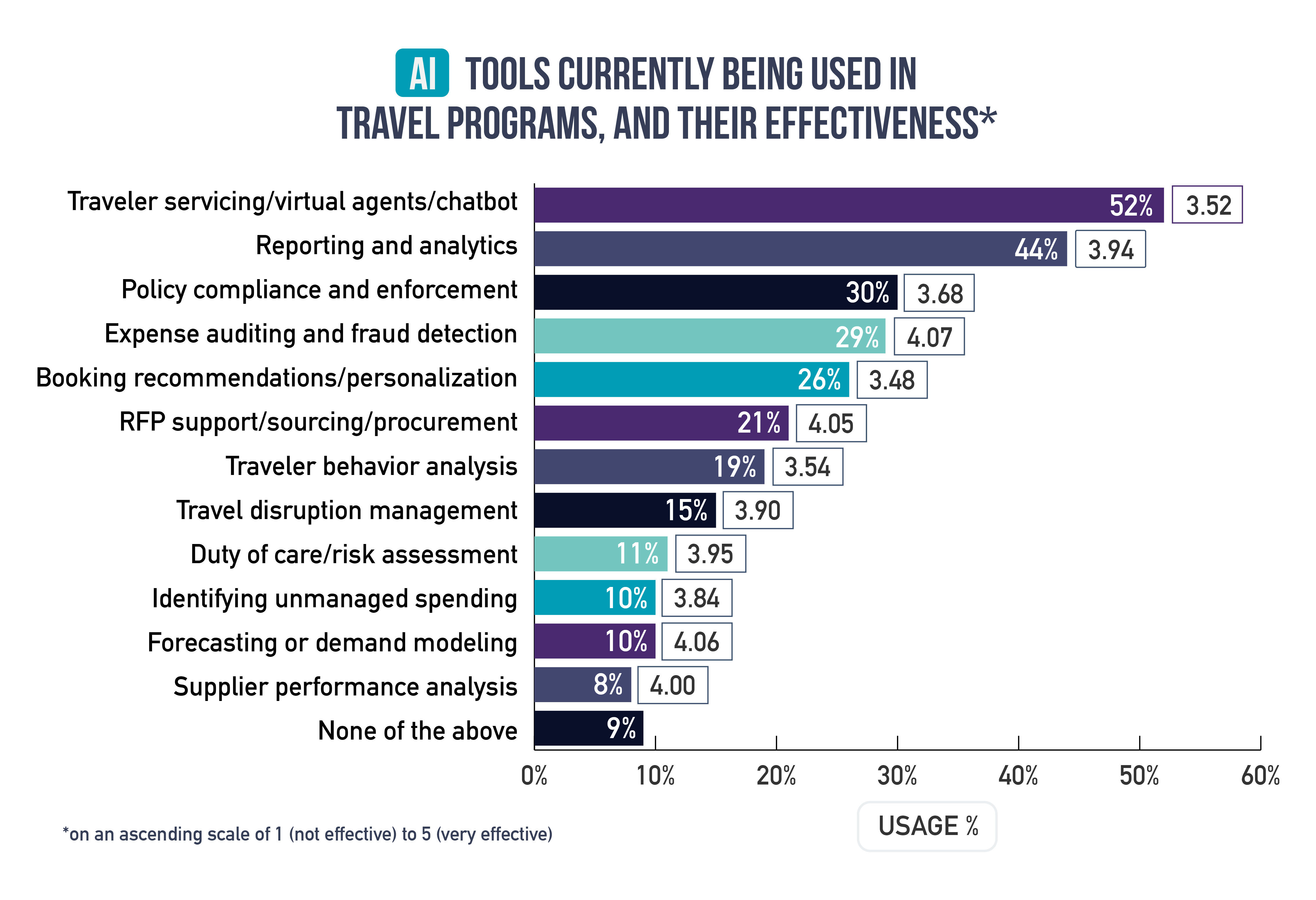
High usage doesn't always equal high value. The most widely used applications—traveler servicing and chatbots (52 percent of respondents) and reporting (44 percent)—are not the highest-rated for effectiveness.
Less widely used tools are viewed as the most effective. Expense auditing and fraud detection, used by fewer than 30 percent of buyers, earned the highest effectiveness score (4.07/5), highlighting a gap between experimentation and measurable value.
ROI remains elusive and unevenly measured. Only about 21 percent of travel programs formally measure AI ROI, with many citing it as "too soon" to do so, even as those who do measure it overwhelmingly report positive returns.
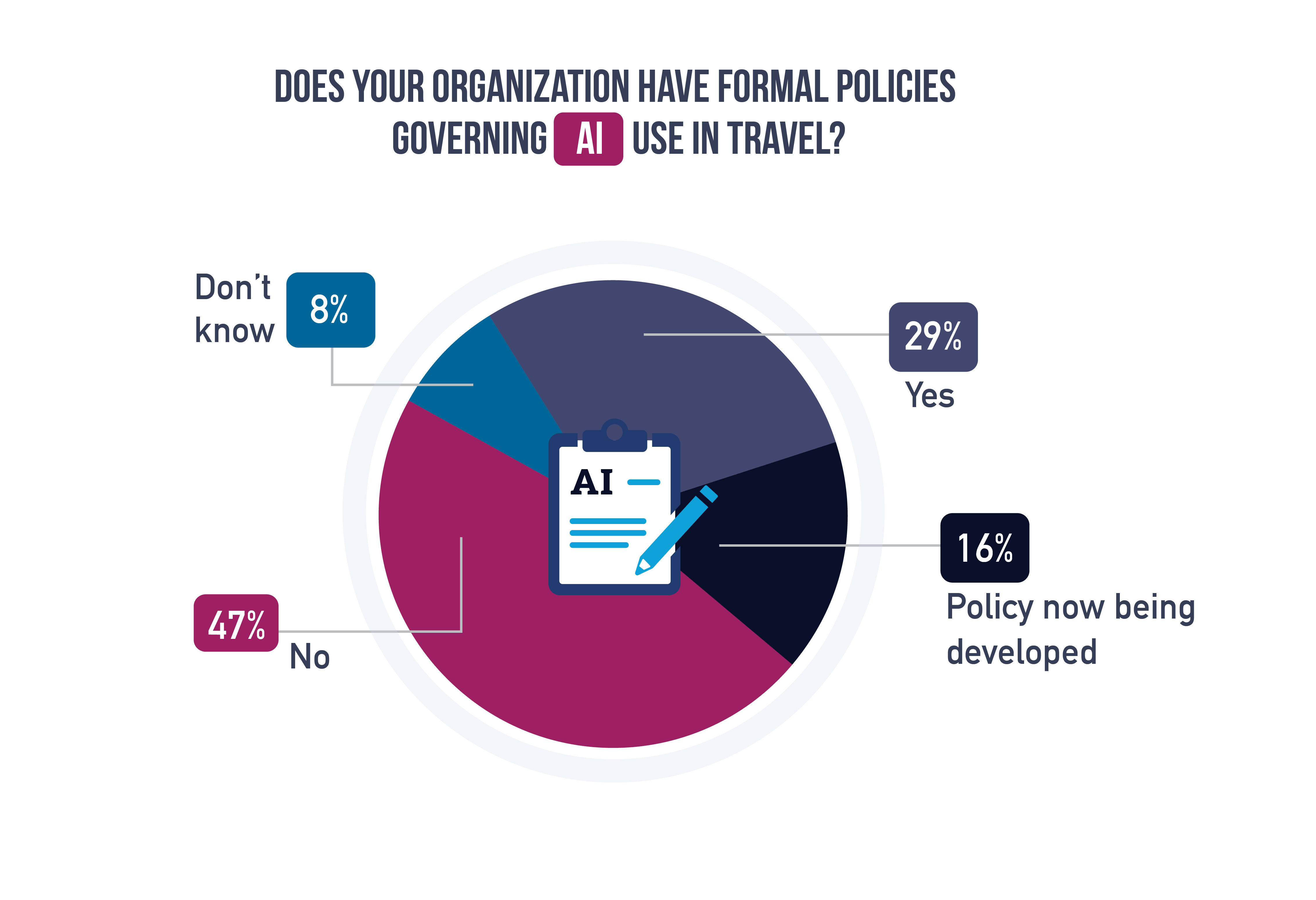
Policy and governance are emerging but not universal. Just 29 percent of organizations have formal AI policies for travel, though adoption rises significantly with program size.
AI is shifting from insight to execution. Early deployments focus on productivity and automation—chatbots, reporting, auditing—but emerging use cases point toward real-time decisioning, policy enforcement and workflow orchestration.
Use cases are expanding into higher-impact areas. Travel disruption management, sourcing/RFPs and risk monitoring remain underutilized today but show strong potential to move from reactive to predictive, AI-driven processes.
The next phase is integration, not experimentation. Leading programs are moving toward connecting travel, expense and payment data into unified workflows, signaling a shift from isolated tools to enterprise-wide orchestration.