The Data Story: Buyer Innovation Appetite Muted for Majority; Pursued by Minority
Managed travel isn’t always at the forefront of technology
innovation. It’s a complex proposition to balance the preferences of a business
traveler with the protocols and cost optimization required by their employer. Additionally,
travel buyers aren’t always looking at travel technology opportunities
directly. According to BTN data, travel buyers’ tech experience and tech stack is
mediated largely by their travel management companies. If this trend holds
true—as it has for many years—TMCs will need to innovate before we see
large-scale movement across travel programs toward new or upgraded
technologies.
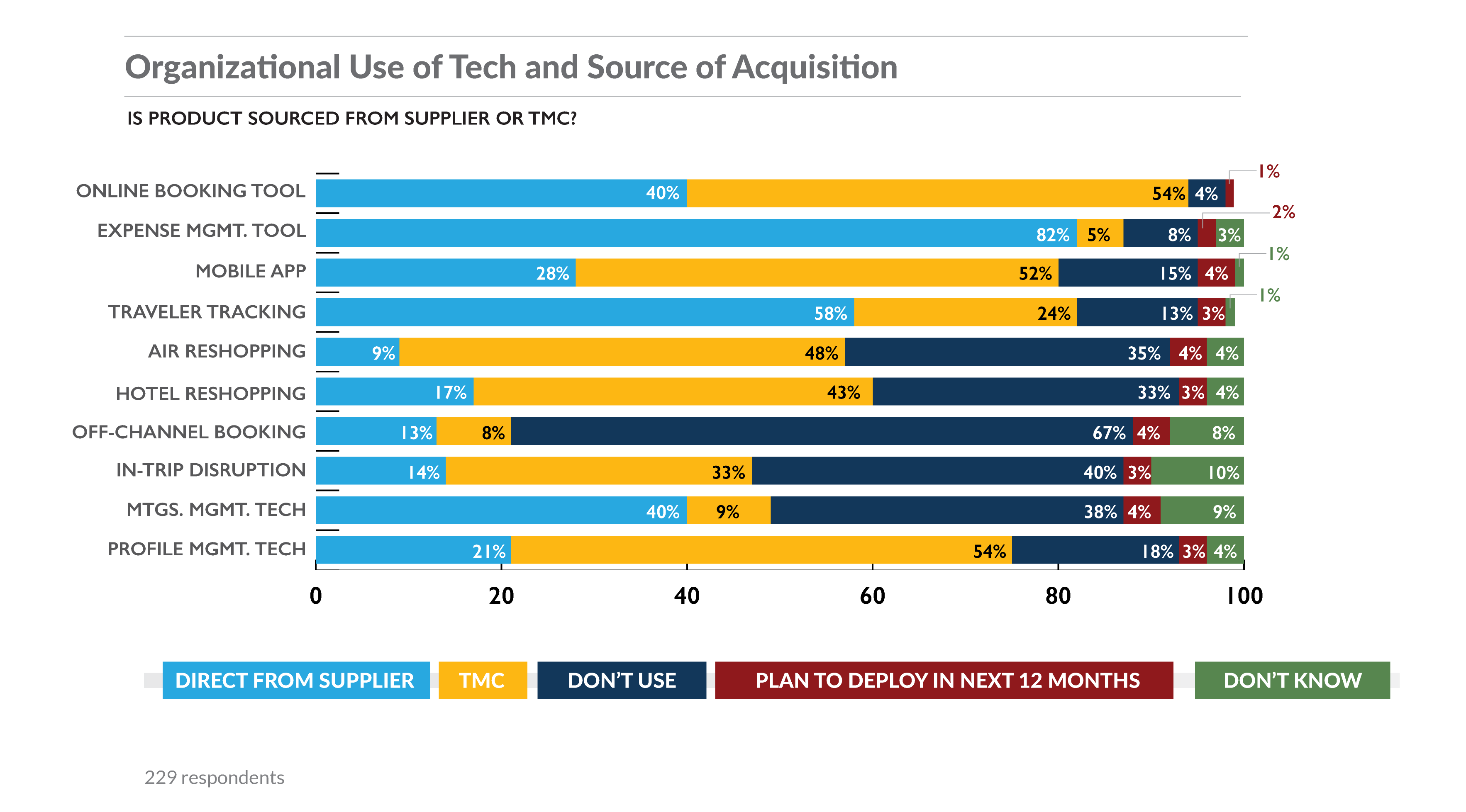
The yellow bar sections in the chart below show
what percentage of surveyed companies for BTN’s State of the Industry Report
sourced several categories of technologies from their designated TMC partners.
The light blue bars show what percentage was sourced directly from the
technology providers. Dark blue indicates percentage of buyers not using tech
from the various categories. More than half of companies source online booking
tools, profile management systems and mobile apps through their TMCs. These are
major drivers of business travelers’ digital experience.
There is a lot of TMC investment toward innovation happening
now—much of it around artificial intelligence, but not all. Some TMCs continue
to develop their own technologies, while others will purchase or partner to
achieve roadmap milestones. The consensus among industry observers is that
innovation—whether developed internally within the TMC or externally for
them—is happening more quickly than ever, thanks to the support of AI in
developing more AI technologies.
Where those capabilities have been applied first has been
interesting to watch. While the industry is hearing a lot about chatbots and
AI-driven travel assistants, fewer of those big-swing agentic technologies have
delivered huge value to the business traveler as yet, even though several tech
companies and TMCs have articulated the vision, made investments and are developing
quickly. We’ve seen more products and upgrades geared toward automating
internal repetitive tasks for travel and expensing, routing known travelers and
deploying AI as a first line of response for basic traveler inquiries. More
powerful data analytics have also been a natural fit for a layer of artificial
intelligence.
This will be a critical development in the TMC space as
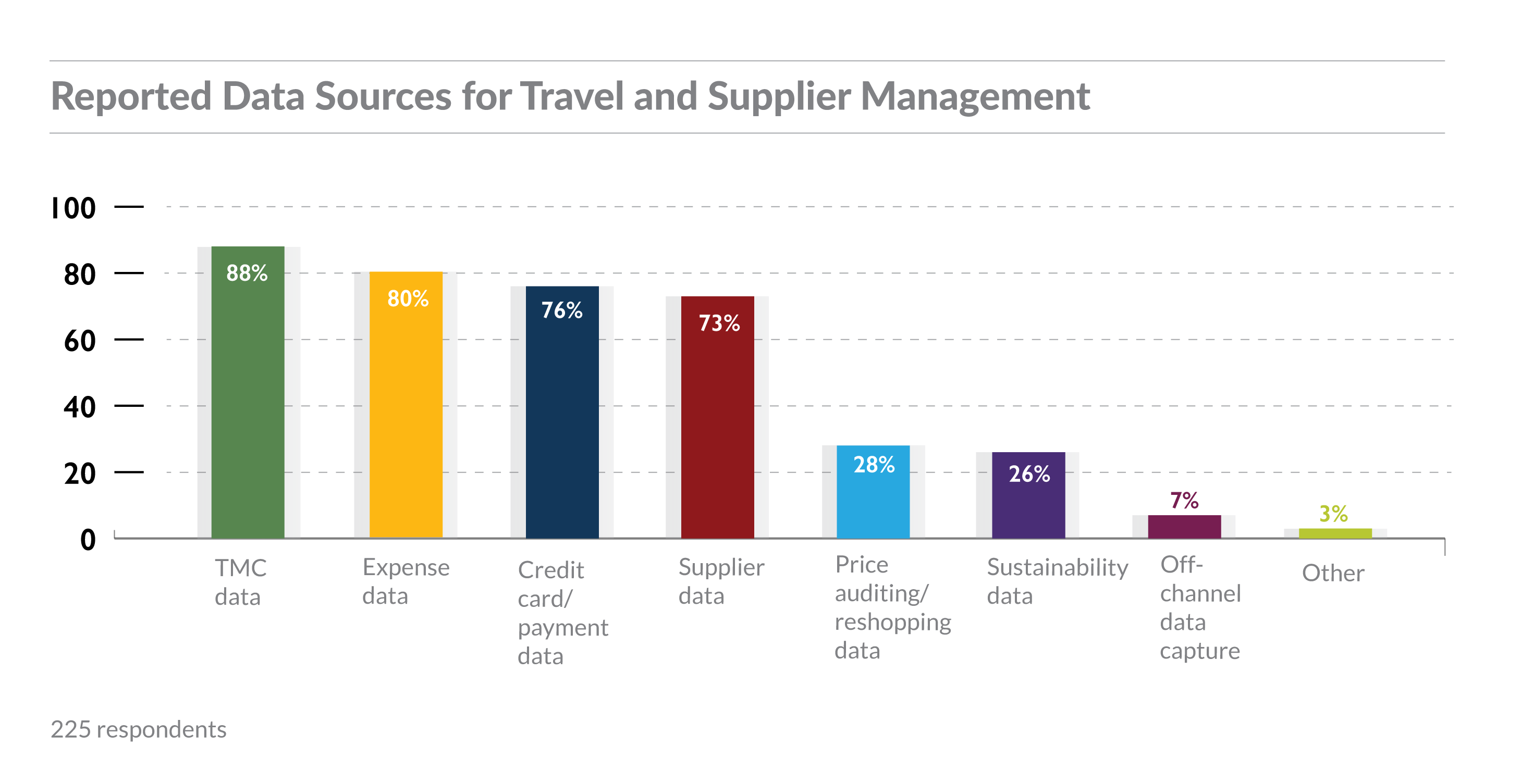
buyers rely heavily on their agencies for data reporting. Indeed, agencies are
the most used data source across all buyers surveyed, though a good majority of
travel buyers also subscribe to payment, expense and supplier data to inform
their programs. Ultimately, the application of AI on corporate travel data sets
will go beyond the idea of reporting and into predictive analysis that delivers
recommendations. Some providers have begun to surface program optimization
options based on AI data analysis and automating changes to policies and
program settings if the options are approved.
Whether applying AI innovations for traveler servicing,
supplier sourcing or surfacing novel program strategies, new tools will need to
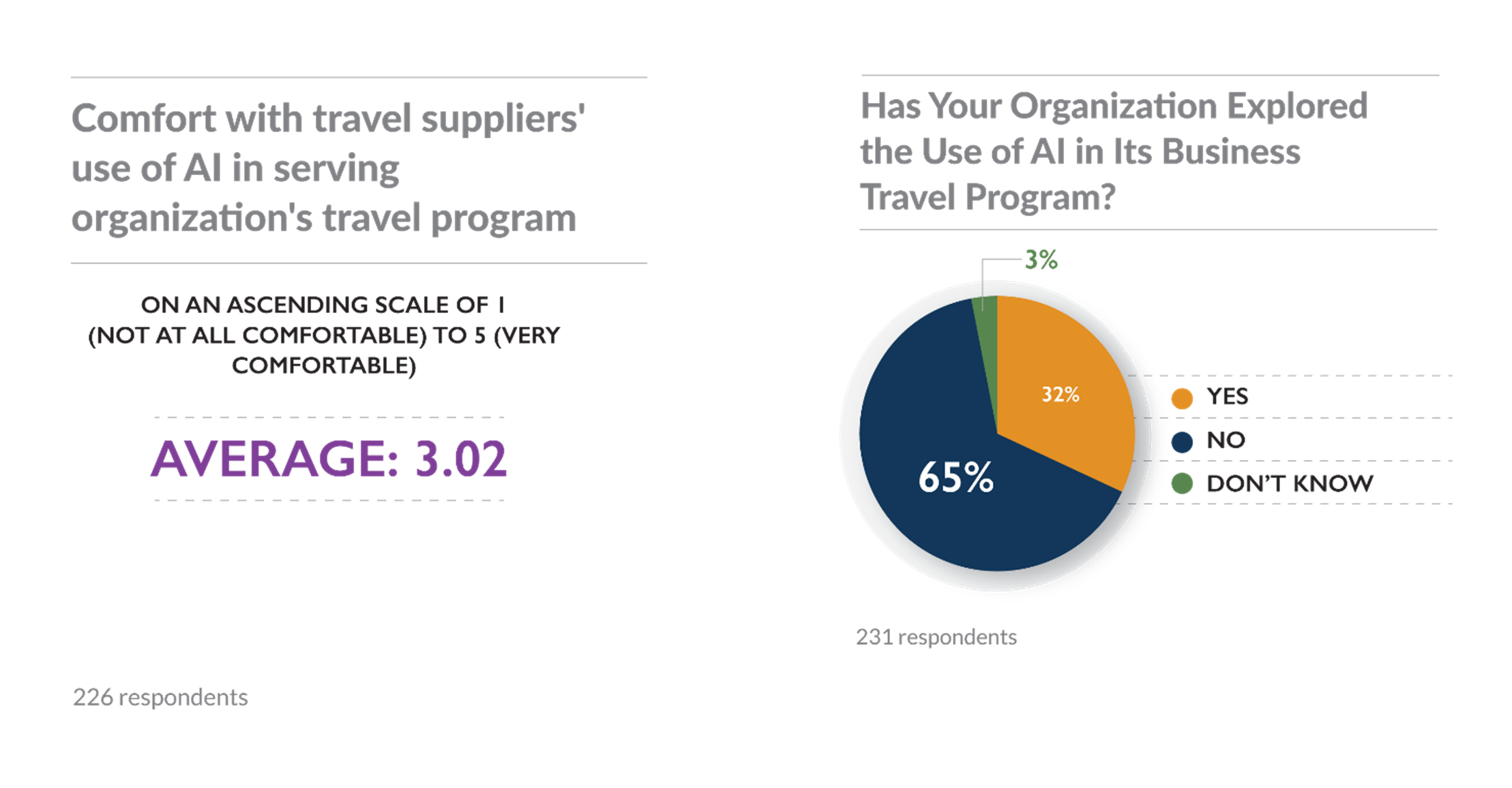
build trust among the travel manager set. Asked whether they trust AI to serve
their travel programs, travel buyers rated their trust at a “meh” 3.02 on a
scale of 1 to 5. Looking deeper into that average, however, slightly more than
a quarter of respondents on the top two rungs of the AI trust ladder.
Twenty-one percent were feeling wary or were not interested at all in AI
developments. Slightly more than 50 percent sat expectantly in the middle, with
lingering questions around accuracy and effectiveness of AI solutions.
Even so, one-third of travel managers said they were
exploring AI options for their travel programs.
______________________________________________________________________________
The Intelligence Report
Technology permeates almost every aspect of managed travel.
From traveler profiles to online booking tools, mobile travel apps and
automated expense reporting, today’s business travel solutions have moved well
beyond the era of printed tickets and lengthy phone calls with agents… or have
they? Recent advances in generative AI, blockchain technology and sovereign
identity have created a green field for innovation within managed travel, but can
these new capabilities be harnessed?
“I remember
the inception of online booking tools [in the late ‘90s]. It was groundbreaking in the day”
said a global travel, meetings and events leader from the professional
services sector. “Unfortunately,
they’ve not changed much since.
They're not agile.”
Agility, it seems, is what the business travel industry is
in need of most. Despite the emergence of new technologies that support open
architecture in the travel ecosystem and allow for greater flexibility and personalization,
most travel buyers rely on traditional partnerships with legacy players to provide
their tech stack.
So how and from which part of the ecosystem will that
agility break through—and what’s been stopping it?
More than half of travel managers responding to the BTN
State of the Industry survey cited their TMCs as the source for their online
booking tool, mobile app and their traveler profile technology—all of which
form a backbone of the managed travel ecosystem. Expense technology was largely
sourced separately, but often that would be handled by the finance team and not
by travel.
Resourcing is a particular hurdle for travel managers, who according
to an industry consultant and former travel buyer, are working with diminished
teams.
“Over the
last few years, [corporate] travel teams have gotten smaller and they haven't
got as much time to handle multiple contracts. So, if there's an opportunity to
get tech through a TMC, they will take it,” they explained. Plus, it’s “easier”
for most corporates to simply increase budget with an incumbent for an added
service rather than presenting a whole new business case to secure additional budget
to integrate a new tech supplier.
While some industry observers called buyers “too passive”
and faulted them for “not asking the right questions” in order to achieve real
innovation, buyers themselves voiced the desire to drive more progress and ideas
around what it would take to achieve it. What they lacked was corporate support.
First Movers Find the Will, the Skill and the Bill
Few travel buyers have a mandate from within their companies
to pursue true innovation around travel management models, and it’s a rare
travel manager who also has an incentive structure to match the effort required
to innovate in the space.
The exceptions, however, often are found within professional
services and technology companies. Both are highly competitive industries that
compete for talent and whose businesses rely on being able to stay on the
leading edge of the technology systems required to run enterprises. Not only do
they need these to equip their own workplace and heavily used travel programs,
but they also have a stake in providing, advising and installing such systems
into their client organizations.
As a result, the managed travel industry continues to see names
like EY, PwC, Deloitte and ZS Associates, as well as enterprise technology
companies like Microsoft, Salesforce and Oracle in industry headlines—either in
building their own tools and integrations or actively working with new entrants
and legacy players to develop new capabilities.
In perhaps the biggest move of late, PwC designed the
Blockskye / Kayak for Business collaboration KayakBTX for their own needs;
Deloitte has signed on to the same system and Blockskye continues to hire to
develop the tools to their needs. ZS associates has signed on as a development
partner for midsize player Direct Travel to help Steve Singh pursue his vision
of “The Perfect Trip” via the Avenir product. To a certain extent, all these
programs are willing to shape shift to fit the capabilities available now and will
expand developments towards the future.
One of the most visible example of this has been the
decision of both Deloitte and PwC to carve up their global programs to pursue innovation
in regions where their partners were ready to collaborate on it. Both large
consulting companies committed their U.S. programs to the innovation effort—Deloitte
added its smaller Israel firm to their project—but sourcing a global partner
for innovation was not a prerequisite. Even smaller ZS Associates is working with Direct Travel only in the North America market. It has other partners elsewhere.
One travel management consulting firm CEO told BTN that more
clients were going that direction.
“Do global companies need global scale in their TMC or tech?
Whatever the solution—like, are they leading with that?” they asked. “The
industry has spent years building up the globalization of programs, so that all
happened. But we are now having conversations with clients where they’re
saying, ‘Is it time to unpick global because I can then run faster with innovation.’
It’s a valid step forward if the infrastructure isn’t ready for you to switch
across globally.”
For the vast majority of buyers BTN spoke to, the answer to
the question about needing to maintain a globalized structure was ‘yes, we do.’
Whether that will evolve further is hard to say, but veteran travel managers at
least for now do not seem to have a strong appetite to manage additional
contracts, relationships and technologies.
“I love what Blockskye is doing; I love what Direct Travel is
doing. I’m interested to see what Serko does with GetThere,” said one veteran
travel buyer, who went with FCM as a global TMC partner in their company’s recent
RFP process. “I can’t move with any of those suppliers because they really are
not global; I can’t break up my program.”
Changing to a new entrant TMC is only one way to innovate
with travel management, and plenty of travel buyers are looking at other ways
to bridge program gaps and enhance the traveler experience without necessitating
the foundational shift.
Positioning Artificial Intelligence as the Clear Path
Ahead
The travel industry has worked with the concepts of machine
learning and artificial intelligence for more than a decade. With the advent of
generative AI and the lightning-fast development that has come with the
prospect of having AI tools to support development of new AI tools, the
industry is moving quickly.
While one consultant cautioned travel managers not to fall
for the “spin” and “AI washing” happening in the industry, most consultants and
industry players were more positive on the capabilities artificial intelligence
is already bringing to the table for travel management.
A big motivator on this front is the resource gap mentioned
above—not only the resource gap within corporates for additional headcount and
tools, but also the resource gaps still happening at some travel agencies that
are viewing AI as a huge opportunity to boost productivity across the board,
for agents, for account management and even on the consulting front with deeper
insights into data.
As of February, however, when BTN’s State of the Industry survey
was in the field, only one-third of travel buyers surveyed were actively
deploying artificial intelligence-powered tools to support their programs—at least
knowingly. It’s not clear how aware some buyers might have been about how their
suppliers had integrated AI into the products they employed or how much suppliers
have promoted AI-powered changes they are making to their tools and services in
ways that don’t directly touch travelers and travel managers.
While attitudes are changing quickly, in February the
majority of travel program managers surveyed rated their comfort levels with
suppliers of any kind using AI to serve their programs at 3 or less on an
ascending scale of 1 to 5.
Qualitative
survey data indicates that most corporate buyers are “still learning” about AI or
are “waiting” to see further use cases. Many remain “unsure” about the
potential benefits of AI or believe the technology is “still too new” to be
reliable.
In
response to such hesitations, one data analytics company CEO responded: “People's
ultimate fear of starting is perhaps the most fundamental barrier. Misunderstanding
the speed of adoption and the areas of quick wins is a significant barrier.
Many companies overestimate implementation timelines while underestimating
potential returns, creating unnecessary hesitation.”
AI Applications—More Robust & Building Trust
A quarter of travel buyers said they were “comfortable” or “very
comfortable” with AI-enhanced services, and the industry is engaging with it in
a number of ways:
Internal
Travel Program Chatbots—Several BTN Corporate Travel 100 buyers have been working on internal chatbot
tools that go well beyond the old “call and response” platforms programmed prior
to the pandemic. Rather, such tools now are mining unstructured information in travel
policy and travel intranets to find answers to questions asked in natural
language. In addition to providing answers, they in many cases are also
pointing users to the chapter and verse of the policy or other resource where bots
have located and interpreted the information.
That style of
fact checking and surfacing information sources is a key factor in gaining
trust in AI for travel managers—and, for that matter, anyone.
Describing
how his company developed and stress tested its latest AI analytics platform, one
Germany-based chief product officer put it this way:
“The last [step] and one that's most important, we call this
chain-of-thought transparency. That means you basically have the AI model
layout. What is the data source? What is the data's time span you look at? What
insight do you derive out of this and why do you come to this conclusion?”
It’s this type of transparency, they said, that allows users
of AI to peer into what can feel like a black-box process and understand how AI
tools are “thinking.”
CT100 travel buyers BTN spoke to said this was precisely how
they were designing their chatbots now, though some still maintained partial
hybrid call-and-response programming that worked well for them in a hybrid configuration
with more advanced AI.
Data Analytics Platforms—Travel program analytics is among
the most natural starting places for AI applications in travel, given the vast
quantities of data travel managers are asked to aggregate and understand. A
number of data providers, including TMCs, travel booking and expense tools and certain
category management specialists, have made recent announcements about
AI-enhanced analytics platforms.
The tools are doing more than supplying natural language
interfaces to facilitate data mining. The industry is more broadly moving into
a world of predictive analytics models and optimization recommendations that,
depending upon the depth of integration with the provider—a TMC, booking tool
or other solutions provider—an approval or two can cascade policy and other
programmatic changes throughout a tech stack to realize the optimization.
That’s not quite into the realm of what has become known as Agentic
AI—where users trust the tools to make program decisions on their behalf. As
users see evidence, however, that AI can surface effective recommendations with
traceable data, removing that approval process is the next step on the horizon.
As travel managers lean more into those types of tools with their providers,
the value of the provider to their program also increases.
That fact cuts both ways.
“Data is the key to everything now,” said one industry tech
entrepreneur and CEO. “Once upon time data was for reporting, but today, in an
AI world, it gives you insights and once you have insights you can build
predictive models.”
This is a critical point, the tech CEO added, because when
travel managers begin to peel back the different layers of data that make up
their program, they often realize they don’t have full access to—nor control over—the
data they need for predictive analysis.
That’s the key reason some sophisticated programs prefer to customize
with third-party data analytics system providers that can integrate travel,
expense, payment and supplier data, sustainability data, off-channel booking
data and even market data that will produce better models and insights.
“Data ownership doesn’t mean isolation,” the tech CEO said.
“It means collaboration between the traveler, the company, and the suppliers
that support them.”
Co-pilots & Assistants—Artificial intelligence enhanced
agent desktops, booking tools, and by extension mobile app itinerary and
disruption managers, were among the first generation of machine learning-enabled
applications to capture the industry’s imagination, and were rolled out prior
to the pandemic. Today’s more powerful AI has advanced those opportunities.
For the agency, AI-powered force multipliers are boosting
productivity levels and closing some gaps to customer service as AI tools quickly
surface trip options, waivers or other critical information while the agent concentrates
on customer service. Conversely, for routine tasks, allowing AI to resolve an
issue entirely frees agents to address complex problems or VIP clients.
For travelers, having a mobile AI-powered assistant in their
pocket that understands natural language and that knows their personal travel
profile, their company’s travel policies and preferred suppliers and can marry
those worlds into a recommendation and booking engine has been something of a
holy grail for business travel management. The industry is closer to this
possibility than ever, and prototypes exist, though they are not perfect.
All-in-one TMC/Booking Tool providers have been among the
first serious players in this market. Navan launched Ava in 2023 to serve as a
traveler’s co-pilot. AmexGBT just enhanced its traveler-facing AI assistant for
Egencia. GBT claims it can resolve about 30 percent of inquiries without human
intervention. Steve Singh’s investment in Otto an AI travel assistant created
by former Egencia executive Michael Gulmann is targeted mainly to the unmanaged
business travel market—i.e. limited travel policy interference—but can recommend
options and divert to Spotnana to book itineraries.
Booking tools themselves also are in the AI travel assistant
game. Serko launched Zena in 2019 and enhanced the large language model
foundation with more AI in 2024. Travel booking giant Concur has not developed
its own co-pilot, but at least one buyer has told BTN they are working on a
Skylink overlay of their company’s Concur booking tool instance, which is
sourced directly from Concur and not through the agency.
Skylink is an AI-native start up and an interesting case
study in that it’s a standalone app that bridges travel booking tools with enterprise
collaboration systems like Slack and Teams. It interfaces with the user in the
collaboration environment to respond to prompts, understand their personal
preferences over time as well as company policy to return compliant booking options
to the user. It can run approvals to the associated approver and then send the booking
through the booking tool—all without the traveler ever touching a traditional
booking interface.
Skylink itself has direct connects to airlines as well as
connections to the GDS. One judge at the BTN Innovate conference in late 2024
where Skylink won first prize—suggested that technology like it would obviate
the need for booking tool displays altogether as personalization and satisfaction
rates drove trust through the user community.
Indeed, as such technologies become more sophisticated and more
heavily used they will accumulate the user data and travel patterns, integrate into
the user’s business calendar and open up possibilities for Agentic AI to take
over certain tasks.
The Future Is Now?
Warning labels that come with AI use are plentiful—and above
all, travel managers must ensure that their company’s own travel data stays
within a proprietary sandbox. In order to be truly useful, however, data has to
be shared, and at the end of the day each trip is connected to a traveler and
becomes part of their personal travel history.
A handful of companies have come to the conclusion that
while the corporate may own that data in aggregate—and perhaps the TMC owns a that
data on more macro level across their own business—there is an important level
at which the individual traveler is the owner of that data and should be the
one releasing permissions and access to interested parties along the travel
supply chain.
Without that aggregated view of the traveler, each traveler
likely has a profile at the TMC, loyalty profiles with a number of disparate
suppliers and possibly another profile with a booking tool. The picture of that
traveler becomes fragmented. Gathering that picture back together, for some in
the industry, is the key to unlocking true personalization and an
individualized approach to corporate travel.
One professional
services company buyer said their firm was currently building a tech stack
“that will be based on the type of traveler that we actually need to support.”
This includes potentially unravelling a globally consolidated program to push
travelers “to some different platforms” and “segmenting” the program based on
traveler needs.
They believe
the convergence of data ownership and AI insights combined with increased content
fragmentation, suppliers seeking a direct relationship with corporate
travelers (often via loyalty
programs) and the onset of AI agents will ultimately render the TMC
superfluous. “We’re already
figuring out what that needs to look like because we see it happening,” they
said.
That’s a
far cry from how most corporates are configuring their travel programs today, and
likely not what most corporates envision for their future. But as a potential new
model—even for a global company—it’s a concept that’s out there.
“You can’t
just sit back and wait for an industry to get ready. You need to make the
industry ready… we actually have to push the industry to advance because it
needs to. Otherwise, how are we going to attract new talent?” they added.
“We've got to create different opportunities in this industry because if we
don't, goodness knows where we'll be in the next five years. Programs will just
dissipate, and it will be like the Wild West. It's on all of us to drive
innovation.”