The Data Story: TMC Service Levels Questioned, Wait-and-See Persists
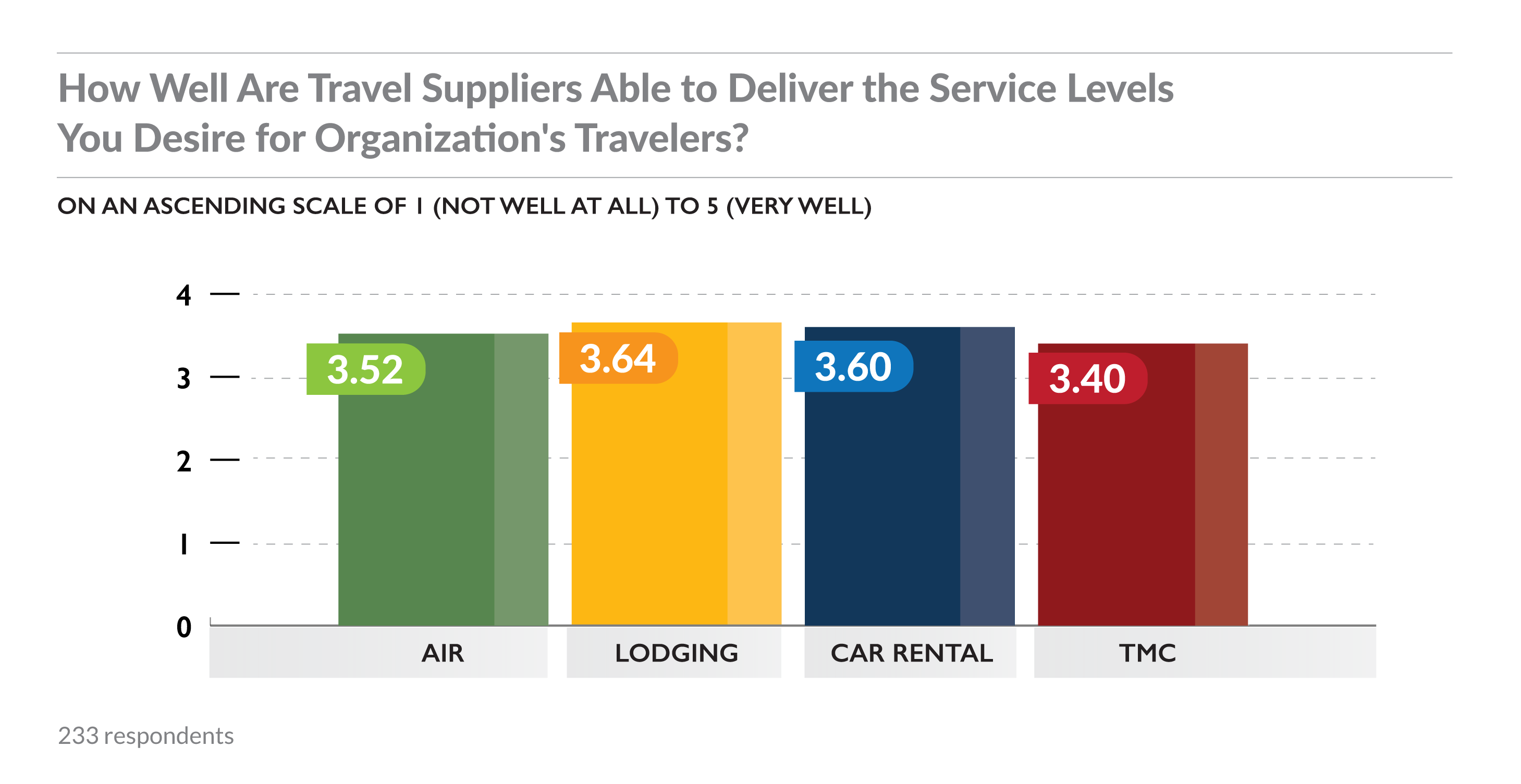
BTN’s State of the Industry survey responses ranked travel
management companies as last among key supplier categories to deliver service
levels desired for travelers. None of the categories in the response set stood
out for especially excellent or poor service levels, but TMCs at 3.4 on a scale
of 1 to 5 brought up the rear in a head-to-head ranking.
The drivers are multifold but center around one word:
Technology. At issue for many TMCs is how technology reacts in the traveler
space with TMCs’ mission around service.
Travel management companies struggled during the pandemic to
keep agents on staff. After the pandemic, they struggled to attract talent.
Just when travel volumes and a more promising growth outlook were inspiring
TMCs to return attention toward innovation with artificial intelligence and other
critical technologies (as they already had been doing in the lead-up to the global travel shutdown) distribution disruption diverted them to new priorities.
How would they book and then service NDC bookings? That process came with intensive
resource demands and associated costs to the customer. Avoiding that process
came with loss of content, and loss of relevance.
On the flip side of that coin, some tech-first TMCs that may
be brilliant with self-serve technologies for simple itineraries and even NDC
bookings may still fall short of the mark when called to apply deeper travel and
servicing experience. Buyers report such TMCs have deployed technology
solutions beyond their actual capabilities and not resourced properly—or
perhaps have not priced properly—to be able to shift those more complicated
service needs to experienced agents.
Aside from agent know-how, buyers also report that account
management and other traditional TMC support is in short supply at some
so-called “next-generation” TMC players at least at the entry-level agreement.
Upgrading to VIP servicing, however, upsets certain commercial agreements
underpinning the relationship and pushes the client to higher fees.
Have these service and technology issues resulted in the
corporate set changing their TMC relationships en masse? Overall, the answer is
no—at least that was the answer in January and February, when BTN fielded the State
of the Industry survey. Recent reports from the consulting sector offer an
evolving view on the notion that corporates are entrenched with their current
TMC partners. The status has turned at least somewhat on fatigue surrounding the merger of American Express Global Business Travel and fellow mega-TMC CWT,
which has undergone lengthy anti-trust review and has invoked a 'failing firm' defense in reference to CWT.
Additionally, the market has become intrigued with a tranche
of new and growing TMC players that claim to solve for some of the NDC-driven
and manual service-versus-technology issues that are responsible for lower
client satisfaction levels. They are also playing with commercial models, both those they offer to their customers but also commercial models that have long been the foundation of supplier and GDS relationships. Innovation is a tricky business, however, and not
all corporate clients want to be first movers as next-generation TMCs work out
new technologies and financials.
More traditional TMCs have seen the writing on the wall and
are investing millions in technology efforts that will drive better
efficiencies and service levels, too. As a result, corporates could be
rewarded with a less disruptive pathway but it will take longer.
________________________________________________________________________________
The Intelligence Report
Current buyer sentiment toward TMCs broadly can be summed up
by one of Yogi Berra's oft-quoted "Yogi-isms": "Nobody goes
there anymore; it's too crowded."
In their rankings of service deliveries of different
supplier categories in BTN's survey, TMCs averaged 3.4 on a 5-point scale,
lower than airlines, hotels and cars—albeit not dramatically so. While about
half of buyers rated their TMC's service a 4 or 5, that was a smaller
percentage than other categories—and buyers were more likely to rate TMC
service a 1 or 2 compared with other categories.
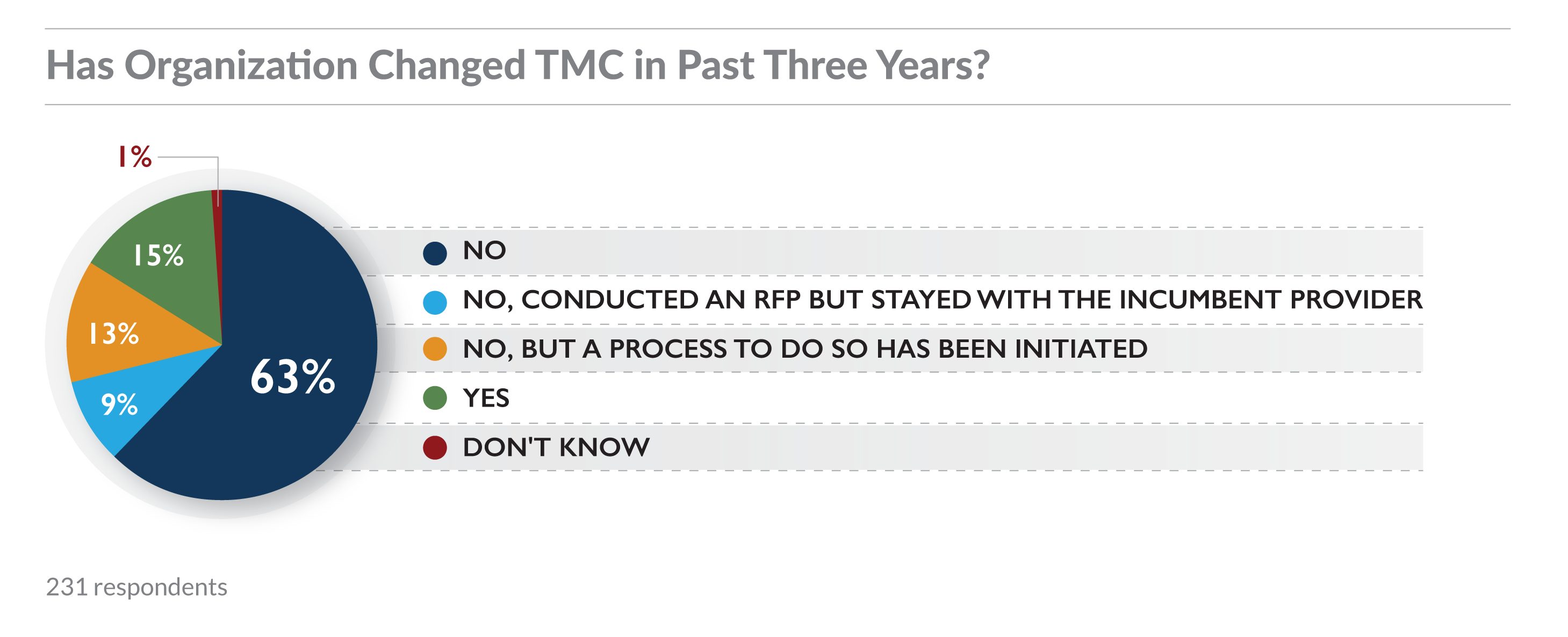
At the same time, buyers don't appear to be in a huge rush
to switch TMC partners. More than 60 percent of buyers in the survey said they
have not changed TMCs over the past three years, and an additional 9 percent
said they had conducted an RFP but ultimately elected to stay with their same
TMC. Twenty-eight percent, however, said they have either switched TMCs within
the past three years or have started the process that could lead to a TMC
change.
Both internal and external data for BTN tell a similar
story. BTN's CT100 list generally has shown little movement between TMCs over
the past few years, and BTN's research last year surveying small and midmarket
buyers showed 75 percent had not recently changed TMCs. Publicly owned TMCs,
meanwhile, have been boasting retention rates in the high 90s in recent
earnings calls. Their reported SME growth often is heavily weighted toward
previously unmanaged programs.
Going out to bid for TMC service, and ultimately switching
services, is a complex process, often lasting years and requiring a heavy lift
of collaboration and change management across an organization. As such, the
relatively low buyer movement among TMCs even when satisfaction levels are not
sky-high is not surprising.
Even so, the clock could be ticking on this current level of
stability. For one, several buyers have anecdotally said they are in
wait-and-see mode with a pending merger, facing a legal challenge by the U.S.
Department of Justice, of two of the largest suppliers in the TMC space,
American Express Global Business Travel and CWT. With a trial set for
September, buyers have been opting for short contract extensions rather than
going out for bids as they wait to see how that shakes out. There could be a
flurry of activity once the merger's fate is clear.
As TMCs have limited resources to respond to bids, more
activity means it could be more likely that buyers could face no-bids in the
process. It's important that they begin building relationships before the
process to improve their odds of participation.
"I've gone through multiple RFPs where big TMCs decline
to bid if they don't know you," one buyer said. "Buyers need to be
more focused on building and establishing a relationship outside of their
preferred supplier relationship, so in the event you have to make changes, you
have levers to pull."
RFPs are not the only harbingers of change. Bold buyers are
willing to break off segments of their programs to work with emerging players,
deglobalizing their programs to test the benefits of working with new entrants.
Among the most notable moves, PwC and more recently Deloitte have moved
portions of their programs—including their U.S. programs, both of which are
among the largest in the country—to the emergent Blockskye/Kayak TMC and
booking platform, signaling a move to acceptance of new industry models.
"If that's not the shot heard around the world, I don't
know what is," one buyer said. "That says, 'Guess what, TMCs? You
need to get woke and take this seriously.'"
Buyers who aren't inclined to be early adopters also are
possibly delaying TMC decisions to watch how such moves work out, along with
newer platforms such as Spotnana. They will want to be sure such set-ups are
"ready for primetime," one buyer said.
"Most companies cannot handle being an early adopter of
innovation," the buyer said. "It doesn't come with perfection; you
have to be more tolerant of things."
A Buyer's Market, or a "False Positive?"
When it comes to negotiating with TMCs, buyers feel they have a stronger advantage compared with other categories, according to BTN's
research. Forty-five percent of buyers surveyed said their negotiating position
had improved with TMCs since their previous talks, about double the percent of
the air and lodging categories.
What marks a successful negotiation, however? One buyer
suggested that price-focused buyers might be counting driving down transaction
values as success, regardless of the impact on service and other aspects of
their program, which could be creating a "false positive."
"Buyers are strictly putting a buyer hat on and not
considering the broader impact of what you do to a program if you force your
TMC into crazy transaction prices that are not reasonable for [the TMC] to run
a business," the buyer said. "Ultimately, the buyers will give up
discounts in other ways."
In the wake of the Covid-19 pandemic—when TMCs saw
transactions, and hence revenues, dry up to near zero—some analysts predicted a
big shift in TMC revenue models to guard against similar disruptions in the
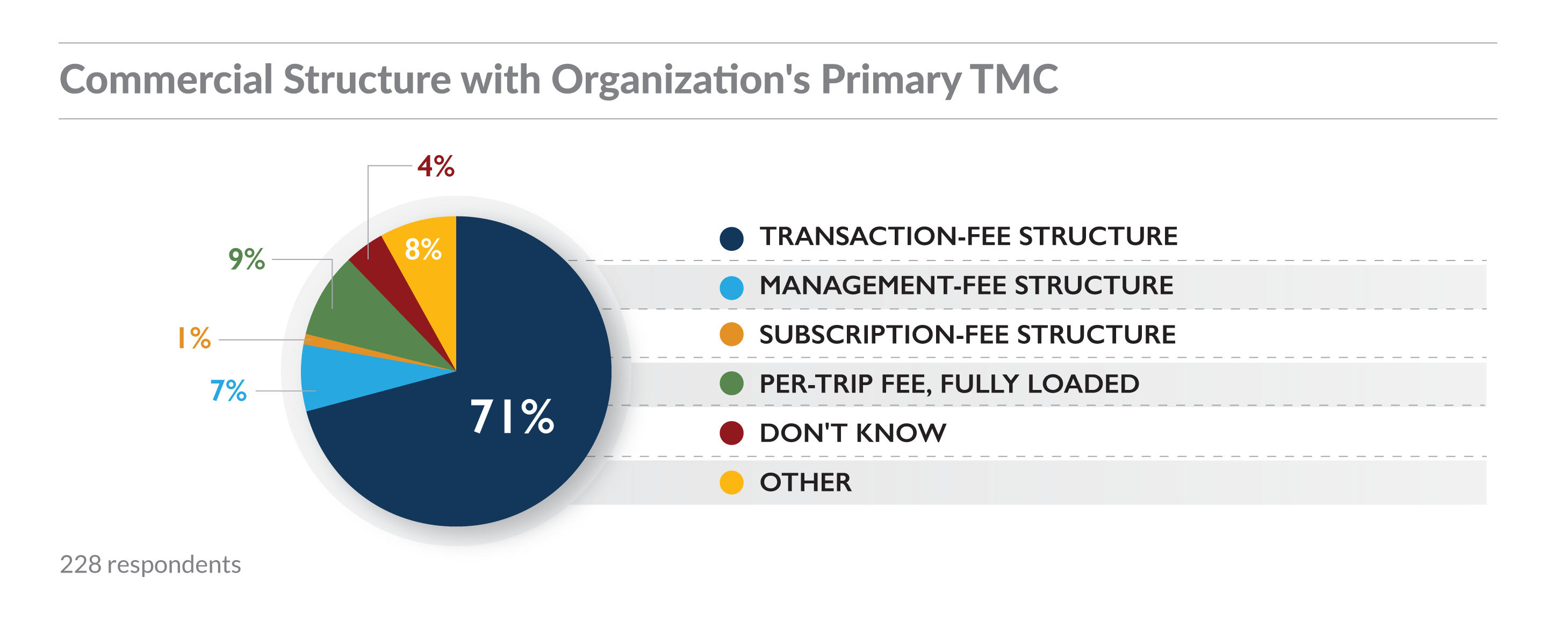
future. That is yet to happen on a widescale, with 71 percent of respondents in
BTN's survey saying they use the transaction fee model with their TMC.
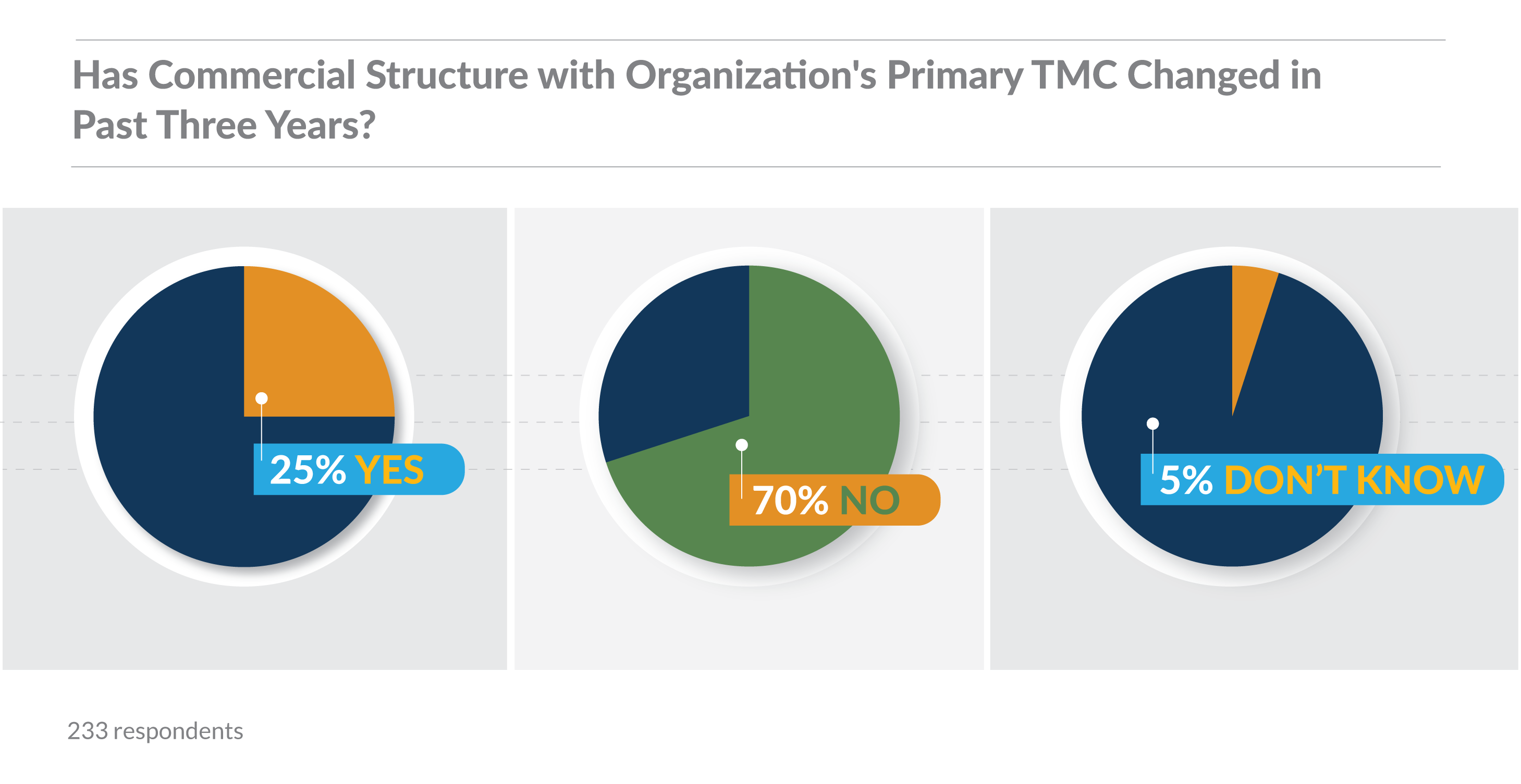
Still, a quarter of respondents said their commercial
structure with their primary TMC has changed over the past three years,
indicating the willingness to shift is out there. Per-trip fees and management
fees were the most common non-transaction-fee structures among respondents,
collectively representing 16 percent of total respondents.
One TMC executive said his business had seen a "slight
increase" in interest from corporate customers in centralizing fees rather
than applying them at the point of sale, both from existing clients and new
clients via RFPs.
"We show a higher Net Promoter Score on accounts that
have fees paid centrally," the executive said. "We've seen happier
travelers when it comes to that because they don't understand that we might be
aggregating 10 different reporting fields for them behind the scenes and don't
understand why there is a fee associated with a ticket [under a transaction fee
model.]”
The common wisdom is that TMCs earn more revenue from
suppliers than they do from clients, which buyers said goes to the heart of
those total satisfaction levels. Some buyers questioned whether TMCs push
decisions that are best for travelers or best for their own revenues, and that concern
likely will be exacerbated as airlines strike deals with global distribution
systems that give higher revenues to certain kinds of bookings.
As such, the call for transparency remains one of the key
points for buyers with their TMCs.
"The TMC is the backbone of the travel program, and as
long as we don't have proper clarity, it's an imbalance," another buyer
said. "They need to see all of your volume and details, so they want
transparency, but they won't give you transparency in return, which is
frustrating."
Rising Distribution and Technology Challenges
Airline content strategies and New Distribution Capability
have presented a new challenge in buyer/TMC relations in recent years. While
TMCs are making progress in integrating NDC content, a recent report by
advisory services firm Garner estimates that NDC represented about 6 percent of
total TMC bookings in 2024.
Meanwhile, the overall content and pricing gaps between EDIFACT
and NDC channels continue. Depending on fare classes, airlines and routes, industry
sources like AmTrav and Emburse have reported differentials can be as high as 30 percent, while other
times they are as low as 5 percent—or nothing at all. Without full access to
NDC content the options remain opaque in the TMC channel.
So far, buyers are showing patience with the situation,
according to BTN's survey. More than 60 percent of buyers said airline
distribution strategies have had no impact on their TMC relationship and they continue to turn to TMCs as their main
technology platform and data partners.
Fifty-four
percent of buyers in BTN's survey said they get their booking tool through
their TMC, as opposed to 40 percent who get it directly from a technology
supplier. Profile management technology sits largely with the TMC as well.
Buyers rely on TMCs more for reshopping tools and mobile apps than going
supplier-direct. Expense management platforms, however, were overwhelmingly preferred
as supplier-direct in the survey. [For more on these practices, see Part 6. Technology & Innovation]
The large
TMCs are still treading the line of acquiring and developing their own
technology offerings while pledging to work with third party suppliers as their
clients demand it. In their self-reported trendlines, they are seeing success
in moving clients to proprietary technology, which makes it less of a heavy
lift for clients as far as installation and interoperability—but the more
technology a client sources from a TMC, the more complicated it becomes should they
need to change.
Continued Consolidation
As the industry awaits a final decision in the Amex GBT-CWT
"merger of giants," many buyers remain in limbo—some with very large,
very progressive programs. A few had thrown in with CWT’s pilot program on
Spotnana’s technology platform, but a couple of program administrators have
told BTN they are loath to move forward fully with certain initiatives and
investments until they know the disposition of technology options should the
merger go through.
One large CWT account told BTN it had taken control of all
its data and revamped its program from the ground up so that changing TMCs—and
generally being more agile with partners whenever the need might arise—would be
a much easier process.
Such independence may become the new hallmark of a fully evolved travel management
program. Independence aside, a merger that removes a mega player from the
market could leave slim choices for large multinational enterprises in terms of
where they are able to place their business.
The litigation of the GBT-CWT merger has centered around
what exactly is the supplier universe capable of providing TMC services to the
largest corporate travel customers. With the broad expectation that a
business-friendly environment under the Trump Administration will clear the
GBT-CWT merger to move forward, both large and midsize TMCs are getting ready
to step up to the task of bidding for any business that defects. One consultant
BTN talked to intimated that has already started to happen, as companies tire
of the protracted and “uncertain” merger that seems to materially weaken CWT’s
position the longer it drags on.
One-stop-shop travel and expense players like Navan and
TravelPerk have deep funding pockets and high valuations. In addition to
investing in their own technology stacks content sources, they’ve pursued
travel expertise and geographic growth via acquisition. Barcelona-based
TravelPerk acquired NexTravel and AmTrav in the U.S. along with ClickTravel in
the UK. Navan (then still TripActions) acquired Reed & Mackay and, more
recently, a number of smaller European TMCs. These players continue to position
themselves as entities capable of chasing bigger fish. Navan, additionally, has
been preparing for an initial public offering.
Madrona Venture’s big-swing investment of Direct Travel has
tied together a cast of next-generation travel technologies already in the
Madrona portfolio: Spotnana, Troop and Center (the latter was recently acquired
by American Express). This is Concur co-founder Steve Singh’s latest venture,
and he has publicly said the industry should expect more acquisitions under the
Direct Travel aegis as the company re-platforms.
Then there’s Kayak BTX/Blockskye—a booking tool/TMC
product constructed to the specifications of big-four consulting firm PwC.
Annually one of the largest corporate travel programs in Business Travel News’
Corporate Travel 100, PwC’s drive to create a more intuitive digital experience
for its business travelers operates on a blockchain foundation that links the
agency, the booking tool and, now, a number of suppliers. It is one of a
vanishing few innovations in the past five years that has successfully brought
distributed ledger technology to bear on the corporate travel industry. Another
big-four firm Deloitte has adopted the platform, but it is limited in
geographical scope. Both PwC and Deloitte launched their U.S. programs with
Kayak BTX/Blockskye, while their other regional firms remain on traditional
service models.
These TMCs are the ones on the leading edge of innovation,
but they aren’t the only players capable of serving global clients. A number of
other agencies—both large and midsize—are making big investments in
re-platforming and/or bringing on artificial intelligence-powered technologies
to bear on their workflows and processes, with the idea that AI will help them
personalize service. At the same time deploying human resources on the
most complex tasks.
Buyers believe some TMCs will not survive, particularly those not adapting
to new technologies and supplier strategies. "They're in denial of the market dynamics, the evolving requirements of their customer base and the evolving expectations of senior management from their customers," one buyer said.
Even as the market changes, TMCs are confident in their capabilities and the continued need to provide value via service.
"We're starting to see the pendulum swing; it's going
to swing where 'everything can be automated,' where maybe things haven't been
automated enough," one TMC executive said. "But it's going to level
somewhere in the middle, when people realize automation can't solve for
everything. There are things [TMC teams] are doing and value they are adding
that no amount of AI will be able to solve for. There has to be some level of
customer service that comes with that."