The Data Story: Macro Uncertainty Dims Sunny Projections
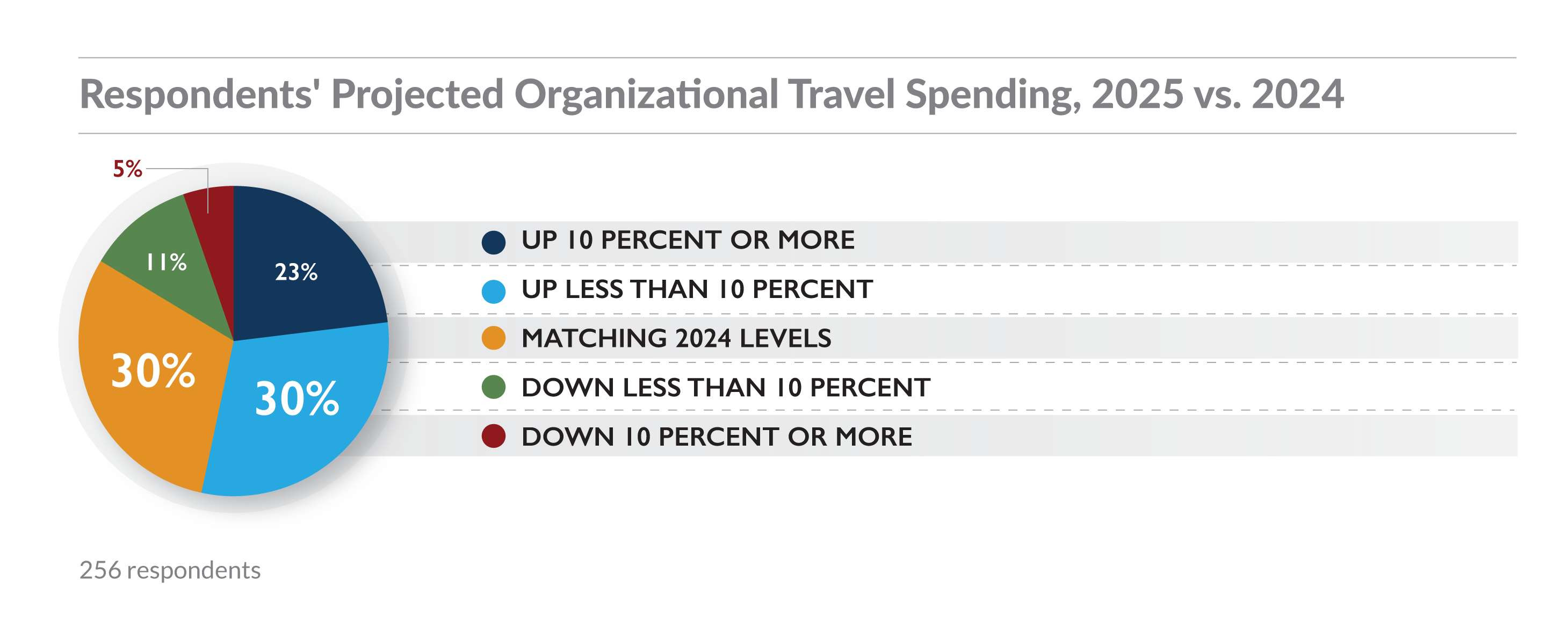
BTN Intelligence surveyed 314 business travel buyers in
January and February about their company’s business travel outlook and program
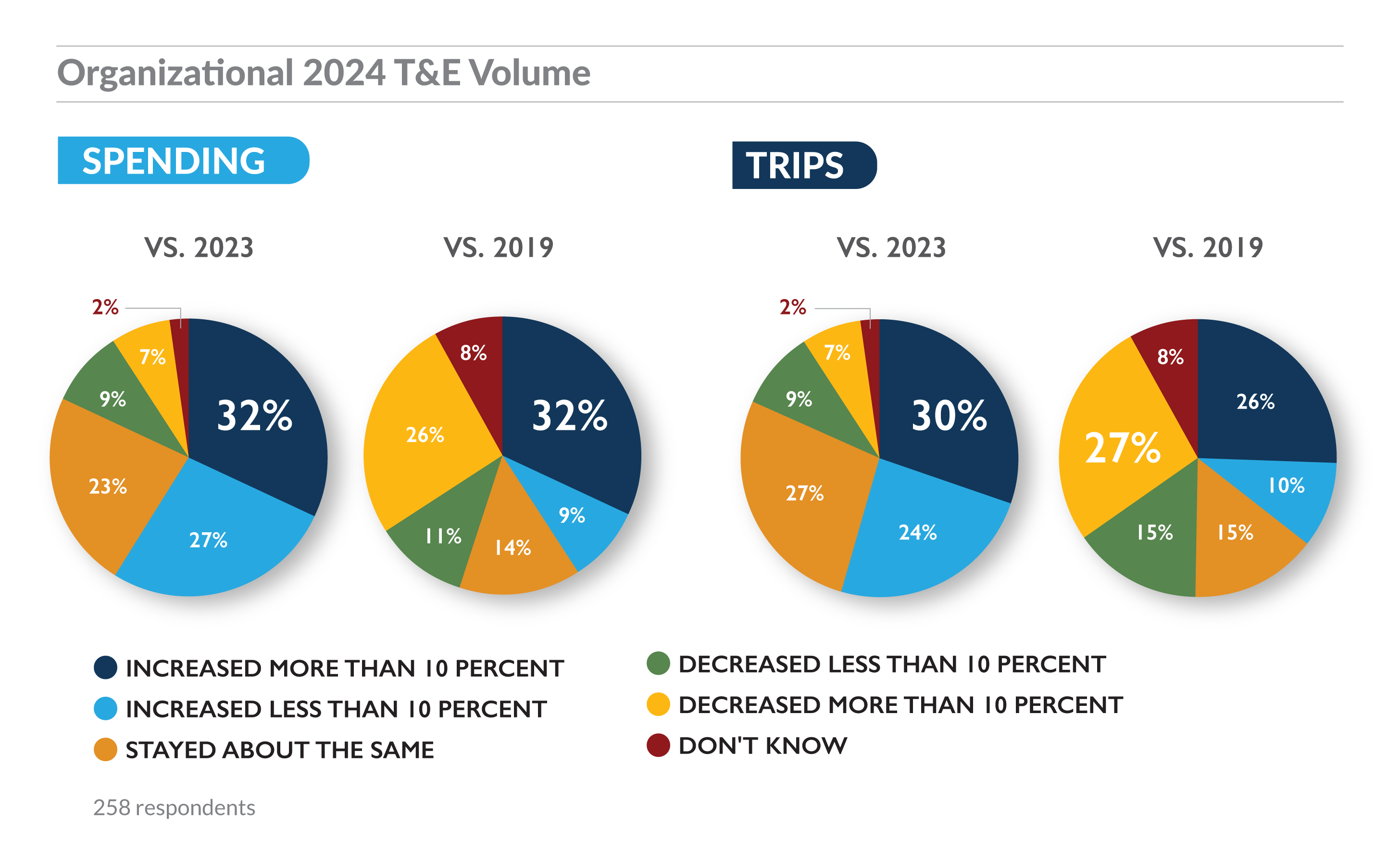
strategies for 2025. At the time, both spending volume and trip volume
projections were up substantially over 2024 levels. Sixty percent of buyers
said their spending volume would come in above 2024 levels. And that was after
similar increases in 2024 vs. 2023.
That outlook has shifted in the intervening months for a
significant percentage of companies originally surveyed, according to a flash
survey BTN fielded on April 4 and 5, in the wake of trade policies and
geopolitical shifts happening in the United States.
_______________________________________________________________________________
The Intelligence Report
The Trump Administration’s now-you-see-it, now-you-don’t
tariffs announced on April 4 and fully implemented on April 9 before getting
partially pulled back within 24 hours of going live, convulsed global economic
markets, sending markets plummeting with the implementation and then spiking on
the pullback. Aggressive tariffs still are expected within the next 90 days,
and some tariffs have remained unchanged: Canada and Mexico still have 25
percent tariffs on goods imported to the U.S., and Canada has retaliated with
similar taxes on U.S. goods coming into the country. China and the U.S. have
been shifting rapidly through various levels of a trade war with tariffs that
at certain points reached 145 percent. Ongoing volatility regarding tariffs
with China and other key countries remains.
The result on both U.S. and global economies has been swift.
Goldman Sachs, the International Monetary Fund and JPMorgan all have raised
their projections for recession risk in the U.S.—the latter in April raised it
to a probability at 60 percent, while both Goldman and IMF have basically
stopped at a coin toss. Goldman revised in May its recession risk assessment
down to 35 percent; JPMorgan walked its risk assessment back to “below 50
percent” but the IMF has not issued a revision of its outlook.
The business community, in turn, has found itself in a fog
of uncertainty, which is usually negative territory for business travel
decision-making. According to numerous industry reports, including BTN surveys,
companies have started to pull back.
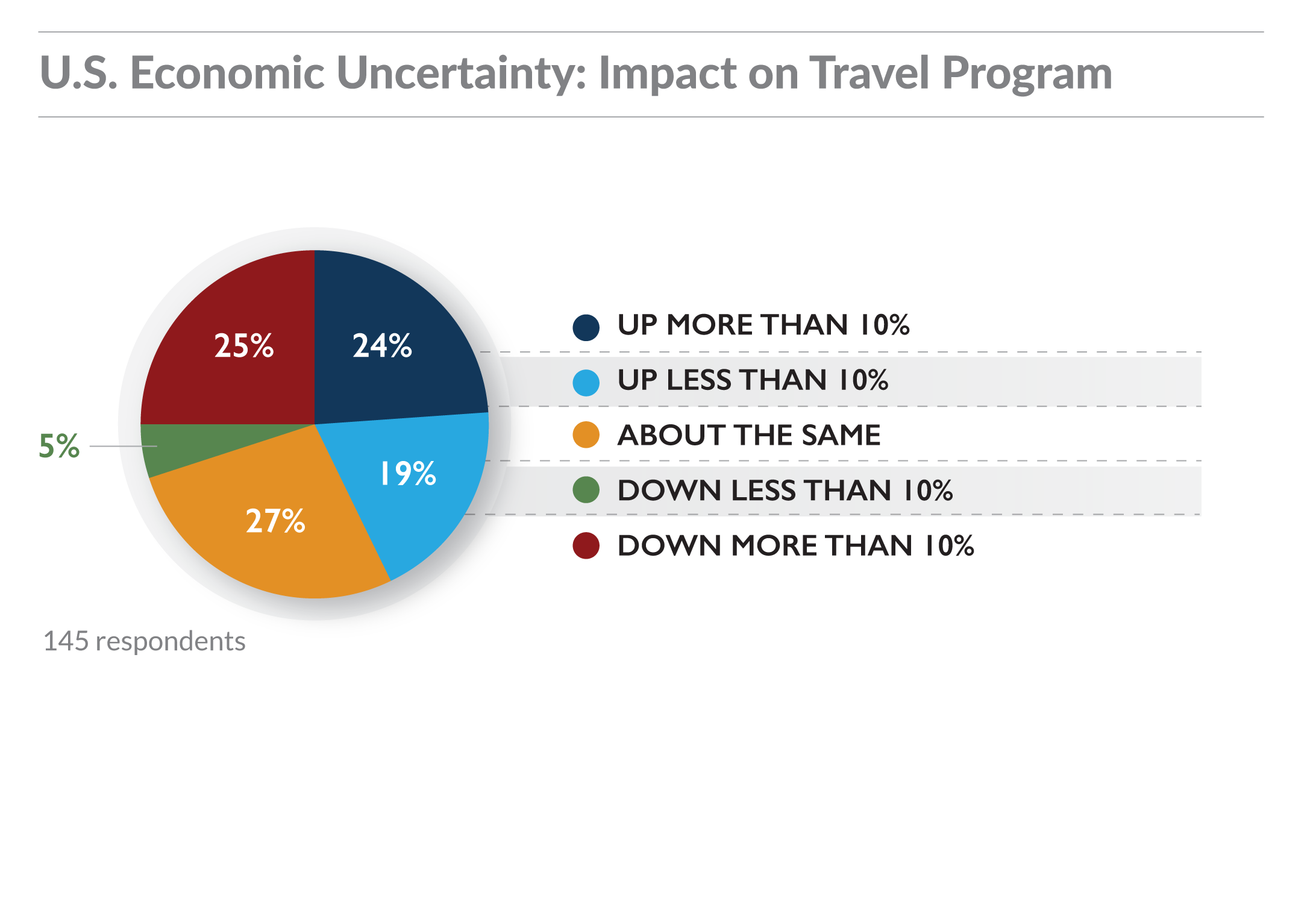
A BTN flash survey on April 4 and 5 found that 41 percent of
145 companies surveyed had seen “significant” or “very significant” impact on
their travel volumes. That said, 38 percent reported “very little” or “none.”
Sentiment from a Global Business Travel Association survey
fielded Mar. 31 to Apr. 8 reflected similar movement, showing just 31 percent
of more than 900 survey respondents (including travel buyer, agency and travel
supplier respondents) had an optimistic outlook for 2025. That number was down
from 67 percent when the association posed the same question in January. Buyers
that reported to GBTA that their companies were pulling back on travel now were
doing so by more than 20 percent compared to 2024.
Those trajectories aren’t wholly reflected in business
travel volumes, according to several travel management companies BTN queried in
mid-April. Companies like Navan and Flight Centre Group, the parent company of
both FCM and small- and midsize specialist Corporate Traveler, have noted a
strong first quarter, particularly with inbound international volume to the
U.S., with a growth slowdown—but still growth—in the early weeks of April.
Those trends roughly resemble ones cited by U.S.-based air
carriers, which sounded early alarms in recent earnings calls about softness
across corporate travel growth—but not reversals. Delta CEO Ed Bastian pointed
to softness in business travel and domestic main-cabin travel, but said premium
cabins and international travel from U.S. origin cities still showed strong
numbers. United CEO Scott Kirby echoed those same demand contours for the
Chicago-based carrier. He added that softness on government-heavy routes and
some transborder routes have warranted planned capacity cuts. Southwest noted a
similar trends among government travel but CFO Mike Watterson mused that while
economic uncertainty usually “shows up in business [travel] first… business
travel has held up, so we’re pleased with that.” American cited similar
resilience across managed corporate accounts as well as similar erosion of
government travel.
Economic policies aside, travel and immigration processes
have become more cumbersome and uncertain in the U.S. as international
travelers report secondary screenings, detainment and deportation at air
crossings. Some airlines have noted modest declines in inbound traffic to the
U.S., but not specifically business travel. That said, global risk management
firms have cited increased concerns among corporate clients regarding scrutiny
of traveler documents, personal social media activity, past incidents of visa
overstay or minor infractions with law enforcement as they prepare employees
for international travel to the United States.
The GBTA survey showed varying—but significant—pluralities
of travel managers with concerns over increasing costs, increasing
administrative and documentation demands, increased safety issues and decreased
willingness among non-U.S. based travelers to make trips to the U.S.
The global uncertainty is hitting the business travel
industry at a critical moment of transformation. Should contraction in business
travel volume occur, it could distract from—or intensify—evolutionary changes
already underway. Some observers worry that capital to invest in transformation
could become more scarce; others project confidence that the particular
investments needed right now—in artificial intelligence, in supply chain and
value transparency—would garner more attention as they are key to industry
efficiency, cost reduction and governance should an economic downturn occur.