The Data Story: Buyers Report Weaker Negotiation
Positions
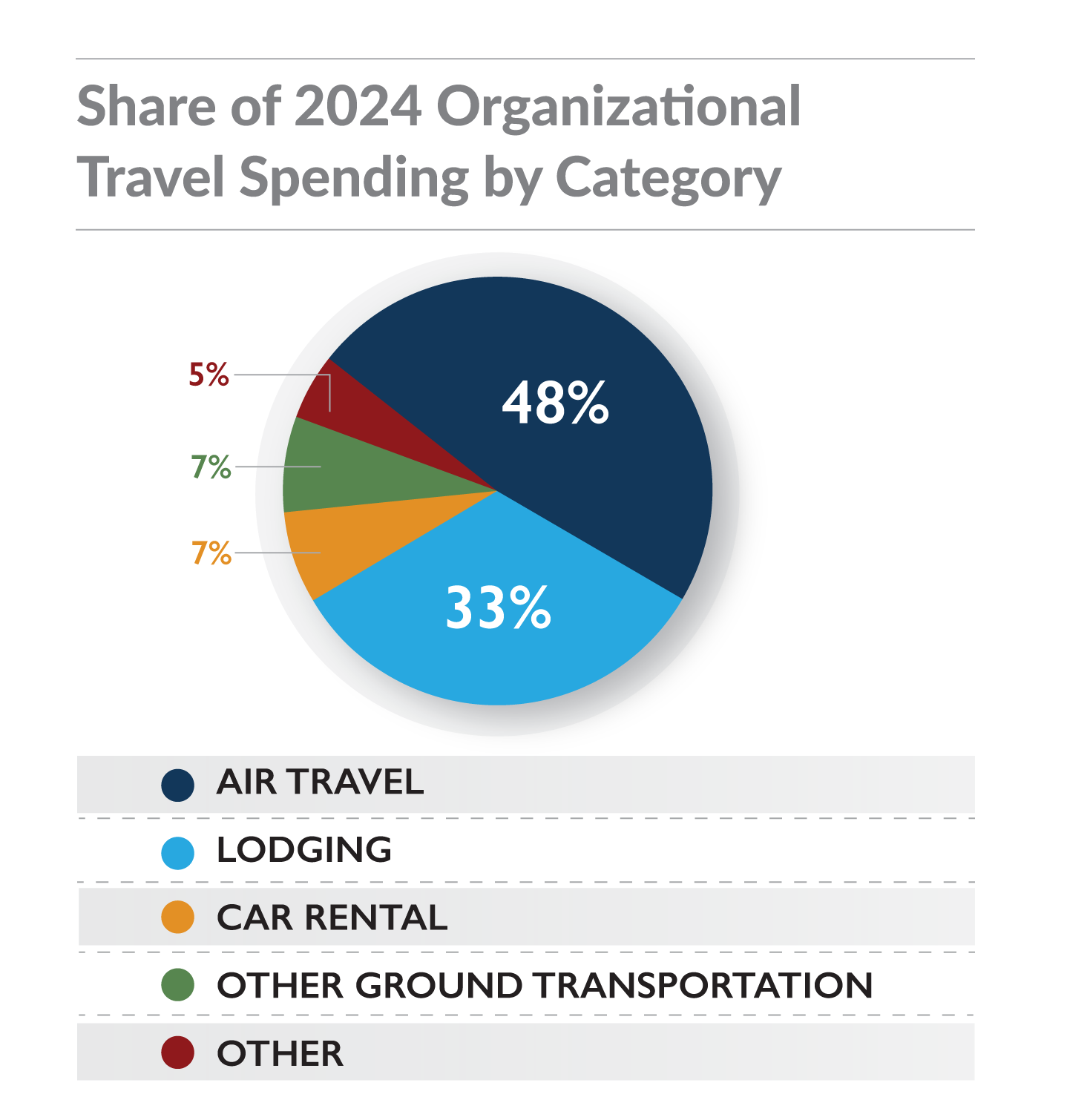
Share of organizational spend per travel category hasn’t
shifted much over the past three years, according to the BTN 2025 State of the
Industry Report. Of those who did report changes the shift seemed to be
slightly away from car rental and toward other categories. In Europe, there was
a noticeable shift from air to “other ground,” which would include rail.
Countries like Spain and France have taken legislative action to ban some short
haul air routes.
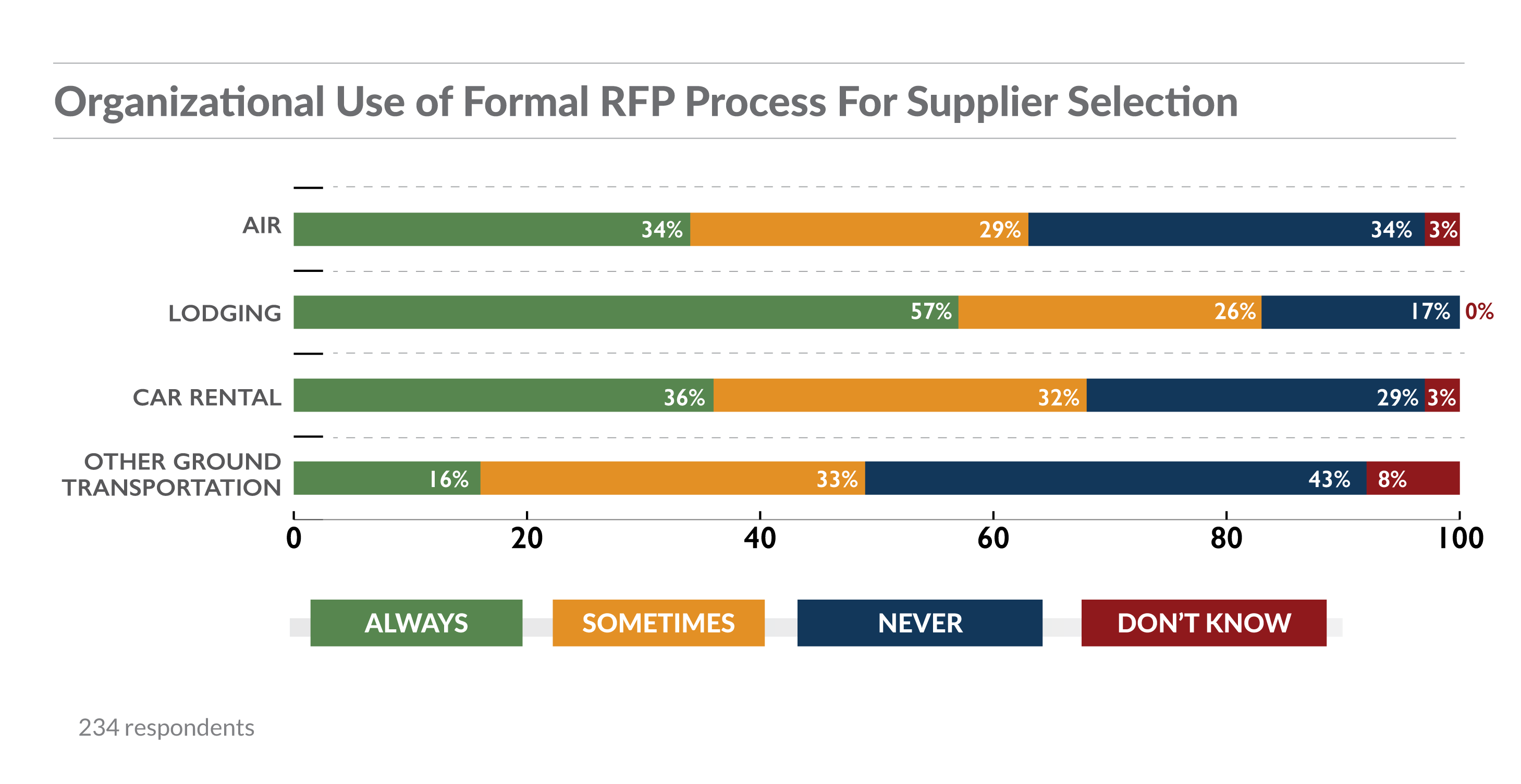
A majority of buyers continue to use formal RFP processes to
source their travel supply chains, but not for every relationship. Large
programs engage more heavily with airlines, as the thresholds required to
negotiate a contract are increasing and the discounts themselves continue to
decline. Pre-set midmarket programs have become a priority for more airlines
and some hotel companies, and consultants say that some of these options are
well designed—but not all.
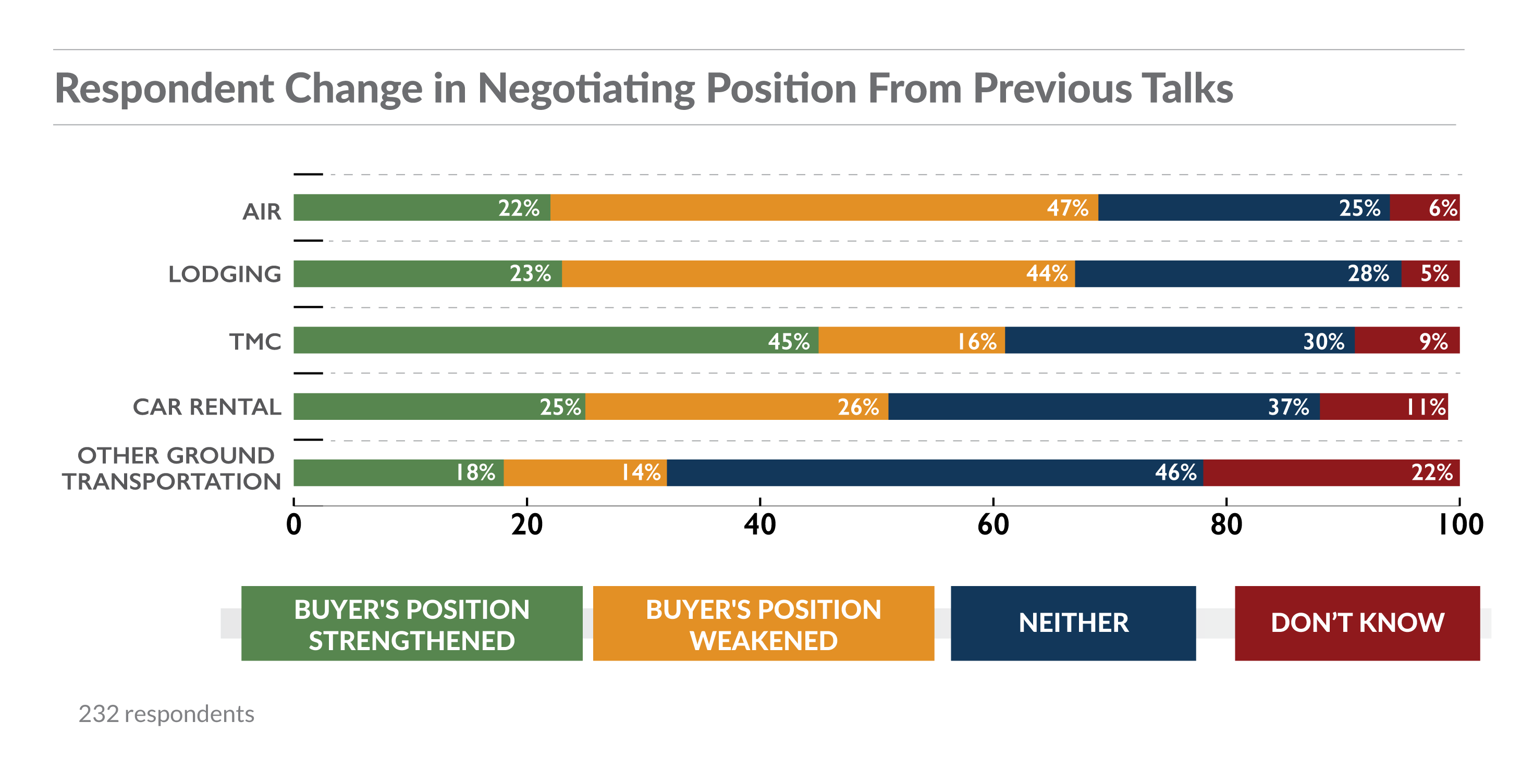
Suppliers have been more aggressive in traditional
negotiations, pushing buyers to prove volume and demonstrate share shifts to
qualify for corporate contracts. Nearly half of respondents said their
negotiation positions have weakened in the both the airline and lodging
categories. A quarter of survey respondents said their leverage with car rental
was worse than in years past; that was balanced in car rental, however, by
those companies that said their negotiation position had improved.
Consultants report discounts have been reduced enough in the
airline space—along with contract duration—that it is harder to justify the
resources needed for a full RFP, especially if the corporate works with a third
party to execute the tender.
Buyers held the line on rate more successfully with hotel
partners, but they may have given up other inclusions or soft benefits.
Last-room availability, for one, has been harder to secure across the board.
Some advisories project the tariff situation in the U.S. could impact corporate car
rental rates, as the cost to acquire fleet increases as does maintenance.
Recent commentary on that status, however, has suggested the automotive
industry will get a reprieve from the steepest levies. However, buyers should
keep tabs on surcharged cities, as those are shifting upward.
____________________________________________________________________________
The Intelligence Report
As loyalty structures form the basis of suppliers’ new ways
of thinking about the corporate market, larger midmarket and bona fide large
market companies aren’t letting go of traditional travel sourcing and best
practices that have delivered on savings and corporate cost avoidance
imperatives. According to buyers and consultants, however, suppliers are making
it harder to prove the value proposition for negotiating business travel
specifically on the basis of discounts.
Airlines
“Particularly in the airline category, the point of sale
discount has become harder to get, and many airlines are looking for two-year
deals,” said one travel management consultant who works with both large and
midsize accounts. “We used to yield out our services over the life of a
three-year contract, and there was a higher discount. With the continuing
downward trend on the point of sale, and even one airline this year that wanted
to do an 18-month contract, it’s much harder to show the value of investing in
the cost of going out to bid."
One interviewed buyer said airlines were much more focused
on buyers proving volume and scrutinized the program’s ability to shift market
share to preferred suppliers. Speaking for a midsize program that was
formalizing a travel program for the first time, this experienced buyer said
they had to leverage some intangibles to get the deals done. The buyer had the
good fortune to represent a travel program from an up-and-coming life sciences
company. They said suppliers took into account the halo effect they might gain
from having the company in their client portfolio—even when the travel volume
on the table might not have garnered contract consideration for a similar sized
program at a different company.
"The [company] name helped a lot because in some areas we might not have had enough spend or even the data available to us to prove… what? There was no Prism data, there was nothing. I had to leverage my contacts and my reputation, and I had to convince suppliers to come on this journey with us,” the buyer said.
One BTN Corporate Travel 100 program reported consternation
with their primary airline partner going into 2025. The company’s location and
routes ostensibly tie travelers to American Airlines for the majority of its
city pairs. While 2024 would have been an off-year for airline contracts for
this buyer, the corporate forced American back to the negotiating table last
fall after insisting on a one-year contract when AA restructured its sales team
in 2023 and there “were a lot of no-bids and people not getting contracts at
all,” the buyer said.
The buyer was unhappy with the 2024 deal, and took a gamble
that the carrier would soften its stance. The company in 2025 improved
discounts over 2024 and got competitive rates for domestic routes, but that was
not the case for international. “I really need my [key international city pair]
to be much better, but they are not budging so they are starting to lose
share.”
The buyer said AA had indicated the company
could negotiate with its joint venture partner serving that route, but the
reality turned out to be different. As an alternative, the buyer is now pushing
for travelers to take a connecting flight on another airline “that has given us
some amazing deals,” but it is hard to convince travelers to take that
additional leg.
Another large market buyer told BTN that airline
negotiations have to go beyond the discount conversation.
“Pricing isn’t really the point,” the buyer said. “It has
become secondary. Now, it’s about how the airline handles your travelers during
irregular operations, or how we would be designated a little bit differently in
sales support but also in our PNRs to recognize travelers.”
In return the buyer said their company was now giving
preferred suppliers more exposure in the booking tool and even investing in new
technologies that allow the program to feature preferred suppliers in new ways
and allowing suppliers to promote certain products to the company’s
travelers—like the airline credit card or club membership. That exposure also
includes promotion of the airline loyalty program and an active effort to drive
loyalty membership.
“Value is coming in different ways—and some of it reflects
what we give the airline beyond the volume business. Some of what we open up to
them also impacts their ability to handle our travelers well and support the
travel ecosystem our company has constructed to drive our mission.”
The buyer said the company’s primary airline agreement
actually includes contracted meetings between top executives to ensure
alignment and strategic understanding of priorities.
“We also are watching our dashboards really closely, and our
spend goes up and down.” When it drops, the airline has been very aware of it
lately. “They’ve been a little nervous,” the buyer said, referring to negative
economic indicators and the U.S. airline sector’s recent reductions in earnings
projections. “We’ve had weekly check-ins with them lately; sometimes twice a
week.”
On the Horizon: Hotel Merchandizing Strategies?
Industry analysts have projected a concerted effort among
hotel companies to adopt similar merchandizing models to their airline
counterparts in terms of assessing the characteristics of a stay and looking at
them as individual revenue opportunities: the floor level, the view, distance
from the elevator, access to the gym, breakfast inclusion. Like airlines,
hotels are looking at how to understand the potential traveler and provide a
customized experience for them by mixing and re-mixing amenity packages.
The corporate market has not seen this strategy come into
play yet, but hotels have been studying the space and investing in new
technologies to enable more advanced merchandising platforms. Accor, Hilton,
Hyatt, IHG and Marriott all announced investments and projected rollouts of
cloud-based property management systems that include artificial intelligence
layers that will help them tailor products to guests. Like in the airline
category, the corporate market won’t be immune to these tech-powered strategy changes.
Hotel & Lodging
Buyers and consultants BTN interviewed for this report
agreed that the competitive landscape across the hotel sector remains stronger
than in the airline category, where most companies have a “natural” fit with a
certain airline based on location and required routes and, therefore, may not
have reasonable alternative carriers.
Still, major hotel companies have changed their positions in
regard to certain elements of rate negotiations. Marriott, in the most recent
negotiating season, moved to do away with the concept of last room availability
rates, according to buyer reports. This is on top of the idea that it also has
not entertained chainwide discounts. The hospitality giant did not manage to
drive all those out of the negotiating equation, but they did work to minimize
them.
“More hotels are going in that direction,” said one
consultant. “Marriott was definitely the leader in moving away from LRA. In
current contracts, more LRA went to non-LRA and more rates went from static to
dynamic.”
Some large buyers said they dropped certain hotels from
their programs because of this push to diminish use of LRA rates.
Speaking more generally about negotiation shifts, one large
market European buyer remarked, “It is the suppliers’ prerogative to do what
they believe is right for their business. Our job is to manage these types of
changes. If we no longer see the relationship as a fair trade, and as long as
we have alternatives, we block them from the program.”
Not all program managers, however, are willing to put a hard
stop on a long-standing partner, especially when they are situated in key
business locations, and overall, the corporate hotel negotiation story was not
a zero-sum exercise.
“Hotels often come out of the gate with bravado declarations
of raising corporate rates by 8 percent—or whatever the number is—early on in
the negotiation cycle,” said one consultant. “We saw buyers largely limiting
those increases to the low single digits for this year.” Another large market
buyer agreed with that assessment, calling the end result of hotel contract
negotiations “very successful,” though the process took persistence.
The consultant also remarked that some hotel companies have
come out with promising programs for the corporate market that can bypass
full-fledged negotiations and still produce results.
“I’m seeing some structured programs come out which I
actually like,” they said. “Hilton probably has the best one. Of course, you
have to sign up [for the program] to even get in the door to talk to them. But,
if you do, then they give you a baseline for a chainwide discount and then
identify properties where you have volume within a certain range where you’ll
get dynamic discounts and then probably a handful of properties at the top
where you can negotiate a static discount.
“That’s exactly how you want to structure your program
anyway. Hilton has met the market requirement with this.”
Car Rental
Car rental costs have increased for corporate travel in line
with inflation and the cost of living. They may increase more, however, as
supply chain turbulence and U.S. tariffs impact not only fleet costs in the
near term but also parts and maintenance costs for car rental and mobility
companies. Those companies that locked in rates for 2025, may be happy they
did.
Coming off those negotiations, the mood among buyers was
more positive for this category than for airline and hotel. A quarter of buyers
responding to BTN’s survey said negotiations netted better results than the
previous year; that balances another quarter who said they did worse.
Thirty-seven percent said there were no changes to the power dynamics in their
negotiations.
Consulting experts in the space, however, said buyers will
need to watch out for stealth fees across car rental providers that could
dramatically increase the total cost of the rental. Commercial structures baked
into the car rental models include weekly or monthly multipliers, fees for
one-way rentals and fuel surcharges. One-day and short rentals are coming
through with higher rates. And one consultant warned buyers to be mindful of
city surcharges.
“Go back 10 years and you’ll see three [surcharged]
cities mentioned in the contract. Now, there’s a whole tier structure and they
are moving cities up and up that structure. So it doesn’t look like you’ve got
a rate increase, but they move cities up from the $5 tier to the $8 tier and
you have the same result.”