The Data Story: The Small & Midsize Business Travel Boom
The robust recovery of business travel for small and midsize
companies after the pandemic sparked supplier innovation around how to attract
more of that business to diversify and bolster their portfolios. American
Express Global Business Travel in 2023 sized the small and midsize enterprise opportunity
as 40 percent of the managed travel market, but estimated SMEs represented about
72 percent of the larger unmanaged business travel market globally.
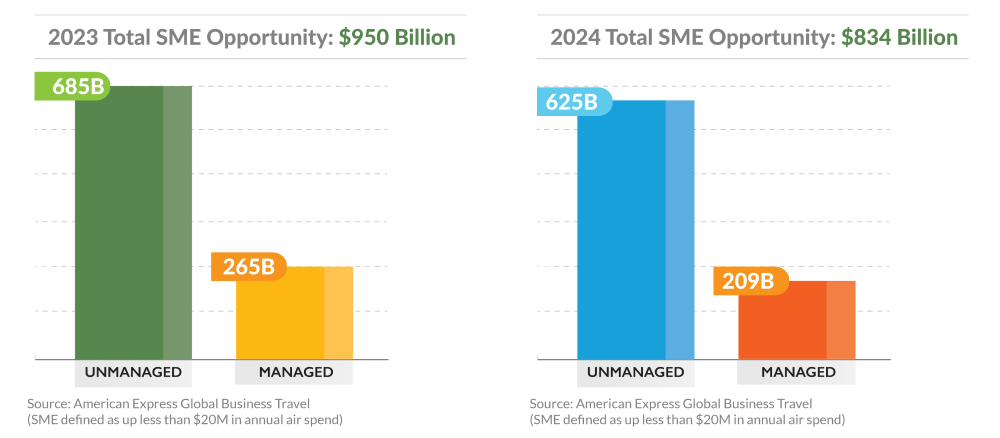
Amex GBT downsized the overall SME market opportunity by 12
percent to $834 billion in its most recent estimation. The company in its
annual report released in March also showed SME transactions in 2024 slowing to
2 percent growth compared to large corporate market transactions rising 6
percent. How current economic uncertainty may impact those dynamics will be
closely watched by corporate travel players.
That includes travel suppliers, which are competing with
TMCs to capture that segment—which is often unmanaged or lightly managed—as
direct business. Recent moves have shown suppliers angling to maximize merchandizing
elements in the SME market that they can’t fully leverage through
agency-mediated managed travelers.
Airlines and hotels in the past two years have moved en mass
to revamp special programs for small and midsize enterprises. Emerging SME
solutions intertwine significantly with supplier loyalty programs and reflect direct
booking strategies suppliers have long wanted to execute to the broader
corporate market.
TMCs, too, have diverted significant resources to SME client
acquisition and have refocused their efforts on this market as a “higher
margin” opportunity. Particularly in tech platform investments that will
automate processes and introduce more self service for these clients—eventually
driving out more costs and further increasing margins.
So far in 2025, travel supplier earnings reports have noted
mixed experiences regarding the durability of business travel volume for the
SME segment. Some companies have been buoyed by “resilient” SME bookings, while
others have noted softness in the segment and the relative reliance on larger
corporates for business travel volume.
How an inversion of the pandemic-era “resilient SME”
narrative could shake up supplier and intermediary strategies is yet to be
determined. Still, the higher margins—and potential for advanced
automation—associated with the SME client remain an enticing prospect that the
supplier market is likely to pursue aggressively. How suppliers and intermediaries eventually
balance their business travel acquisition strategies across the SME and larger
corporate markets will be telling.
______________________________________________________________________________
The Intelligence Report
Today’s distribution strategies aren’t just about retailing
or increasing ancillary sales. They are also about loyalty and gaining a closer
relationship to the business travel customer through personalization. Airlines,
hotels and car rental companies want to enter a world of closer relationships
to their customers by using individual buying patterns and loyalty data to
inform offers and rewards tailored to that customer.
Then-Marriot-CEO Arne Sorenson declared in 2019 that its
newly launched Marriott Bonvoy was the hospitality company’s most important
brand. The activities behind that statement had yet to play out for Marriott at
the time, but the concept itself has been ardently embraced by many suppliers
and more persistently pushed into the managed travel arena as well.
American Airlines, in its 2023 NDC gambit, used its
AAdvantage loyalty program as its organizing principle, stating "AAdvantage
is very much the platform upon which we will build all of our commercial
programs."
Business travelers—whether managed or unmanaged—are
high-value customers that travel suppliers want as their closest customers.
Putting an agency, a policy and a corporate online booking tool in the middle
of that relationship isn’t exactly ideal (for them) and a number of major travel
suppliers are looking for new models that will allow them better access to the
individual traveler.
The drive to capture business traveler loyalty is crystal
clear in such moves. And once the loyalty is in place, the Marriotts, American
Airlines and other suppliers similarly positioning themselves can market and
promote additional products—like credit cards and other affiliated
products—that bolster the bottom line.
Activation of business travel among small and midsize
companies was an eye-opener for some travel suppliers post pandemic.
Non-contracted SME travel realizes higher margins than travel connected to
heavily negotiated corporate contracts. That, combined with the more sluggish
business travel demand from large companies until 2024, pushed suppliers to
think of SME business as a more significant opportunity.
Suppliers have also begun to comment on the percentage of
business travelers that are unmanaged and lightly managed versus corporate
contracted business travel, and seeing more opportunities to reach the former
two categories directly—not just with consumer websites but with better
programs targeted to what looked like the growing needs of that market, without
diving deep into a corporate discount strategy.
Add to that the fact that large programs had a tough time
lifting travel volumes post pandemic, and a larger portion of the business
travel market looked like it would play in the SME segment—at least for the
midterm. The situation shuffled how some major suppliers approached the
business travel market overall.
“With unmanaged or lightly managed small and midsize travel
programs, suppliers saw an opportunity to reshape their approach,” said one
consultant. “And it aligned with certain efforts that suppliers were already
driving toward in the larger market to disintermediate global distribution
systems and bring more business through direct channels to reduce costs and get
closer to the traveler.”
Could corporate travel models that hewed closer to direct
booking programs for SMEs work for a larger swath of clients?
American Airlines tested the idea in 2023. At the same time
it pushed New Distribution Capability booking volume “requirements” through its
corporate agency channels and upended its TMC relationships, it also reduced
and reorganized its corporate sales team in a way that pushed some corporate
clients down into a newly designed SME structure. Media reports claimed that AA
had stopped negotiating contracts for clients that produced less than $1.5
million in annual revenue for the carrier.
AA’s stated goal was to support a new business environment
in which an "increasing number" of customers seek "to interact
directly with American.” An executive memo also said the carrier was aligning
its approach to the corporate market to support “modern retailing solutions,
simplified products, streamlined processes and a connection to our premier
travel rewards program.”
While the carrier has since backed off its most aggressive
moves to push this strategy onto corporate customers, BTN sources have said the
industry should make no mistake that American—and many other suppliers—will
continue to pursue similar retailing and direct-relationship status with
corporates, and not just SMEs.
That said, the more sophisticated products for small and
midsize companies look to be some of the first avenues to test and scale
solutions toward these goals.
Marriott’s Business Access program is one example of a major
travel brand that has launched a direct booking site for “member” small and
midsize companies looking for rate discounts and loyalty perks for business
travelers. Marriott has wrapped travel policy configurations and reporting
into the deal as well as content from hotel and car rental partners, enabling
lightly managed SMEs to complete full trip itineraries and apply controls without requiring
travel management company or online booking tool relationships. From the
beginning, Business Access was tightly integrated with Marriott’s Bonvoy
loyalty program, and the hospitality giant recently sweetened the deal with an
additional loyalty layer. Qantas launched the same SME platform strategy in the
Australian market. American Airlines wrapped simple travel policy controls to
its AAdvantage Business booking site in October 2024.
French hospitality giant Accor has announced a
direct-booking meetings platform that will roll out this year—not just for
small and midsize business—but tied closely to its ALL Accor loyalty program as
just the latest example of loyalty-driven, direct booking strategies, supported
by major technology platform investments.
Delaying an SME (or any company’s) journey to a travel or
meetings agency allows suppliers to bypass the costs of securing bookings
through global distribution systems and online travel agencies like Expedia or
Booking.com. Plus, at the smaller end of the SME segment, companies aren’t
looking for corporate contracts or account management. So locking in loyal
relationship with convenient tools and loyalty accumulation direct to the
traveler and at the company level is a strong win for the supplier.
New Tech Sweetens the SME Opportunity for TMCs
Travel management companies won’t be left out of the
competition, however, despite the fact that many larger TMCs once looked at
SMEs as high-maintenance and low margin in manual environments. With new
technologies in play, SMEs represent a more lucrative sector. They have less
leverage to negotiate reduced agency fees; they have a higher likelihood of
using agency-negotiated deals for lodging (and, thus, to return more
supplier-commissions to the agency); and with less scale, flatter
organizational structures and less complex itineraries compared to
multinational enterprises, they start to look more like high-margin, lower
maintenance opportunities if TMCs can get the automation and artificial
intelligence enhancements right.
American Express Global Business Travel acquired Egencia in
November 2021 to get at this market and also deployed the Neo1 booking tool as
a play for the SME segment (though some larger programs use both products). CEO
Paul Abbott has made no secret of the agency’s two-pronged approach, one for
large corporates and the other for SMEs. He consistently calls out the growth
of the SME segment within GBT’s business mix on company earnings calls and
details how the TMC is working to capture its share of what GBT now estimates as
a $834 billion opportunity.
The company’s ongoing acquisition efforts are a part of that
strategy—growing the scale of the agency to garner deeper discounts that will
attract that SME buyer. But there are other TMCs aggressively pursuing this
business and they also are bringing new industry models and technologies with
them to compete with bigger agencies for this segment.
Steve Singh’s Direct Travel—with Spotnana as a technology
foundation—is one of these, as is Navan, for which SMEs make up the vast
majority of its business, and Barcelona-based TravelPerk, which made
significant acquisitions of SME-focused agencies over the past four years,
including ClickTravel in the UK and AmTrav in the U.S. All these players—and
the SME strategy for Amex GBT as well—includes automating as much of the travel
booking and service process as possible, to keep expensive human touch at a
minimum and allow SME travel spend to drop directly to the bottom line.
Singh told audience members at The Beat Live in New York in
December that Direct Travel, through technology integrations, AI-application and
enhanced self-service capabilities, expected to drive out half the costs of
servicing a transaction, compared to TMCs on a more traditional tech stack.
As such companies mature their technologies and apply
artificial intelligence enhancements to their service offerings—which all of
them are doing—the allure of driving more companies down set, automated pathways
may be difficult for suppliers and intermediaries to resist. SME buyers have
reported to BTN that they already chafe against some very boxed-in program
configuration options with limited service options and would like to see more flexibility.
It also will be critical to watch how TMCs balance the current
wave of AI-driven innovation with human intervention—and how knowledgeable,
empathetic and empowered that human needs to be.