The Data Story: Most Buyers Respond with Traditional
Strategies
Ongoing fragmentation of airline content has put a burden
on the managed travel ecosystem to re-aggregate this content. The vast majority
of buyers, however, has little control over how that aggregation happens, short
of taking their programs apart and rebuilding from an ecosystem perspective.
While some daring (and often business incentivized) buyers have pursued that
with emerging partners [see Part 6 for more details], it’s not a reality for
most buyers.
Instead, the travel buyer community has chipped away at
the fragmentation problem with more traditional strategies.
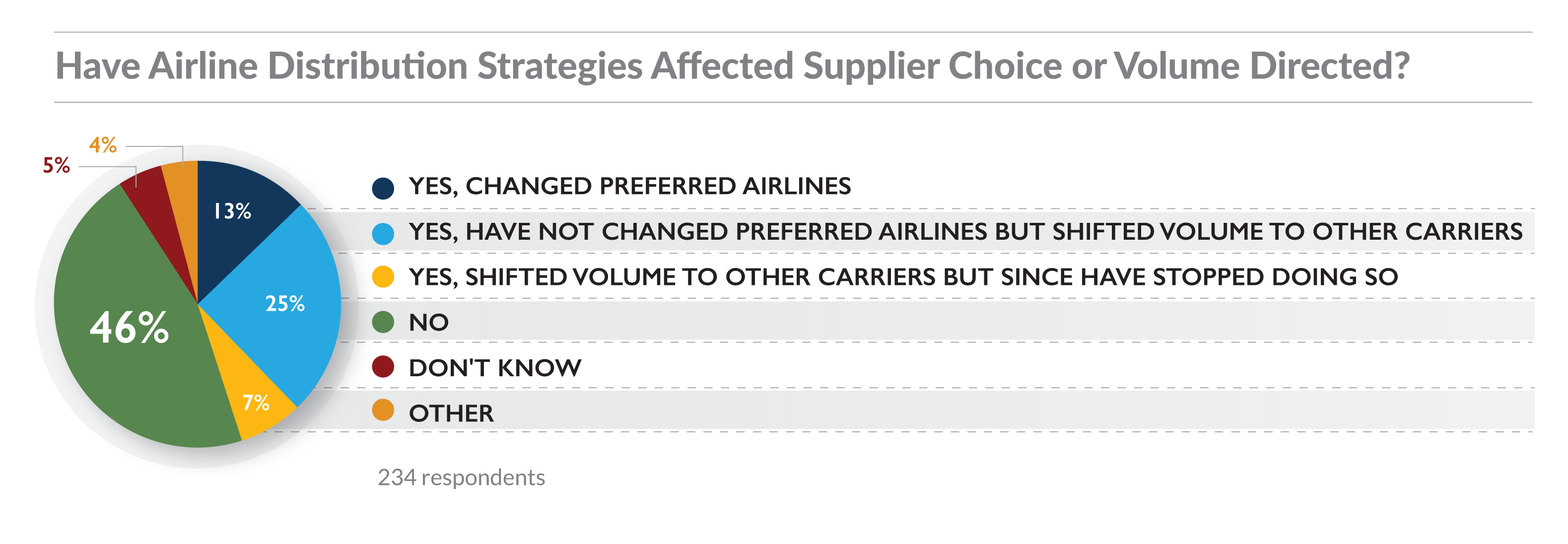
According to BTN survey data, 13 percent have changed
their preferred airlines to those that continue to provide more complete
content in traditional channels, while 32 percent stopped short of changing
partners but hard shifted their volume to other carriers (7 percent have since
shifted back—this undoubtedly represents some claw back by American Airlines
which reversed its most aggressive NDC plans in mid 2024. The airline in a
recent earnings call said they were on track to regain lost market share by
year-end). That said, 46 percent of buyers have made no changes to their
airline partnerships amid content challenges.
Part of that ability to shift volume may have been travel
buyers tightening up their travel policies. Or, if travel buyers weren’t
shifting volume, policy would be a critical lever to keep travelers in the
program, rather than booking away when they found cheaper rates via direct
booking or on a retail online travel agency site like Expedia or Booking.com.
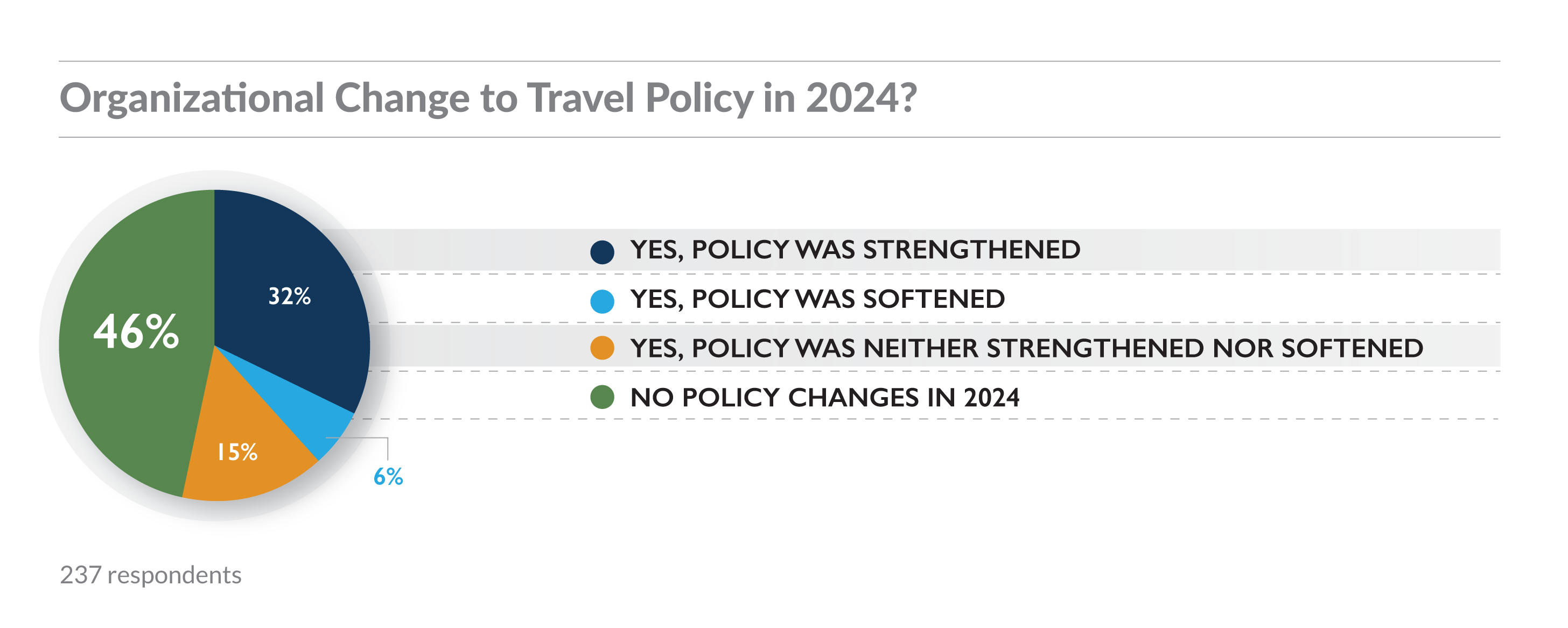
One-third of travel buyers said they strengthened their policies in 2024; 15
percent changed policy to re-direct travelers but didn’t feel the changes impacted
the enforcement strength. Only 6 percent loosened their policy structures.
Changing certain technology or service partners was
another option to combat the fragmentation.
Some buyers looked to their TMCs as the go-to aggregators
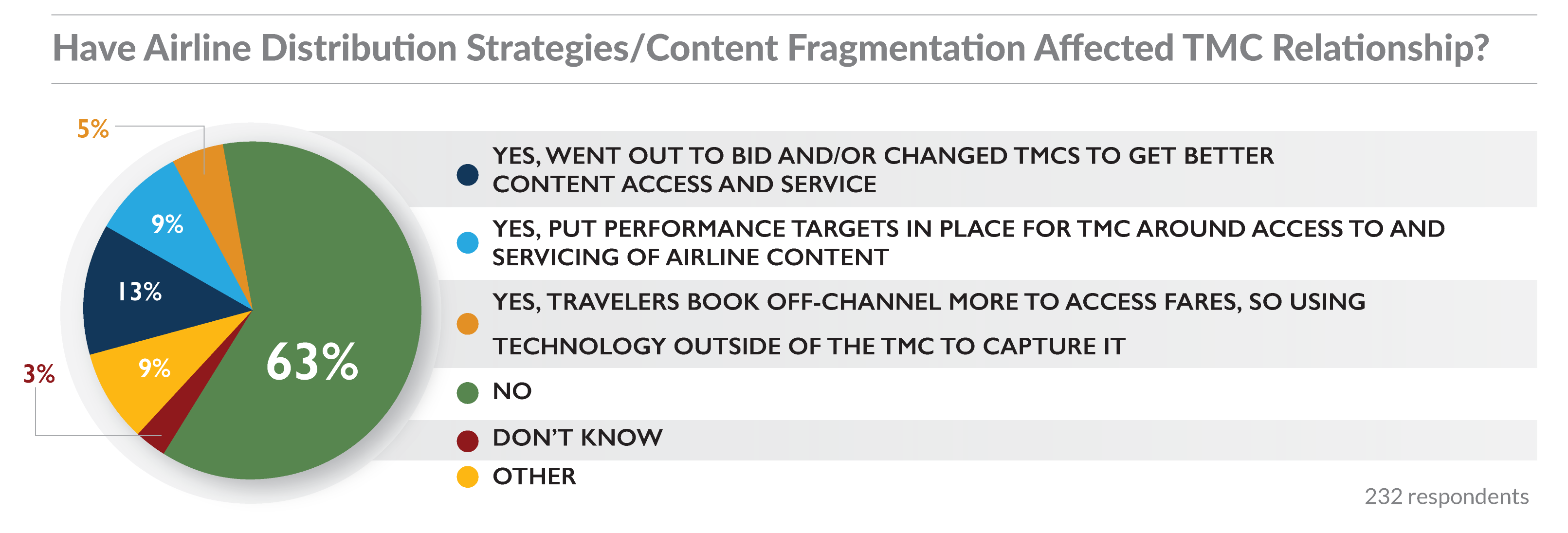
of travel content and found them lacking. Thirteen percent either went out to
bid or actually changed their TMC partner to get better content and service,
while 9 percent put performance targets in place. Five percent of buyers
participating in BTN’s survey had given up trying to push all bookings through
the TMC and instead implemented technologies outside the TMC structure, like
Traxo or Traverse, to capture those bookings and bring visibility back to the
program. That said, 63 percent made no changes to their TMC relationship.
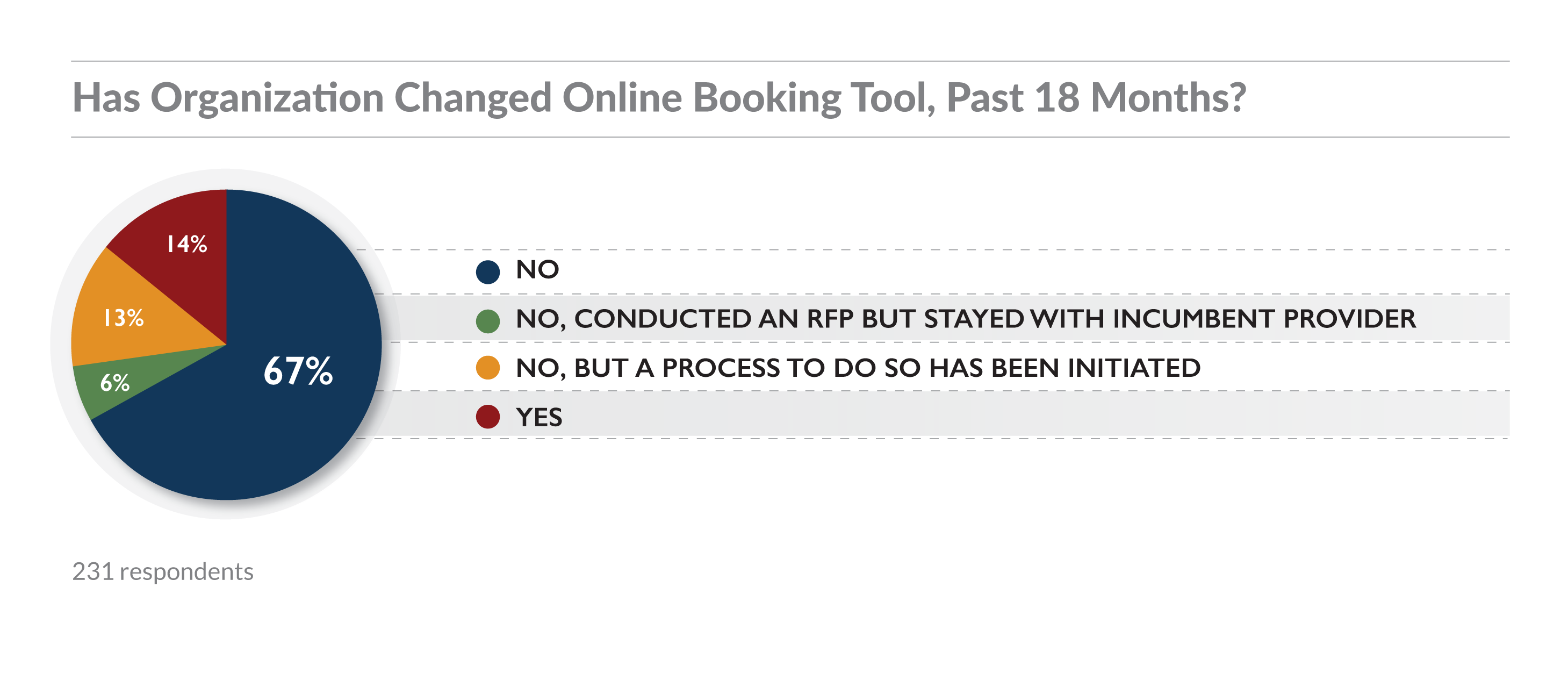
Similarly, 67 percent of buyers stayed with their
existing online booking tool in the last 18 months. While BTN’s survey didn’t
ask specifically if buyers had changed such relationships in response to
distribution changes or to expose more detailed content, the buyers BTN
interviewed said achieving better content access on the back end and/or
displaying more detailed content on the front end were driving factors in their
reasons to change. For some buyers, new booking tools alone have not
necessarily netted clear results.
________________________________________________________________________
The Intelligence Report
The business travel industry for decades has been tethered to
global distribution systems and the travel agency technologies and revenue
streams those distribution systems define. The restlessness began with the
onset of online booking in 1997 but heightened in 2002 when airlines eliminated
commissions to agencies, and global distribution systems (then called computer
reservation systems) figured out they could secure agency booking volume by kicking
back incentives. To pay for those incentives, the costs they charged airlines
to distribute via GDS channels went up.
Airlines have bridled against that revenue structure ever
since. They first attempted to draw corporate business direct to their own
dot-coms in the early 2000s, mostly to avoid rising distribution costs. The
inability for business travelers to comparison shop coupled with the loss of
agency service was a no-go for corporate clients. By 2010, there was a new
rationale to change the commercial model: Airlines had unbundled services and
amenities from base fares and were moving toward merchandizing strategies that
the GDS channel was not prepared to support.
American Airlines that year attempted to sell agencies on a
controversial American Airlines Direct Connect to bypass GDS costs but also to enable
agencies to sell the airline’s new tailored fares. Agencies collectively
rejected the model, standing their ground for a consolidated and standardized
distribution model. They settled for standard fares via traditional fare filing
at ATPCO and accessing those rates through GDS-provided agent desktops. But
airline websites continued to differentiate fares, driving their own strategies
in the consumer market and they weren’t going to turn back.
Two years later the International Air Transport Association
began its campaign for New Distribution Capability as a more modern standard
for airline distribution.
Flash forward a dozen years and American Airlines again made
distribution headlines. The carrier in 2023 pulled 40 percent of its content
out of the traditional global distribution EDIFACT channel only to backtrack on
that strategy a year later (at least partially). And while AA’s brasher moves have
made headlines lately, United has had a slightly quieter strategy adding
content and continuous pricing to its NDC channels that it cannot provided to
GDS EDIFACT. Plus, any buyer with remit in Europe can attest that airlines have
been unraveling content from global distribution EDIFACT channels for years.
Lufthansa caused AA-level industry tremors in 2015, pulling
content out of the GDS and also introducing surcharges. British Airways and Air
France-KLM followed Lufthansa’s lead with surcharges. Plenty of other airlines
have taken action with NDC and have been aggressive in other ways with
controlling how and where their content is distributed. Concur in December 2024
did a rare direct connect with Ryan Air to keep that content live.
Indeed, local and low-cost carriers regularly choose to
distribute their content directly instead of through the GDS, largely due to
cost. Local and small chain hotels eschew the GDS for cost reasons, but
multinational and global programs need this content. HRS built a dynamic
business consolidating hotel content that wasn’t buying into the traditional
GDS. This also pushed the TMC community from 2017 to 2019 to launch hotel
program solutions divisions wherein the TMC aggregated global hotel content to
serve a larger swath to their clients. Partnerships with Expedia and other
large OTAs continue to bring a lot of that hotel content to the table, but TMCs
constantly work to bring more complete content from a multitude of sources.
But airline content via NDC has proven much more complex,
especially with each airline’s unique merchandizing strategies behind them. Few
TMCs have the appetite to aggregate airline content directly into their
platforms. As most see it, it is literally the role of the GDS to rationalize
and deliver that content so TMCs can consume it. And to be fair, GDSs are
working hard to ingest NDC content into their platforms with both legacy GDS
participants and carriers that are new to the GDS. Frontier airlines, for
example, will come into the GDS for the first time via an NDC connection with
Amadeus, BTN reported recently.
Even so, a recent report by advisory services firm Garner
estimated that NDC represented only about 6 percent of total TMC bookings in
2024, 10 percentage points below NDC's penetration in the leisure sector, and
future growth will likely remain steady but slow, even as large TMCs have
invested hundreds of millions of dollars to access and service NDC content.
As one TMC executive put it, "For every airline, we
have to implement by GDS, by country, by airline; the implementation and the
cost are going to be a lot more complicated and longer than the airlines would
like, the [travel management companies] would like and the customers would
like."
The AA gambit laid bare a number of complications that slow
down the process. Working within the traditional passenger name record (PNR) formats
with passive segments and other notations proved untenable from a productivity
standpoint. The trouble wasn’t all on the agency side. Incomplete functionality
on AA’s APIs left a number of critical holes in the process. Whether EDIFACT
bookings could be exchanged for NDC bookings and vice versa; how to deal with
unused tickets was another big issue. There were several other issues, and for
agencies looking for efficient ways to sell and service travel, they weren’t
insignificant.
But even if all such connections were established and
complete tomorrow, airline-GDS contracts are not necessarily being built to
guarantee full content and full rate parity. Nor will GDS-agency contracts
guarantee that NDC-powered bookings through the GDS will receive the same
incentives back to the agency that they have enjoyed from traditional EDIFACT
bookings. It may also be the same with fees: Agencies may pay a higher booking
fee on certain NDC segments—and it may not be standard across all NDC bookings.
So from a commercial perspective, the work and investment needed to transition
an agency to NDC “readiness” looks like it could be an investment in lower
revenues.
Such commercial changes bring up questions of conflict of
interest and transparency for agencies and clients. Some buyers questioned
whether TMCs are pushing decisions that are best for their travelers or best
for their own revenues. That concern likely will be exacerbated as airlines
strike deals with global distribution systems that give higher revenues to
certain kinds of bookings. One buyer even spoke of a case where a TMC had
pulled content out of their booking tool without the client’s knowledge because
it did not provide TMC revenues. Maneuvers like that are unlikely to keep
clients.
The question remains, however, what can buyers do to help
keep their programs whole? It will be challenging without a collective industry
re-model that redefines the value chain.
At least two large corporate buyers—at Oracle and at Salesforce—have
explored exactly that and have worked with partners to enable NDC bookings at
scale for the respective companies. They started with their GDS providers and
then brought in their respective TMCs and booking tools. Both companies
workshopped their programs independently, but each working with that triad, they
forged critical inroads with NDC connections served to their traditional
agencies through the GDS model.
Results for such programs so far have focused on corporate savings
when compared to fares and pricing available within EDIFACT. Another benefit
has been the ability to book ancillaries like inflight wi-fi within the agency
workflow and have access to seat choice entitlements from loyalty status. At
least in the first push, neither were able to hammer out tailored fare bundles
for their companies. One has claimed to be working on that.
Achieving NDC bookings at scale was a significant milestone
for the industry. Savings reportedly have been significant, upwards of $1
million or more annually for each company, both of which provided initial data
to BTN last summer. Keep in mind, however, these programs each implemented a
single airline through this process, so scaling to numerous airlines still
could pose a challenge. Another priority will be pushing NDC booking processes
beyond the U.S. domestic market.
Most buyers are taking smaller steps, as reflected in BTN’s
State of the Industry survey data. One told BTN they had taken the online
booking tool route, thinking that an open-architecture booking tool would allow
them to bring in the required content. They consolidated their global program
with a mega TMC (already among a number of TMCs and regional booking tools the
company had in play) and moved all their business to the TMC’s in-house booking
tool. The buyer said they were looking for consistency of experience,
simplified training and improved access to content when they consolidated to the
mega and the booking tool, “but a lot of those benefits haven’t materialized,
particularly around content,” they said.
Despite the tool’s open architecture, the TMC’s willingness
to articulate the program on that open platform is a “significant part of the
challenge,” they said. As a result, the buyer told BTN, “ ‘I can find it
cheaper online’ is the most common phrase I’m starting to hear again, which is
incredibly frustrating given the situation.”
A growing number of buyers are looking beyond the idea of
isolating the issue to a booking tool. Instead, they are considering entirely
new technology platforms—often provided by a new generation of TMCs and occasionally
built from scratch with emerging technology players—to tackle the problem of aggregating
and servicing increasingly fragmented content. A handful of players are
creating more sophisticated mid-office and back-office systems that accept a
larger universe of content sources. [For more detail on such technologies and
how they are coming to market, see Part. 6]
One BTN Corporate Travel 100 buyer recently revamped their
program and moved it to a new omni-channel content platform in an effort to
overcome legacy tech and revenue models standing in the way of industry
progress. “We know the commercial modelling dates back to the 1970s, and it
doesn’t work really for anybody—not the airlines, hotel or vehicle rental side.
… It’s a broken model,” they said.
With an omni-channel platform in place, the buyer took the
next step toward the supplier set, looking to re-balance the value proposition
in a new world of distribution options. The reception from the supplier set was
cooler than expected.
“My issue is that when I offer to understand the
distribution costs to those vendors, and they want to take us down different
channels that ultimately help their distribution costs with aggregators and new
entrants also to enable retailing (which I am all for, by the way).” The buyer
continued: “I also want to benefit from
that. If I’m going to help them, they also need to help me. But they still want
to look at my business very traditionally, and that’s where I get stuck with
them.”