Asked about their biggest travel management challenges for
2025, travel buyers responding to BTN’s 2025 Small & Midsize Travel Program
survey clearly had one thing on their minds: cost. One travel buyer speaking to
BTN even said an approximate 20 percent increase in travel costs year-over-year
“wouldn’t be that bad” in the current environment for SMEs who didn’t have contracted
supplier deals. Granted, the buyer’s travelers frequented highly compressed
business travel markets. But still…
SME travel buyers are working hard to negotiate the market,
but a plurality believes that critical travel categories are harder for smaller
players to hammer out deals. And if they do, the results may be less
satisfactory than they hoped.
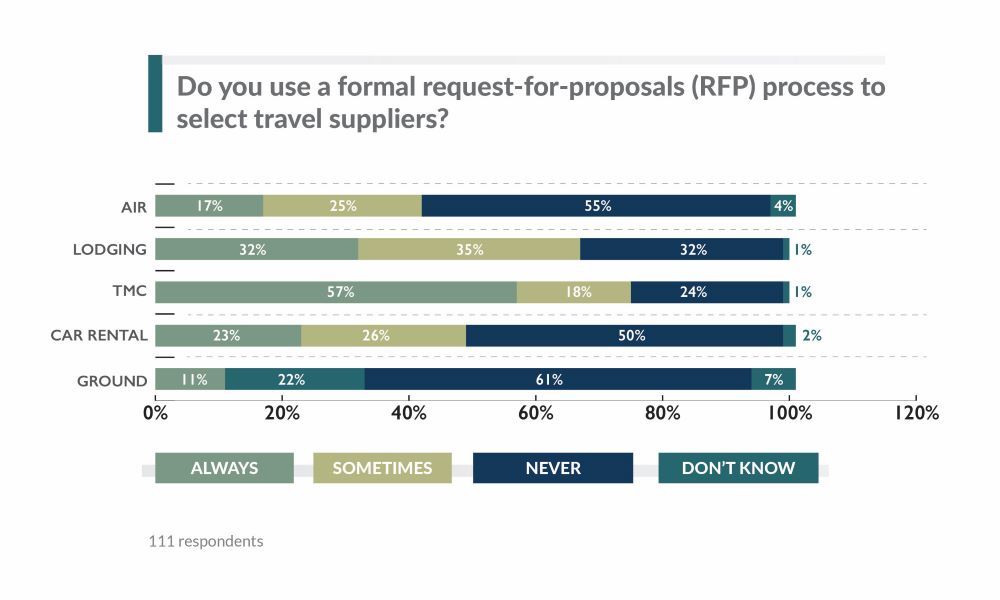
Less than half of SMEs responding to BTN’s survey even
attempt to initiate a formal request-for-proposals process with airlines. A
quarter of SME buyers “sometimes” will go out to RFP for an airline partner,
but only 17 percent always do so.
 Source: BTN Intelligence 2025 Small & Midsize Travel Mgmt Survey, Jan. 15-Feb. 15
Those numbers are only slightly better for car rental
contracts, where 49 percent “always” or “sometimes” will go out for bids, but
50 percent still sit it out.
Lodging is more positive for the SME travel management
segment, possibly because hotels have a more fragmented business model within
which it is possible to approach a single hotel or a smaller chain and not bid
out to a national or global sales operation. Some SMEs consolidate their
transient and meetings travel needs into a coordinated pitch that is attractive
to a larger sales organization. Others may have concentrated volume in a few
cities where the business fits a supplier niche. Whatever the individual cases,
BTN’s survey showed two-thirds of SME organizations either “always” or “sometimes”
go out to bid for formal lodging contracts.
 Source: BTN Intelligence 2025 Small & Midsize Travel Mgmt Survey, Jan. 15-Feb. 15
But the going is getting tougher
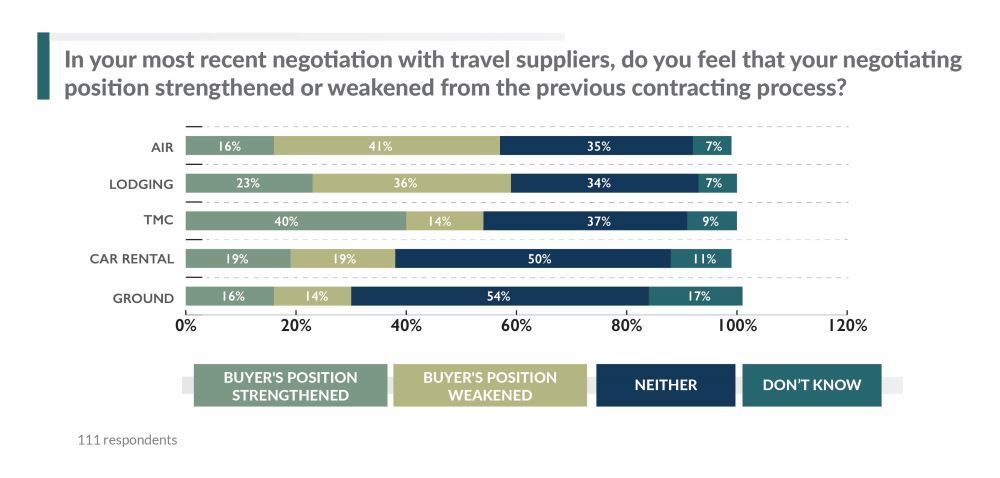
in these categories for many buyers. More than 40 percent of respondents to BTN's survey said the buyers’ position had weakened toward airlines since their previous attempt
to negotiate, while only 16 percent said buyers were in a stronger position
now. While most buyers are still sitting down to the negotiating table for
lodging, more than one-third said getting to a deal is harder than it was in
their previous attempt, and not even a quarter of buyers said they were able to
fare better than last time.
Power dynamics in car rental
negotiations were, on balance, unchanged, with 19 percent of buyers saying it
was harder to get a deal but another 19 percent saying it was easier—and 50
percent saying it was the same difficulty as always.
Non-Negotiated SME Programs
In lieu of corporate contracts,
travel buyers can opt for SME-oriented supplier programs that do not require
negotiations. Many such programs will offer limited discounts but are more squarely
predicated on loyalty rewards and perks—and often will require travelers to
book directly on the supplier’s website, but not always.
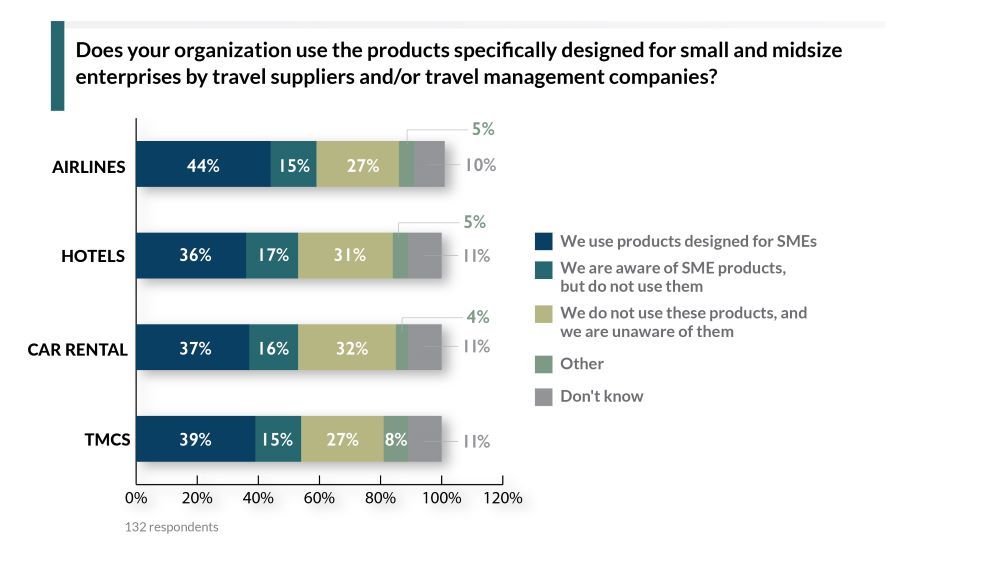
BTN data shows adoption of such programs
in inverse proportion to the use of corporate contracts among SMEs. In general,
the stronger SMEs are in negotiating directly with a supplier category, the
less they take advantage of pre-set SME programs and vice versa.
 Source: BTN Intelligence 2025 Small & Midsize Travel Mgmt Survey, May 4-14
Forty-four percent of BTN survey
respondents said they use airline SME programs; 37 percent said they use car
rental SME programs and 36 percent said they use such programs in the hotel
category. Suppliers report the use of these programs is growing, and they continue
to invest in them. (see Part 3. SME Loyalty Strategy? for more on new program
developments and how SME buyers are using loyalty strategically for their
programs).
SME Buyers Respond to Sourcing Challenges
“Over the course of my career with
Riot Games and Snapchat, I’ve had those opportunities where I was with a small
company but some of the airlines would still work with you,” said veteran
travel buyer Sean Parham, who now manages travel for online community communications
app Discord. “And I’ll call it out—Delta used to be really amazing about
working with startups. That’s really changed a lot, I think, for all airlines.
Now, I don’t really have any airline relationships other than a couple of small
business programs.”
That could be a story associated with nearly half of small and midsize programs, according to BTN’s data. Partnership
Travel Consulting CEO Andy Menkes would offer that for many SME buyers putting
energy into an airline program wouldn’t deliver dividends, from a policy compliance
standpoint or from a cost savings one. Especially if most of the travel is
domestic—and coming through at an average of about $500 per ticket, as tracked
by ARC so far in 2025.
“Even if you got a 5 percent
discount, which would be considerable for an SME, on a $500 ticket, the difference
is $25. Do you think that is going to move the needle on a traveler’s decision
to take that airline or another one? I don’t think so,” he said.
If the travel manager has the
right kind of business mix, however, it could be a different story. “If they can leverage international travel to get a better
domestic discount, there could be an opportunity,” he said.
For Parham’s startup companies,
however, the contracts weren’t only about the discount—he’s also looking for
those experience benefits that are more elusive without that corporate
relationship.
“Contracts often have certain status
matches or lounge access availability that are baked in. I don’t have that
magic hat to reach into anymore when a traveler needs the lounge, or when an
executive might be hired from a larger company and is looking for that status
match,” he said. “I now have to tell them that our spend isn’t high enough to
get that and it’s something we need to pay for.”
He doesn’t fault airlines for
changing their strategies. He said the strong post-pandemic recovery of leisure
travel had a lot to do with the demise of airlines’ consideration for smaller
companies—and possibly startups, in particular, that are more likely to fail
than to succeed. “Both of my former companies grew, so that was great for us
and for Delta in offering us that program… but in the airlines’ defense they’re
very proud of [their leisure growth] and they should be proud of it; and a lot
of startups fail, so that was a risk they were taking. They have to change
their business strategies and you can’t fault them for it.”
Another midmarket travel buyer for
a life sciences company was in a similar position for airline contracts,
post-Covid, but looked to be on the favored side of the supplier’s strategic
alignments. All airlines, she said, were much more focused on buyers proving
volume and scrutinized the program’s ability to shift market share to preferred
suppliers. This experienced buyer said she was able to leverage some
intangibles to get a deal done.
Her target airline partners took
into account the halo effect they might gain from having the up-and-coming life
sciences company in their client portfolio, even though the travel volume on
the table might not have garnered contract consideration for a similar sized
program at a different company.
"The [company] name helped a
lot because in some areas we might not have had enough spend or even the data
available to us to prove… what? There was no Prism data, there was nothing. I
had to leverage my contacts and my reputation, and I had to convince suppliers
to come on this journey with us,” the buyer said.
The contract has been a success. “I
committed to the airline certain agreements,” the buyer disclosed; that’s a
kind of commitment that larger companies might try to avoid. “We moved the
market share. We’re overperforming by 35 percent on our contract. The airline
could not be happier.”
Menkes says hotels, too, while
they may well be a riper opportunity for SMEs compared to airlines, are getting
more exacting with market share commitments and the proven ability to shift
share, particularly in the SME market.
“They want to know how you are
preferencing them and highlighting their brands in the online booking tool;
they want to see how you’ve shifted share in the past,” he said. Additionally,
they’ll want ongoing proof that the account is delivering.
“[They’ll want] you
to actually provide numbers back to the hotel that show, ‘OK, in Charlotte for
the 400 room nights in the first half of this year, you got 300 of them,’”
Menkes said, adding that for large accounts, hotels might not be as persnickety
because they can rely on loyalty to deliver the room night volume.
Parham has experienced this increased
data scrutiny first-hand: “One of my best hotels was looking at our contracts
and they came to me and said, ‘Look, you aren’t producing.’”
Parham, however, had different
numbers, but not in the traditional transient travel cited in his original
pitch to partners. His company’s remote and hybrid work structure had changed
the shape of his business into room blocks due to the growing number of internal
collaboration events that he has started to deliver through the Discord travel
program.
“We call them ‘gatherings’ and not
exactly meetings,” he said. “The number of rooms has just gotten bigger and
bigger. I’ve been able to get the hotels to understand the value of the
business I’m delivering, even though at first they weren’t considering these
room blocks applicable to the transient contract.”
Parham has said he’s been able to
get both individual hotel property teams and national sales organizations to
recognize the room nights from his room block-based business and he continues
to get transient rates for them. He also includes his strictly transient volume
in his deals.
SMEs Seek Supplier Alignment
& Flexibility
Another experienced travel buyer
who has long served the midmarket and now works for an entertainment company
said this is the type of flexibility SMEs need to be actively seeking in their
travel partners.
“You need to be able to talk to
them, and even if you have to go with a small business program for the moment—or
certain terms in your contract to begin with—you should be able to go to them
after six months and see if they can offer you something more customized if you’ve
proven that you can deliver. If you can’t get that, maybe it’s not the right
vendor for you.”
Pretium Partners global director
of travel and expense Maria Chevalier said the supplier set may be painting their services and
support for the SME segment with too broad a brush.
"Suppliers have
been servicing [the large market] for a long time. [They have] that depth of
knowledge of over 30 years of understanding servicing that segment in the
business. In the SME market, they don't have the same depth of knowledge, data
and experience," said Chevalier, who advises a number of SMEs as part of a private
equity company
“Right now, suppliers sort of throw
SME into one bucket. I would actually categorize SME in three
categories,” she proposed. “There’s the startup environment, where they are unmanaged and
they travel a lot like leisure travelers with very few restrictions, policies,
etc. Once you get above what I call that startup and you start growing up, you
shift, into small, then midmarket. … Their travel programs are very different,
and as long as the supplier community keeps lumping them in one—so-called
SME—they'll never be able to accurately support them.”
The life sciences buyer agreed
that suppliers could miss opportunities if they can’t get more creative with
this segment and flex programs to encompass the bigger picture of what SME
travel buyers may be asked to manage.
“SMEs need to look for the innovators,
people who are willing to do things and make sure you have good service as long
as you are managing a quality program,” she said.
“You can’t build your program
myopically as an SME, you have to look for ways to expand your program across
the organization—what other departments do you touch? It’s not just travel; it’s
not just meetings.”
The buyer said she is expanding her
remit to participate in workplace services processes for planning onsite
meetings and how to manage them better. She’s also working with the company’s clinical
and medical people after she discovered their in-progress RFP for meetings
services. As she pitches in her knowledge to those efforts, the shape of her spend
volume and program are changing.
“Those other aspects will change
your program, and good partners should go on that journey with you. I’m like, ‘Why
should we not leverage this spend and reduce our costs? SMEs have to share that
narrative; it’s how they grow their programs.”
________________________________________________________________
For insights on TMC sourcing, relationship
management and tech advancement, see Part 4. SMEs Rely on TMCs, but Want More