Few small and midsize travel programs put up blockers to
travel supplier loyalty programs, according to BTN’s 2025 Small & Midsize
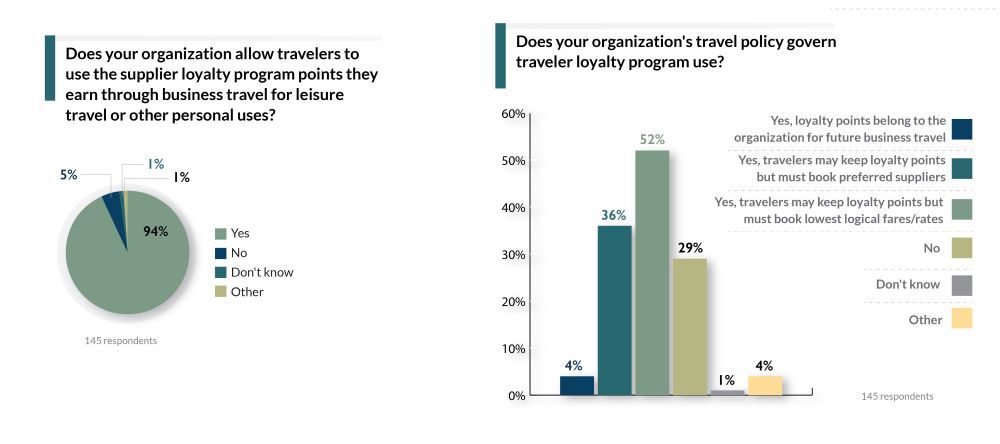
Travel Management survey. Ninety-four percent of surveyed companies allow
travelers to use the supplier loyalty points they earn through business travel
for leisure travel and other personal uses (i.e. transferring them to friends
and family or using them to access other experiences or products loyalty programs
now offer to members.)
Why would any company block travelers from earning or
keeping loyalty points for their own use?
 Source: BTN Intelligence, Small & Midsize Travel Mgmt Survey, May 4-14
“Many companies have seen small—and sometimes larger—abuses of
the travel program for the purpose of earning the last tranche of miles to support
that next vacation or to achieve a higher status level,” one travel buyer told
BTN. “It’s a hard element to wrap enforceable policy around, when most business
trips ultimately are approved by managers. There would have to be pretty heavy
scrutiny in place to avoid each small adjustment to bookings that were made in
the pursuit of loyalty advantages.”
In efforts to control the murky ways that supplier loyalty
programs can mix with corporate travel programs, most SMEs do put policies in
place to address how business travelers should earn—and occasionally how they should
burn—their loyalty points and status entitlements. But a considerable
percentage do not.
Nearly one-third—29 percent—of SME travel programs do not
address loyalty membership or usage within their travel policies. Four percent
of companies, however, go the completely opposite direction, keeping business
traveler-earned loyalty points as the purview of the organization and requiring
that the points are used for future business travel.
For the remaining two-thirds of surveyed companies, travel policy
works to guide employees on how to book travel responsibly, regardless of the
loyalty points that may be on offer. BTN allowed buyers to pick more than one
answer in response to this question.
Thirty-six percent of companies told BTN they advise
travelers to book company-preferred suppliers regardless of the traveler’s personal
loyalty affiliations. Fifty-two percent advise travelers to book the lowest
logical fares and rates for their travel, regardless of their personal loyalty
affiliations, and regardless of any status bumps or additional points they
might achieve from booking more expensive or longer routes. Four percent of
survey respondents said they governed loyalty program use with some other policies.
The buyer BTN spoke to, however, called attention to some
gray area when it comes to such policies. They noted that achieving loyalty
status can provide considerable value to the company, especially when that
extra leg pushes a traveler to the next tier. “It can reduce traveler friction
and may save the company money over the long run,” they said, citing amenities
like free checked bags and lounge access (that would otherwise cost money), more
chances for upgraded seats or rooms (which can improve productivity) and improved
consideration in the event of travel disruptions (better for the traveler and the
company’s peace of mind).
“I encourage travelers to sign up for loyalty programs
because, especially for road warriors, it can unlock certain amenities and
buffer them from some travel discomforts in ways that I can’t negotiate through
corporate deals as an SME,” said the buyer.
Suppliers Double Down on Loyalty-Based Programs
Suppliers have doubled down on
their SME program offerings in a race to attract the market segment directly to
their websites and capture the attention of high-value business travelers.
Delta may have been first out of the
gate in fall 2023 with their revamped SkyMiles
for Business taking over the former SkyBonus program. It launched with
three tiers—the first of which has no specific structural benefits but opens eligibility for “special
offers.” The fact that a company has registered with the program allows them
to start ramping up to the next level “Plus” that requires five employee
members and $5,000 annual spend. The third level “Elite” requires five
employees and a minimum of $300,000 in annual spend. Benefits increase accordingly.
American Airlines revamped and
renamed its program to AAdvantage Business in October 2023 to include an online
booking function and data portal for SME clients. The carrier added policy
controls to the booking tool in October
2024. It additionally reconfigured the program to issue trip credits for voluntary
itinerary changes to revert back to the company and not to the traveler.
Hilton entered the SME program
game in January 2024 with Hilton
for Business, wherein companies create their own Hilton Honors account to
gain access to discounted rates and a “self-service travel booking and management
system” where account administrators can view accumulated company benefits that
increase as travelers stay more nights.
Marriott came on strong in July
2024 with Business
Access by Marriott Bonvoy—a program that not only offers Marriott content
but also partner air and car rental content in a proprietary online booking
tool that also includes policy configuration and simple management reports. It
was a big swing from a hotel company with the largest footprint in the world,
and one that could pay dividends in attracting potential entry-level clients
away from their first TMC relationship. For companies to garner points and
benefits, all their travelers must be Marriott Bonvoy members. In January, Marriott
sweetened platform registration with loyalty bonuses that fast track individual
travelers to Silver and Gold status.
Both Omni Hotels and Wyndham Hotels
launched SME programs in April. Omni
Select Business includes variable discounts of up to 9 percent on bookings
made through the hotel company’s website. The program is available to companies
that do not have a corporate negotiated rate and requires a minimum of 50 room
nights annually. A differentiator for the new Wyndham
Rewards Business program, in addition to discounted rates offered via the broader
Wyndham Business platform, is that companies are given three Gold status
memberships to gift to any three employees they choose.
To What Purpose—All These Offers?
Driving membership of corporate
travelers and small and midsize enterprises to such programs accomplishes a few critical
objectives for suppliers, according to Partnership Travel Consulting CEO Andy Menkes:
By attracting a company to
discounts and benefits at the top layer, suppliers stand a better chance of gaining
the loyalty of high-value business travelers that potentially spills over into leisure
travel. “Now they own my full profile,” said Menkes, projecting himself into
the role of that individual business traveler. “They now can market to me as
both a business traveler and a leisure traveler. They begin to learn what moves
my spending decisions, so they can extend offers and upgrades beyond what I
might have access to in my corporate program. That’s called leverage, and there’s
an argument in the corporate world that suppliers can gain too much of it
through loyalty.”
Many SME programs come with
specialized direct booking sites. “It’s the Swabiz model,” said Menkes. “More
recently Qantas and Marriott rolled out more substantive booking tools with associated
light management tools—why not? They’ve got footprint in their category; how
hard would it be to pull in other partners to offer the whole trip? I thought
Enterprise/National would do that when they bought Deem. They didn’t, but with
SMEs who often like to self-book and self-fulfill and they aren’t super
demanding in terms of management reports and things. It’s a smart move.”
Whether they have a special
booking site or additional partners or not, supplier programs often require
direct booking as it reduces supplier distribution costs. For unmanaged travelers,
such requirements pull business travel bookings away from online travel
agencies like Expedia, Booking.com and other high-priced channels—that’s great in
terms of reducing the costs of acquiring transient business traveler customers who are allowed to choose
their booking channel.
For corporate travel programs with
designated booking tools and approved agencies, use of SME programs that
require direct bookings run the risk of fragmenting spend and opening holes in traveler
safety protocols that might be in place. Opting for partners with SME loyalty
programs that allow companies to earn points via agency bookings could be a
critical differentiator for those who have a TMC relationship.
Some programs go another direction,
but it can require more program reconfiguration than many SMEs are willing to
accept. They can enable technologies like Concur TripLink or off-channel
booking capture tools like Traxo to pull direct-booked data back together. Rarer
still are programs centrally designed around direct booking using tools like
Traverse to stitch the program together. In April, Traxo
and Traverse announced a partnership that would make it easier for SMEs and
others to consider such strategies.
The Question Remains: How to
Use Loyalty Strategically?
“Loyalty in my career
experience has been a beautiful lever … to drive some of the results I want
faster and more effectively,” said Pretium Partners director of global travel and expense Maria
Chevalier. “But you have to be smart with it.”
Going back to the original buyer
who enumerated the benefits of loyalty program amenities and status achievement
for SME programs, it’s clear that loyalty can deliver value if it can be harnessed.
For larger SMEs that are successfully
negotiating contracts, Chevalier encourages them to include loyalty
accelerators and status matches in the negotiation.
“Once you get the rates you need…
you also need people to actually move from hotel X to hotel Y. If you can
leverage status matches and status upgrades and things of that nature, you can get [your
travelers] the same experiential aspect until … you know they will start using
the new supplier the company needs,” said Chevalier.
Just asking for it, however,
likely won’t get the deal done. “You have to combine the ask with a ‘why’,”
said Chevalier. “You have to explain the specific business justification and
the results you are going to drive if they can release those benefits to your
program.”
For SMEs who don’t have the
volume to negotiate?
“If you can use your program data
to monitor the natural loyalty of your travelers, you
can sometimes accelerate your volume toward that supplier by joining an SME program," said the anonymous buyer, but urged cost-focused buyers to compare rates with what they might be getting from their agency. "If the opportunity is right, eventually
your company may have enough volume to negotiate, and that could be great starting
point for a contracted partnership because you’ve shown what you can deliver.”