BTN’s 2025 SME
Travel Management Report Part 4. discussed in part the fact that small and midsize
travel program use, on average, fewer niche technologies than their larger
counterparts to serve their programs. They are…
- 20 percent less
likely than the market average to have a travel app
- 40 percent less
likely than the market average to engage traveler tracking
- 40 percent less
likely than the market average to use air reshopping
- 50 percent less
likely than the market average to use hotel reshopping
- 33 percent less
like than the market average to have a meetings management tool
(Check out the broader market
stats in the BTN
Intelligence State of the Industry Report)
Perhaps it is no surprise,
then, that small and midsize travel program managers are hungry for more
technology to serve their programs, and they reported to BTN that their
organizations were open to implementing new travel tech as well.
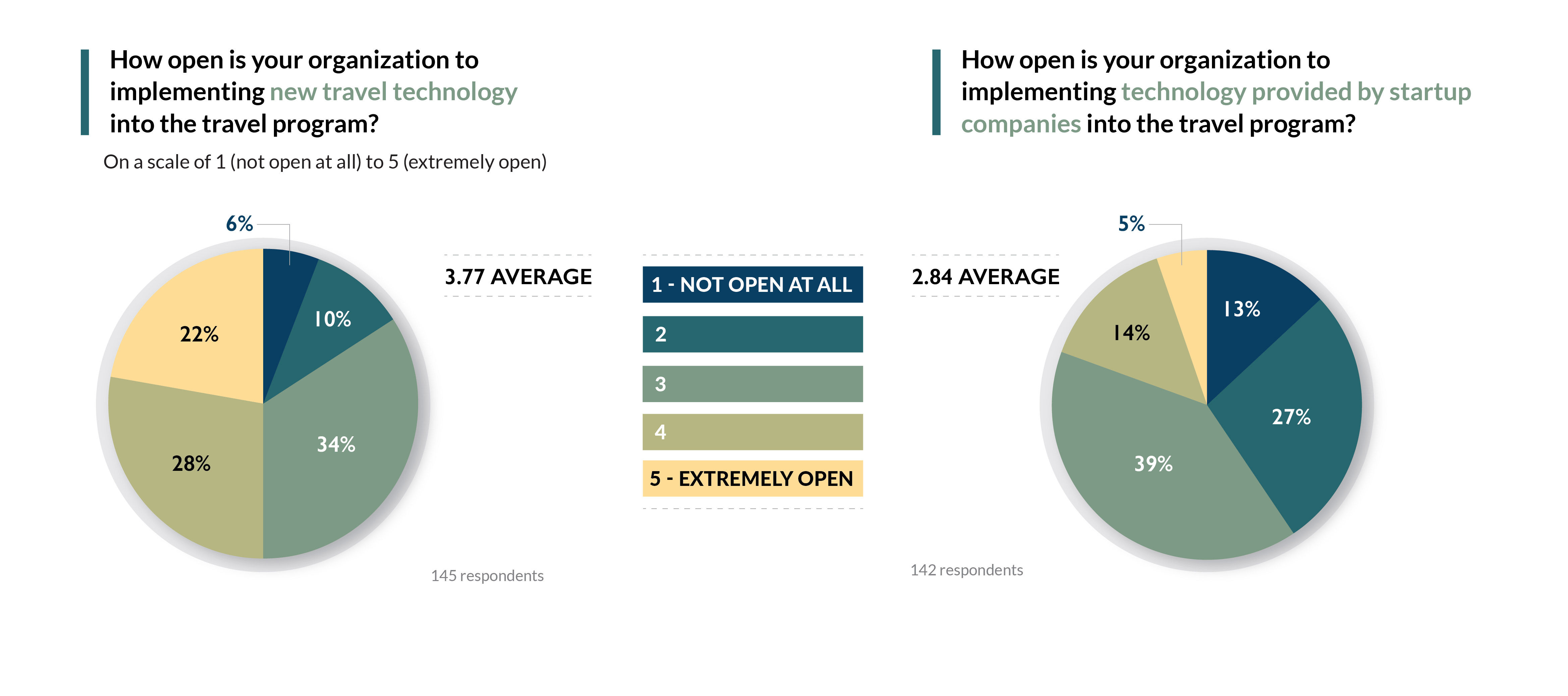 Source: BTN Intelligence 2025 Small & Midsize Travel Mgmt Survey, Jan. 15-Feb. 15
A full 50 percent of SME
travel buyers said their organizations were “extremely” or “very” open to new
tech implementations, and the average among all SME companies responding to BTN’s
survey was a 3.77 on a scale of 1 to 5, where 5 was “extremely” open. There were
a couple of caveats to that openness, however.
SMEs want their tech
providers to be established industry players. Less than 20 percent were “extremely”
or “very” open to working with startup companies in the industry. And on the
same scale of 1 to 5, the average willingness to work with startups fell to
2.84—below the middle band.
Additionally, less than 20
percent of SME program respondents said they were currently experimenting with artificial
intelligence solutions for their programs. That means SME programs are about 40
percent less likely to be engaging with AI than the industry average program. Moreover,
they are more wary of their suppliers use of AI to serve their travel programs.
On the 1 to 5 scale, SMEs again fell below the middle band in terms of their comfort
levels with AI at 2.97.
Looking at travel programs across
all spend levels in BTN’s State of the Industry Report, that comfort level hit a
little higher at 3.02.
Where Do SME Travel Programs
Need Innovation Most?
Asked in BTN’s 2025 SME
Travel Management survey where they most needed industry innovation to address
their challenges, respondents listed the following: NDC, NDC, NDC.
There were other responses,
of course, but those three letters rose very significantly to the top of the
buyers’ list of concerns.
They recognized, however, the
challenges with distributing, exposing, booking and servicing New Distribution
Capability content were not limited to their travel management company
partners, necessarily.
“We still can’t get content
that is out on direct websites into my booking tool so we can access it,” wrote
one buyer respondent to the BTN survey. “We have had access to NDC fares in our
booking tool for a year at this point, but there are still needed improvements
for 3rd party booking tools and [working with] NDC fare tickets,” wrote
another. “We’re closely observing how NDC is working out since we implemented
it for two airlines at the beginning of the year,” wrote a third. These were
the more detailed responses from the survey, most listed their challenge
straight up as “NDC,” which reads like a dead-end of frustration.
AmTrav CEO Jeff Klee, whose
company has direct connected to seven airline NDC content feeds, sees the
industry progress on this front, but underscores that functionality across
different NDC connections still varies—and the industry is still working out
how best to integrate with airline content. He used his own company, which was
acquired by well-funded startup TravelPerk last year, as an example of how different
TMCs are navigating NDC waters.
“AmTrav has built a lot of
direct connects to airlines. We think they are great. We know they offer
considerable value to customers over a GDS connection [to NDC]. I think we have
seven connections now, but that’s it—because, you know, they’re intensive to
do,” he said. “Conversely, TravelPerk
has taken a different approach where they do lots of NDC—they have like 20-plus
carriers—but they’re using aggregators, and I include [the] GDS as an
aggregator. I think by combining the two strategies where we take the airlines
and airline groups that are most important to us, we direct connect. But then
we also have a solution for the long tail so we can be offering NDC content
globally.”
Other companies have likewise
gone with a direct connect NDC strategy. Of particular note is Spotnana since
it is now powering Steve Singh’s new midmarket TMC venture Direct Travel but
also has provided tech stacks for midmarket player JTB Travel’s new Teal and also
for specialist TMC Goodwings, Solutions Travel and an innovation “incubator”
program within CWT.
Asked if he thought the
industry would come to the same conclusion, where each TMC would take their top
airlines via direct connect NDC and access the longer tail via aggregators, Klee
said, “Yes, I really do, because you need the best functionality where you have
the most volume.”
Booking Tools, Booking
Tools
SME travel programs are keen
to innovate, but they need practical solutions and booking tools were another
pain point where BTN survey respondents said the industry needed to supply more
investment.
“Our OBT and technology are
not agile,” said one buyer in the survey. “Support for our OBT has really
suffered,” said another. “Online booking tool issues,” a third buyer said more
generally, and the proverbial, “Our travelers are finding everything cheaper
online.” Several specifically noted that
NDC content was not very well configured within their OBT.
How these booking tools present
and handle seat selection, access to status entitlements, exchanges and refunds
for both EDIFACT and NDC content is shaping up to be a differentiator. Per Klee’s
comments direct connecting NDC content, so far, has offered the most
functionality.
But booking tools aren’t all
about delivering NDC content—at least not exactly. One survey respondent
actually pointed out that booking had become confusing. “Sometimes travelers
think the enriched content and choices can be overwhelming.”
That comment reflects a
long-standing issue in corporate travel, according to Klee, especially for the SME
market—and at least partially explains why the majority of it is still
unmanaged. While company controls, data capture and reporting have been great
for companies through their OBTs and travel management partners, the traveler
experience, he said, is not well supported.
“While…maybe there would be
aspects of a TMC offering that appeals to [SMEs] … when they see what they
would have to do to get that benefit—like the clunky booking tools and,
frankly, the horrific process that your travelers would have to go through
versus what they are used to doing when they go to supplier site—it’s a game
stopper. SMEs don’t want to inflict that on their travelers,” he said.
“I don’t think this gets
talked about enough, but I think we in the TMC space have to acknowledge and
confront the fact that we have provided really great value at the company
level, but in many cases we ask travelers to sacrifice their own experiences to
deliver that value.”
That is changing to some
extent and booking tools have been a focus of that investment in traveler experience.
AmTrav has long had its self-titled
booking tool. Spotnana has its own booking tool, Navan and TravelPerk largely
started as mobile booking tools and more TMCs are pushing proprietary booking
tools as the first option to clients, particularly SMEs. Amex GBT now has
Egencia and Neo that specifically serve the SME market. FCM has Melon through
its Corporate Traveler brand; CTM has Lightning.
Third party booking tools are
also making changes. Certainly Concur’s T2 continues to roll out its new
booking experience and still is transitioning clients to the new platform. The
company has said the rollouts are going well; buyer reports to BTN have been
mixed. Cytric, Atriis and Serko’s Zeno are all booking tools that have seen
upgrades to make them more intuitive for travelers.
AI – Get Used to the Idea
Whether SME travel managers
are ready for artificial intelligence or not—and the data suggests they really
don’t think they are—it’s coming.
Aside from NDC content integration
into booking tools, many of the enhancements the industry is about to see in the
booking space will happen with AI. Indeed, a layer of AI over the booking
interface, is poised to transform how the next generation of business travelers may even
think about what a booking tool is. Those complexities caused by too many NDC options
and enriched data? AI can probably make that disappear.
Cytric has integrated booking
functionality into Microsoft Teams. Amadeus introduced Cytric Easy a couple of
years ago, enabling natural language queries into the Teams chat to generate
booking options, without having to present complex decision trees. Navan
launched Ava in 2023 to serve as a traveler’s co-pilot. AmexGBT just enhanced
its traveler-facing AI assistant for Egencia. GBT claims it can resolve about
30 percent of inquiries without human intervention.
Steve Singh’s investment in
Otto an AI travel assistant created by former Egencia executive Michael Gulmann
is targeted mainly to the unmanaged business travel market—i.e. there is
limited travel policy interference—but it can recommend itinerary options and
divert to Spotnana to book them.
BTN Innovation Face-Off winner
Skylink is a third-party option. At least one buyer (in the large market,
albeit) has reported to BTN that they are considering overlaying Concur with Skylink’s
large language model AI to build dynamic booking histories for travelers and
create personalized, intuitive booking experiences, powered by natural language
requests.
Travel Managers Need AI,
Too
But AI won’t just be for booking
tools and traveler assistants, AI capabilities can support the work of managing
the travel program as well. How SME travel managers use AI as a force multiplier
may be the next horizon in their quest to improve their programs.
Agencies are working with AI
to build better data reporting environments that offer insights akin to
consulting services. Depending on how they are integrated with booking tools
and other tech platforms, some providers can cascade AI-driven recommendations,
if approved by a human, into policies or processes.
Sourcing platforms also are incorporating
big data, machine learning and AI to short-circuit painful RFP processes that bog
down the strategic work of managing and servicing business travelers.
As SME travel managers look
for additional resources to streamline their day-to-day responsibilities and
look for ways to cut hard costs from their program as well as find program
optimization opportunities in their data, they shouldn’t overlook that possibilities
that AI-driven agency services and data analytics can offer them.