The havoc wrought upon business travel by Covid-19 and the
long-term changes to corporate travel priorities engendered by the pandemic are
driving many small- and midsize enterprises that previously had unmanaged
programs to explore adopting a managed model, experts note. SMEs considering
such a transition face a fast-growing marketplace, with travel management
companies and other suppliers rolling out new products and services designed to
meet the increased demand from a sector that often has foregone managed programs.
That dynamism means SMEs have more flexibility than ever to choose
a travel management model tailored to organizational needs. But the bevy of
available options also makes the already complex process of building a
corporate travel management paradigm that much more complicated—especially as
post-pandemic travel strategies and policies remain a work in progress for many
SMEs. Meanwhile, travel managers have been given yet another ball to juggle in
the form of new demands from SME travelers themselves, the majority of whom are
willing to get back on the road in the near term—but only if company policies
empower them to do so safely and confidently.
For companies currently considering a shift to managed
travel, the process can seem daunting—but the opportunity is ripe to leverage
new offerings to create and implement a tailored management framework that will
pay off handsomely in the long run.
Motivations to Manage
Within the context of Covid-19, there are several factors
pushing SMEs toward some form of travel management, with the drastically
increased emphasis on corporate duty of care responsibilities post-pandemic
high on list.
"Covid has moved duty of care to a critical
consideration, as travelers truly may incur life or death consequences, so
companies now have an HR requirement to not only care for the travelers, but to
create goodwill for both their current and prospective employees," noted
Will Tate, partner with GoldSpring Consulting.
SMEs "seem to have put more internal focus on their
programs," Tate continued—citing specific duty of care-focused measures
such as pre-trip approval requirements, policy revisions, as well as
enhanced—and ongoing—communication between travelers and arrangers.
Along with the ramped-up onus on SMEs to ensure the health
and safety of their travelers post-Covid, the pandemic's still-lingering effects
on end-supplier operations and the resultant travel friction also is helping make
the case for managed travel in the eyes of many SMEs, others note.
"The economic conditions caused by Covid reduced the level
of capabilities of the travel ecosystem that all travelers are forced to deal
with now," noted Patrick Linnihan, president and CEO of Gant Travel
Management—citing in particular the "chaos" caused by the "unprecedented"
level of flight schedule changes and cancelations currently taking place on a
regular basis.
"Unless you have a high level of airline travelers with
status, [a company] can expect next-to-no help navigating the current
conditions of last-minute schedule changes and flight cancelations,"
Linnihan said. "So if an SME has a high number of infrequent travelers
flying right now, choosing more of a managed travel approach for the purposes
of productivity and cost control makes sense."
Along with air disruptions, the hotel and ground
transportation industries continue recovering from the damaging effects of Covid,
making for "a new level of travel hassle that all corporate travelers now
have to navigate to ensure their trip goal is accomplished," Linnihan said—citing
a surge in demand from Gant's smaller corporate clients for the TMC to assist
in dealing with those supply complexities.
"We’re experiencing a new level of engagement, which
seems to indicate that SME leadership is attempting to adapt to the conditions
in front of them," Linnihan said, noting that Gant accounts of "as
little as $25,000 in air spend and $5,000 in unused tickets [are] asking us to
apply some of the more sophisticated travel management tools we offer… on a
daily basis."
And as SMEs with unmanaged travel face those supply-side
complexities, it's safe to assume many are looking for similar assistance by
adopting some form of managed travel—whether a full-scale TMC servicing model or
a more narrowly focused, service-specific approach.
U.K.-based TMC Corporate Traveler, which specializes in
servicing SME clients, has gone so far as to predict that unmanaged travel
could become a thing of the past in the near future for essentially all SMEs
due to changing sector needs.
Picking the Path
Once an SME decides to implement some form of managed
travel, the next question is what level of "managed" works best for
its particular goals. That means it's vital for a company to have a clear
picture of what those aims are. They may need to tread lightly or be more
innovative about their program strategy and platforms than they were in the
past—because SME travelers have some thoughts about their needs, as well, when
it comes to post-pandemic travel.
"It’s critical for the organization to determine the
outcome they want by implementing any flavor of a managed travel program,"
said George Kalka, vice president of business travel for Fox World Travel. "A
common misconception is managed travel is all about control: controlling
traveler decisions; costs; suppliers utilized; et cetera. But an SME may simply
want a managed program to provide a better traveler experience and internal
awareness, without implementing any control measures," Kalka noted.
Results of a recent SAP Concur survey indicate that lighter
touch should be taken seriously. According to the survey, SME employees as a
whole overwhelmingly are eager to return to the road. Ninety-five percent responded
that they were willing to travel in the ensuing 12 months. However, it also
revealed that travelers are prioritizing flexibility and personal control. They
are expecting employers to enact policies that empower them choose their own travel
options, which may be changing.
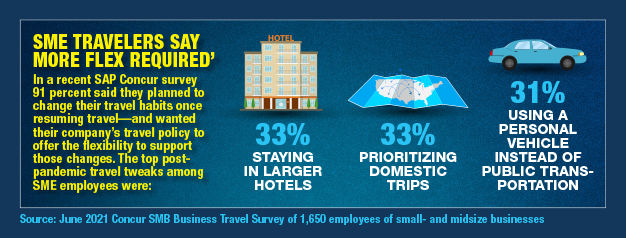
More than 91 percent of survey respondents expected to change
their typical pre-pandemic travel behavior once back on the road. Specific
measures included staying in larger hotels, prioritizing domestic trips and
using cars instead of public transportation.
The survey data showed that such flexibility regarding travel
was even more of a prerequisite to resuming travel than policies mandating
vaccinations and/or negative Covid tests—with flexibility cited by 70 percent
of respondents, versus just 55 percent for vaccines and test-related mandates.
SMEs crafting managed travel policies would be wise to take
into account those demands, lest they risk employees rethinking their willingness
to travel—and even whether they want to stay with the company; 29 percent of
survey respondents said they would try to reduce travel and 22 percent would
look for a new position if their desired travel policies were not put into
place.
A Question of Resources
But whether a light touch or a heavier hand, once an SME has
a clear picture of what it wants to accomplish by managing travel, the next
step is to assess the resources it has available in-house to devote to the ongoing
oversight of travel versus outsourcing that function to a TMC.
"Internal resources play a factor, especially with a
light-touch approach, where the company is going at it on their own by piecing
together some technology solutions," said Kalka. "Many SMEs don’t
employ a dedicated travel manager, nor is travel expertise a core competency
within their organization [so] the ultimate key factor is the organization
looking internally and asking themselves if they are ready to make a strategic
decision and investment in the active management of this spend category. If the
expertise isn’t easily identified internally, a TMC will be an invaluable
partner to accomplish their managed travel objectives."
Companies with sufficient manpower and expertise have the option
of creating a more bespoke model, with strategy and ongoing oversight driven by
a travel manager or other designated leader, while other specific functions, such
as online booking, expense management integration, risk monitoring and data
analytics, are outsourced to specialist service providers.
For SMEs exploring that "build-it-yourself" route,
the available service options are many. Recent years have seen a bevy of
specialty providers and tech-based tools come to market offering out-of-the box
functionality and easy integration with other systems via application
programming interface. The gamut of services on offer has afforded corporate
travel departments an unprecedented opportunity to create new models of travel
management, such as the program launched in 2019 by professional services firm
ZS Associates.
Based upon allowing direct booking with suppliers while
leveraging third-party specialists for support, all undergirded by data capture
and aggregation from Traxo, the program earned ZS travel operations manager
Suzanne Boyan BTN's 2019 Travel Manager of the Year award. And in July 2021, ZS
and Traxo rolled out a commercially available version of the platform targeted for
use by other corporate users, pitching the service's data capture capabilities
as particularly vital post-pandemic.
Indeed, far from stemming the flow of new travel management
tools, Covid-19 actually ramped up innovation as providers raced to build new
services designed to help travel managers track infection and risk levels in
specific locations and handle the deluge of unused air tickets many companies
had on hand due to mass flight cancelations. And as travel has returned over
the past several months, tools designed to help manage pre-trip approval flows
and deliver health and safety-related messaging during the booking process have
risen to the fore.
But while there's no shortage of new products and services
available, manpower at many SMEs has been stretched thin by the effects of the
pandemic, making efficiency a top priority.
"SME staffing is a challenge for a number of reasons
right now and a good number of SME travel managers are doing more than one role
at a company," noted Linnihan. "Under these conditions, we’re seeing
SMEs ask, 'how do we redesign our program to streamline the work in order to do
more with less?'"
Linnihan said Gant is seeing "consistent requests for
sophisticated managed travel program tools at lower travel spend rates than
we’ve seen before," citing as a prominent example clients utilizing a virtual
payment card program designed for travelers who don't have a company credit
cards."
An Attractive Segment
As SMEs demand more sophisticated capabilities, even the
largest TMCs are making overtures to serve the segment. Among the big names,
American Express Global Business Travel has been particularly focused on
growing its SME client roster, citing that goal as a key driver of its May 2021
agreement to acquire Egencia, which has a major presence in that segment. In
July, Amex GBT announced plans to bringing its SME-focused Neo1 travel booking,
expense and purchasing management platform to the U.S., a year after first
launching the system in the United Kingdom. Amex GBT's focus on SMEs dates back
several years; in 2018, the mega-TMC signed an exclusive agreement with SME-focused
travel and expense management provider Lola.
Meanwhile, newer TMC market entrants such as TripActions,
TravelPerk and Travel Bank continue to enhance their own offerings by adding
new services and partnerships designed to woo SMEs with unmanaged travel by
fulfilling specific needs around payments, booking, duty of care and other
functions.
As SMEs return to travel with new post-pandemic priorities,
challenges and demands, and enjoying increased attention from providers
offering tailored solutions, the value proposition of adopting some form of
managed travel to meet those needs is perhaps more compelling than ever, observed
Fox's Kalka.
"A key value in managing travel is driving a return on
the investment, even if the return is more supported travelers versus cost controls,"
noted Kalka. "This takes skilled people and resources to evaluate
information, educate the organization and evolve the managed travel practice as
the environment changes."
Thinking About TMCs: Transaction Fee vs. subscription fee
Travel Manager: Steven Mandelbaum, VP Business Solutions, EAB
Industry: Education Consulting
Number of Travelers: 500
EAB vice president of business solutions Steven Mandelbaum likes to know what he's paying for. He's known for teasing through travel program finances with a fine-tooth comb and holding suppliers to account. Currently, the EAB program operates on transaction fee pricing. "You know what you are paying for," said Mandelbaum about the model.
Asked how the model performed during the pandemic, he expressed equanimity. "[Our TMC fees] scaled down when our travel went down to nothing. There's been a lot of agencies in trouble and complaining about this. But they weren't complaining the other way when travel was gangbusters and they were growing. You can't have it both ways."
That said, Mandelbaum said he has long been intrigued by the idea of a subscription fee or monthly charge per traveler, but doesn't believe the TMCs have quite the right formula yet. "People have to get value every time they are charged. So if you are charged on a monthly basis and no one traveled, there's no value there. Frankly, the only way you solve for that is to provide other services beyond travel."
Thinking About TMCs: Management Fee vs. Transaction Fee
Travel Manager: Danielle Amoroso, Sr. Corporate Travel Manager for the U.S., Otsuka
Industry: Pharmaceutical
Otsuka U.S. senior corporate travel manager Danielle Amoroso takes a partnership approach with her travel management company. Prior to the pandemic, she placed her program with JTB under a management fee model, and she's glad she did.
"We transitioned the payment structure from a transaction fee model to a management fee model. I think that made all the difference for us managing Covid," she said. "The TMC saw our relationship as beyond transactional. Our entire staff stayed employed, and we worked on a variety of projects during that time. It really changed the dynamic and the relationship I have with the TM C– moving away from that fee interaction."
As a pharmaceutical company, Otsuka maintained essential travel throughout the pandemic. "We needed their help to do that. We shut down our booking tool and relied on our agents to help us research all bookings to ensure traveler safety."
None of Otsuka's program resources were diminished during Covid, so Amoroso also had the bandwidth to consolidate a number of partner programs under one universal policy and one TMC. "I couldn't have done it on my own," she said.