A string of impressive earnings and five consecutive years
on Deloitte's Technology Fast 500 have made Cvent an attractive acquisition
target for Vista Equity Partners, a San Francisco-based private equity firm
with a recent history of buying meetings and event management technology
companies, including Cvent's closest competitor, Lanyon. Cvent and Vista
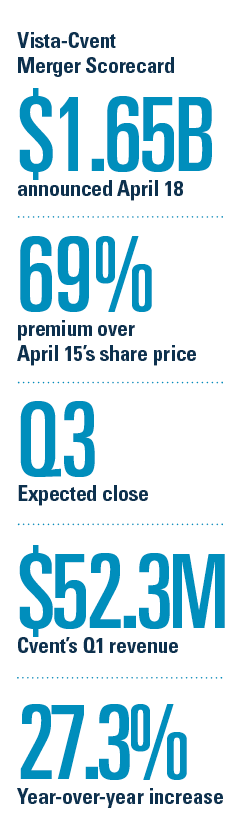
announced a merger agreement on April 18, wherein Vista would buy the meetings
technology firm for $1.65 billion in cash, a 69 percent premium over Cvent's
share price on April 15. The companies expect the deal to close in the third
quarter of 2016.
In what is likely to be Cvent's last earnings presentation,
the cloud-based meetings and event planning technology firm reported $52.3
million in revenue in the first quarter, a 27.3 percent increase over the first
quarter of the previous year. It posted similar growth on both sides of the
business: Hospitality Cloud revenue was $15.9 million, which was up 24.1
percent year over year, and Event Cloud revenue gained 28.7 percent, climbing
to $36.4 million.
Cvent claimed key client wins in the quarter, including both
a Fortune 50 technology company and a Forbes Global 1000 pharmaceutical
company. It also expanded and renewed several of its large enterprise
relationships. Midmarket client acquisitions like the International Air Cargo
Association and continued adoption of its mobile app by new and existing
clients also drove revenue on the event side. The Hospitality Cloud added
Palladium Hotel Group and signed renewals or expansions with Fairmont Raffles
Hotels International and Preferred Hotel Group, among others.
"We executed well in the quarter, delivering better
than expected earnings, as we continue to invest in our technology leadership
and expanding our sales focus on enterprise-scale organizations," said CEO
Reggie Aggarwal.
He was upbeat about the acquisition in Cvent's earnings
report. "We are excited to be joining Vista Equity Partners, whose investment
in Cvent will continue to position us to deliver innovative solutions that can
transform the meetings and events industry," he said. Whether that
includes consolidation with other technologies in Vista's meetings portfolio
remains to be seen.
Speaking at IMEX in Frankfurt on April 21, Cvent senior vice
president Brian Ludwig said Vista was one of four companies that had approached
the meetings technology firm with a buyout offer. Cvent chose the private equity
firm based on price, he said, but also for its industry know-how and belief in
Cvent's potential. "Vista has invested heavily in the event space already,
and they see a huge opportunity in the industry," said Ludwig. "They
see us as an individual business, which is why they were willing to pay a 69
percent premium."
Still, he admitted that Cvent can't yet see that far past
the merger. "Today, [Cvent and Lanyon] are direct competitors. Ninety days
from now, I can't say what's going to happen. I can say categorically, though,
that the solutions aren't going anywhere."
Lawrence Coburn, an admittedly interested observer as CEO of
mobile meetings technology provider DoubleDutch, wrote in a blog post on his
company's website that Vista's typical playbook of "eliminating
duplication and seeking efficiencies" likely would enter the picture. "It's
still unclear if Cvent and Lanyon will be merged, but you have to expect that
this is the eventual play."
Vista's recent meetings technology acquisitions also suggest
such a move. It acquired Lanyon in January 2013 and Active Network that
November. It separated Active Network Business Solutions, formerly StarCite,
from the parent company in February 2014 and merged the meetings management
solution with Lanyon's hotel-sourcing technology. That created, under the Lanyon
name, Cvent's closest competing technology stack.
Formal consolidation or not, Coburn noted that "each
company's primary competitor has been eliminated, clearing lots of white space
for each. This should eventually pay back their investors due to increased
pricing leverage."
Regulatory Hurdles
Both Cvent and Vista Equity Partners seem confident that the
tie-up will pass regulatory muster. One industry analyst who spoke to BTN
on condition of anonymity, however, pointed to pricing leverage as a potential
problem. Whether Vista Equity Partners ultimately combines Cvent and Lanyon is
immaterial for the U.S. Department of Justice. Should the agency look closely
at the deal, shared ownership would be reason enough to block it, the analyst
said.
Regulatory approval could hinge on how the DOJ defines the
market in which these meetings technologies play, according to the analyst. On
the hotel-sourcing side, for example, the DOJ could consider the market to
include companies like HelmsBriscoe, ConferenceDirect and other third parties
that support clients by sourcing and securing the right venues for their
programs. However, most of these companies probably use Cvent and Lanyon to
facilitate their business, and that could cause the DOJ to frame the market differently,
considering those third parties as additional clients for Cvent and Lanyon
rather than competitors of the tech companies.
That would leave just a handful of competitors. As a rule of
thumb, if federal regulators determine that a company can raise pricing by 5
percent through the effects of a merger and not see a consequential decline in
customers, the merger creates unfair pricing power.
But markets aren't always defined by regulators the way a
layperson or even an industry would. In a somewhat similar merger years ago,
enterprise resource planning technology giant Oracle acquired PeopleSoft with a
hostile bid. After 1.5 years that included a month-long antitrust suit, Oracle
prevailed. The win hinged on the idea that the ERP market included the many
corporations that built and managed their own ERP systems internally. That's
not the case for meetings technology, however, where few companies would
consider creating their own meetings tech when modules are available off the
shelf.
One major advantage that Cvent and Vista Equity
have going is a relatively low profile. Cvent and Lanyon are critical to
managing and sourcing meetings and events and form an increasingly essential
distribution channel and RFP source for group business, but they count a small universe
of customers when compared with, say, an airline or large retail brand merger.
Regulators are likely to devote fewer resources to the meetings technology
firms and Vista will draw less attention if bigger names like
Marriott-Starwood, Alaska-Virgin America and Office Depot-Staples continue to
break merger news.