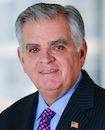
 Ray LaHood
Ray LaHood, U.S.
Secretary of Transportation from 2009 to 2013, joined U.S. regional air
transportation network OneJet as a senior advisor in late August, following his
deputy secretary, John Porcari, who became an advisor for the company earlier
this year. Both LaHood and Porcari spoke with BTN transportation editor Michael B. Baker about the model’s
potential effect on corporate travel growth.
What moved you to get
involved with OneJet?
John Porcari: Pittsburgh is one of the cities OneJet is serving and
one of the cities interested in being a focus city down the road at some point.
It’s a great example of a community on the rebound that’s rebuilding its
economic base and they need this tool, direct air service. OneJet allows these
cities to fight above their weight and … their business communities to thrive.
If you look at some of the markets like Memphis, which has lost more than 70
percent of its air service, there’s clearly a huge need for additional service.
In my personal opinion, the airline industry has consolidated too much, and
it’s been to the detriment of cities throughout the United States. Air service
is the economic lifeblood of these communities, and OneJet is filling a need
that the consolidated major airlines no longer wish to or are able to.
Ray LaHood: I served in Congress for 14 years
from a pretty small community, Peoria, Ill., and we were always fighting for
regional air service to connect us to hubs in St. Louis or Chicago or other
areas. The largest employer in my hometown is Caterpillar. They obviously fly
people all over the world. They’re an international company, so I know pretty
well from my own experience how frustrating it can be to really get to where
you want to go in an efficient time and in a way that you’re not delayed in
Chicago. The whole concept of OneJet when it was presented to me made a lot of
sense. When I was secretary, the folks at Pittsburgh asked me to come to the
community and visit with them about how they could restore some semblance of
service after US Airways pulled out, so this notion of a OneJet would have
obviously answered at least part of the problem for a community like
Pittsburgh. When I saw the caliber of people that they’ve been able to attract
to their board, for me, this provides the kind of air service that’s
professional, that delivers service in a way that really fills a huge void in
air service for a number of communities.
Are local companies
involved, as well, in determining where to add service?
Porcari: It’s a great combination of Fortune 500
companies and smaller ones. In Memphis, FedEx has signed an agreement with
OneJet because it allows their executives to be much more productive than they
were. There are a number of Fortune 500 and Fortune 50 agreements
that are signed out there. Equally, with medium and small companies, either
through formal agreements or informally through word of mouth, we have a lot of
repeat customers already [who are from] companies that [send] their executives
and sales teams [to] Pittsburgh, Milwaukee, Memphis or Indianapolis for a day,
and they’re back home for dinner the same night.
Is this a model
others eventually will replicate?
LaHood: OneJet is the Uber [or] the Lyft of the airline business. If you
remember when Uber and Lyft really began, no one really thought they could
accomplish what they’ve accomplished. OneJet is filling a huge, huge travel
void that will become very popular in many different ways, and they’re doing it
in a first-class fashion. They’re not trying to cut corners. They’re using
terminals, TSA and professional pilots. This really is first-class service
provided to individuals and communities where they’ve been lacking. This is
going to spread when, in communities, mayors start talking to other mayors and
see what service is being provided. This is going to catch on.
Porcari: It is a new model. You can have
profitable direct connections between cities that aren’t possible under the
existing consolidated airline model, but it also has the best features of what
people are familiar with and comfortable with. You book your trip through
Expedia, BCD or Carlson Wagonlit or whatever. Your corporate travel department
knows it’s a safe, predictable first-class experience that works from a
business point of view. It is good from a competition point of view, and the
model is different. Even cities that had service by the major airlines with
50-seat regional jets … are not flying 50-seat jets economically anymore. The
OneJet model allows business class travelers, even if the demand is lower than
a 50-seat jet, to operate profitably, and that’s the difference between
connecting those communities around the country and forcing them through hubs
where, any way you look at it, you lose a day.
What will your
primary role be?
LaHood: It’s meetings needed to be arranged.
It’s opportunities to talk to key people at the [Federal Aviation
Administration]. It’s meetings with communities. We’d be available to attend
those meetings either to promote OneJet or get answers to questions.
Porcari: A part of it is in the air service-development industry, making sure
the word is getting out and people understand the potential. Some of it is
listening to the airport operators and understanding the need they’ve
identified. In general terms, it’s making sure from a safety and from a
convenience and from a public service point of view that OneJet is providing
the level of service we all want it to.