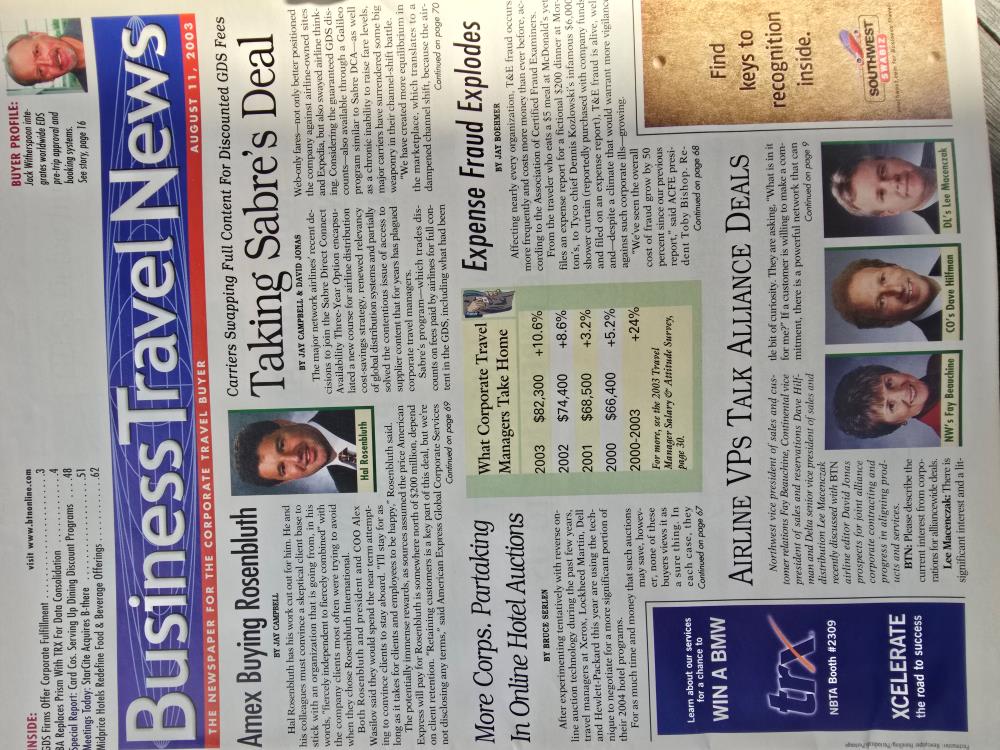
 Amex buying Rosenbluth was big news, but among many big stories in 2003
Setting the stage for business travel in 2003 is a complicated matter. The industry is getting buffeted by so many factors, even major announcements seem like run-of-the-mill occurrences.
Coming off a desperate year for business travel in struggling economy, the build up of military action in the Middle East that culminated in the U.S. entry into the Iraq War on March 19 pushed the industry into the direst of straits. Corporates, already in a minimalist mood regarding travel, held back even more, citing traveler safety and security concerns. Airline finances were reeling.
A U.S. Department of Transportation report showed Q1 operating losses for the major U.S. carriers reached $2.9 billion, with United which filed for bankruptcy in late 2002 accounting for $1.3 billion of that. Airlines managed to cut operating losses to about $450 million in Q2, and some signs of life began to revive business travel in the second half of the year.
While the war seems like it should have had deeper impact, it was little more than a blip in BTN reporting, with travel buyers reporting about a month after the Bush Administration's initial "Shock and Awe" campaign, that companies were returning to normal business travel operations, even though they were at drastically reduced levels due to ongoing economic uncertainty. Hotel occupancy continued to struggle. Average daily rates were depressed, but all players were angling for whatever business travel volumes were available and supplier efforts to capture market share were fierce.
Of course, the competition wasn't just with other suppliers. The big competition for managed travel in 2003 was the World Wide Web. The big "www." continued its rampage into traditional managed travel structures. Hoteliers finally figured out that competing web fares were undercutting negotiated rates in a big way and began to proactively extend lower market rates when they were available. It was tough though. Making those available through the GDS proved a Herculean task, and buyers who had been promised "floating rates" found that they weren't available in the channels they needed when they needed. Hoteliers pivoted to efforts that guaranteed business travelers would get the lowest unrestricted rates regardless of channel and/or enabled web bookings to be credited toward volume agreements. Lots of different strategies tried to bridge the gap.
In the meantime, airlines were grappling with similar issues. American Airlines EveryFare program that incentivized travel agencies to book direct on aa.com gained some traction in 2003. Maritz TQ3 showed 7 percent savings for such fares compared to negotiated rates through the GDS, but the productivity hit absorbed by the agencies to service such bookings and the volume hit to their GDS agreements also became an issue.
But all the distribution dynamics were in play in 2003.
The largest global distribution player Sabre in mid-2002 had rolled out a discounted distribution rate for airlines that would commit to provide full content, including web fares, to the GDS. Only U.S. Airways had taken that deal at the time. Whether it was the desperate financial straits or some other influence that brought the airlines to this table in the first half of the year, I'm not sure, but by August all five of the other major U.S. airlines had taken Sabre up on the Direct Connect Availability Three-Year Option program for discounted distribution fees. The program went a long way to gathering content back into the GDS for a number of years. Though airline dissatisfaction with the configuration would continue and they would champ at the bit for more self determination.
Other agreements were changing as well. One, in particular, was the beginning of a reversal for agencies, and started to show how GDSs, which had suffered from lack of business travel bookings as well (both due to the general downturn but also siphoning of volume to the dot-coms), were eager to get those transactions volumes back through whatever means possible. According to a Sep 24 securities filing, Worldspan
and American Express adopted a new model in which the former pays the
latter for travel segments booked, instead of the other way around as per
standard industry practice. Check out this article from then-BTN distribution editor Jay Campbell.
Another wrinkle would enter the game in 2003 and that was agency technology that became GDS agnostic, enabling agencies to engage with multiple GDSs and not locking them into just one. That capability would increase GDS competition with one another, and it looked like that contest would play out with incentive structures.
BTN had a critical development in 2003 as well, with a young editor named Jay Boehmer joining the ranks. Jay is now the chief editor of The Beat, BTN Group's subscription channel for distribution and technology news. Don't forget, there's an in-person component to The Beat as well. Hope to see you at The Beat Live conference on December 3.
_______________________________________________________________________
.png "2003 timeline header")
_______________________________________________________________________

U.S.
Department of Transportation OKs Continental-Delta-Northwest alliance but with
hefty conditions. The airlines push back, setting out concessions of their own
that they are willing to follow. Industry is divided on whether DOT should take
action.
Travel managers report that discounted online fares were
beginning to provide transparency into how low hoteliers were willing to go
with rates—informing corporate negotiations at least for key properties in key
markets.
Airlines continue to search for what the industry called
“fare rationalization.” United dropped walk-up coach fares by as much as
40 percent to, from and connecting through Chicago and Denver.
Online check-in processes debut for Delta, Northwest,American and US Airways—in that order. Continental and United were still assessing tech platforms. The tech advancement was an effort to stem
secondary screenings at security and not at the gate; boarding passed become
required.
Hilton and Marriott implement wireless
internet connectivity.
Sabre increases 2003 distribution fees; Worldspan and Galileo wait.

Delta Air Lines and United Airlines resurrect
the carrier-within-a-carrier concept for low-cost subsidiaries. The trend had
sputtered in the U.S. following the Sept. 11 attacks when Delta, United and US Airways each disbanded such strategies. At the same time, some
carriers accelerated service transitions to smaller jets operated by regional
partners in an effort to maintain hub dominance while competing with the likes
of Southwest, Air Tran and JetBlue.
Car rental companies slash non-negotiated rates,
but corporate rates stayed relatively firm, with car rental companies
looking to maximize margin to already-agreed upon pricing even as local and
state taxes—as well as surcharges imposed by airlines for frequent flier
partnerships—added to total daily rates.
While a half dozen vendors in Europe launch solutions for
integrating Web-only content with global distribution systems, General
Electric enables travelers to make direct website reservations with rail
providers and low-cost carriers for fares "not available through the
local GE Travel Centre or its customized Sabre solution GETRes.
InterContinental
Hotels Cancels 2003 Cancellation Fees for meetings booked at hotels in the
United States, Canada and Puerto Rico between Feb. 1 and April 30, 2003, and to
be held before Dec. 31, 2003. The chain said the move was meant to boost
confidence in booking meetings during uncertain economic times and as potential
military action looms in the Middle East. No other major chains follow the
move.

Airline
owners of Worldspan sell the smallest of the global distribution systems
to Travel Transaction Processing Corp. The sale will close in July
but will leave intact close ties to Delta and Northwest airlines.
Sabre's
GetThere subsidiary shows clients a non-GDS content solution that, execs
said, improved on GetThere's web fare offering and competitive solutions by
enhancing travel management control of self-booking.
Delta reorganizes its sales organization in the face
of slumping corporate travel in 2003, removing the “district sales” layer and
focusing field sales on regional accounts. At the same time, Southwest,
JetBlue and other low-cost carriers were bulking up sales organizations.
Qantas
joins British Airways in trying to eliminate card costs. It announces it
will impose a 1 percent fee on card payments in Australia.
U.S.
airline carriers are in the brink of disaster as corporates cut travel in a
protective stance against the war in Iraq. UAL corp. liquidation and AMR Corp
bankruptcy are both possible by summer. Several U.S. carriers announce they
will reduce international capacity and warn of domestic service cuts, which
would force travel buyers to find alternatives and modify volume contracts.

London-based Six Continents PLC spun off its hotel and
restaurant businesses. The
hotel portion became know as InterContinental Hotels Group, including InterContinental,
Crowne Plaza, Holiday Inn, Holiday Inn Express and Staybridge Suites extended
stay brands. The spinoff followed a failed hostile takeover bid in February
that would have resulted in the outright sale of the hotel business.
Sabre’sTravelocity and GetThere become
the highest-growth units of the company as revenues from transactions processed
by traditional travel agencies fall.
Northwest Airlines announced it will begin loading
negotiated corporate rates via ATPCO into Orbtiz for Business, if
requested by clients.
Continental-Delta-Northwest
raises eyebrows as it moves forward with domestic alliance while defying conditions
laid out by the DOT; meanwhile United and US Airways continued to align
services, sales, marketing and corporate contracts. DOT also granted American
limited code sharing with British Airways.
As merchant model internet sites eat into hotel
profitability as they undercut corporate and other GDS rates, Hilton,
Carlson and other hoteliers begin to put in safeguards around rates. Hilton
mandated rate parity to all owned and franchised hoteliers and Carlson signed
on to TravelWeb, which emulated merchant sites but was owned by hoteliers as a
clearinghouse for distressed inventory.
US Airways exits bankruptcy after seven months of
court-supervised restructuring.

Sabre adds business fare filing, allowing carriers to
feed negotiated rules and rate formulae directly to the GDS via ATPCO without agents. The process is called Fare by Rule, category 25. Galileo,
which had
offered the capability for over a year says it will enhance its category 25
capabilities.
E-booking providers, like TRX, GetThere and E-Travel among others, push room reservations with in attempt to foster booking for the
whole trip and not just air. Attachment rates for hotel still today in 2024
linger at about 50%
ARC announces a “significant volume” of American
Airlines online traffic shifted to its Direct Connections program,
encouraging what ARC called its “viable” ambition to “be recognized as the
industry’s data store.” Continental, Northwest and three other major U.S.
carriers were participating in the program that enabled settlement and credit
card billing on bookings made outside the GDS.

UAL and Air Canada report progress in
bankruptcy reorganizations as airlines see a
string of positive developments for
the industry, after a “horrific” first quarter, citing airport efficiencies,
reduced labor and increased demand for the upcoming summer months.
Hotels report a rise in occupancy, citing “pent up demand
from business travel” as a major primary factor in rising revenue per available
room, up 2.1% in Q1 and another 1.3% for Q2.
AA’s EveryFare offer, which incentivizes agencies to
book on aa.com, is met with some hesitancy as GDS contracts with incentives
based on volume thresholds deter agencies from fragmenting their booking
channels. Servicing issues also have become evident since the rollout in late
2002. Some
agencies using it, however, say they are saving as much as 7% on AA fares.
Maritz’s TQ3 takes on expense reporting for DaimlerChrysler with back-office responsibilities that include auditing, compliance checks and archiving.
DaimlerChrysler has automated expenses through SAP.
More than 6 months after the conventional end of the annual
hotel RFP cycle, many corporate travel managers were continuing to make
deals—signaling a new strategy for off-cycle negotiations that often included
muti-year deals and hotels eager to secure market share.
AA and Amex launch joint corporate card for midmarket
companies.
ANC
Rental Corp. agrees to sell Alamo and National to Cerberus Capital
Management LP, a private New York investment firm, for $290 million. The sale
culminates the restructuring effort ANC has undertaken since filing for
bankruptcy protection in November 2001.

General
Electric moves the vast majority of its $70
million in Europe-originating travel to a new Carlson Wagonlit service center in Warsaw. According
to a CWT exec, “it’s not for everybody,” citing requirements like streamlined
policy across European countries and at least 30 percent adoption rates for
online booking.
Marriott joins Starwood in displaying total
pricing in the GDS, including tax and surcharge information.
As corporates revive business travel, buyers reengage with
airlines and both sides get creative with deals, pursuing tiered discounts, shared-risk
arrangements and even reverse auctions.
Sabre enhancement enables zone fare loading for
meetings.
U.S. Department of Justice closes its anti-trust
inquiry into Orbtiz and owners United, American, Delta, Northwest and
Continental.

American
Express Global Corporate Services buys Rosenbluth
International for “somewhere north of $200M” according to sources quoted by BTN with Amex confirming that retaining
customers is a big part of the deal.
Five remaining U.S. airlines follow U.S. Airways to Sabre’s
Direct Connect Availability Three-Year Option. Constructed more than a year
earlier, the option trades discounts on fees paid by airlines for full content
in the GDS, including what had been web-only fares. American Airlines was the last to sign.
Seeking to serve the more than $30 billion market for
lightly managed corporate travel, according to its own analysis, Sabre
Holdings launched Travelocity Business after an April announcement of plans
for $5 touchless and $20 agent-assisted transactions
Cendant
Corp.'s Travel Distribution Services division unveiled Travelport a new
company to offer corporate clients ticketing and fulfillment bundled with or
separate from the Highwire online booking tool and the Galileo
International global distribution system.
Association of Certified Fraud Examiners determines
the cost of corporate T&E fraud has grown by 200% since its last report on
the issue in 1996, even in an environment of increased audits and automation.

Buyers continue to include rate loading in their hotel
contracts, with some auditing monthly and at least one demanding refunds for
overcharges at the hotels.
Orbitz again floats agent connectivity, but it’s
predicated on whether the Department of Transportation will let GDS
regulations expire. The company also announces plans for an IPO. (DOT lets GDS
regulations expire in early 2004).
British Airways reduces agency commissions to 1% and
plans an all-out assault on intermediary costs, with sources at the carrier
saying the airline will begin to charge for credit card payment on all fare
types and introducing surcharges for paper tickets. It also says it will unlock
an alternative distribution strategy should GDS negotiations stall.
Buyers revolt as they realize the “floating rates,” the rates
in certain markets that fell below negotiated rates, were not loaded accurately
into the GDS.
Akamai
Technologies sends a market signal as the midsize program shifts its entire program to Expedia Corporate Travel and accesses Expedia hotel rates instead of issuing an RFP.
Company names like Nike in the U.S. and Barclay’s, Pearson
and Telenor in Europe begin publishing
carbon emissions data for business travel; some begin carbon
off-setting projects with select suppliers.

GDS deregulation gets under the microscope as regulations
are set to expire in 2004. The
voice of the industry cites mounting competitive pressures from supplier
websites, merchant websites and newer multi-GDS enabled agency technologies
that have worked to mitigate any monopolistic power of the GDS.
According to a Sep 24 securities filing, Worldspan
and American Express have adopted a new model in which the former pays the
latter for travel segments booked, instead of the other way around as per
standard industry practice.
Negotiators from the United States and the European Union begin
the task of creating an open aviation area spanning the Atlantic and
integrating the world's two largest commercial air markets. The liberalized
framework provided the beginning of the process that stretched
into 2007 (after a failed agreement in 2005) as the U.S. pushed for more
access to London Heathrow and Europe pushed for cabotage—the ability to fly
between U.S. cities.
Starwood
Hotels & Resorts introduces a new pricing
policy for corporates that guarantees contracted business accounts
the lowest internet rates as provided by retail channels “like starwood.com”
for Monday, Tuesday and Wednesday nights in North America. Buyers remain
concerned about how the company will execute on this and that lower “merchant
fares” still remain.
Hyatt begins crediting corporate clients for
volume purchased directly on Hyatt.com—if they can associate that booking with their
corporate identification number.
Cendant introduces “Corporate Select” program which offers a fixed percentage off the rack rate at 2,300 of Cendant’s 6,000+
properties globally that are selected by the parent company and not requested
by individual buyers.
Air France and KLM Royal Dutch Airline merger makes the joined up carrier the largest in Europe.
Travel management companies deploy multi-GDS interfaces. The
industry begins to see more competitive incentivizing across GDS contracts as TMCs
gain access to multiple channels from a single interfaces.
Sabre’s TMC incentive line item increased by $63Mto $400M in
2003; it estimates in 2004 it will increase by $50 million
again.
TMC
service off-shoring becomes a hot point after Amex began delivering
some standard 24-hour support through the Philippines and tests similar
operations in India. Other intermediaries like Orbitz and WorldTravel
BTI had overseas operations but seemed undecided about potential future servicing
strategies.
Orbitz continues to build on its “for Business”
brand, but buyers using some of the features aren’t yet sold on its
capabilities, called them “the icing but not the cake.”
PNC Financial Services Group radically converts its
travel program, ditching its TMC and moving to a GDS relationship. It enables
travelers to purchase travel the same way they do other commodities and moves
all travel management under procurement as cost pressures mount on travel
programs.
Proctor & Gamble on the other hand outsourced its
travel management to IBM, seeking to reduce costs through grouping up volume.
Over the long term, such strategies provided mixed results.
EU-U.S.
data impasse threatens U.S. Customs and Border Protection the ability to
access passenger name records of European travelers flying to and through the
U.S. Customs began receiving feeds in February 2003 from airlines, but the EU
said the process contradicted European data privacy laws and clearance was set
to expire at year’s end.
NOVEMBER – After delivering three issues in October,either
BTN did not publish in November 2003 or we no longer have a printed record of
those issues.

American Express Corporate Travel Services axes fixed
hotel rates in its consortia program replacing it with the hotel’s “best,
unrestricted rate.” TQ3 follows the move but says it also will retain the
fixed-rate program.
IATA
begins dismantling the numerous barriers it maintains against true pan-European
travel management, with change accelerated by the European Commission,
which surprised IATA by announcing that immunity from prosecution for acting as
a cartel is likely to end May 2004. Among changes are pan-European
accreditation for international travel agencies, scrapping restrictions on
storing ticket stock on corporate client premises and introducing a single bank
settlement plan.
EU
and U.S. come to agreement on passing customs and immigration data for European
travelers.
Orbitz and its airline owners sell nearly 12.2 million shares of the stock for $26 a
share in its long-awaited initial public offering, raking in $316M.
_______________________________________________________________________

Elizabeth West is the editorial director of the
BTN Group. She has reported on the business travel and meetings industries for
24 years. Beth was editor-in-chief of Meeting News from 2006 to 2008 and
director of content solutions for ProMedia Travel from 2008 to 2011, when
ProMedia was acquired by Northstar Travel Media and merged with BTN. She became
editor-in-chief of BTN in 2015 and editorial director of the BTN Group in
2019.
_______________________________________________________________________