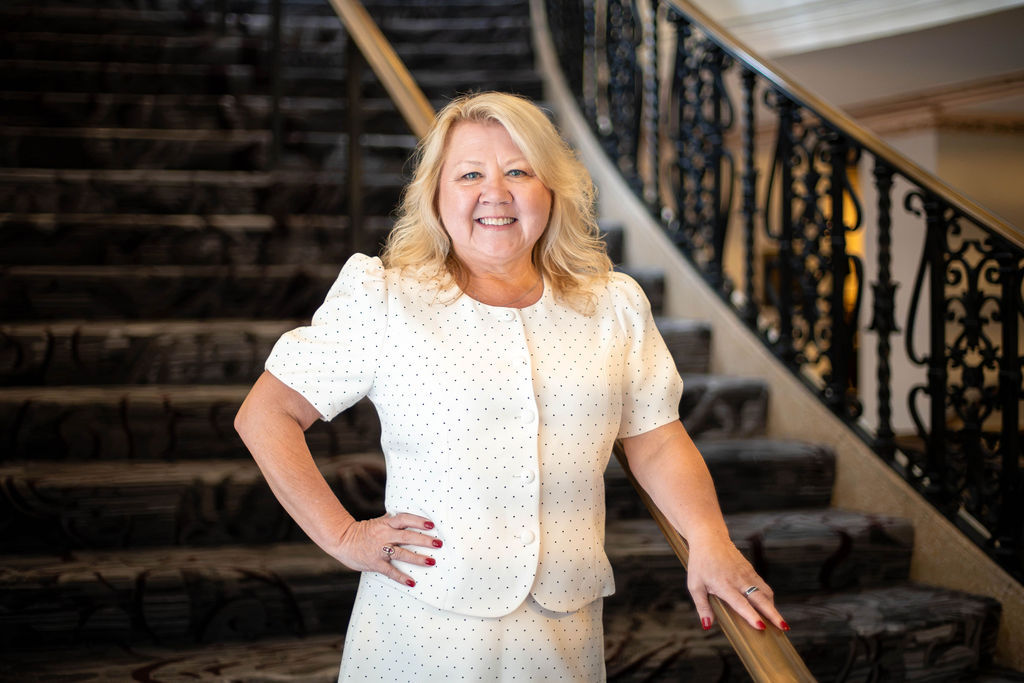
 Moderna's Jennifer Steinke is BTN's 2026 Travel Manager of the Year
Moderna director of travel, meetings and fleet Jennifer
Steinke has long known how she wanted her travel program to operate. Now that
technology has caught up to her vision, she's building an AI-centered, “live
and in person" travel program capable of delivering dynamic policy and
personalized offers at the point of sale. The platform and the program hinges
on a consolidated data strategy that not only understands who the traveler is,
thanks to a dynamic profile, but also uses artificial intelligence to puzzle
through itinerary options using traveler history and profile as context and at
the same time benchmarks choices against “normal" Moderna rates for
similar bookings.
Steinke's career that has spanned consulting and tech
supplier roles as well as multiple travel manager gigs has put her in the pole
position for racing forward with an AI-powered program. For the past four years
she has led travel for Cambridge, Mass.-based pharmaceutical and biotech
company Moderna, which Steinke said is “very AI-focused,” with all employees
tasked to demonstrate how they are using AI for improvements in their work.
Rather than reaching out for off-the-shelf AI solutions that
addressed segments of the Moderna travel program—like a data analysis product
or an AI expense auditing tool—she wanted to drive more than an incremental
process change.
"I was looking at vendors, but no one was doing what I wanted
to do; they hadn't put all the pieces together,” she said. “These are things
I've thought about for years and years, but the tech was not there.”
Steinke realized in October 2024 that what she needed to make
her vision possible was a kind of “travel brain” that was able to bring data together
from all the disparate systems involved in a travel program. But more than creating
a data lake, she wanted this brain to accumulate a kind of memory of the traveler
and create contextual awareness around how their individual travel attributes should
impact what could be considered “in policy" for that traveler. The brain should
remember the traveler's historical preferences and balance those preferences against
policy. But even the idea of “what is travel policy?” needed to be interrogated,
particularly from a cost perspective according to Steinke, because pillars like
lowest logical fare and other seemingly cut-and-dry rules have long raised traveler
hackles, especially when their status levels open amenities and services to them
that “dumb" managed travel systems can't parse or take into account.
Open AI rolled out ChatGPT in December 2022. Steinke originally considered building her “brain” as a kind of policy and
process tool, where employees would find information about the program. But she could see that with the right platforming, her “travel brain,” which she called
Tami—short for travel and meetings intelligence, ultimately could pursue bigger opportunities.
“If we can book and turn the program… where the interactions
between the travelers and the booking experience can be powered by data that help
them make better decisions,” she said, “then we create curated offers, which gives
the program a “Policy of One”—a term that Steinke has trademarked, alongside Tami.
Building the Booking Experience
Steinke had no intentions to build her own booking tool that
would work from Tami, but some of the offerings she explored were too “confined"
for what she had in mind. An industry colleague turned her on to BizTrip.AI, the
nascent AI business travel concierge technology founded by Yapta co-founder Tom
Romary and AI entrepreneur Scott Persinger. It was a fit.
Steinke figured: “If I go with a good, young startup partner,
I can build what I want. I can build what Tami is going to be.”
It took about a year for the BizTrip.AI team to produce on the
Tami foundation what Steinke had in mind. This included dynamic profiles that had
a static layer for travelers to populate some traditional fields, but these profiles
have a deep focus on traveler status and the pluralities that heavy travelers can
accumulate in that regard. The profiles also collect historical booking data per
traveler to understand their preferences and narrow search results in the booking
tool, while also staying within policy guardrails, but that policy also is not static.
BizTrip.AI in recent weeks has turned some of that work to face
other clients as its Dynamic Travel Policy Engine. BizTrip.AI CEO Romary said the
engine was “built around Moderna's needs" but was also “an industry need” to
create policies that are living systems that adapt at the moment of booking.
“A lot of travel policies are created and then within three or
four months, something changes—there was a FIFA event or other large event, and
that jacks pricing around [for hotels or airfares],” Romary said. “Market ricing
is dynamic, and the travel policy should adjust to that as well.”
The "Accounting" Process
To help guide that policy and to drive more nuanced itinerary
curation for individual travelers, Steinke has created a matrix that assigns values
to the perks and amenities tied to traveler status levels with suppliers. And she
designed the Moderna travel technology and policy to bake those values into a total
trip cost for the traveler. Some amenities have
clear monetary values—a checked bag or a premium seat assignment have a clear
value—but Steinke had to add in some logic for others.
If a traveler purchases lounge access, for example, the cost
is considered an offset of what a meal would cost and is a different value depending
on whether the traveler is flying at breakfast time or dinnertime. The potential
for a traveler to get an upgrade also has a value in Steinke's program and booking
on a carrier where the traveler holds status to potentially get that upgrade becomes
an allowable move in certain circumstances, even if flying on a different carrier
would cost less on its face. The booking tool can do the accounting on that item
in the background and understand the upgrade probability based on the travelers
status level—silver, gold, diamond, concierge, elite, global, whatever suppliers
are in play.
Having those values took away the standard “lowest logical fare"
approach, said Steinke, which is loathed—and, therefore, often gamed—by savvy travelers
who can see the value in their own preferred choices, but until now could not adequately
account for them.
“We can track that now,” said Steinke. “I can say here's the
ROI; here's why you didn't take that fare that was $200 less,” Steinke said. With
status entitlements, “there's cost avoidance in there, which is important.”
Oracle director of global travel sourcng and GPO Rita Visser,
one of several travel managers who nominated Steinke for BTN's Travel Manager of
the Year award, said that move alone addresses an issue that has long vexed travel
managers.
“There's so much emphasis on low cost, but if low cost provides
less value in the long term, you could be looking at higher cost [for the total
trip],” Visser said. “That's something, from an industry perspective, that we've
been waiting for and asking for from booking tool providers. The fact that Jennifer
is making that real in her program is pretty cool.”
Testing 1-2-3, Testing 1-2-3
Booking on the BizTrip.AI platform started with a pilot of 20
travelers and has since been soft launched to more than 200 travelers at Moderna.
By September, all U.S. domestic travelers should be on the platform, and work is
underway for points of sale in the UK and Europe, the Middle East and Africa, which
Steinke said should be up and running by January.
As the pilot has grown, Steinke said she's noticed some travelers
getting chummy with Tami, responding to the platform by name and with appreciation.
“One traveler passed along that Tami had become “one of my best friends!”
“I really like the feature where I can drop in a conference schedule
or an email with an agenda and ‘she' books my travel,” the traveler told Steinke.
“That's efficiency!”
Some would call that “agentic.” In time, that's where Steinke
wants to move the program and she's laying those foundations.
Adding Brainpower
Initially, Steinke was manually uploading data into
Tami—spreadsheets with a year and a half of program data, for example—but she
wanted to ensure full card, travel and expense data were in the brain. For
that, she's tapped travel data specialist Cerebri AI, and will be launching
that data project on Oct. 1.
She will be the launch client, in fact, for Cerebri's
new Frictionless Travel & Expense enterprise solution, and Cerebri
co-founder and CEO Jean Belanger said the company has been working closely with
her and BizTrip.AI on that launch. Cerebri's role will be curating and
normalizing the data, which it then can provide it back into Tami via API.
"In order to drive an agentic booking solution, you
should have access to up-to-the-minute data," Belanger said. "We're
about to integrate her set-up into our data foundry, which will form the basis
of Tami."
Building AI on top of that full data picture unlocks some
new capabilities for Moderna's travel program, particularly around budgeting,
Steinke said. A traveler flying to Warsaw, for example, might have no idea what
a typical flight to that destination costs. If the lowest flight cost for a
particular day comes well above the average flight cost to Warsaw, Tami can
alert the traveler when they are booking to perhaps consider alternative days or
a flight with connections rather than a nonstop.
"I'm a big believer in internal benchmarking,"
Steinke said. "What does our policy do, what do our people do, and based
on that, what should a trip cost?"
It also provides better visibility to managers and finance
teams as to the full cost of a trip, she said. Without consolidated data,
travelers typically file an expense report with their booked flight, and then
other expenses from that trip appear a month later when the travel actually
happens, and the dots are never connected. With Cerebri, those dots can be
connected, which might ultimately reduce the number of expense reports employees
have to do, she said.
Unlocking Sourcing Possibilities
Steinke also is working on curated offers from suppliers
that could feed into that Policy of One and drive traveler behavior.
For example, Moderna has two primary hotels in Cambridge.
One is a short walk away, and another is farther out, requiring an Uber or
shuttle ride to get to the office, but it also tends to be significantly
cheaper than the other option. By working with the less expensive hotel, it
could offer special perks in the booking process to entice the traveler
to book while Tami also lets travelers know how much they'll be saving the
company by taking the less expensive option.
"If I want to create more value for you by putting more
heads in beds, what will you do for my travelers to entice them?" Steinke
said. "We're talking about talking about things like discounts in the
restaurant to stretch their food budget further, double points, cocktails,
things like that."
Kelvin Woo, director of national sales at the Hyatt
Regency Boston Cambridge, said Steinke has been "a true partner,"
already having created unique benefits for Moderna travelers to drive program
engagement. That has included special recognition of the company, World of
Hyatt promotions, status upgrades and special food and beverage benefits.
"We've developed a great rapport and a strong
understanding of what it takes to make her program successful," Woo said.
"She knows exactly what she needs from us, and we can anticipate and
deliver on those expectations."
Increasingly, delivering on expectations for Steinke will include suppliers buying into Moderna's travel technology strategy. Supplier integrations will be key not just for traveler satisfacton but for delivering on supplier expectations.
That applies to airlines as well as hotels, particularly with carriers making
offers on specific routes where Moderna's travel program wants to increase use.
Steinke said has begun discussions with two major airlines to see what direct
connection options into Tami are available.
The data, meanwhile, can inform the travel program on routes
or hotel suppliers that need improving, "That leads into a whole other
sourcing conversation and how much more dynamic that could be," she said.
Sowing the Seed
As Steinke gets closer to realizing her full vision, she
also aims to act as an industry "ambassador" for travel buyers who
are looking to make a similar transformation. As she worked with BizTrip.AI,
one thing she emphasized was that anything they build should be plug-and-play
to be able to adapt to other programs, she said.
"The way you're going to get traction is to not disrupt
the managed travel program for others," Steinke said. "They may not
want to change their TMC or reporting tools, so they could essentially keep the
foundations of their program."
That evangelism goes beyond the suppliers she selected, as
different programs will face different cultures and needs. Rather, she wants to
encourage other buyers to think differently about what is possible.
"I'm helping to build a framework, where I am breaking
down a lot of the barriers to success that we have in our current programs,"
she said. "We're beholden to the only way the TMCs want to do, or just
this reporting tool and the 9,000 disparate systems we have to go to, but why?
The technology is here."
Corporate travel consultant and
former Microsoft travel manager Eric Bailey, also among Steinke's nominators
this year, said what he saw revolutionary was the approach in "putting
technology first" rather than looking for technology that fit within the
company's current ecosystem.
"We always get stuck in
this industry with, 'There's the technology there, but I can't implement
it,'" Bailey said. "Ideally, this gets us to the next phase, where
technology becomes the standard. It's taking a risk, and it's a risk a lot of
us didn't want to take."
Visser concurred, saying
Steinke's work is "a visionary way from the industry perspective to push
the boundaries."
BizTrip's Romary said Steinke is
paving the way for the "archetype" of a future "travel manager
persona."
"She behaves more like a
product manager than just checking the boxes and doing what travel managers
do," he said. "She's thinking about changing the whole process and
streamlining it, making it easier and at a lower cost for everyone."
As Steinke's project moves from
pilot group to global, she's hoping to soon have the solid proof of all that. "When
you're trying to do something powerful and revolutionary, you have to start
somewhere and let it grow," Steinke said.