The year-over-year declines in demand and capacity for Middle East carriers seem to have begun to ease, according to the latest monthly report from the International Air Transport Association.
Still, September demand, as measured in revenue passenger kilometers, for the region was down 8 percent year over year, and coupled with a decline also in North America (1.6 percent), global air demand decreased 0.5 percent year over year, while global capacity, as measured in available seat kilometers, dipped 0.2 percent. Passenger load factor declined 0.3 percentage points to 83.2 percent. Excluding the Middle East, September global air demand increased 0.3 percent year over year.
September international demand increased 0.4 percent year over year, but excluding the Middle East, it was up 1.7 percent. International capacity increased 0.5 percent, while the load factor was down 0.1 percentage points to 83.6 percent.
Domestic traffic in September fell 2.2 percent year over year, while capacity decreased 1.3 percent. The load factor was down 0.7 percentage points to 82.5 percent.
Though total demand was down, "this was an improvement from August, with a welcome return to growth in most international markets," IATA SVP of sustainability and chief economist Marie Owens Thomsen said in a statement. "Global sched
uled seat capacity is expected to remain above 2025 levels in October and November, but the rates of growth remain weak and highly unbalanced between regions."
[Report continues below chart.]
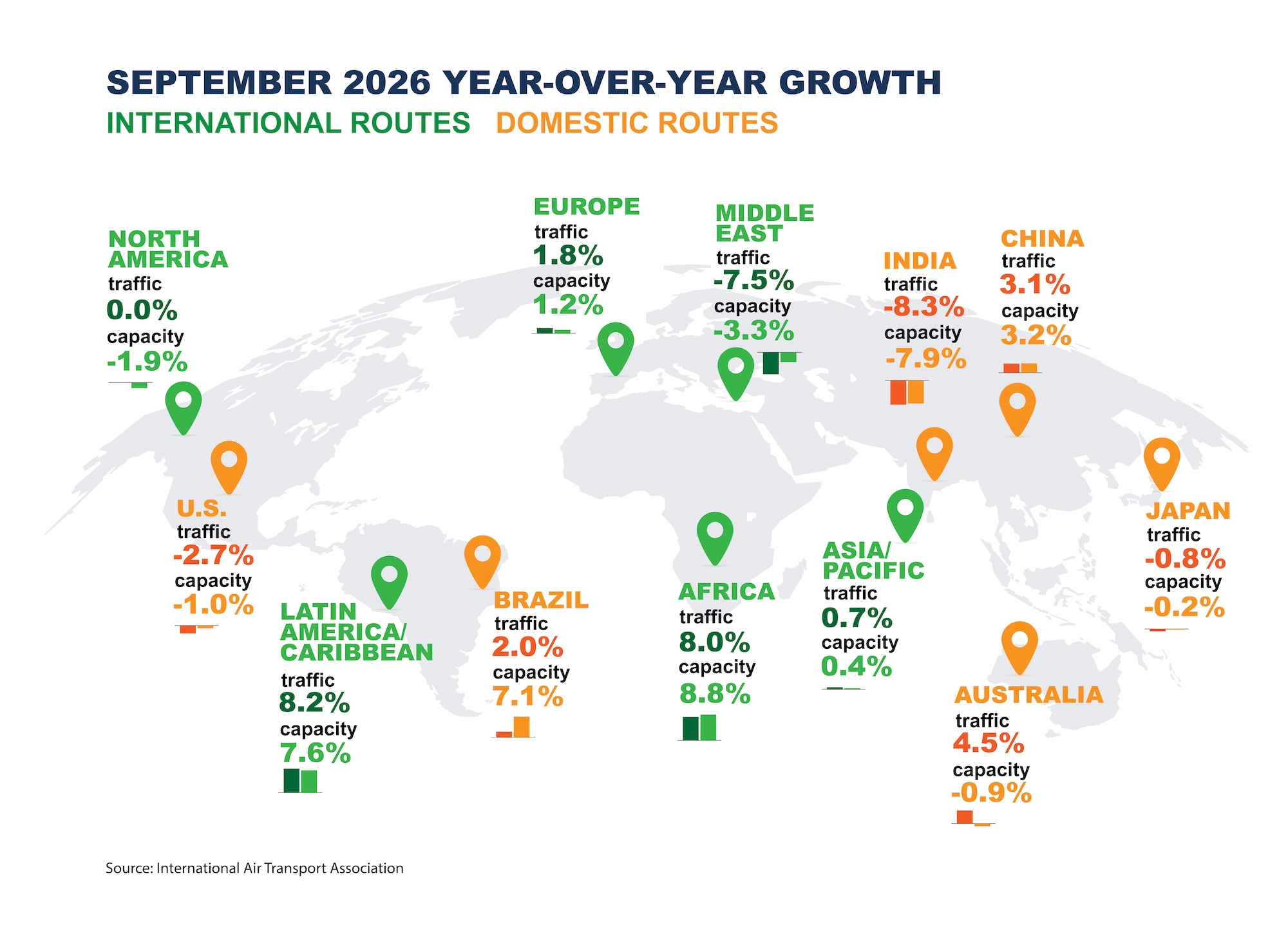
The regions with the highest September total air demand percentage growth were Africa, up 5 percent year over year, and Latin America and the Caribbean, up 4.3 percent. Those regions led in capacity growth at 7.7 percent and 5.1 percent, respectively. Europe was mainly flat, with demand up 0.3 percent and capacity down 0.1 percent, as was Asia-Pacific, which saw traffic up 0.5 percent and capacity increase 0.1 percent. Middle East capacity dropped 3.8 percent, while North American capacity declined 1.3 percent.
September international demand growth was highest in Latin America and the Caribbean, up 8.2 percent year over year, followed by Africa with an 8 percent increase. The capacity for each region increased 7.6 percent and 8.8 percent, respectively. North America was flat for demand and down 1.9 percent for capacity.
The domestic markets in September were mixed. India had the sharpest traffic and capacity declines, at 8.3 percent and 7.9 percent year over year, respectively. The U.S. and Japan also were down for each metric. Though Australia had the highest demand growth rate at 4.5 percent year over year, its capacity declined 0.9 percent.
RELATED:IATA: August Global Air Demand Again Dips