Global air demand and capacity for each December and full-year 2025 increased in the mid-single-digit percentages year over year, according to the latest report of the International Air Transport Association.
Total December demand, as measured in revenue passenger kilometers, increased 5.6 percent year over year, with growth in capacity, as measured in available seat kilometers, at 5.9 percent. The passenger load factor fell 0.2 percentage points to 83.7 percent.
Full-year 2025 air traffic was up 5.3 percent compared with 2024, while capacity increased 5.2 percent. The 2025 load factor increased 0.1 percentage points to 83.6 percent, a record for full-year metrics, according to IATA.
International demand growth remained stronger than domestic growth for the month and full year.
December international demand was up 7.7 percent year over year, while international capacity increased 7.9 percent. Load factor declined 0.1 percentage points to 83.9 percent.
Full-year international demand increased 7.1 percent compared with 2024, while capacity increased 6.8 percent. International load factor for the year increased 0.2 percentage points to 83.5 percent.
Domestic demand for December increased 2.2 percent year over year, with capacity up 2.7 percent. Load factor declined 0.4 percentage points to 83.5 percent.
Full-year domestic demand increased 2.4 percent on a capacity increase of 2.5 percent. 2025 domestic load factor declined 0.1 percentage point to 83.7 percent.
The 2025 demand growth for air travel "returns industry growth to align with historical growth patterns after the robust post-Covid rebound," IATA director general Willie Walsh said in a statement. "The strong and continuous increase in demand puts into sharp focus two key challenges—decarbonization and supply chain. The first will protect future long-term growth. The second was the biggest headache for airlines in 2025."
[Report continues below chart.]
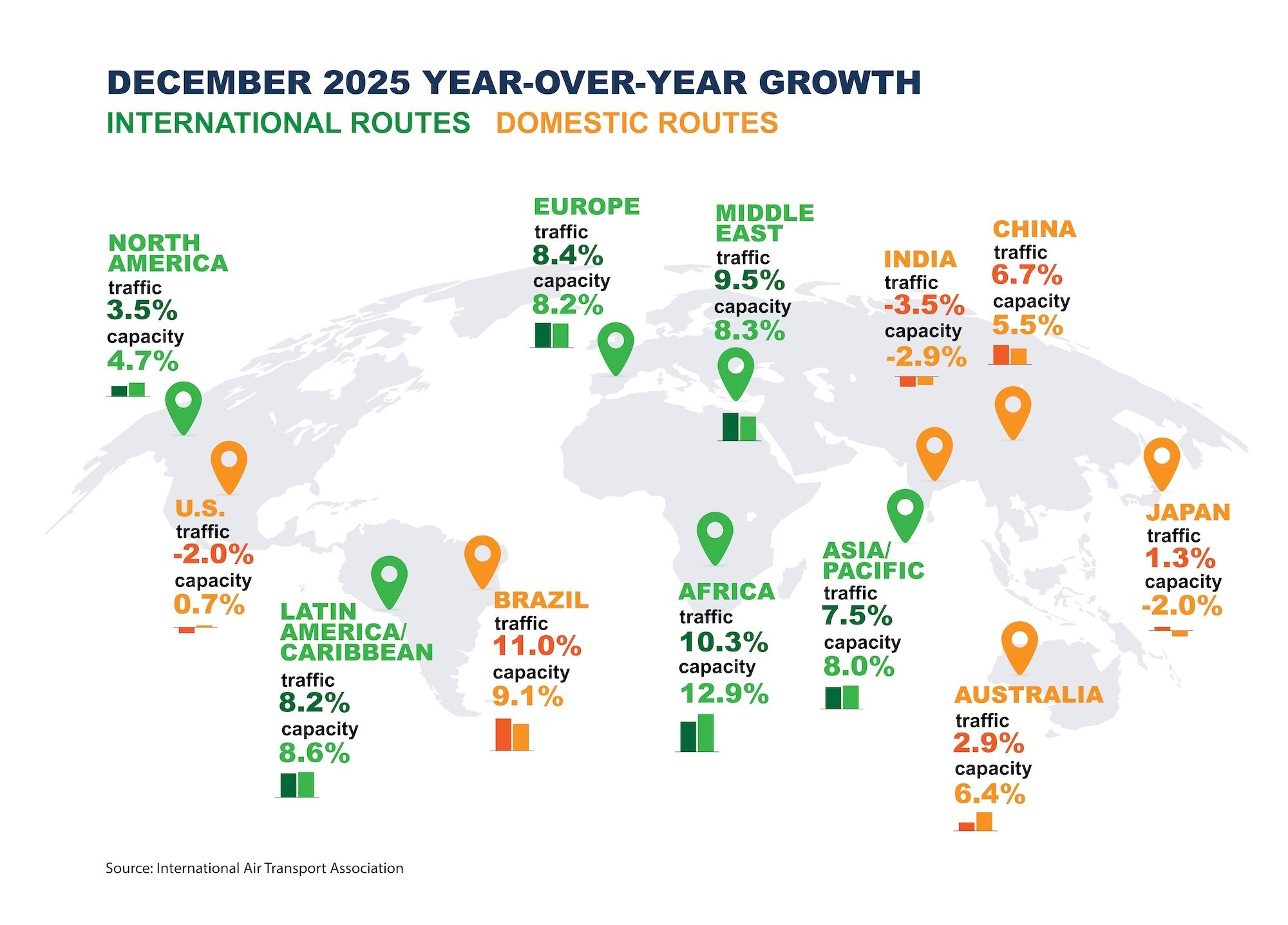
North America was the only regional market with a decrease in total December air demand, a drop of 0.1 percent year over year, but capacity for the period increased 2 percent. Africa reported the largest total December growth rates for demand (12.8 percent) and capacity (14.1 percent) year over year.
North America had the slowest regional growth rate for 2025 air traffic, at 0.4 percent compared with 2024 and the lowest capacity increase, at 2 percent. Africa led the growth rate increases for full-year 2025 regionally for traffic and capacity, at 9.4 percent and 8.3 percent, respectively, compared with 2024.
Africa also led regional traffic and capacity increases for December, at 10.3 percent and 12.9 percent, respectively, year over year. North American reported the slowest December international growth for traffic, at 3.5 percent, and capacity, at 4.7 percent, compared with December 2024.
For the year, Asia-Pacific led traffic growth at 10.9 percent year over year and tied for capacity growth with Latin America and the Caribbean at 10.2 percent compared with 2024. North America had the slowest growth rates for 2025 international demand and capacity compared with 2024 at 2.1 percent and 2.4 percent, respectively.
For December domestic markets, Brazil reported the largest year-over-year demand growth at 11 percent and capacity growth at 9.1 percent. The U.S. and India had demand declines of 2 percent and 3.5 percent, respectively. India's largest low-cost carrier Indigo had severe operational challenges in December that led to government-mandated capacity cuts.
Brazil also led full-year domestic demand with an increase of 11.1 percent year over year and capacity growth of 9.3 percent. The U.S. was the only domestic region in 2025 to report a demand decline year over year, at 0.6 percent. Japan had the slowest capacity growth at 0.4 percent compared with 2024, followed by the U.S. at 1.7 percent.
RELATED: IATA: November Air Demand Growth Continued