Autonomous vehicles seem to be in the same position ride-hailing companies were in when they first came on the scene: They're a cool new option that some tech-forward people are into, but many others remain a bit cautious about.
Yet, billions of dollars are being poured into AV development. There's an increasing number of cities where driverless cars are available. And companies are investing in AV partnerships on a regular basis, particularly Uber—which has invested in the technology for years and earlier in March announced a $1.25 billion investment in Rivian to purchase 10,000 fully autonomous R2 robotaxis with deployment in 2028 and with the option for up to 40,000 more. It seems just a matter of time before they are a regular part of corporate travel rotation.
Some managed programs already have included them.
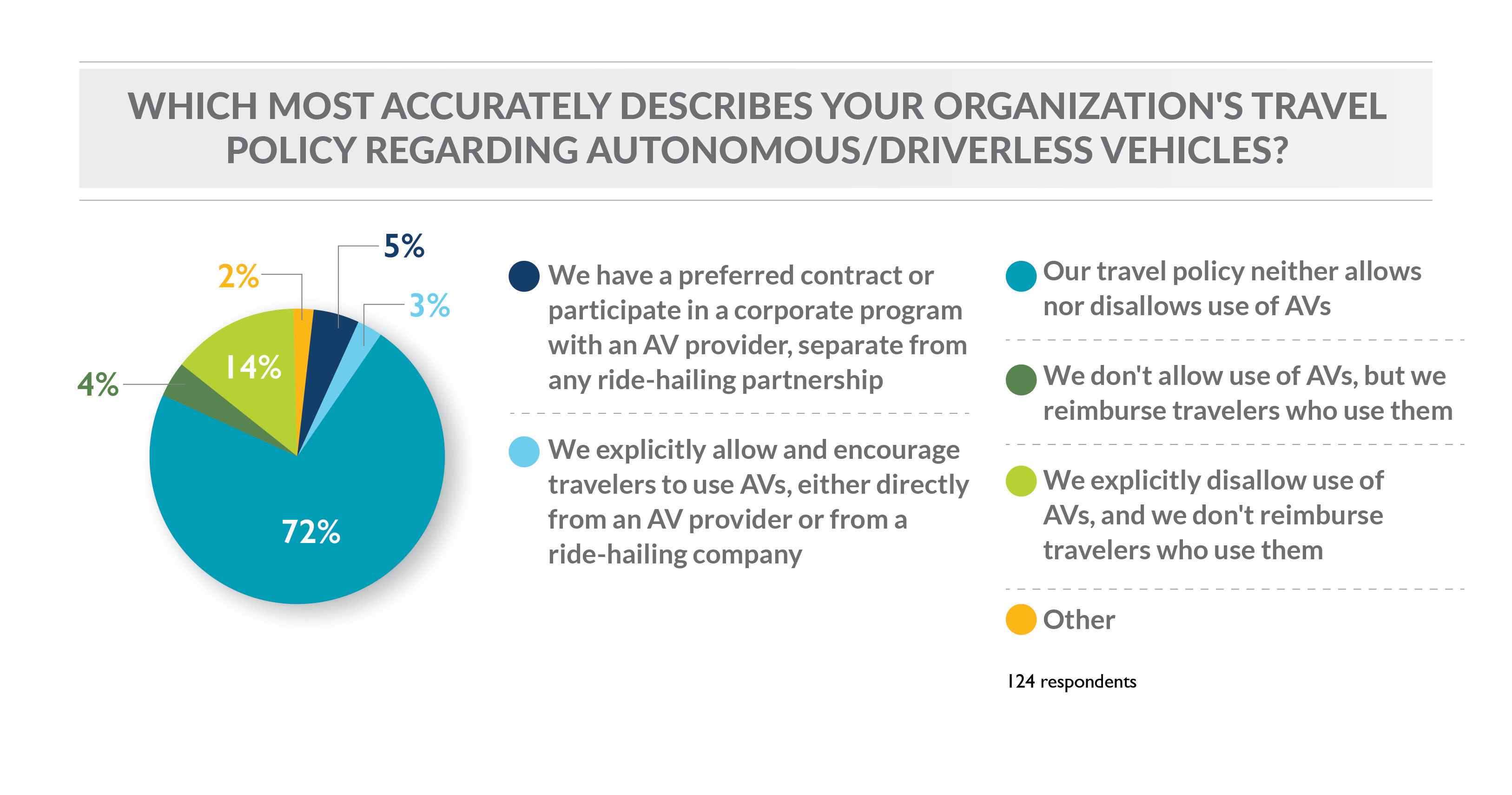
BTN in its 2026 Car Rental Survey & Report found that 5 percent of respondents have a preferred contract or participate in a corporate program with an AV provider—separate from any AV usage from a ride-hailing provider. Another 3 percent of respondents said they explicitly allow and encourage travelers to use AVs, either directly from manufacturers or from ride-hailing companies.
"We are having a lot of conversations with clients about whether they need to put something in their policy about Waymo, particularly as it relates to ride-hailing contracts," KesselRun VP of program management Krissy Herman said. "How do you want to approach this, and how do you want to educate your travelers about it?"
Herman added that it's smart to bring legal departments into the conversation as well as risk and security managers. "Very few clients have taken a true stance with AVs," she said. "It's more been an educational opportunity, but I do think that will grow this year."
AVs Moving into the Corporate Space
AV ride-hailing supplier Waymo last fall started Waymo for Business, a program that can be set up for corporate travel, events transportation and commuter travel. (Waymo is a subsidiary of Google parent Alphabet.) At the program launch, Waymos were available in three cities—San Francisco, Phoenix and Los Angeles. Today, they also operate in Dallas, Houston and San Antonio, Miami and Orlando and in the broader San Francisco Bay Area. In addition, through a partnership with Uber, they also are available in Austin, Texas, and Atlanta. Waymo cars primarily are Jaguar I-Pace SUVs, although the company is incorporating other providers into its fleet.
Salesforce is one company that has signed on for the opportunity to partner with Waymo for Business.
"Being a San Francisco-based company and in one of their launch markets, there were some natural synergies for us," Salesforce senior manager of global travel Dorian Stonie said, who added that use of driverless vehicles was something initiated by the company's travelers, "very similar to the days of when Uber and Lyft were coming up."
Stonie said that the company's global safety and security team vetted Waymo and "gave us the green light to proceed, so they've now become part of our ground transportation program," he said, "and our employees are starting to use them."
AVs aren't a separate section of the Salesforce travel policy. Instead, they roll up under ground transportation and follow the same guidelines for taxis, Ubers, Lyfts other shared services, Stonie said.
While there are aren't yet any corporate discounts on rides, he added, the partnership has enabled learning opportunities on both sides.
"It's an opportunity for them to share their roadmap with us on expanding their product line, as well as for us sharing the information of what we're looking for from ground transportation companies, and they understand the requirements that are needed for a corporate travel program," Stonie said. "That is laying the foundation for further growth of corporate programs within their business model."
The service works like that of other ride-hailing providers. A user downloads the app, creates a profile, enters a form of payment, and when in a location where the AVs operate, orders one just like an Uber or Lyft. Waymo cars hold up to four passengers, and users unlock the door with the app. Users also can personalize their ride with temperature control, adding stops or changing the destination, and playing desired music or podcasts from the in-car screen or from a customer's phone.
Buyers Currently Cautious
Still, 14 percent of survey respondents said they explicitly disallow use of AVs and do not reimburse travelers who use them, while another 4 percent don't allow their use, but do reimburse for them.
GoldSpring partner Neil Hammond said that mirrors pre-Covid stances toward ride-hailing, resistance that largely has dissipated.
"I think the same thing will happen on autonomous vehicles," he said. "There's an abundance of caution at the moment, until it becomes more prevalent. … We still need a lot more data on it. It doesn't surprise me that there's a percentage of companies out there that are actually banning it, but I do see that as a short-term measure."
Still, banning AV use can be a complex endeavor. Herman cited one client who wanted to do so for meeting attendees in a city that allowed AVs, but there was no easy way to prevent an AV from being booked in a ride-hailing app. The client instead put out messaging to alert attendees about the possibility of an AV option for rides.
"There's certainly workarounds, but it makes it difficult to guarantee that somebody won't just get a Waymo that shows up for their ride," she said.
Stonie said his advice to travel buyers who are curious or concerned about AVs is to download the Waymo app and see its functions. Then when in a city that offers them, try one out.
"It's like taking your first Uber or Lyft ride," Stonie said. "Try them out. Get a feel for them. The fact that there is no driver in the vehicle can be disconcerting for some people. But I find that for folks that have tried at least a first ride, their confidence level continues to increase. … I think they're going to slowly expand into corporate programs as [AV providers] expand their networks throughout the United States."