Buyer strategies for pursuing preferred carriers hinge on a
number of key factors, with routes and connectivity as priorities, often
definitive. When it comes to rating the service, support and overall success of
those partners, however, there’s much more to consider. Content availability in
desired channels has become a continuous struggle for many corporate programs.
Sustainability, on the other hand, looks to be waning slightly as a concern for
some buyers, but there are other complexities on the horizon. Proliferating
cabin segmentation portends more convoluted airline retailing and negotiation
options. Plus, airlines clearly have downgraded corporate discounts in the past
few years in a way that puts more intense pricing pressure on corporate
programs than it might appear on the surface.
NDC an Ongoing Challenge
American Airlines may have turned the corner on rebounding
from its controversial New Distribution Capability NDC, but the industry still
is leery of the distribution option. About 18 percent of respondents noted a
slight or significant positive impact of NDC on their travel programs. Nearly
two in five (39 percent) said it has a negative or significant negative impact.
One in four found no impact.
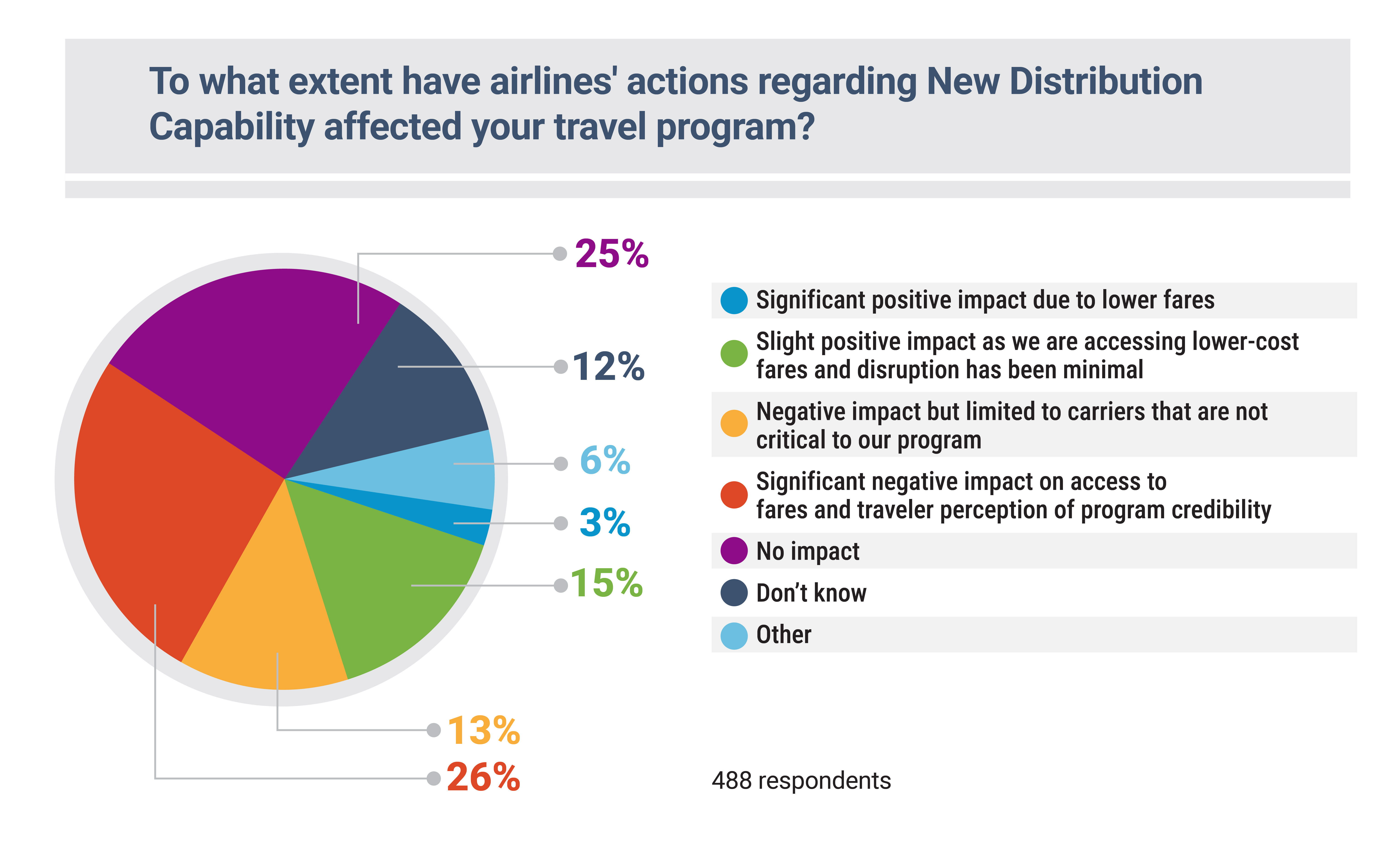
Still, those scores represent an improvement over last
year's findings, when only 14 percent said NDC had any positive impact, 54
percent said it had a negative impact, and 19 percent said there was no effect.
Regarding what needs to be done to improve perceptions of
NDC, KesselRun VP of program management Krissy Herman pointed to the rollout of
SAP Concur's new Concur Travel platform, commonly known as T2, as a "big
step in the right direction" for many customers, as it enabled NDC booking
through global distribution system channels.
"Agency reporting and data capabilities are also
important," she said. "There are still some gaps on the technology
side of being able to combine fare types, being able to apply unused tickets
between fare types."
GoldSpring Consulting partner Neil Hammond noted that the
survey numbers might not reflect the true state of NDC perception,
"because at the beginning of this year, there were still a lot of clients
who did not have access to NDC," he said. "If you were a client and
your [travel management company’s] online booking tool configuration did not
offer you NDC rates, you were at a disadvantage and you were hearing about
travelers finding lower fares, and this time it was real."
Those fares tended to be high-value international trips in
business class where there was a significant difference between what was found
on EDFIACT versus NDC channels, Hammond added—fares often used by executives
and other influential senior managers. "NDC definitely was not a friend to
buyers in that position," he said. "Then it really matters for some
buyers as to which market they are in. If you were flying a lot with Delta,
that didn't affect your world so much as they didn't have an NDC strategy. If you
were more on American and United, then it certainly had more impact on
you."
The type of effect—positive or negative—for those with
American and United again would depend on the client's access to NDC fares,
Hammond said.
Sustainability
The importance of sustainability when assessing partners
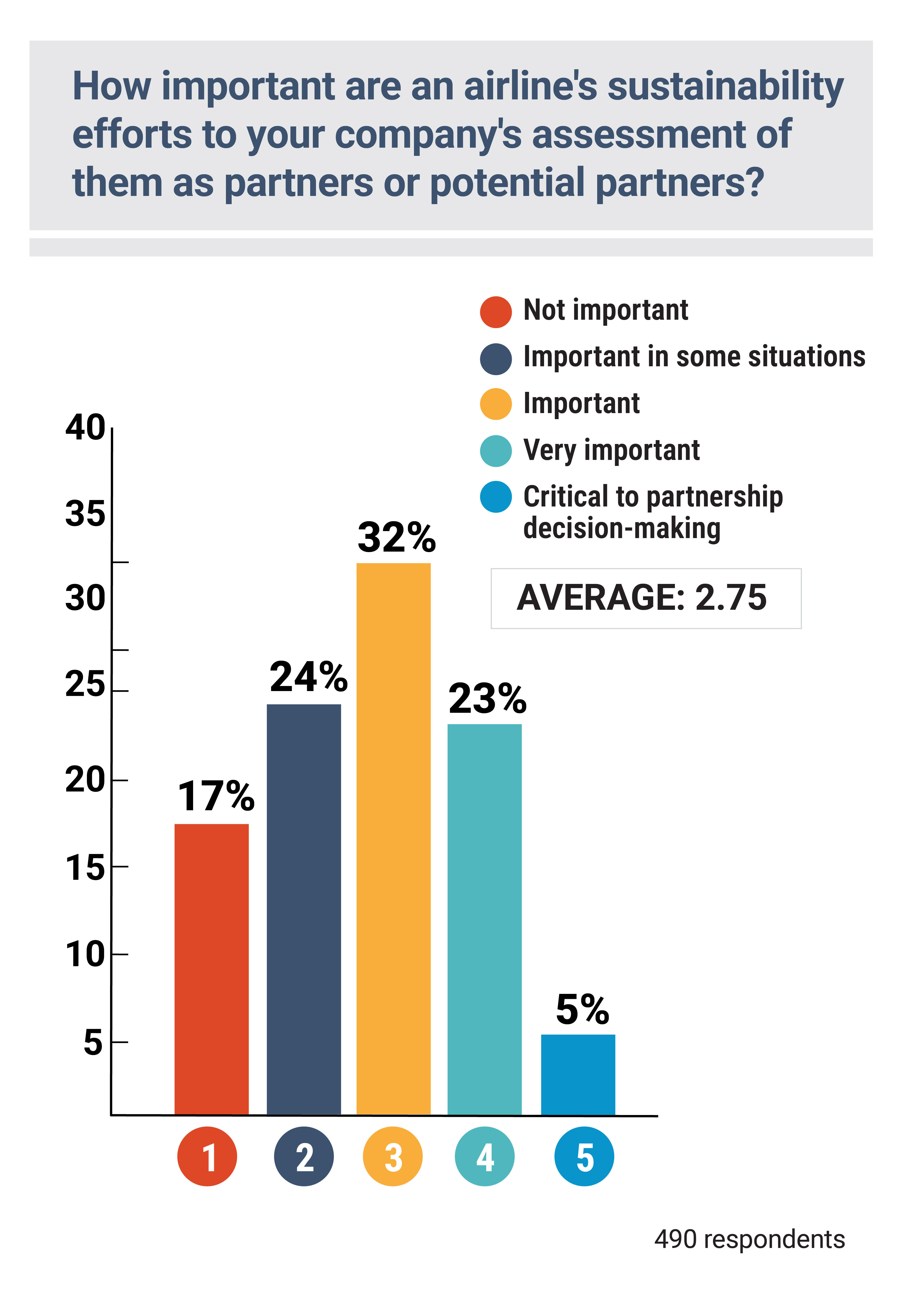
dipped a bit in 2025. Seventeen percent of survey respondents said it was “not
important at all” in their assessment, up from 12 percent last year. Only 28
percent said it was “very important” or “critical” versus 33 percent in 2024.
The Global Business Travel Association Foundation's recent
Sustainability Acceleration Challenge benchmarking report found that the
largest travel programs have lost ground in their sustainability efforts.
"I've seen less of an aggressive push toward more data,
better data, true sustainability-type efforts in the last year or so,"
Herman said. "Clients still want data, but it is not as significant a
priority in the programs that we've seen."
"For some clients, it's really, really important, and
for other clients, it's not so important. There are other bigger priorities,
and I think that's where these numbers come out," Partnership Travel
Consulting SVP of global supplier engagement Bob Brindley said, adding that
overall political environment also could play a part. "It's certainly not
something that the current U.S. administration thinks is important."
Hammond noted
that the travel buyer community as a whole is a very strong advocate of
sustainability "and is trying to raise its level of importance that is not
yet being matched by the C-suite," he said. "They're running into a
little bit of indifference when it comes to the travel program."
One reason for
that could be that "most of the regulation now is around Scope 1 and Scope
2," Hammond said, citing the categories of greenhouse gas emissions
generated by a company's direct operations or those in its value chain—unlike
Scope 3, the category that includes emissions generated by business travel.
"There's
some regulation on Scope 3," Hammond said, "but the travel piece is
only one of 12 elements, and some companies in order to make a bigger impact on
their sustainability and carbon footprint are better focused in areas other
than travel to get a better return on their sustainability investment."
Cabin Segmentation
With the continued focus on premium demand and seating,
airlines are adding more seating types than ever before. Delta recently
announced a Comfort Basic fare on the heels of segmenting its main cabin into
Basic, Classic and Extra, along with Classic and Extra for all its other cabins
too—meaning there are now up to 12 types of seats on some Delta planes.
"It's a lot of segmentation," Brindley said.
"I've heard they were looking to [add Basic] in business class as well. …
A lot of corporate clients block basic economy, so I'm assuming they'll
probably block Comfort Basic as well because they realize they don't want to
lose that extra flexibility. It just adds additional stress to an already
relatively stressful process."
Hammond noted that there's a new classification, or
branding, not unrelated to the cabin segmentation. "We have booking class,
we have fare class, and then we now have something called service class, which
is more complex and more nebulous than cabin," he said, adding that
service can mean access to better seating and extra legroom.
"And it's not just on U.S.-based carriers. I've seen
European airlines, Latin American airlines presenting their offers by service
class," Hammond added. "Some airlines are doing a good job of
aligning their booking class codes, which is so important to us, with those
service classes. But others don't, which means we have to go through some
gymnastics to figure out how to apply the discount or how to model the
discounts. We're seeing that as a trend."
Shorter
Contract Lengths
Hammond
doesn't understand why, but he has seen some airlines seek contracts of two years
in length rather than three. "In some cases, we've managed to persuade [them], and get our sales back to better deals, but they
are shortening contract lengths," he said. "This has come out of the
pricing. It is not the people that we speak to that are making these decisions.
… The decision makers are either in the pricing department or sometimes even in
the legal department where they decided that this strategy is working, but we
have seen more limited contract durations.
Pricing
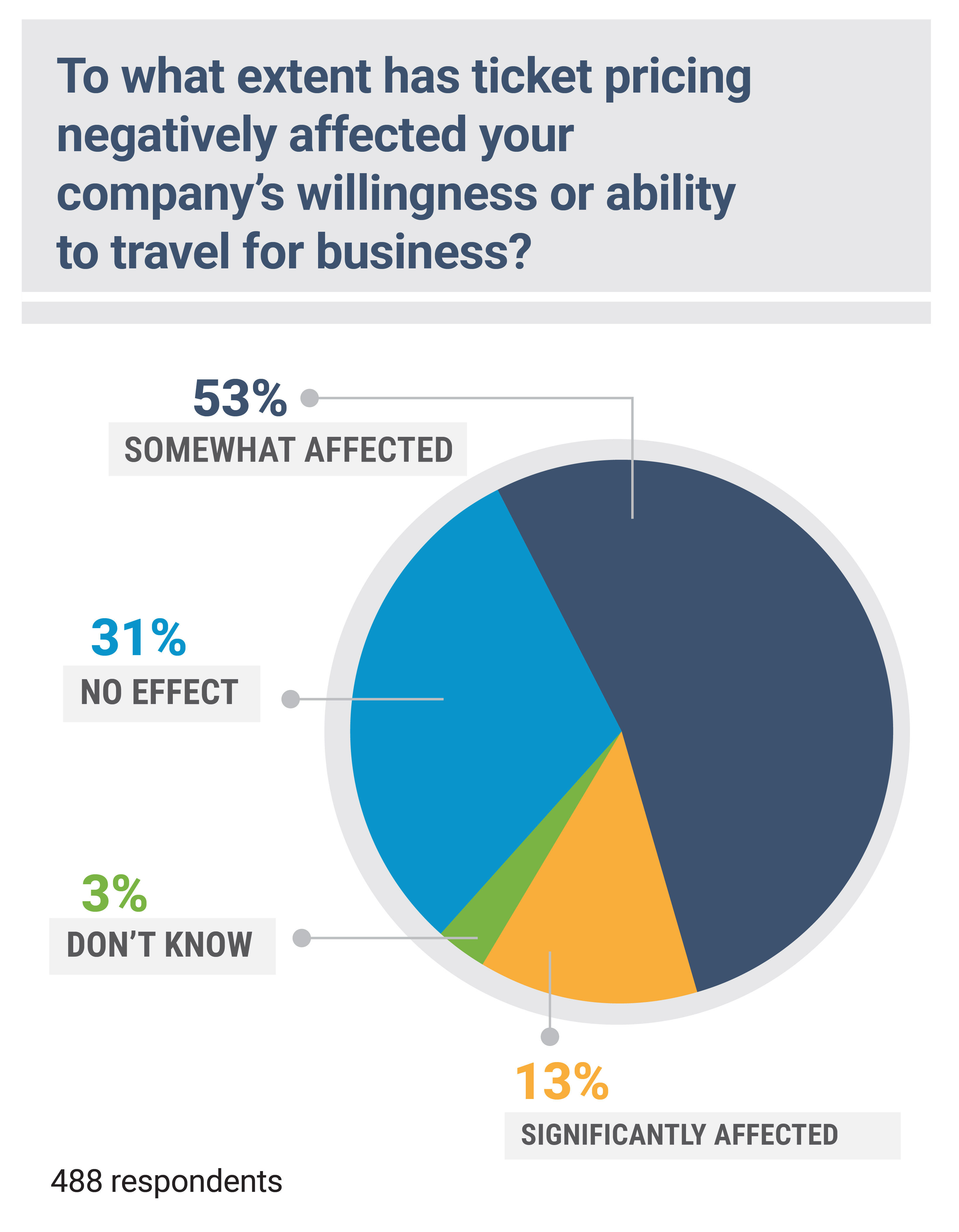
Two-thirds (66 percent) of respondents said ticket pricing
has somewhat or significantly negatively affected their company's willingness
or ability to travel for business, with 31 percent citing no effect. But such
perceptions may not tell the whole story.
"Pricing has been for the last three years pretty
steady in the U.S. with really small variances," even in an inflationary
environment, Brindley said. "But from the corporate side, with some of the
carriers pulling back their corporate discounting, the corporate prices may be
going up more than the [general consumer] price."
According to data from the U.S. Bureau of Transportation
Statistics, national-level domestic average fares, when adjusted for inflation,
declined year over year in 2023, 2024 and through Q2 in 2025. In absolute
numbers, fares have increased 0.9 percent, 0.6 percent and 1.9 percent year
over year, respectively, for those timeframes.
Hammond added that the trend of lower corporate discounts
"has begun to stabilize a little bit." Where he sees an effect is
with high load factors driving pricing. "The airlines are flying very full
nowadays, they're almost at capacity," he said. When load factors get too high, he said,
"we have no recovery potential … to reposition travelers and reposition
aircraft … if one thing goes wrong, which it always does."
And with higher load factors, by the time corporates
purchase their tickets, "the planes are a lot fuller than they used to be,
so you've less options and all those lower-inventory buckets have been
consumed," Hammond added.
Those two scenarios support what some airline executives
have said is that corporate flying may still be at about 70 percent to 80
percent of pre-pandemic levels, but corporate revenue is at or above 100
percent.