In its 100th year of operation, Delta Air Lines for the 15th
consecutive year took top honors in BTN's 2025 Airline Survey and Report. The
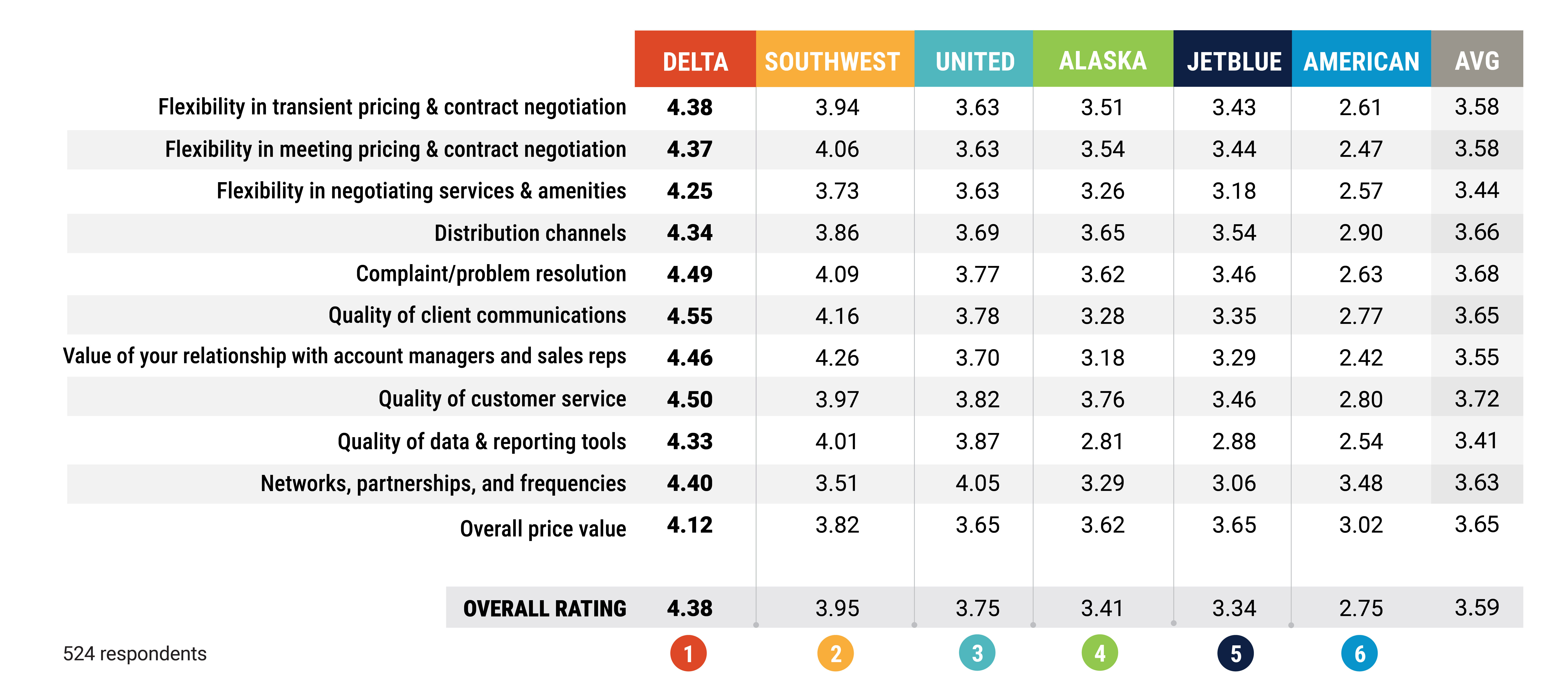
carrier managed to earn the highest average score in each of the 11 categories on
which corporate travel buyers rate their preferred airline partners.
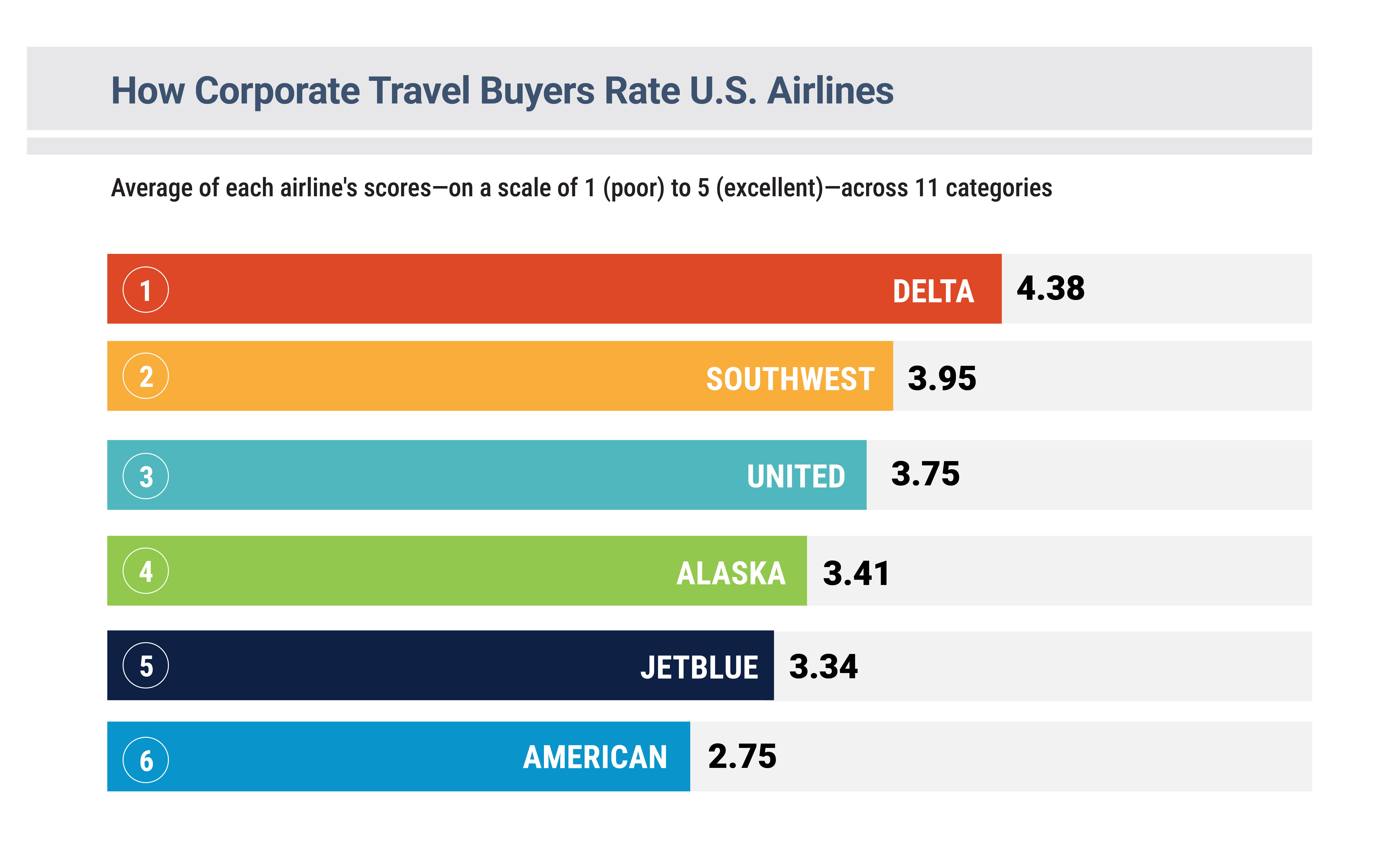
Delta's 2025 overall score on an ascending scale of 1 to 5 increased
to 4.38 from 4.32 in 2024. It was the only carrier with an overall score above
4.
The industry's average score for all categories also improved
to 3.59 from 3.54 a year prior, the first time since 2021 that the overall
average increased. And for the second year in a row, a new carrier qualified.
This year it was JetBlue, following last year's entry of Alaska Airlines, which
remained in the survey in 2025.
Average scores for all but one of the carriers that ranked
last year improved this year—particularly American Airlines, whose score increased
to 2.75 from 2.15 last year despite still coming in last.
Southwest Airlines, however, slipped to 3.95 from 4.21. But
the carrier managed to maintain second place overall and was second to Delta in
10 of the 11 categories, the exception being "networks, partnerships and
frequencies," where United Airlines snagged the second-place spot.
"I think the airlines are having—and this is a broad-stroke
statement—more and better conversations about transparency, what they're trying
to do, how they're doing it, both in regard to pricing from a contract
standpoint and from a distribution standpoint," KesselRun VP of program
management Krissy Herman told BTN. "They may not be conversations that
clients want to hear, but [the airlines] are at least more open to those
discussions."
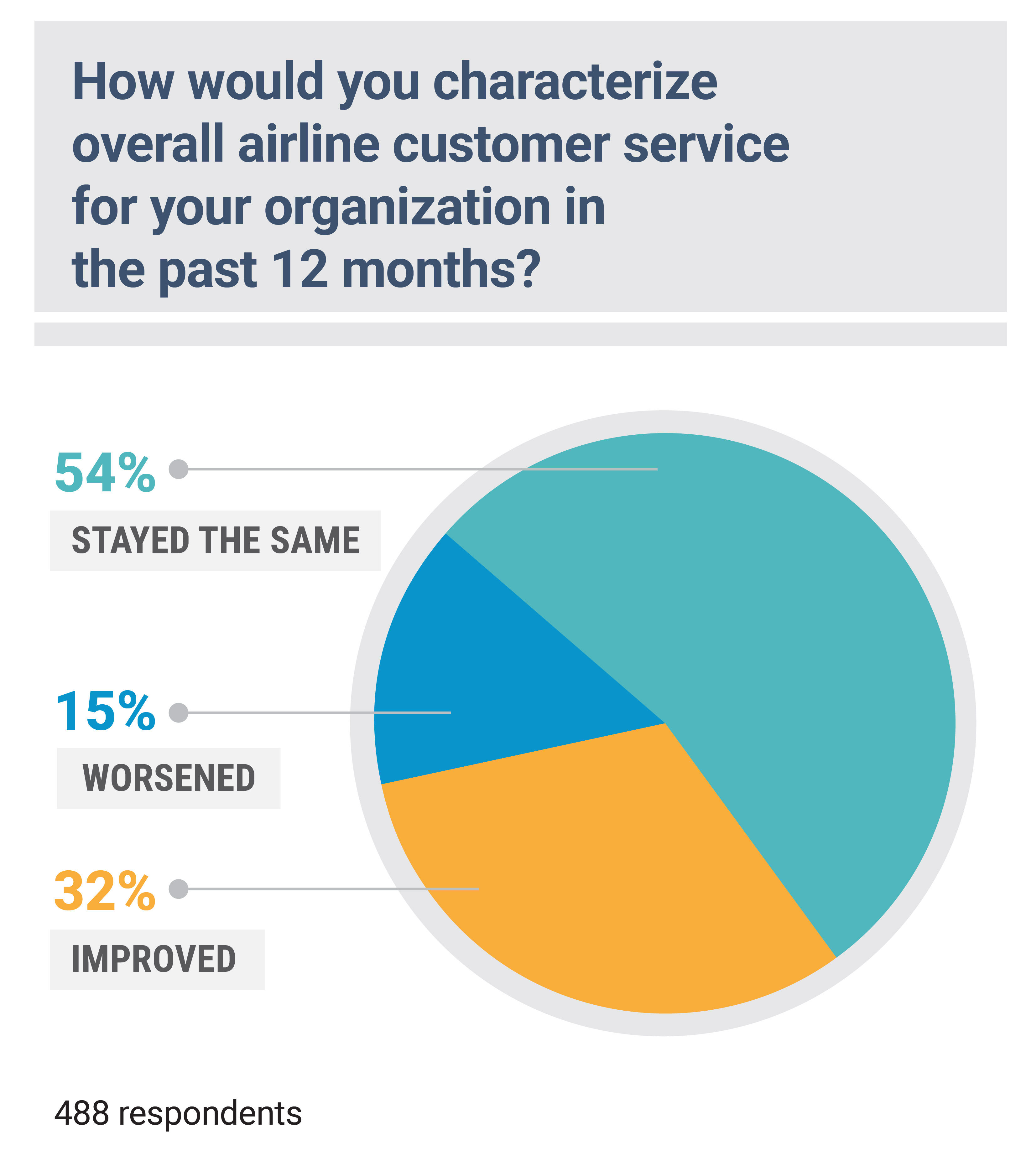
Still, overall perceptions of airline customer service remain
steady. More than half (54 percent) of travel manager respondents to BTN's
survey said service had stayed the same from prior year-levels, compared with
50 percent who said so last year. About 32 percent said it improved, while 15
percent said it had worsened, down from the 18 percent who said the same last
year.
Delta Air Lines
After coming in second in three categories last year to
Southwest, Delta swept the survey this year, with improved scores in nine of
the 11 categories. "Quality of client communications" had the highest
score at 4.55, followed by "quality of customer service" at 4.50.
"Delta is still going gangbusters," Partnership
Travel Consulting SVP of global supplier engagement Bob Brindley said.
"We've never worked harder to earn these scores,"
Delta SVP of global sales Bob Somers said. "It means a lot for us to sweep
every category because … we had three that we didn't win last year, and the
three that we didn't win were some of our highest scores. It tells us rolling
up our sleeves and leveraging our strength works."
The category Somers said Delta really wanted to win was
"value of your relationship with account managers and sales reps."
"That's the one I look for every year, and you know
that the last two years, I haven't been very happy [coming in second],"
Somers said. "I stopped being defensive and started going on the offense
to try to figure out what is it that we needed to do."
Somers said his team talked with each salesperson and asked
what could they do to help. "Responsiveness was key," he said.
"The business travel world has changed, but what we can do is help them
navigate the change."
Delta's introduction in 2025 of new business travel service
structures, including a
corporate solutions team and a self-service unused ticket management mechanism,
has removed some of that responsibility from sales representatives, allowing
them more time for customer engagement, Somers said.
"We put self-service in the hands of the corporate
travel managers so that our account managers and their value can be more tied
to what they do to bring more value to the company as opposed to chasing
laptops if they're [forgotten] in the backseat of an airplane," he said.
Delta in January 2025 also created an advisory board for the
small and midsize enterprise market. "We really stepped up our game in the
SME world," Somers said. "We dedicated more resources to that
channel, more tools." The SME board was "incredibly valuable" to
help Delta understand how to communicate what is important to that market, he
said.
Customers took notice of Delta's efforts. In open-ended
comments on the survey, multiple respondents noted the SME board and how the
carrier "listened" and "demonstrated they value our business as
much as the mega corporates." Respondents also praised the improved UATP
process for unused tickets, and gushed about the "reliable,"
"proactive" and "exceptional" account management support,
as well as "dedication to customer satisfaction."
Where some travel managers would like to see further change
is in having UATP account numbers and balances on their profiles in the Delta
Professional platform instead of logging into UATP. They also are looking
forward to Delta's New Distribution Capability offering.
"Delta has taken a more wait-and-see measured approach
to its NDC revenue strategies, and buyers seem to have appreciated that,"
GoldSpring partner Neil Hammond said.
The carrier said it is making progress toward rolling out
its NDC offering. "We are in the process right now of adding more and more
capabilities to our APIs, and we're testing alongside the [global distribution
systems]," Delta managing director of sales and distribution innovation
Sara Reid said. "We are beginning integration, so currently we have the
ability to be able to shop for an offer, price the offer, create an order.
We're settling the order with ARC. You can cancel an order. And our big focus
as we move into 2026 is all about change and making sure that we are providing
the best-in-class customer service. … Once we feel like we have it right, we'll
have a public launch."
Southwest Airlines
Dallas-based Southwest was "incredibly proud" to
maintain the No. 2 position, "especially in the midst of a year with a lot
of transformational change," Southwest VP of sales Aileen Furlong said.
The carrier early in 2025 laid off employees for the first time in the
company's history, in May started to charge for checked baggage, and in January
2026 will introduce seat assignments and extra-legroom seating.
"Change overall is different. It's things that our
teams need to adjust to, our customers need to adjust to," Furlong said,
adding that she was pleased, though, to see the carrier's top two scores remain
in the categories of "value of your relationship with account managers and
sales reps" (4.26) and "quality of customer service" (4.16).
"We knew how critical it was to clearly communicate, to
actively educate, to bring customers along on our journey," she said.
"Between the communications and the [active engagement from the] sales
team, those were absolutely things that we felt were critical to our success."
Buyer sentiment toward Southwest, however, may have shifted because
the airline's changes were driven by upper management, Hammond said. "It's
challenging some of the unique selling points that have always made Southwest a
different airline," he said. "And in the marketplace, they have
certainly tightened up their pricing strategy, which may have impacted some
bias."
KesselRun's Herman said questions about Southwest's future
remain. The carrier has been transparent at a high level in saying what they're
trying to do, she said, "but when you push them on what your pricing is going
to look like—what does that new model do to that savings that they've promoted
for so long?—I've not been able to hear a straight answer to that, because I
don't think that they know. I imagine this slight dip [in Southwest's overall
survey score] has to do with the uncertainty about what Southwest is going to
look like and what the value is for that corporate customer."
Still, open-ended comments praised Southwest account
managers and sales reps as being "amazing," the "best in the
industry" and "incredible." Multiple respondents also lauded
Southwest Business' "constant updates," "transparency,"
"the opportunity to meet with executives to discuss the changes" and the
benefit of placing unused ticket values on a UATP card.
Some respondents noted Southwest could improve in offering a
way to prepay for checked baggage.
"We have some solutions in the works for prepayment of
bags and know how important that could be," Furlong said. "You'll
start to see that roll out in different places late this year, early next.
There's a lot of value in having prepay capability, and we see that as
well."
United Airlines
United maintained its third-place position with an improved
score of 3.75 from 3.69 in 2024, with scores in 10 of the 11 categories increasing—the
exception being "distribution channels." Its highest category was "networks,
partnerships and frequencies," at 4.05, coming in second among carriers.
"The funny thing about United is they've improved in a
lot of areas, but they have been experimenting with [New Distribution
Capability] and their overall pricing strategy with continuous pricing, which
clients appear to have loved," Hammond said. "I know a lot of clients
who have access to their continuous pricing like it and can see the difference,
yet it appears they're still behind Delta."
Brindley also said he was surprised United didn't score
higher in some categories, citing their lower scores in flexibility.
"That's partly because they tried to do a little bit of
what American is doing and I think that's reflected in client feedback,"
he said, referring to American's since-reversed aggressive approach to NDC.
"They're still below Southwest, which is surprising to me because
Southwest [doesn't] have as much room to negotiate. … It'll be interesting to
see if United softens their approach a little bit in the coming year for
certain clients."
Still, respondents in open-ended comments said that United's
customer service was "outstanding" and that its sales reps were
"great," "always checking in with me," "very
proactive" and "very engaged."
As for its high score in "networks, partnerships and
frequencies," "after years and years with an extremely stable set of
partners, what's happened over the last 12 to 18 months has been pretty
revolutionary for them," Hammond said, noting new partnerships with Emirates
and Virgin Australia and the new "Blue Sky" loyalty and interline
collaboration with JetBlue.
"They seem to have made a lot of positive moves, and their
overall network generally is reckoned to be one of the best," Hammond
said.
United SVP of worldwide sales Doreen Burse in an email said that
"the routes that matter most to our corporate travelers have also seen
substantial frequency and capacity increases." She called out up to 15
daily flights between Chicago and New York LaGuardia and resumed service to Tel
Aviv, and added that in 2026, "we will add 28 departures per day from San
Francisco including additional frequencies to business centers like Boston,
Chicago and Dallas," as well as introduce new service between Newark,
N.J., and Seoul.
Survey respondents when asked specifically about usage of
and ratings for airline partnerships rated the United/Lufthansa/Air Canada joint
venture fifth among 10 options.
"Our priorities are focused on fixing friction points
identified by our business customers, and we're making great progress," Burse
said. "A good example is name corrections, which can now be made on wholly
unused tickets with Air Canada and/or Lufthansa Group operated flights. In the
next few months, we'll expand seat selection capability (for changes and
purchases) on United's channels for Lufthansa operated flights—and there's much
more in the pipeline beyond that."
Alaska Airlines
Alaska held steady in fourth place this year, with an
improved overall score of 3.41 compared with 3.32 in 2024. The carrier improved
in nine of the 11 categories, with the exceptions of "overall price
value" and "quality of data and reporting tools." Its highest
score was for "quality of customer service" at 3.76, which also was
its most improved category year over year; last year it was at 3.55.
"Four or five years ago, they weren't very active in
the corporate market," Brindley said of the carrier. "Then they
started getting more involved. At first it was done in partnership with
American and being part of Oneworld. They were like an attachment to an
American [corporate] contract. Then with what American's gone through, that all
ended, and they realized they had to do things on a standalone basis."
Alaska and American announced a new "West Coast
International Alliance" in February 2020, just before Covid-19 was
designated a pandemic. Since then, Alaska joined the Oneworld airline alliance,
of which American also is a member. The carriers' partnership includes a
codeshare agreement and reciprocal loyalty benefits, but neither carrier has
mentioned their alliance lately.
"That relationship has fluctuated," Hammond said.
"It's blown hot and cold at times. … It's difficult to say whether they
benefited a lot from their relationship. … At the moment, our clients are doing
more direct deals with Alaska than they are through pairing them with American."
Regarding Alaska's merger with Hawaiian Airlines, "they
do have some additional international service," Brindley said. "A lot
is still going to Asia, but connecting over Hawaii is not the most direct way
to go. I don't see them being a big competitor in that market yet, but we'll
see how that develops."
Still, "on the West Coast, they play an important role,"
Brindley added.
Alaska did not respond to BTN requests for an interview.
JetBlue
Despite JetBlue's reputation as primarily a leisure-focused carrier,
it offers "a value proposition that works for corporate customers,"
JetBlue SVP of revenue, network and enterprise planning Daniel Shurz said.
"We have a strong transcontinental network, a strong transatlantic
network. We have a good product, and in all of our significant markets, we have
significant frequency. We have the flexibility that corporate travelers are
looking for. So yes, we're continuing to focus on corporate travel."
The airline in mid-2024 introduced "Corporate Perks,"
benefits for contracted corporate customers that include early boarding,
same-day changes with no fee or fare difference, preferred seating and priority
security. These are in addition to core corporate benefits, such as the ability
to book or rebook up to 331 days in advance, a dedicated support desk, and the ability
to reuse a canceled, nonrefundable ticket or transfer it to another traveler.
JetBlue also is expanding its premium Mint product
availability and plans to open the first of its dedicated lounges later this
year, with first class scheduled to launch in 2026.
The other big news the past year is JetBlue's Blue Sky partnership
with United, which in some ways replaces the dismantled Northeast Alliance the
carrier once had with American. "We've had full regulatory approval for
the [United] alliance," Shurz said. "This is a durable alliance. … We
have this significant presence of our own, we have a really good partner, and
we can cooperate [with] frequent-flyer reciprocity between the airlines. … It's
going to have longevity, [which] is what we need because the NEA was good while
it lasted, but it didn't last very long. We intend for this to be a significant
and stable partnership."
KesselRun's Herman said of JetBlue approach to the corporate
market, "after the American deal shut down, they needed to grow their reach
themselves, and I think they've done that. We've seen more engagement from
sales reps on the corporate side. The United announcement certainly intrigued
many corporates that have a strong United program."
Hammond added that the Northeast Alliance may have benefited
JetBlue's corporate program. "They got drafted into a lot of corporate
deals because of their relationship with American that they might not have got
otherwise," he said. "Now that that relationship has been broken
down, they are trying to continue [it] on their own two feet, which means
they've suddenly got a new set of clients. I think it may have worked out for
them. … They're in a very interesting situation."
American Airlines
American achieved the strongest improvement year over year
in this year's survey, with notable increases in all 11 categories. In
particular, "distribution channels" improved nearly an entire point,
to 2.90 from 1.98 in 2024, and "quality of client communications"
rose 0.68 points to 2.77. The airline's pivot on the corporate segment from its
controversial prior strategy between April 2023 and May 2024, when its average
survey scores tumbled, seems to be having an effect.
"We spend a lot of time listening to the corporate
travel managers. We spend a lot of time listening to our agency partners,"
American SVP of global sales Lucas Martin said. "Corporations are deciding
for lots of very good reasons on how they want to access our content. Different
agencies have their own unique points of differentiation, and that resonates
with different corporates. At the highest level, our strategy has been to
recognize this and to recognize that we need to be able to compete across those
different captive pools. … We need to be very easy to do business with."
American also has announced a UATP solution for unused
tickets, a revamping of its AAdvantage Business strategy and its new portal for
corporate accounts. "What's still to come is going to be more coverage for
the ecosystem, allowing us to go further into the account base," Martin
added. "I'm very confident that that's going to continue on this
momentum."
"American improved dramatically," Brindley said.
"And while they've taken a lot of steps to improve their approach to the
corporate market, people have long memories—or longer than [AA] probably hoped
for—so they still have a way to go to climb in the rankings. But they are definitely
moving in the right direction."
Respondents seemed to agree. In open-ended comments, travel
managers praised the carrier's turnaround from its prior corporate strategy and
hoped it would continue down that path, although some noted that they either
were still waiting for a dedicated account rep, or had only recently been
assigned one.
Martin said that since joining American in February, he's
been rebuilding the sales team. In early November, the carrier had dedicated
account managers for 98 percent of its accounts, with the "last wave
coming in the next few weeks," he said.