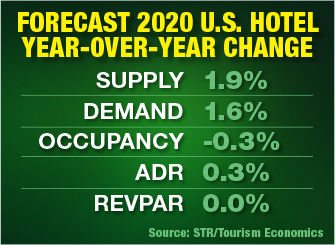
STR and Tourism Economics anticipate flat 2020 year-over-year growth in U.S. hotel revenue per available room, the first such zero-growth projection since 2009, according to the companies' latest forecast, released this week at the Americas Lodging Investment Summit in Los Angeles.
The anticipated 2020 RevPAR rate was downgraded from 0.5 percent in November. The projection for 2021 RevPAR is a slight uptick, 0.5 percent year over year, but that too is down from the previous 0.7 forecast. Occupancy is also expected to decrease slightly in both 2020 and 2021, by 0.3 percent and 0.1 percent, respectively. Average daily rate is anticipated to grow, but at continued low levels of 0.3 percent for this year and 0.6 percent for next.
Supply growth for both years is forecast to exceed demand, which will likely contribute to muted ADR growth.
"[The forecast] is realistic of where we are in the cycle right now," STR president Amanda Hite told BTN. "The positive news is that we have demand growth on top of the all-time highs [in occupancy] that we saw in 2019, and that speaks to the strong consumer confidence that we see in the economy and the growing wages. Those are the indicators and factors that will continue to drive growth for our industry."
Hite added that the issue is new supply. On a national level, the industry will be able to absorb it, but certain markets might see a real effect. "New supply growth is one of the reasons why there is lackluster ADR growth for the industry," she said. "There is no indicator in the industry or in the larger macroeconomic environment that says this will give us more positive rate growth than what we've seen in the industry. So that is why we've lowered the rate forecast to 0.3% for this year. We do think the economic environment is stable. There is just as good a chance we can go slightly positive or slightly negative."
One thing that could move the performance numbers upward is capital investment from private companies. "There's not been any capital investment happening, so if that were to start flowing a little in 2020, that could be positive for us," Hite said. "But I don't expect it to because it is an election year, and I think companies will wait to see what happens."
Transient Performance
Transient data from the 65,000 hotels STR collects information from is not segmented between business and leisure. However, the company reviews day-of-week changes in performance indicators as a way to look for trends in each segment. Looking at the annual day-of-week changes for 2019, STR saw the largest growth in occupancy on Monday, at 0.64 percent year over year, followed by Tuesday at 0.04 percent. The other days had negative changes. "This points to the transient business and group business demand," Hite said. Tuesday's ADR change of 1.92 percent year over year was the highest day-of-week change. The largest increase for RevPAR also was for Tuesday, at 1.97 percent.
Group Outlook
STR doesn't collect forward-looking group data in the U.S. yet, but Hite cited anecdotal evidence of stronger 2020 group business than in 2019, through conversations with clients and at conferences. "That's great news from a demand standpoint, but I'm not sure it will translate into any significant room rate growth," she added.
One trend that Hite said was a bit surprising was that at the end of 2019, group demand month-to-month growth rates had started to slow, though still positive, but group rates maintained steady growth. Since group business frequently is negotiated four to six quarters out, "hoteliers were in a much stronger negotiating position because transient rates were so high and ADR was growing," Hite said. "We're not certain that the trend of ADR growth on the group side will continue into 2020."
STR also has heard that operators are focusing on groups to drive revenue in food and beverage and auxiliary spending, rather than the room rate. "Because operators want to get that group business in the door, they're not increasing the room rate, but where they are seeing additional spend is the revenue for F&B and other ancillary spend," Hite said.
Risks for 2020
For the top 25 markets in 2019 and moving into 2020, STR sees a tougher operating environment than in other markets. "That is where you see the new supply coming in," Hite explained. "Yes, they tend to get more of the demand, but the operating fundamentals and environment is much tougher in the top 25 markets, and I expect that to continue."
Another issue is the recent coronavirus outbreak. Travel to and from China is being impacted, with airlines suspending some service. Hite anticipates markets with a lot of inbound Chinese travelers, like New York, Seattle and Los Angeles, to be affected, "hopefully not for the long-term into 2020, but certainly in the first quarter."
Otherwise, STR expects more of the same in 2020 as what was seen in 2019. "People are still traveling, we're growing demand, and that's great," Hite said. "It might be challenging in some markets, but overall for the industry, there are more positives than negatives."
RELATED: STR, Tourism Economics Yet Again Downgrade U.S. Hotel Performance Projections