Global air travel demand in October increased 5.8 percent
year over year, a slower rate of growth than in the previous month but in line
with long-term averages, according to the International Air Transport
Association.
IATA director general and CEO Alexandre de Juniac said effects
from terror attacks and political instability have tapered off but "the
long downward trend in yield," an indication of lower fares, "has
leveled off." Additionally, a recent OPEC agreement to restrict oil
production could end the decline in fuel prices, another factor that has kept
fares low, he said.
Global capacity growth outpaced demand growth, increasing
6.3 percent year over year and pushing load factor down 0.4 percentage points
to 80.1 percent.
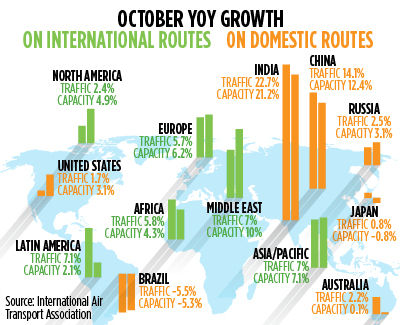
Among international air travel markets, both European
airlines and Asia/Pacific airlines with routes to Europe have seen recovery
following terrorism and political instability in the region earlier this year.
Latin America also has seen a strong demand increase amid slow capacity growth,
while Middle Eastern carriers experienced their lowest rate of demand growth in
18 months, according to IATA. While international traffic growth for North
American airlines was the slowest among all global regions, they have seen
steady growth since March.
On
domestic routes, carriers in China and India continued to see double-digit
growth rates in demand as the rest of the world was more muted. Brazil was the
only major domestic air traffic market to see demand decline year over year in
October.