Every industry has buyers and sellers, and most have an additional
network of partners that ease the pain points between the two. The business travel
industry works similarly, but with airlines, hotels, transportation providers, technology
companies, payment providers, global distribution systems, travel management companies
and others, a travel buyer's supply chain is more complex than most. Though challenging
for travel buyers to control, these interconnected relationships help them manage
their category effectively.
Adding to the complexity is that these suppliers and partners
don't have commercial contracts just with buyers but also with each other. Airlines
and hotels have agreements with GDSs, GDSs have agreements with TMCs and TMCs have
agreements with airlines and hotels—independent from each party's agreement with
the buyer. It's an invisible stream of payments, incentives, commissions, bonuses,
overrides, discounts, waivers and favors. And it poses a challenge to travel managers.
What if these agreements create dynamics that are harmful to
travel buyers or create potential conflicts of interest for their suppliers and
partners? Moreover, what if the buyer doesn't even know they're there? This is the
hidden economy behind business travel. And the list of unresolved issues in this
hidden economy continues to grow. Consider how the following conflict-of-interest
scenarios affect travel buyers and their programs.
The At-Odds Pricing Structure
You've decided to manage your company's travel. In that single
decision, you've already hit perhaps the most fundamental of conflicts in the managed
travel industry: the transaction pricing model. Because a primary goal for most
buyers is cost containment or cost reduction, transaction pricing puts the travel
program's goals at odds with suppliers' revenue objectives. Simply stated, in a
transaction pricing model, buyers benefit from fewer transactions and suppliers
benefit from more transactions. A few suppliers—particularly TMCs like AmTrav Corporate
Travel, Executive Travel and most recently Casto Travel—have experimented with subscription
pricing, citing better traveler engagement with the TMC when travelers don't have
to consider the fees associated with every touch. But research from The Beat, which
like BTN is owned by Northstar Travel Group, showed that corporations have been
slow to see the merits of such as approach, preferring what they consider to be
the transparency of transaction fees.
Buyers need to be careful in the transaction pricing scenario
because it may not be as transparent as it seems. Even with booking tools, GDSs,
TMCs and suppliers pricing mostly per transaction, buyers need to look closely at
how transactions are grouped—by inquiry, by segment, by trip, by record, etc.—to
ensure that the net economics remain favorable. Buyers also must guard against pricing
practices in which vendors group transactions to increase revenue, and they need
to protect their programs from entities that fraudulently bill for nonexistent transactions.
The Diminishing Discount
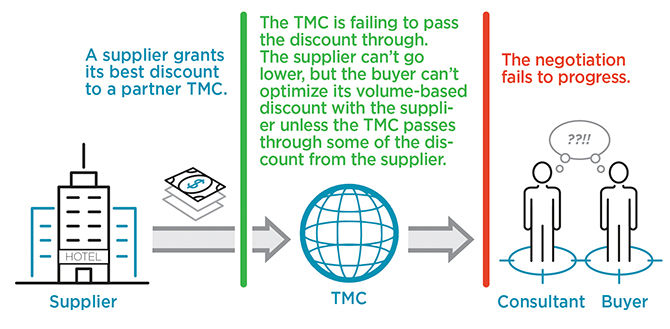
You've hired a consultant to help negotiate a direct deal with
a key supplier. Your consultant and TMC are at the negotiating table. You know that
this supplier is already a preferred supplier to your TMC, but you feel that you
could be achieving a greater "discount" because your expected volume with
this supplier is high. Further, the consultant has reviewed comparable corporate
discounts for this supplier with you, and you're confident you can achieve the additional
savings you seek. After a few rounds, you don't know why the negotiation isn't progressing;
the supplier seems to be dancing around the issues. Like you, your consultant seems
irritated, too, pulling you aside to tell you the supplier's offers are significantly
worse than those it has provided to clients of similar size and travel patterns.
You wonder, "Where is the rest of the discount?"
Both the TMC and the supplier have conflicts of interest with
the buyer because of the commercial agreement they have with each other. The supplier
is not disclosing to the buyer or consultant that it can go no further on a discount
because it is already providing the TMC with a higher-than-usual discount, a portion
of which it expects the TMC to share with the buyer. Nor is the TMC disclosing to
the buyer or consultant what its deal terms are with the supplier or that the buyer
could receive a larger discount from the supplier if the TMC weren't already receiving
such an attractive discount. The discount the consultant said was likely isn't materializing,
not because the consultant had inaccurate data or was incapable of negotiating a
better discount but because the deal between the TMC and the supplier is affecting
the deal between the buyer and the supplier.
The Misaligned Mix
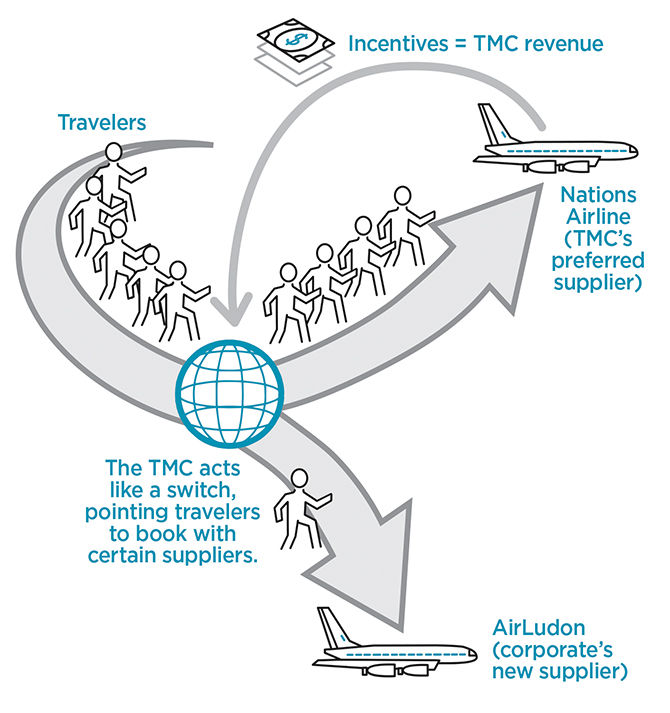
You've hired a consultant to help you negotiate a direct deal
with "AirLudon," a supplier that has quickly become a primary provider
for you and one with whom you expect to increase volume. You realize that AirLudon
is not a preferred supplier of your TMC, but your anticipated volume necessitates
a direct supplier agreement, and your TMC contract still has more than two years
remaining. Your current supplier, "Nations Airline," has been your primary
provider and is a preferred supplier to your TMC. Your consultant and TMC are at
the negotiating table with AirLudon.
The consultant has reviewed comparable corporate discounts for
this supplier with you. If you reach the discounts in the comp set, you will achieve
financial metrics that surpass previous goals. Your TMC seems to be dancing around
the issues.
After a short negotiation, you and AirLudon agree to a discount
in the range your consultant had promised. You're thrilled. But incorporating AirLudon
into the mix proves challenging before, during and after implementation. Your adoption
numbers aren't happening on the time line you laid out. You wonder, "Why is
everything moving so slowly?"
The TMC has a conflict of interest with the buyer because of
the commercial agreement it has with Nations Airline. As you move transactions from
Nations Airline to AirLudon, the TMC may fall short of the volume commitments—and
consequent financial incentives—it has with Nations Airline. These incentives are
often a major source of revenue for TMCs. The TMC is, therefore, not terribly motivated
to accelerate your adoption on AirLudon because of the loss in supplier revenue
it will experience. This misalignment can be costly to both you and your TMC.
Will Shifting Industry
Dynamics Bring Solutions?
These are just a few examples of the unresolved potential conflicts
of interest that may exist in a travel program. Yet they occur frequently, whether
openly addressed or not. And they happen in other areas of the program, such as
online and offline shopping, technology configuration, reporting and program consolidation,
data transfer between third parties and consulting projects. Given that agreements
between third parties likely contain confidentiality and nondisclosure clauses,
the travel buyer's visibility and access to vital information may be limited.
Significant shifts happening in the business travel supply chain
are creating new conflicts of interest, taxing the longstanding relationships to
which buyers are accustomed. Suppliers continue to consolidate and reduce economic
incentives to buyers and their TMCs, a dynamic that has played out in the air, hotel
and car categories. Public distribution lawsuits are changing the nature of contracts,
redirecting some of the economics among airlines, GDSs and TMCs. And suppliers—particularly
airlines like Lufthansa, British Airways parent company IAG and American Airlines—are
leading experiments with alternative technology and business models to create and
distribute corporate travel offers.
The introduction
of an International Air Transportation Association New Distribution Capability program
by American Airlines, for example, does not just involve a new technology standard
for distributing content. It also involves a new economic model. Under the proposed
arrangement, American Airlines—instead of GDSs—would pay TMCs an incentive, and
TMCs would likely pay—instead of be paid by—GDSs for usage of the services they
consume. The proposal has received some positive feedback, but travel buyers have
to weigh the benefits and drawbacks, of how a new economic model like this will
flow through their travel supply chain.
New agreements are being crafted, new terms and conditions
are emerging and economics are beginning to flow in new ways. By forcing transparency
throughout the RFP process, having proper representation during negotiations and
introducing disclosure and right-to-audit terms and conditions into final contracts,
buyers could find hidden benefits in the hidden economy.