Supplier rate increases, per se, may not be travel managers'
biggest challenge in 2017. Instead, uncertainty—in emerging market performance,
in the global economy, in geopolitical relationships and in financial markets,
interest rates and commodity prices, oil, in particular—has produced a fragile
business environment and potential volatility in major business markets around
the globe, according to the 2017 business travel forecast, co-authored by the
Global Business Travel Association and Carlson Wagonlit Travel.
Region by Region
 Source: Global Business Travel Association & Carlson Wagonlit Travel's 2017 Global Travel Price Outlook
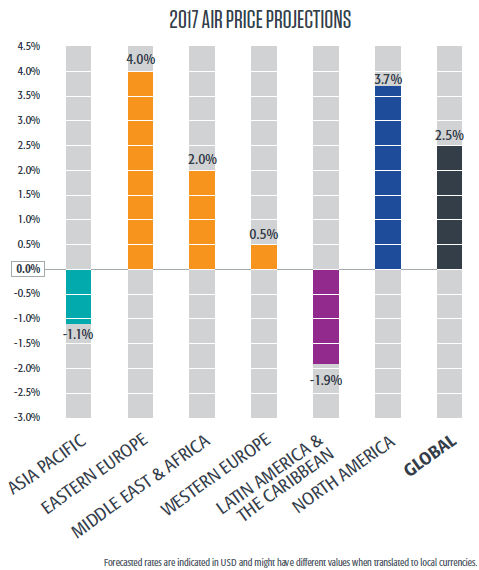
Suppliers in North America will maintain the strongest
overall price positioning for 2017, according to the report, which projected airfares
in the region to rise 3.7 percent. Low oil prices and rising fares will allow
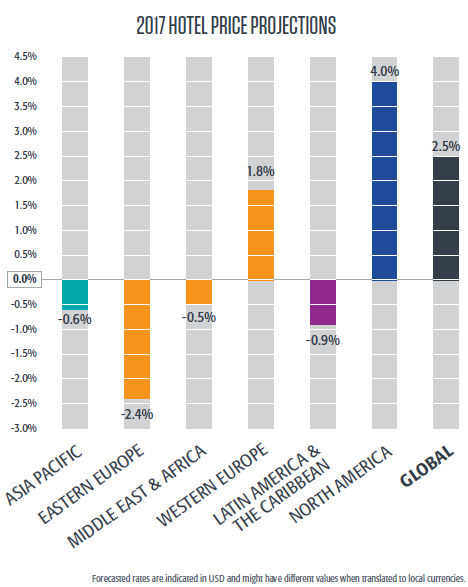
North American airlines to reinvest in products and services. Hotel prices,
continuing a soft landing from peak highs in some markets, will rise overall by
about 4 percent. But it will be a tale of two coasts, with supply shortages on
the West Coast driving prices up by low double digits while the East Coast may
slide slightly backward thanks to low demand from Toronto's oil and gas
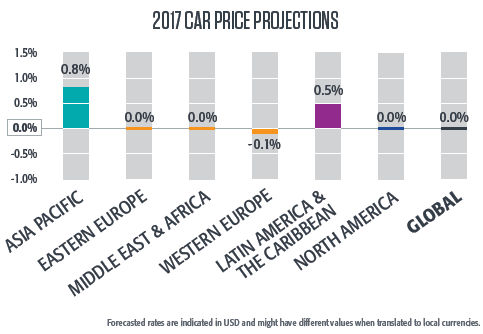
industry and oversupply in New York. The report projected flat ground
transportation rates for the region.
Europe, the Middle East and Africa, hit by recurrent terrorist
activity and the uncertainty of Brexit, is among the most precarious regions when
it comes to travel pricing projections. GBTA and CWT called it a "mixed
bag" with airfares in Eastern Europe up as much as 4 percent due to lack
of competition while rising a half-percent in Western Europe and 2 percent in
both the Middle East and Africa. That said, Delta and Virgin Atlantic have announced
capacity reductions for routes to the United Kingdom, based on stagnant
business travel demand and Brexit concerns. Travel managers should keep an eye
on whether other carriers follow suit. On the hotel front, low oil and gas
revenues will put a damper on travel volume, particularly in Africa, the Middle
East and Russia. Report authors anticipated a 2.5 percent drop in Russia's
hotel rates, a 1.8 percent rise in Western Europe and a half-percent fall in
the Middle East and Africa. Despite the Brexit vote, the report predicted a
strong hotel market in the United Kingdom, with rates rising nearly 7 percent
next year. Ground transportation is expected to remain flat throughout the
region.
 Source: Global Business Travel Association & Carlson Wagonlit Travel's 2017 Global Travel Price Outlook
Suppliers in Latin America and the Caribbean will face rate
decreases overall, according to the report. Airfares will fall 1.9 percent, while
hotel rates are forecasted to drop by just under 1 percent. Ground
transportation offers a dim ray of light, with rates projected to rise by half
a percent. The oil markets will play a big role here, as will political and
economic uncertainty in the region. The economic outlook in Brazil, which was an
emerging business travel darling, has crumbled under oil and gas pricing
pressures. Despite the fact that airlines have cut capacity in the region
ruthlessly, report authors still predict a 7.1 percent drop in fares. Scarcity
of basic resources in Venezuela and challenges in repatriating revenue for
tickets sold in the country have prompted airlines to reduce or stop service to
the market. Not only could this worsen the economic situation in the country,
the report predicts more than a 10 percent spike in airfares and a more than 12
percent increase in hotel rates. Mexico may offer a healthier outlook in the
region, with airfares projected to rise 4 percent and hotels to track a
moderate 2.6 percent rate increase.
 Source: Global Business Travel Association & Carlson Wagonlit Travel's 2017 Global Travel Price Outlook
Asia/Pacific is looking at moderate growth in airfares and
hotel rates in 2017. China is settling into a "new normal," after
years of explosive growth. Airfares there will stall at less than half-percent
growth. The strongest airfare increases in the region will go to Hong Kong, at
3 percent, followed by Indonesia at about 1 percent. Japan will see airfares
decline 5.5 percent, and in Singapore, fares will drop nearly 3 percent,
according to the report. Australia, Indonesia and New Zealand—and China to a
lesser extent—are driving hotel rates 2.5 percent higher in Asia/Pacific
overall. Australia hotel rates will jump 4.4 percent; the increase will be
higher in Sydney and Melbourne, but rates will decline in western energy
markets. A strong leisure market is poised to drive hotel rates up 7.6 percent
in New Zealand. Conversely, report authors show Singapore rates dropping 5.7
percent in 2017 despite tight supply. India, where overbuilding has led to low
occupancy, will see hotel rates decrease by 2.5 percent. Ground transportation
rates appear flat in the region overall, but rates in Australia are expected to
edge up by 2 percent.
"We are seeing relatively low, inconsistent and in some
cases fragile economic growth," CWT CEO Kurt Ekert said about 2017.
"Travelers and travel managers need to understand their
travel patterns and spend and be alert to the impact of economic uncertainty
and volatility."
In
other words, while the global and regional pricing outlook gives a certain
view, the market-by-market analysis tells the real story for travel managers. The
report also underscored that travel managers should expect to be nimble and
make significant changes to protect against market volatility. "Consider alternatives in all aspects of your
program," report authors wrote, "and maintain flexibility with your list of
preferred suppliers to ensure you can adjust and mitigate risks as market
conditions evolve."