“It’s more pressure than I’ve ever seen to deliver the right data to the organization,” said long-time travel buyer and new Grasp CEO Maria Chevalier. “There’s more pressure—not just for the ROI of a trip—but to show the ROI of the [travel] department.
“There’s also a pressure to produce [the data] faster, and you have to get the answer right,” she added, because that speaks to the credibility of the travel manager’s role. “The department can lose credibility, even if one data point is wrong.”
That’s the environment travel managers are working in today—with the demand for data escalating, especially as artificial intelligence-driven technologies seemingly make it easier to produce reports and insights on a moment’s notice. But many travel managers still struggle to get the data—and the data accuracy—they need from their travel management companies, according to a recent survey conducted across more than 200 travel buyers in North and South America by the Business Travel Show America. Overall, more than 42 percent of survey respondents indicated at least one category of their TMC’s data and reporting offerings left them open to increased scrutiny.
[story continues below chart]
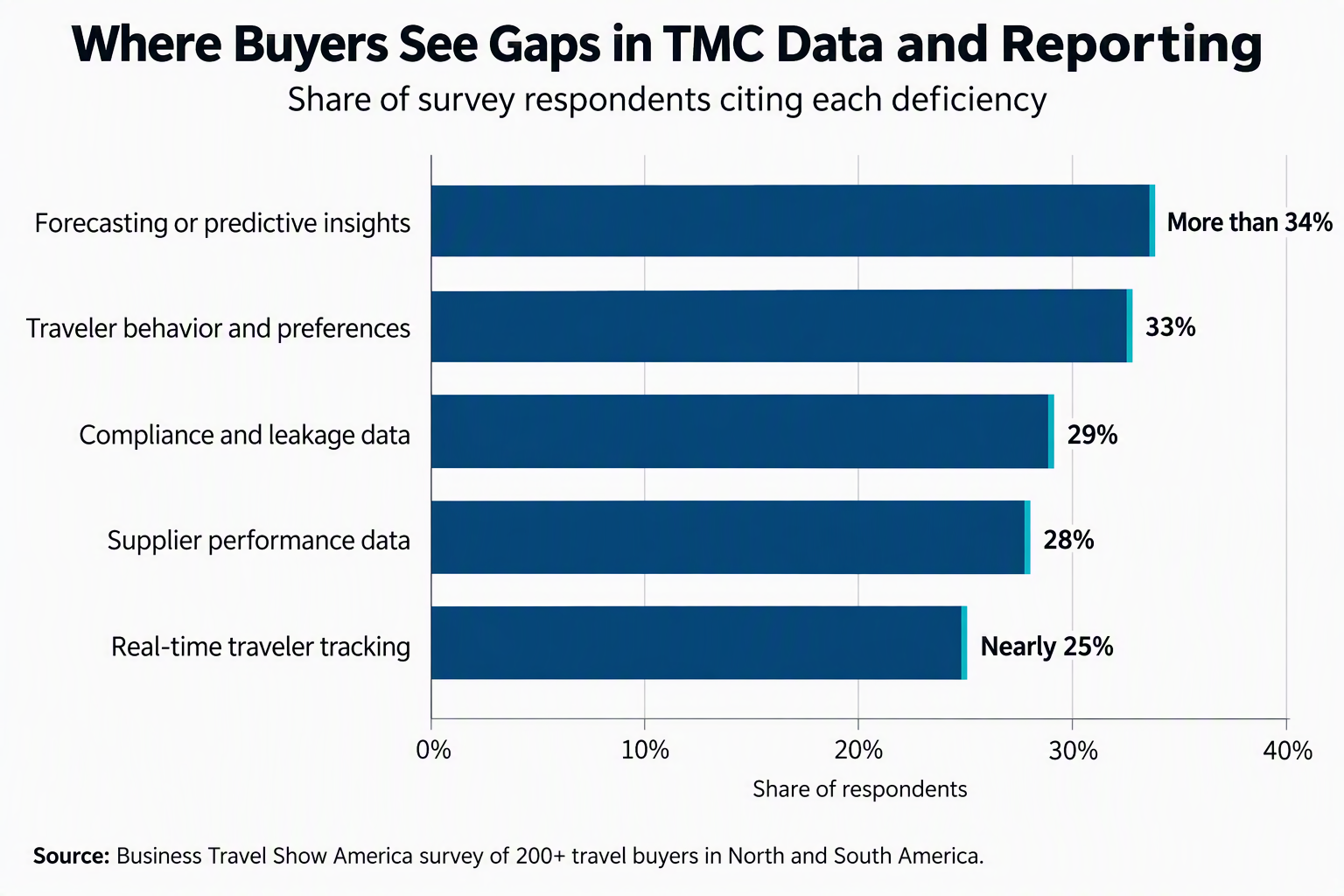
More than 34 percent, indicated TMCs are not delivering enough forecasting or predictive insights in the reporting they offer to clients. One third, would like to see more reporting on traveler behavior and preferences, while more than a quarter see gaps across compliance/leakage data (29 percent), and supplier performance (28 percent). Nearly a quarter need better delivery of real-time data relating to traveler tracking.
Deficiencies Run Deeper than Reporting
TMCs are working to improve those percentages, with a number of them collaborating with data experts like Prime Numbers, online booking tools like Serko.ai and even off-channel booking aggregators like Traxo to bring more and better data into their universes. To that end, 16 percent of buyers told BTSA that they are fully satisfied with the data their TMCs provide and 39 percent said they felt their TMCs deliver almost all the data and reporting they require.
That said, some travel buyers have noted deeper issues, especially in and environment of escalating demands from program stakeholders and executives, as noted by Chevalier. This makes instant insight delivery even more vital.
That point is not lost on experienced travel managers like Zillow senior corporate travel manager Tami Pharr.
“Programs are being asked to manage forward, not report backward—and that's a different data requirement entirely,” she said, underscoring the need for insightful forecasts and predictive intelligence. “I've spent real cycles getting TMC data into our own warehouse and dashboards, because the reporting portal a TMC provides and the questions a program actually needs to answer are rarely the same thing. Until that gap closes, buyers will keep building the forecasting layer themselves.”
Additionally, Pharr said, data quality becomes a more fundamental concern even if the TMC data reporting categories and predictive layers were in order.
“The data sets buyers say are missing matter, but none of them are worth much until the data you already receive is clean, consistent, and defined the same way every time,” she said.
AI has changed how Pharr is working with Zillow travel data but without assurances on data quality, manipulating the data can’t provide real insights.
“I recently had an AI assistant condense two years of booking data across two platforms, rank spend by carrier and build my talking points for an airline meeting. This is work that used to take days. That's exactly why these gaps sting more than they did two years ago: the analysis layer has moved faster than the data layer feeding it."
Taking the Data In-House?
Due to this gap, more travel managers are looking to take their data in-house to produce more insights, particularly those buyers with larger programs. But AI is making it more possible even for smaller buyers to get in on this game.
Cornerstone CEO Mat Orrego, sees more companies wanting to work on their data independently from their TMCs—though the data provided by those partners is critical. Travel buyers “need the data normalized, quality scored, aggregated before it ever touches a benchmark. [That’s] what lets us publish credible industry measures."
Only then, said Orrego, can buyers apply benchmarks, compare their information to data of its peers, and apply their own AI to serve and understand a unique company.
This year’s Business Travel Show America will host panels directly related to AI use in travel programs, where travel buyers will have the opportunity to learn more about the impact of AI on data management. The exhibit hall, as well, will host more than 20 companies that are specializing in data delivery, including Amadeus Cytric, Blockskye, Cerebri AI, Cornerstone, Grasp and many more. These companies are focusing on the latest innovations and solutions in data management and analytics, so keep an eye out for them at this year’s show!