When Adeline Kang, director of travel, meetings, card and fleet operations for pharmaceutical giant MSD, known in the U.S. as Merck & Co., at the end of 2023 went out to bid for a new global travel management company provider, she kicked off what became a 24-month process.
In that time, Kang and her colleagues reviewed and organized hulking spreadsheets, went back and forth with providers to decipher paragraphs of "fluff" in bid responses and endured countless late nights and early mornings to coordinate time zones for the manual supplier scoring and evaluation stage.
MSD may have a large, mature global travel program that spans approximately 70 countries, but what Kang experienced isn't uncommon. Travel managers across all categories, regions and company sizes have, at some point, had to navigate lengthy, overwhelming requests-for-proposals exercises.
The RFP is the basis of billions of dollars in corporate travel spending decisions. It's also a model of inefficiency.
 Adeline Kang
Artificial intelligence could change that, or at least improve it, by shrinking RFP lifecycles, expanding the capacity of teams and individuals, and enhancing the foundational data used by both sides throughout the process.
Kang is convinced that if she had to launch an RFP today, AI would give her back many of those sleepless nights spent trying to compare TMC compliance credentials.
Where AI Can Help
Much of the early adoption of large-language-model AI platforms like OpenAI's ChatGPT and Google's Gemini by individual users has been focused on outsourcing mundane or repetitive tasks in daily life, whether at home or for work.
AI offers the same promise for the mundanity of RFPs.
"RFPs are brilliant for [AI use]," said Jean Belanger, CEO and co-founder of Cerebri AI. "There's so much grunt work, and everyone hates filling out RFPs."
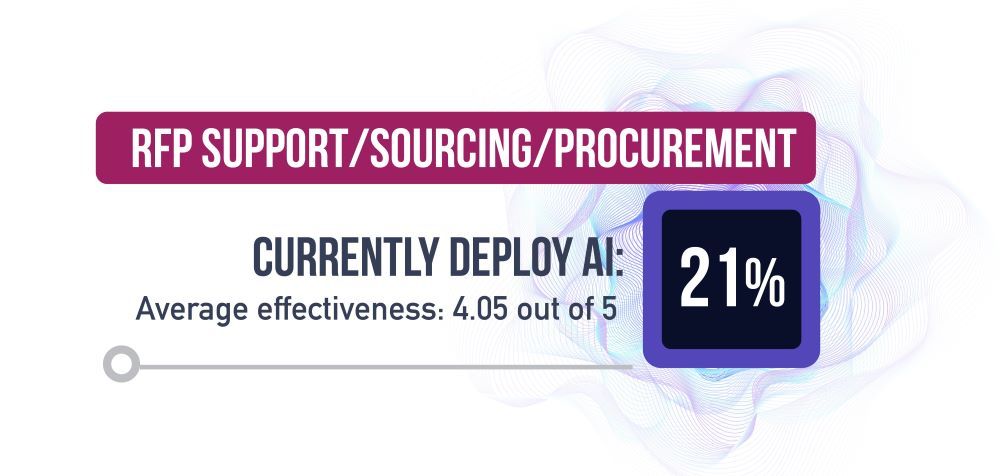
[Despite that potential, only about 21 percent of travel buyer respondents in BTN's survey who are using AI in their programs have said they're using it for RFP support, sourcing or procurement. Those who did gave it an effectiveness score of 4.05 out of 5.
Philip Haxne, senior director of global travel at esports management company ESL Faceit Group, said he's using AI for data analysis.
 Philip Haxne
"Travel is a high transactional business," Haxne said. "We're using it to make sense of the data that we have and using it to strengthen our positioning in the RFP process."
Haxne also is using AI for contract evaluation, searching for gaps.
"If you look at the contract versus volumes and also the spread of volumes," Haxne said, "how can we strategically contract the suppliers that we have to support our business in the best possible way?"
One travel buyer, who preferred not to be named, said he's using AI for "anything and everything travel-related," including drafting and refining RFP documents, conducting comparative analysis on pricing, amenities and contract terms, creating ranked scorecards to evaluate suppliers and supporting lower-value hotel contract negotiations.
"I don't have dedicated analysts on my team," the buyer said. "[AI] gives me the ability to essentially have analysts on demand. I can run through multiple scenarios for bid results, looking at pricing and pulling different levers."
MSD's procurement organization uses the SAP Ariba platform for its RFPs. Kang said after her team launched its global TMC RFP and, later, a global meetings management company RFP, MSD deployed a dedicated data analytics team that used AI tools to produce dashboards from the Ariba outputs, making sense of the massive volume of proposals that had come in so that Kang's team could evaluate each.
Kang said she and her team also leveraged AI translation tools built into Microsoft Teams during capability presentations for the RFP.
"That was important for us, especially for my region [Asia-Pacific], because we do have a lot of stakeholders where English is not their first language," Kang said.
Having the translation available in real time allowed the travel procurement teams to pose key questions to suppliers and understand if they had the adequate expertise to handle the pharma giant's complex program.
Buyers aren't the only ones experimenting. Suppliers are integrating AI into their own workflows too, both within RFP platforms and behind the scenes to streamline internal operations.
"Flight Centre, the parent company, is a 16,000-person global company," said John Morhous, chief experience officer for corporate brands at Flight Centre Travel Group, "and just like every global company, we're using these tools to drive productivity and automation to make employees more efficient at what they do and rethink some of our workflow and processes."
Morhous said Flight Centre subsidiary TMC FCM is using an AI RFP support product called Responsive that helps teams with databasing and documenting answers to questions typically posed to FCM during the sourcing process. The product doesn't automatically answer RFPs but rather gives sales and customer success teams access to standard responses to standard questions that can then be tailored to individual customers.
"One of the really valuable parts of AI tooling is that you can use what you create as kind of a source for quality assurance, whether it was good enough," Morhous said. "Then continually build a better and better repository by giving very clear examples of 'this was an excellent response' versus 'this was a mediocre response.'"
All FCM sales and bid response team members also have access to enterprise-level Anthropic AI tools, which Morhous said the TMC is using to craft better, more detailed and accurateresponses to RFP questions using an up-to-date library of information.
It's that kind of standardization and quality control that Kang cited as being absent from TMC processes during her 2023 global RFP.
"The responses were crazy," Kang said. "It was like paragraphs and paragraphs of words… We read it, and we're like, 'What are they actually trying to tell us?' We had to go back many times with follow-up questions on certain areas that we had concerns about, like governance and compliance."
Gazzebo founder and CEO Jeff Urban experienced TMC RFP chaos firsthand during his tenure as director of sales and business development at CWT. Urban was placed on a six-month furlough at the end of March 2020 amid the Covid-19 pandemic. When he returned, he came back to an inbox full of RFPs, an impossibly small team to answer them and a lot of outdated, unusable information.
It's that experience at CWT and elsewhere that Urban said gave him the idea to launch Gazzebo, an AI-powered travel procurement marketplace that connects corporate travel buyers with verified TMCs. The platform leverages AI intelligence to learn from buyer behaviors, score and match buyers with TMCs, and provide suppliers with SWOT analysis and anonymous benchmarking. Urban said the goal is to improve transparency and make it so both sides spend less time on paperwork and more time on the actual relationship.
One of the more onerous sourcing exercises in the corporate travel world is the annual hotel RFP.
It's also the most important, according to Cerebri AI's Belanger. While air represents the largest spend category in the majority of corporate travel programs, air contracts typically are negotiated every two to three years with a smaller volume of airlines. Hotels, however, are negotiated every year, often across thousands of properties globally.
"Processing RFPs is a lot of grunt work; dull, boring, witless work," Belanger said. "But it has huge financial consequences."
Belanger said Cerebri AI is working on a hotel RFP agent—that is, a hotel RFP offering that leverages agentic AI—to reduce the "grunt work" and level the playing field between hotels and buyers, ultimately making the process faster and less burdensome for both sides.
One provider very familiar with hotel RFPs is corporate lodging, meetings and payment platform HRS. Tim Wagner, HRS SVP of global supply and operations, said the company has been applying AI across the hotel sourcing process for the past few years. Some of those applications include data consolidation and cleansing, demand analysis, hotel portfolio optimization, RFP execution and follow-up, rate loading and rate auditing.
"Our clients hadn't seen AI yet because it's not visible to them," Wagner said. "It's basically in the managed service that we provide to them and it internally supports our work."
Since last year, customers have become more familiar with HRS's use of AI via HRS Copilot, which leverages HRS language models and Anthropic's LLM to support corporates with hotel program strategy and decision-making. Wagner said program managers can use what-if scenario modeling to factor rate, sustainability, traveler preferences and other decision levers into their program.
Where AI Could Harm
AI's promise for buyers and suppliers, however, comes with tradeoffs.
"If you're using AI to write a Shakespearean sonnet about the weather outside and it comes out stupid, you think it's pretty funny," said Belanger. "It's not funny if you lost $100,000 on your hotel bill this year because you bid the wrong price."
Haxne said he's currently using two different company-sanctioned, enterprise-level LLM platforms to cross-check the output of the other.
"AI uses a lot of what you input before, and then it makes an assumption that everything is connected one way or another," Haxne said. "By using two different AI platforms, you can find the gaps in the different platforms. … It's good to ask it in two different ways on two different platforms."
Haxne said he also avoids using AI for real-time information or situations that directly impact traveler safety—for example, which airlines are currently flying to the Middle East amid the war with Iran.
Gazzebo's Urban said another risk with public LLMs is the sharing of confidential information by individuals who don't understand how their queries are being used.
"You have smaller businesses that don't have enterprise-level data security protocols and people using personal AI tools without realizing the risk involved from the business end," Urban said. "This information is being crunched by a platform that's making some of the information that's going out there public."
He added that some suppliers have revealed to him that confidential information they'd provided during bid conversations, including pricing, has ended up on public LLMs.
"You only get one shot to make a first impression," Urban said, "and pricing is highly confidential." He advises anyone experimenting with AI to avoid sharing sensitive information—or to use an LLM that doesn't train on user conversations.
Kang said after MSD became the victim of the global NotPetya cyberattack in 2017, the company built a robust internal IT infrastructure and took a proprietary approach to AI. MSD has its own gated LLM platform called GPTeal.
Where AI Will Go
AI's foothold in the RFP process is still early, but those already using it are thinking well beyond the bid itself.
Wagner said HRS mapped the total length of a hotel RFP cycle last year and found it took 167 days. The company has a goal to reduce that duration to just 17 days by applying agentic AI across various RFP functions, improving supplier response time and optimizing customer use of HRS Copilot.
Kang said her team received access to MSD's agentic AI in the third quarter of last year. She now wants to leverage it across the entire life cycle of an RFP.
"It's not just the RFP, right?" Kang said. "There's so much that happens after the award—the implementation, the stabilization."
Still, greater efficiency doesn't necessarily mean fewer negotiations. Belanger cautioned that as the RFP process gets faster, more time may shift toward haggling over price.
"Everybody thinks that the [AI] agents are going to eliminate the problem," said Belanger. "The problem's not going to go away. The noise is going to go away, but you're still left with the core decisions."
Haxne raised a different concern.
"If you have a TMC that is giving us an RFP response, which is done by AI and we look at it through AI and answer back, then it just becomes very generic," he said. "I think you should never underestimate the personal relationship. The RFP is one thing, but the delivery of what you've procured is a different one."