Artificial intelligence has long-established utilization in auditing expenses and detecting fraud, and BTN's research shows it's the area that's driving the most effective results for travel buyers.
Broadly speaking, AI brings auditing capabilities that can detect abnormalities or patterns that are easily missed by human auditors beyond clear policy violations. For example, a human auditor on an expense report might see an expense for a dinner, paid in cash and submitted without a receipt, that appears within policy because the total is exactly $1 below the receipt threshold. AI technology, however, could notice that the employee has done the exact same thing numerous times and call the behavior into question.
AI also can help with the collection of data needed to audit expenses and combat fraud—analyzing receipt images and payment data and itemizing transactions, translating languages or providing additional context, such as whether location matches up with what makes sense for a business transaction.
 Paula Prejs
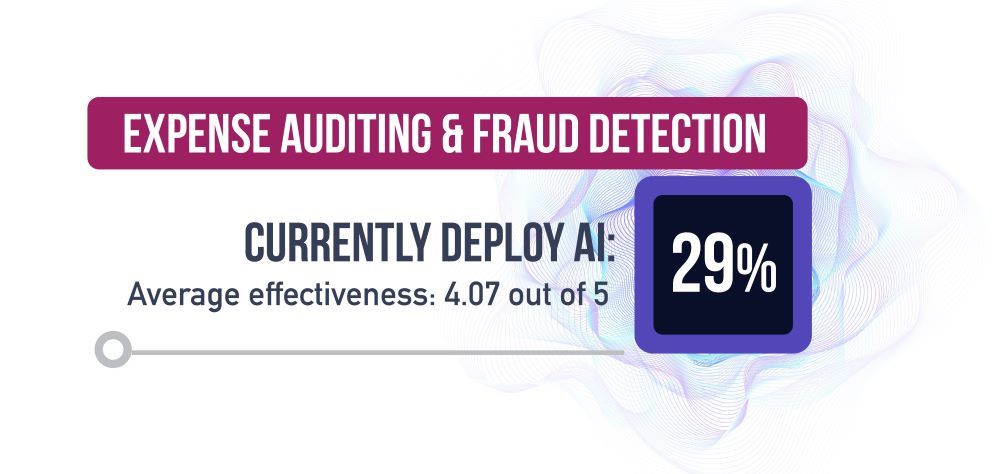
Expense management providers, as well as audit-specific technologies like AppZen, have been honing those automated capabilities for more than a decade. Even so, BTN's research shows that fewer than 30 percent of buyers say they are using AI tools for expense auditing and fraud detection. Of those who do, they rated the tools' effectiveness an average score of 4.07 on a 5-point scale, the highest effectiveness score of any category in the survey.
Paula Prejs, global category manager for travel and expense for lighting manufacturer Signify said her company employs SAP Concur's Detect by Oversight tool, which uses machine learning and AI to detect fraud and compliance risks, to help in expense report auditing. At her previous company, which was much smaller, her team was manually auditing 100 percent of reports, but that would not be possible at a company the size of Signify, which uses Concur's Detect tool in about 60 countries, she said.
"Of course, I would like to have an eye on everything, but with such scope, I understand it isn't possible," Prejs said. "I can't imagine the team doing that manually, because even if they didn't have any other responsibilities, it could not be done."
With the AI auditing backup, Prejs said about 10 to 15 percent of expense reports require manual auditing. Her team has set up as many rules as possible in the tool to catch noncompliance, she said.
Chemical manufacturer IFF also recently has introduced AI auditing to its employees reporting through Concur Expense, global T&E manager for procurement corporate servicesAdriana Menéndez-Huerta said. Her team's analysis has shown the automation has saved the equivalent of at least three full-time employees in-house, she said.
Implementation takes more than just setting up the parameters, as at IFF, it took about three to four months of training and communication for a smooth rollout. Some rules have had to be tweaked, said D. Srinivas Reddy, IFF's operations manager for the T&E team. For example, if an employee expensed a bottle of water bought at a minibar, it was getting flagged because the audit was set to reject all minibar expenses, so that was adjusted to reject minibar expenses over a certain cost.
 Adriana Menéndez-Huerta
Companies should also expect a little friction if their employees are not accustomed to having expense reports scrutinized or are not keenly aware of company policies, as they'll see reports rejected that might have been accepted before, Menéndez-Huerta said.
"If you go from no process to a process where the traveler is getting a lot of notifications, for sure, at the beginning, it's getting noisy," she said. "For us as a company, it shows that we care and we control. At the beginning it's a bit of work for everyone, but it means we are doing our due diligence in terms of compliance."
Ultimately, expense management providers say AI auditing capabilities will reduce the back-and-forth and help employees manage exceptions earlier in the process. Emburse, for example, in February announced a new AI expense compliance tool that checks receipts for errors prior to submission, such as if tax information is missing or a receipt that needs itemization. The tool prompts employees to correct those errors before submitting the report rather than having it sent back to them after submitting.
As AI is better able to understand policies and context, it will increasingly be able to catch out-of-compliance purchases at the point of payment and booking, which will ease the burden on the expense reporting side, with expenses already audited even before they are submitted. Navan, for instance, reports that 73 percent of expenses that it processes are approved and reconciled without human intervention.
However, AI also is introducing new challenges to expense auditing and fraud detection, especially as AI image generators enable users to create fake receipts with realistic logos and even fake metadata that make them difficult for human auditors to catch—which will ratchet up the need to have AI capabilities in auditing. SAP Concur SVP and head of product marketing Christopher Juneau in a December blog post noted that Concur's Verify tool has been flagging on average about 1 percent of reviewed receipts as potentially AI-generated.
"AI isn’t increasing the frequency of expense fraud, but it is changing how it occurs," according to Juneau.