Most corporate travel managers are still on their first
steps of their sustainability journeys. It is clear that, no matter what the
messages are that are emerging from the EU or the White House, that more
companies are taking those steps.
Those companies in the early stages of their sustainability
journeys will quickly mature thanks to the proliferation of technology and
expertise in the market today.
“There is an expectation in the uplift of the quality of
sustainability data to finance-level, audited data,” said CTM head of
sustainability Lauren Hook. “What this means is the need for accurate and
timely data will become increasingly important for businesses at both ends of
the sustainability maturity spectrum.”
While we have seen that companies are reacting to regulatory
pressure more than anything else in their sustainability strategies, peer
pressure is also important.
“We are seeing very significant pressure being applied by
some of the largest companies in the world, in particular, Microsoft,
AstraZeneca, Salesforce, Schneider Electric and Siemens [are] asking their
suppliers to report on their emissions and set up their own forward-looking
targets,” said Adam Braun, founder and CEO of Clarasight.
“We actually believe that added business pressure is more
powerful than just the regulatory pressure. Often, we're hearing from companies
saying we need to do more than just report on last year's emissions. We now
need to set credible targets going forward and then have both a system of
record and a system of action to be able to credibly achieve that goal.”
Thrust Carbon’s CEO Kit Aspen believes we will see more
carbon budgets being used by corporates. Indeed, Concur is set to facilitate carbon budgets in its booking
tool this quarter.
In May, Thrust Carbon’s CEO Kit Apsen told BTN Europe that
it will be the first organization to take advantage of the new capability, with
“several corporates lined up for the initial rollout, including a mix of
Fortune 500s.”
Aspen believes that carbon budgets at the team level will be
the most popular. “How can an individual make that decision? If they think
their trip is more important than their boss's trip in two months’ time
they’re going to book it anyway,” he said. “There are also many places out
there where there is only one flight a day. If your carbon budget said you now
have to reduce your carbon by 10 per cent then that is useless information—you
are going to take that one flight.”
He continued: “When you have budgets at a division
level with 10,000 people, it is too impersonal. What does it matter that you
are emitting one tonne of CO2 when the division still has thousands of tonnes
to emit.” Teams are therefore the sweetspot where a budget is most meaningful
and can truly change behavior and thus impact.
FLYING TOWARDS 2050
Decarbonizing aviation in particular will remain crucial to
decarbonizing business travel by 2050. The figure below shows a range of
different pathways that aviation might achieve net zero by 2050. It shows
scenarios outlined by IATA, ICAO, the International Council on Clean
Transportation and the Air Transport Action Group.
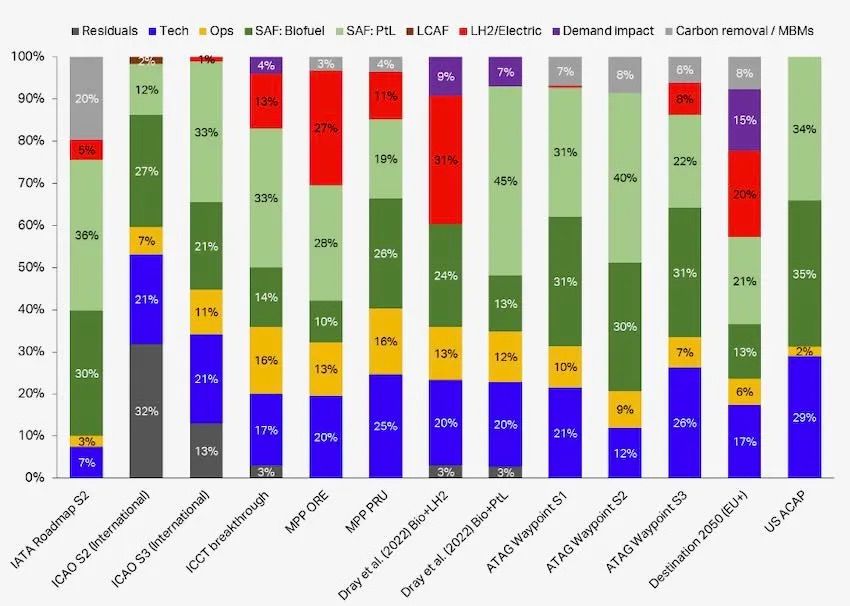 Net-zero transition: multiple levers in different combinations Source: IATA
American Express Global Business Travel’s head of
sustainability, Nora Lovell Marchant, said the figures reveal that “the
low-hanging fruit is basically gone” but that sustainable aviation fuel, shown
in green, is a major part of all these scenarios.
Operations (shown in yellow), such as using greener flight
paths, and tech (in blue), like more fuel-efficient planes, make up another
significant part of the emission reductions.
Carbon removal and market-based measures (light grey), such
as carbon pricing in Europe’s Emissions Trading Scheme, are also important in
many of the scenarios. Other scenarios leave residual emissions (in dark grey)—carbon
emissions that cannot be removed by other methods—that need to be offset in
some other way.
CONTROLLING DEMAND
Many of the scenarios include a purple bar denoting demand
impact or reduction—i.e. reducing the demand for business travel.
Will fewer business trips be part of the solution? The BTN
Intelligence survey showed that 46 percent of travel managers are promoting the
use of virtual meeting tools instead of face-to-face travel, although few if
any companies are mandating this.
Katharina Riederer, co-founder of eco.mio, said: “Obviously
it's the best solution not to travel but the difficulty in our industry is that
this industry exists because of travel, so reducing travel... no one really
wants to push that. Also, when I do my booking, I have already decided that I
have to travel and I have already got the approval.”
Nora Lovell Marchant said the pandemic showed that meetings
could move to Zoom. “Now aviation traffic is growing because people know the
value of business trips and putting people in front of people,” she said. “Are
there some business trips that can and should be replaced with Zoom?
Absolutely, but is there some business travel that will remain imperative
forever? Absolutely.”
She continued: “We need to think about how to decarbonize
that... because even the most liberal non-profit organizations recognize that
other types of solutions besides demand management alone will be needed in
order to decarbonize aviation.”
Benjamin Park, head of travel and sustainability at Parexel,
expects sustainability in business travel to become more data-driven, with
increased transparency and accountability. “Emissions methodologies will
evolve, and corporates will need to adopt more granular tracking and
reporting,” he said.
Park also believes that employee and customer expectations
will increasingly influence corporate travel programs. “For roles requiring
travel, the maturity of a company’s sustainable travel strategy may become a
differentiator in talent attraction and retention,” he said.
Park added: “While cost management remains important, we are
seeing a shift toward ‘purposeful travel’ where the value of each trip is
weighed against its environmental impact. This mindset helps us reduce
unnecessary travel while preserving essential face-to-face patient and customer
engagement.”
As Advito’s senior director of sustainability Julien
Etchanchu said, in spite of delays to the full roll-out of CSRD, “at some
point, we will have to travel less not just because of the environment but
because at some point there will be an energy crisis.”
Could unbridled aviation growth be managed through taxes and
fees that are reinvested in the industry’s pursuit of net zero? “One percent of
people on Earth are responsible for 50 percent of aviation emissions. People
want to travel. At the moment, someone traveling once every 10 years is taxed
in the same way as a business traveler traveling 20 times a year.
“The problem is you don’t pay for the pollution you make—that
is the ultimate issue. You could imagine a frequent flyer levy where the first
trip is free of tax, the second you start to increase it a bit and by trip 10
you are highly taxed and ever more highly in business class. The pressure for
levies will grow,” warned Etchanchu.
With only 25 years to go until 2050, the aviation industry—and
wider business travel sector—is running out of time to decarbonize. While
plans, policies and ideas are rife, now is the time for action.
NEXT
ARTICLE: CASE STUDY - ZURICH INSURANCE - CARBON COMES FIRST
RETURN TO BTN'S 2025
BUSINESS TRAVEL SUSTAINABILITY REPORT