Sustainability
and carbon reporting in business travel is alive and well in 2025,
according to a BTN Intelligence survey of 198 business travel buyers
located predominantly in North America and Europe. Geopolitical
uncertainty, particularly related to U.S. President Donald Trump's return
to the White House, has seen some companies pull back from their net
zero commitments but sustainability is still important, and not just for
travel buyers based in Europe, as is often touted.
The BTN
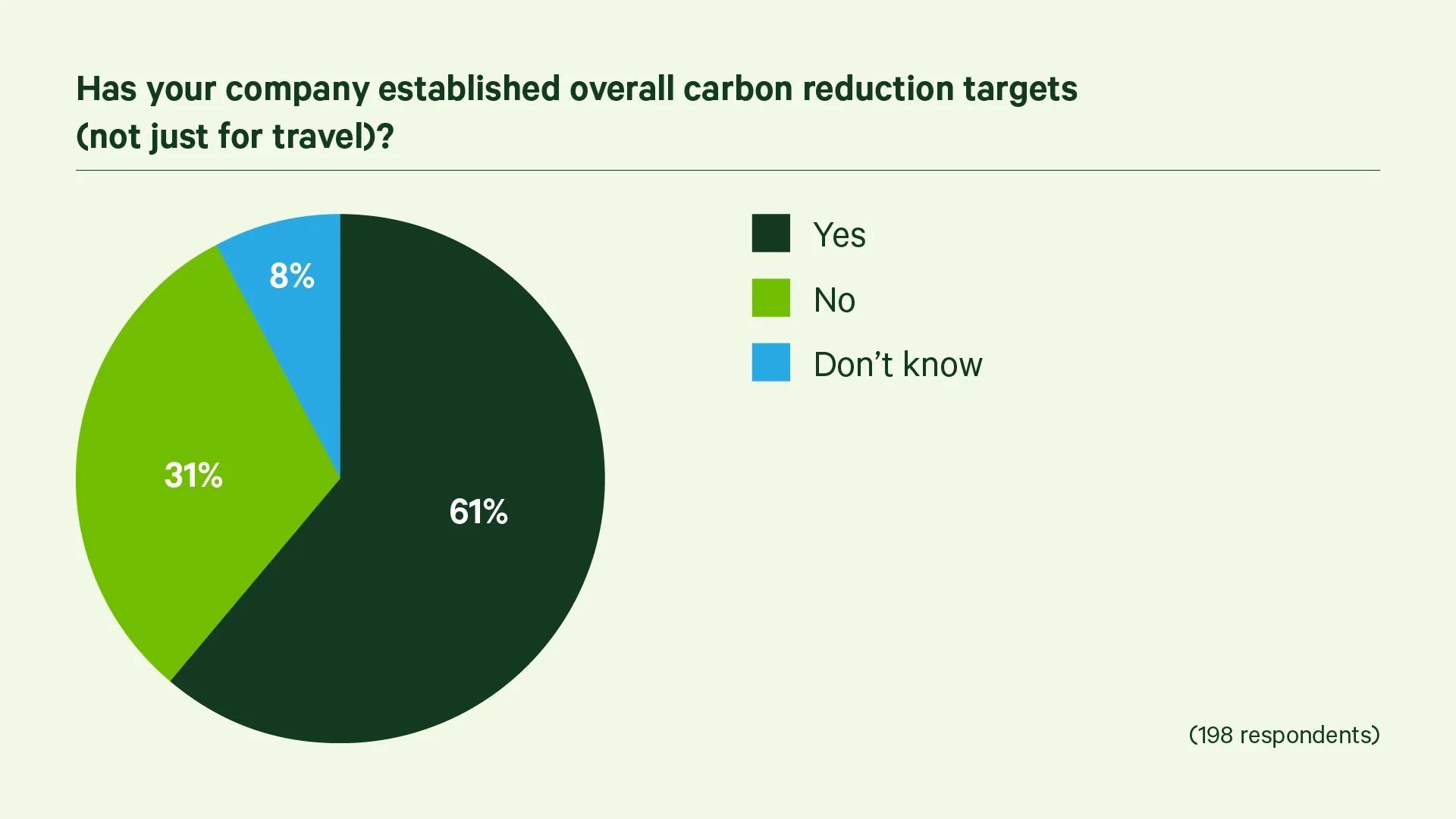
Intelligence survey, conducted between April and July, reveals that 61.1
percent of organizations have set overall carbon reduction targets.
Organizations with travel managers based in Europe (67.2 percent) are
more likely to have set such targets than those in North America (56.2
percent).
BUSINESS TRAVEL IN THE CROSSHAIRS
Although
the majority of organizations setting overall emissions reduction
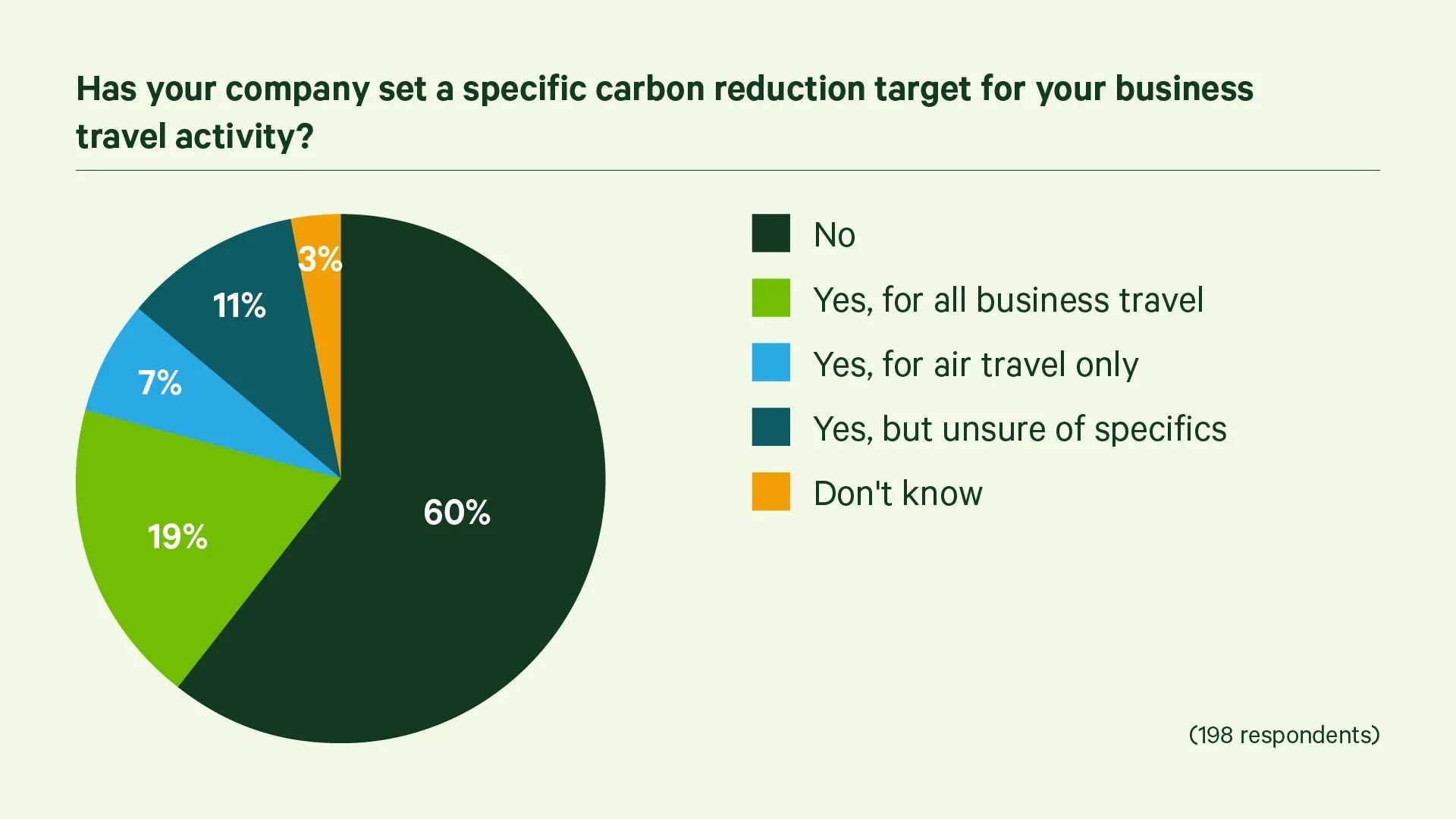
targets is high, the proportion of those that have set specific targets
to reduce business travel emissions – categorized under Scope 3.6 of the
GHG Protocol, which sets global accounting standards for carbon
emissions – is much lower, at 37 percent. Again, there is a disparity
between Europe and North America.
Some 44.6 percent of
Europe-based travel buyers have set some sort of emissions target for
business travel, compared with 28.9 percent of buyers based in North
America. Diving deeper into these figures, 18.7 percent of buyers
globally have set targets for business travel generally while 7.1 percent have set targets but only for air travel. Roughly one in 10 (10.6 percent) have targets for travel but the buyer is unsure of the specifics,
suggesting there needs to be better communication between sustainability
and travel teams within organizations.
REGULATION RULES THE ROOST
More
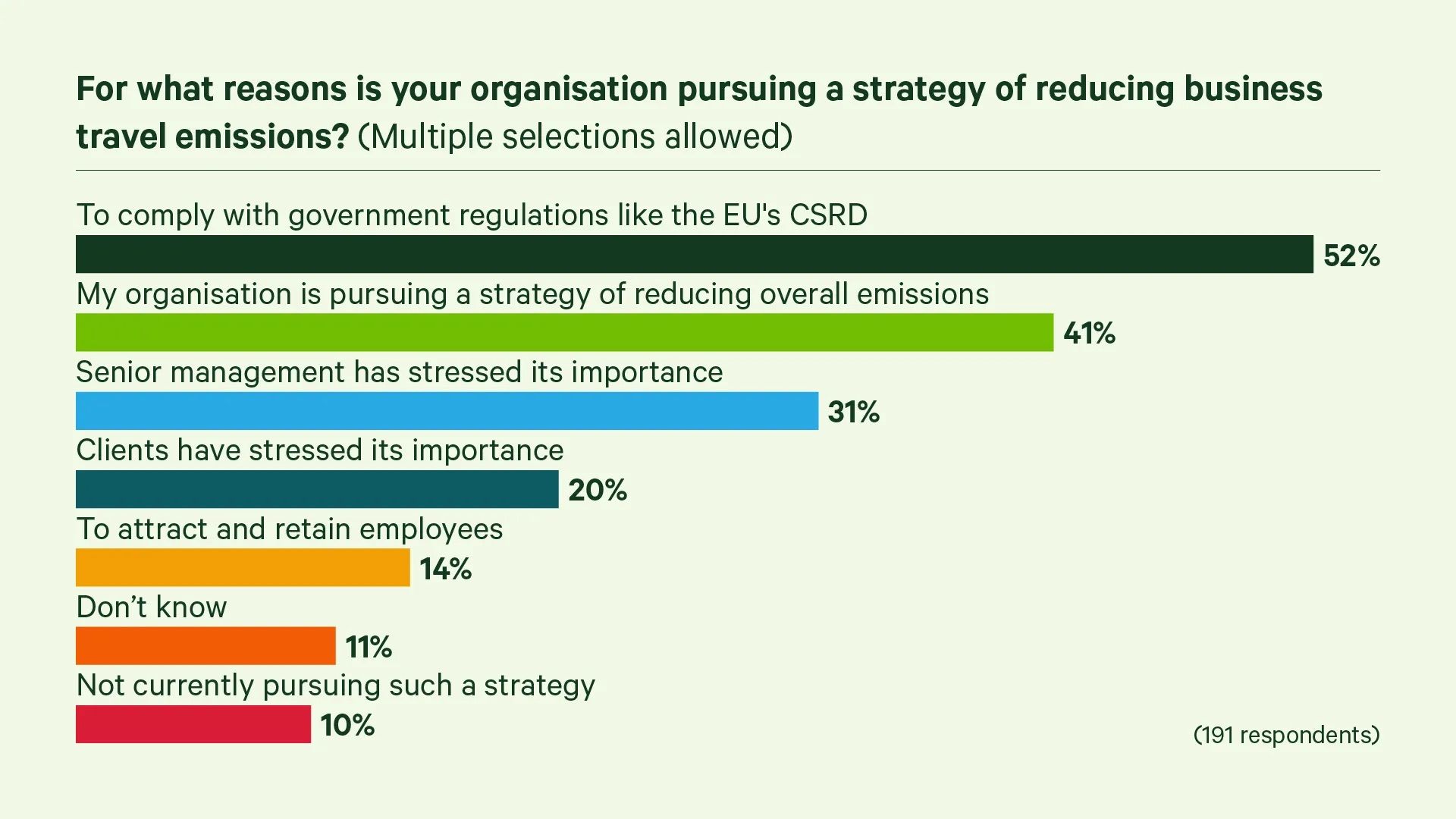
than half of buyers (52 percent) cite compliance with regulation such
as the EU's Corporate Sustainability Reporting Directive as a reason for
pursuing business travel emissions reductions – the most common response
among respondents.
Pressure to reduce emissions frequently comes from the top, BTN's survey
found. Just under a third of organizations (31.4 percent) say that
senior management has stressed the importance of reducing business
travel emissions. Around a fifth of buyers (20.4 percent) say clients are asking for this.
Given the current status of legislation around the world, it
comes as no surprise that there are significant differences depending
on the location of the travel buyer. In Europe, 73.8 percent say they
have business travel targets because of legislation such as CSRD; in North
America, this figure is 36.4 percent.
Europe-based organizations are also more likely than North American ones
(49.2 percent versus 33.9 percent) to be pursuing a strategy to
reduce business travel emissions even when legislation
is not compelling them to do so. In North America, it is more likely that a
leader committed to sustainability is the driver for an emissions
reduction strategy (33.1 percent against 26.2 percent in Europe).
THE CALL OF CSRD
Despite
changes being approved earlier this year that delay some CSRD reporting
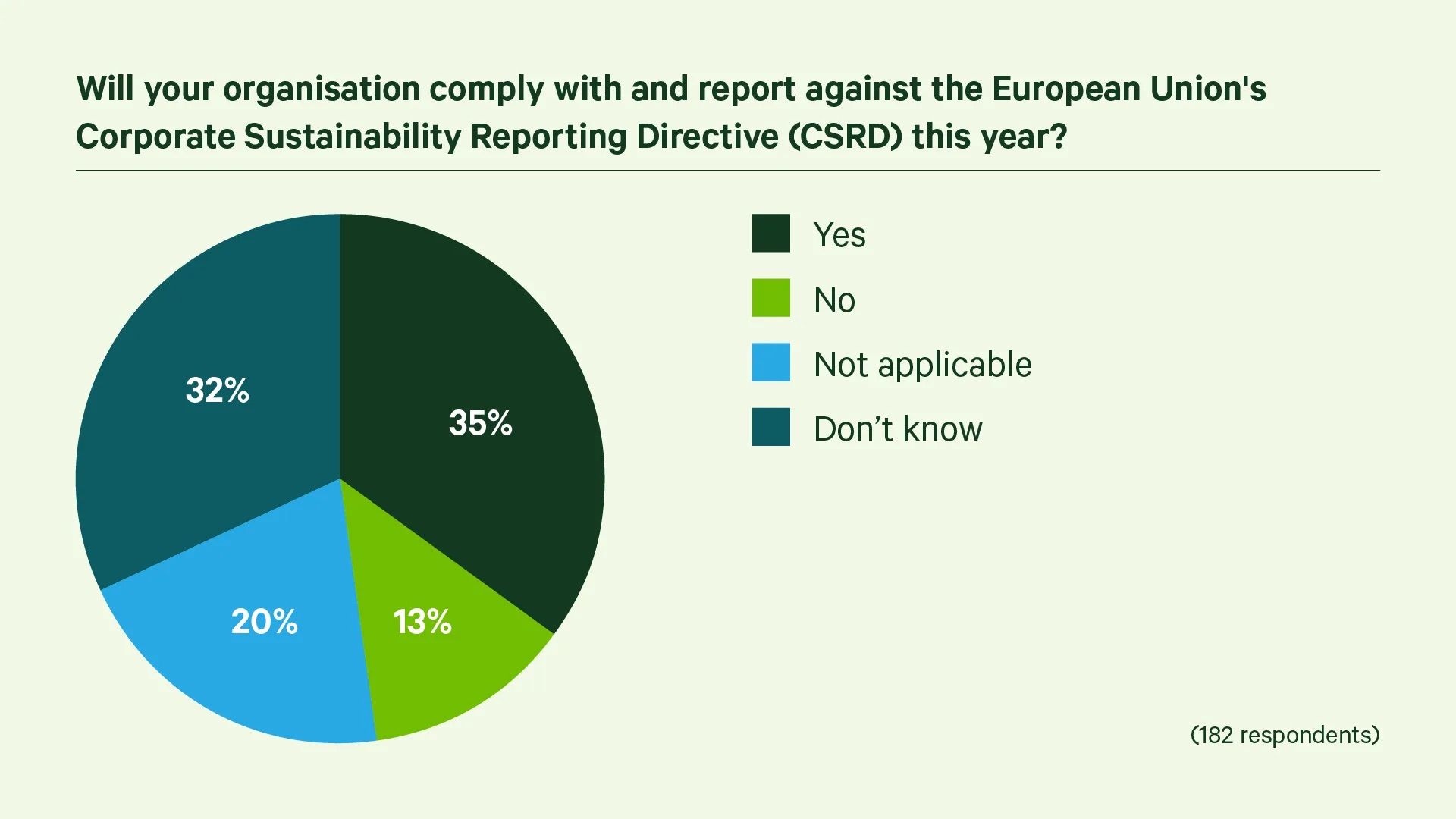
requirements, 35 percent of respondents said their company would
comply with it this year. Unsurprisingly, the figure was higher among
European buyers (41.7 percent) than North American respondents (26.6
percent). The rollout of CSRD reporting requirements is staggered and,
although it is a European directive, it will ultimately apply to some
overseas companies with operations in the EU.
TAKING IT PERSONALLY
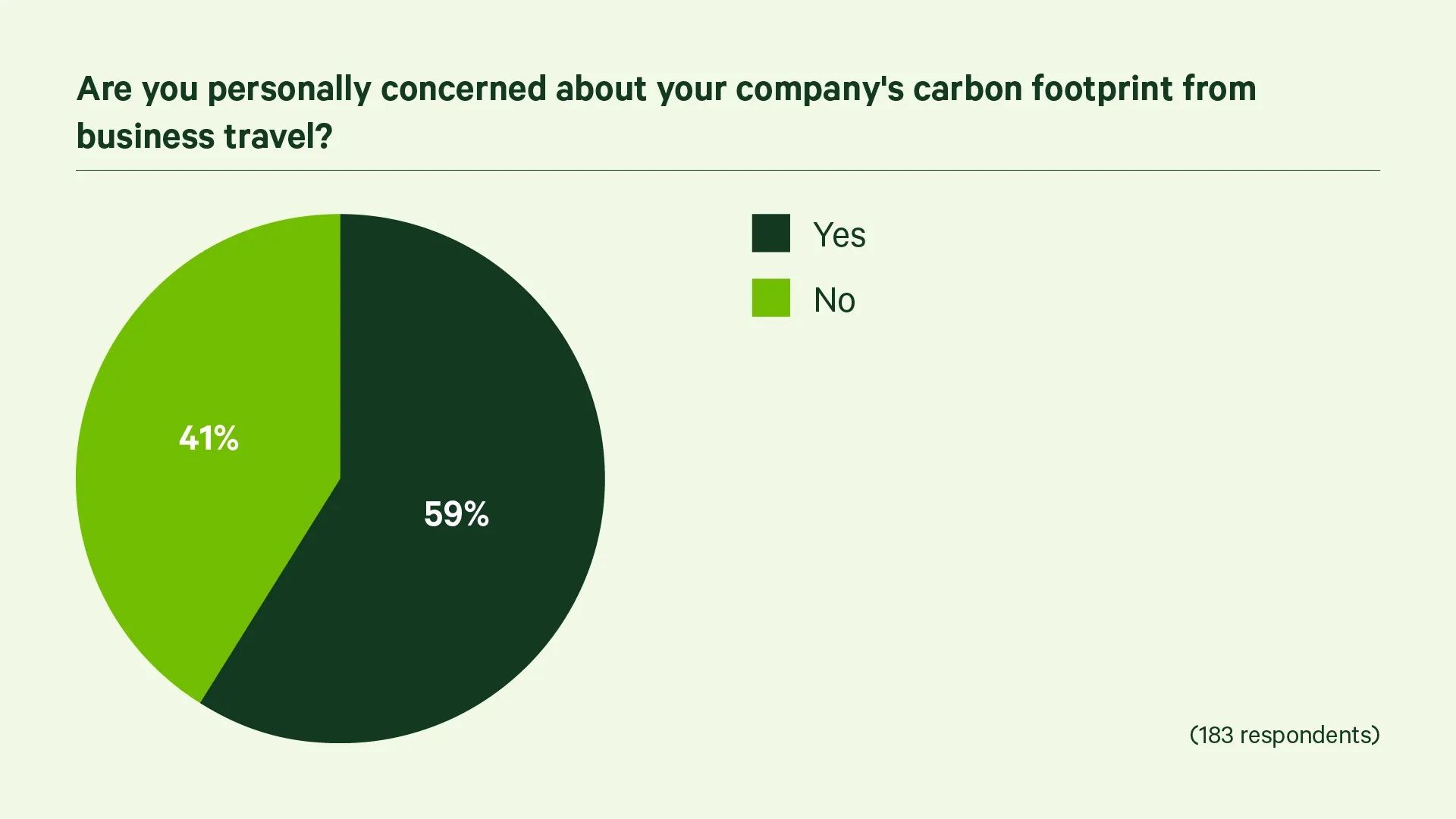
Despite
the watering down of sustainability commitments at a government level,
the majority of buyers say they are personally concerned about the
carbon emissions associated with their organization's business travel
activity. In Europe, this figure is 63.5 percent, while for North
America-based buyers it is 55 percent. This personal concern among
North America-based buyers is particularly striking given the backdrop
to the survey.
STANDARDS SLIPPING
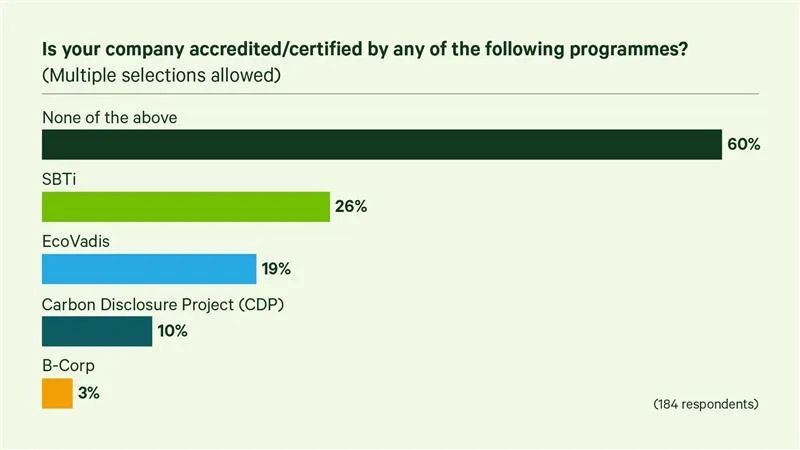
Our
survey also reveals there is a need for more standardization in the
sector. Three-fifths of buyers said that their organizations were not
part of an accreditation or certification scheme. Among those that have
adopted or aligned to a scheme, the non-profit Science Based Targets
initiative
(SBTi) is the most popular, used by around a quarter (26 percent) of
respondents, while the EcoVadis programme is used by 19 percent.
POLITICS COME INTO PLAY
On
January 10, 2025, America’s National Centers for Environmental
Information announced that the total number of confirmed weather
and climate disaster events with losses exceeding $1 billion was 27 for 2024,
second only to 2023 when there were 28. The events included hurricanes,
floods, drought and wildfires.
On January 20, 2025, Donald Trump
was inaugurated for his second term as president. Throughout his
campaign and in his inaugural address, the President repeatedly called
on America to “Drill, baby, drill.”
Just over two months later, on April 8, the president issued an executive order on energy in which he ordered “the
removal of all illegitimate impediments to… domestic energy resources”
such as “burdensome and ideologically motivated ‘climate
change’…policies.”
Each time climate change is mentioned in the
order, it is surrounded by quote marks, indicating the administration’s
belief that climate change is an expensive hoax. Since Trump’s election,
the NCEI has cancelled its Billion Dollar Disaster reporting
initiative.
Trump’s election delivered a body blow to
sustainability and there has been a very public withdrawal of corporate
support in the US for sustainability initiatives and this has been
particularly evident in the banking sector.
In December 2024 and
January 2025, the biggest six US banks – JP Morgan, Citigroup, Bank of
America, Morgan Stanley, Wells Fargo and Goldman Sachs – announced they
were leaving the Net Zero Banking Alliance (NZBA). NZBA, of which
Citigroup was a founder member, is a United Nations-backed initiative supporting
banks to lead on climate mitigation.
SECTOR VARIATION
With the high-profile exit of banks from the NZBA and rowing away from net zero targets, that particular sector now looks like an outlier. Traditionally, it is one which has embraced sustainability in business travel given its high contribution of emissions to banks' overall carbon footprint. Research from Amex GBT and the GBTA reveals that the average contribution of business travel to a company's total emissions is 53% in consulting, 36% in finance, banking and insurance, 15% in the pharma sector and 12% in manufacturing. Business travel's average contribution to organizations' overall emissions across all sectors is 25%.
This has
led to repercussions elsewhere. In July 2025, HSBC announced it would
also leave the Alliance, which was expected by many. In HSBC’s 2024
annual report released in February 2025, the bank said that progress in
reducing emissions in the scope 3 supply chain component was proving
slower than anticipated. “We currently expect a 40 percent emissions
reduction across our operations, travel and supply chain by 2030.” It
has now pushed out the deadline to achieve net zero to 2050.
While engagement with sustainability programs may have slowed in the U.S., there has not been a total U-turn.
American
Express Global Business Travel's head of sustainability Nora Lovell
Marchant said: “The SAF Coalition [of which Amex GBT is a key member]
was instrumental in getting a tax incentive for sustainable aviation
fuels inserted into the Inflation Reduction Act under the Biden
administration. Now under the Trump administration… the tax credit has
been included in the One Big Beautiful Bill (BBB).”
The BBB is
Trump’s blockbuster legislation package. While true that support for SAF
production remains included, the credit has been reduced from $1.75 per
gallon to $1.
THE EUROPEAN VIEW
Elsewhere, the ripples
from Trump’s election continue to spread. In April this year, the
European Parliament voted overwhelmingly in favor of delaying the ongoing implementation of Europe’s CSRD.
When
it was first mooted, the CSRD was expected to apply to around 50,000
companies when fully implemented: those based in Europe with turnover of
more than €50 million, €25 million in assets and/or 250 or more
employees, as well as non-EU companies with significant revenue and a
presence in Europe.
In April, the EU approved the Omnibus
Sustainability Package which has watered down the compliance
requirements of CSRD. Large companies which were due to have to start
reporting in 2026 now do not have to until 2028. EU-listed SMEs now do
not have to report until 2029, two years later than originally planned.
The
result is that only 7,000 companies are now required to report, even
fewer than than the 11,000 companies that were required to report under
the legislation that the CSRD replaces, the Non-Financial Reporting
Directive.
The stated goal of the delay is to “simplify
EU legislation” but many believe the changes came as a result of Donald
Trump’s second term.
CORPORATES UNDETERRED
Global
clinical research organisation Parexel is one organisation which remains
committed to sustainability. “While any dilution of regulatory
frameworks like CSRD is concerning, sustainability is no longer just a
compliance issue, it’s a strategic imperative,” said Benjamin Park, the
company’s executive director for travel & sustainability.
“Reducing
carbon emissions from business travel aligns with our values,
commitment to environmental responsibility, and ability to contribute to
global climate goals. While scope 3.6 [emission relating to business
travel] may represent a smaller share of our total emissions, it is
highly visible and directly actionable, making it a key area for
engagement with employees and customers.”
Like many companies with meaningful sustainability plans, Parexel has
adopted SBTi targets and sees no reason to pull back from these. “Our
commitment to reducing emissions from business travel is embedded in our
sustainability strategy and despite recent changes in reporting
requirements, our 2030 science-based targets remain unchanged,” said Park. “Sustainability efforts within the company are driven by both
purpose and long-term value creation – not solely by regulatory
compliance.”
Adam Braun, CEO of carbon reporting and analysis
platform Clarasight, saidhe has had consistent feedback from corporate
travel leaders in the U.S. “Essentially, they are not changing course,
they are just speaking about it differently or more quietly,” he says.
“Enterprises
look at things over longer time horizons and they know that driving
transformation and change often takes many years. There's an
acknowledgement that the current U.S. administration, which holds a lot of
power, is not a fan of promoting your climate accomplishments. From
what we hear, they are still committed to the goals, but they're just
not speaking about it as loudly.”
Pippa Ganderton, product
director for travel management company ATPI's sustainable travel and
events solutions, Halo, says: “It's almost as if nobody wants to upset
Donald Trump, so they are not going to be as open or openly pursing
their sustainability strategies. I wouldn’t say it's all U.S .organizations though. Outside the U.S., companies are not pulling back
on sustainability. I think there is an increasing focus in Europe and
the UK.”
Nadia Crowe, environmental sustainability senior analyst
for the industrial software company Aveva, part of Schneider Electric,
adds: “Aveva and Schneider Electric are both global and while the US is a
very big market, it is not the only one. We have major operations in
the EU and that's where things are really ramping up. From my
perspective, we're doubling down.”
Lauren Hook, global head of
sustainability at Corporate Travel Management, said, “What we are
seeing across the board is a review and recalibration of sustainability
programs, carbon reduction pathways and net zero targets to ensure
they’re robust and achievable.”
Hook added: “Businesses are
learning how challenging decarbonization can be, particularly in areas
like travel, especially aviation. While we are seeing progress, the
reality is we have a long way to go to true net zero travel.”
NEXT ARTICLE: CONVERTING TARGETS INTO ACTION
RETURN TO BTN'S 2025 BUSINESS TRAVEL SUSTAINABILITY REPORT