The value proposition of the online booking tool hasn’t changed significantly over the past 20 years: Driving self-service through an OBT is far less expensive than calling, emailing or chatting up a live agent. Over time, self-service has become the preferred channel for many business travelers and travel arrangers.
Businesses also look to drive traveler behaviors by automating certain workflows and approvals and flagging bookings that may be outside of policy, either in terms of price, the supplier brand or even outside specific booking windows the company requires. Travel managers use the data derived from OBTs to understand traveler patterns and preferences, which can help to shape messaging about the program or even supplier choice and policy parameters on a go-forward basis.
The issue at this point, for a lot of travel managers is that while there has been evolution of booking tools into mobile platforms and some machine learning-based personalization, there’s not enough functionality in most OBTs to take the traveler across the finish line of their journeys.
“There are a lot of issues with content and booking technology right now,” said Takeda head of global meeting and travel center of excellence Michelle DeCosta, enumerating the gaps in travel content availability through corporate tools, gaps in serving up loyalty-driven entitlements as well as the lack of omni-channel data flow, which ultimately obstructs a more seamless self-service experience.
“If you’re an educated traveler and you’re often traveling the same routes and suddenly the flight isn’t there on the aircraft you know should be there, or the branded metal you are expecting, what is going on? So the traveler has to call an agent to get it done. The answers aren’t great right now of how to solve those scenarios. And ‘call an agent’ is not what I want to hear” since a failure of technology should not amount to higher fees and productivity issues for employees.
Travelers in BTN’s study reported similar shortcomings to those DeCosta listed. “I find the business tools to be clunky and not as up to date [as supplier retailing sites and online travel agencies]; another noted the corporate options “aren’t as detailed and won’t offer the personalized options” and that the retail market offers “better access to amenities.” Of course, there was a segment of the business traveler population that noted “the corporate booking tool pushes… higher prices than what I can find available on the open market.”
Dampening OBT Adoption?
Those shortcomings, however, aren’t necessarily translating into general dissatisfaction or lack of adoption for the majority of business travelers, according to BTN research.
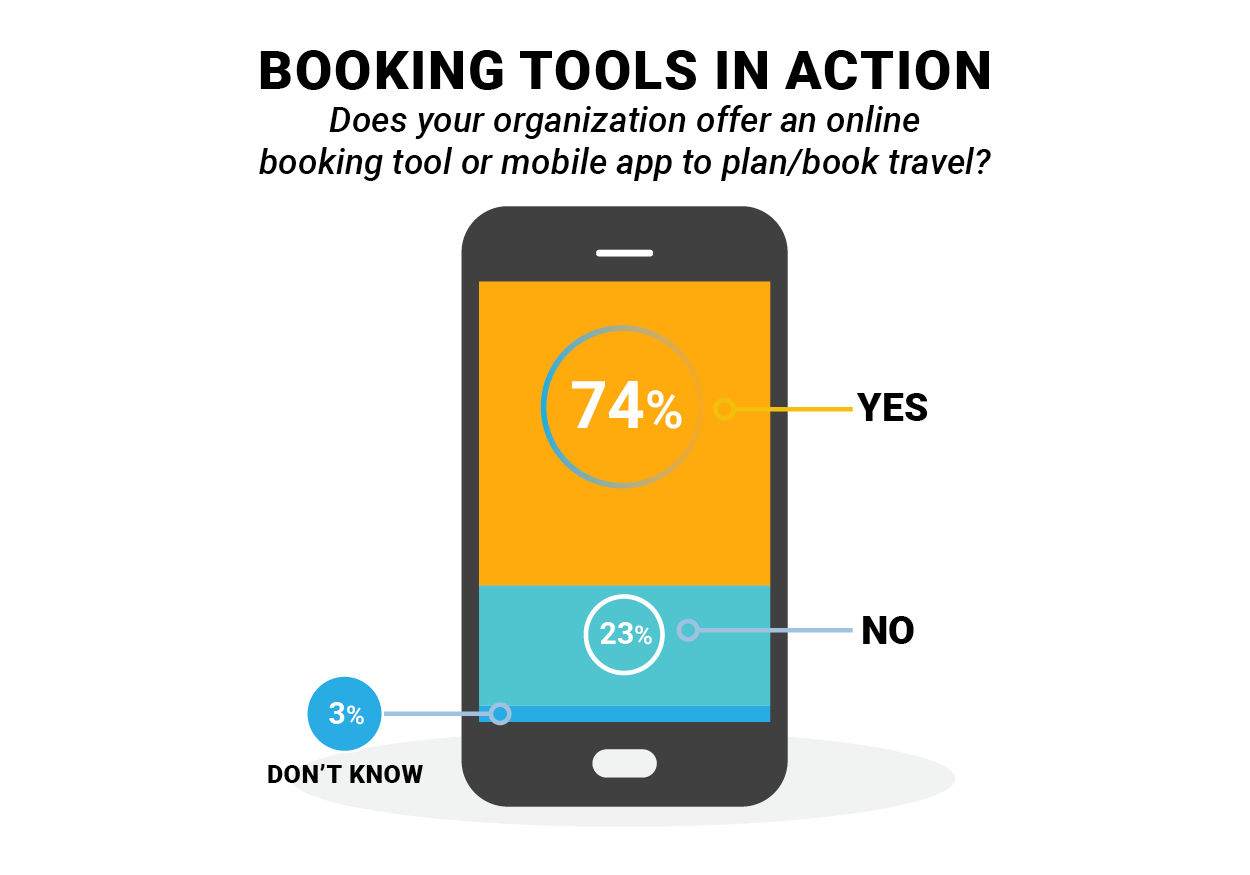 Source: BTN Intelligence survey of 500 business travelers, Aug. 5-28
Nearly three quarters of business travelers surveyed had access to a company recommended or mandated booking tool. This is most prevalent among those employees who have a mandated travel policy. In this case, 84 percent have a tool or app. When travelers have a recommended travel policy, those with an online booking tool or app drops to 80 percent. When there is no policy at all, the availability of a recommended booking tool slumps—leaving more than half of that group to book and support travel via their own reconnaissance.
Those who travel more frequently also showed greater access to booking tools in the BTN survey—it should be noted that heavy travelers in the survey were much more likely to have robust travel programs supporting them. For instance, 78 percent of those who take 11 or more trips a year have a tool, whereas 69 percent that travel only three to four times a year have access.
In terms of using those tools, the travelers in BTN’s survey said they were largely compliant.
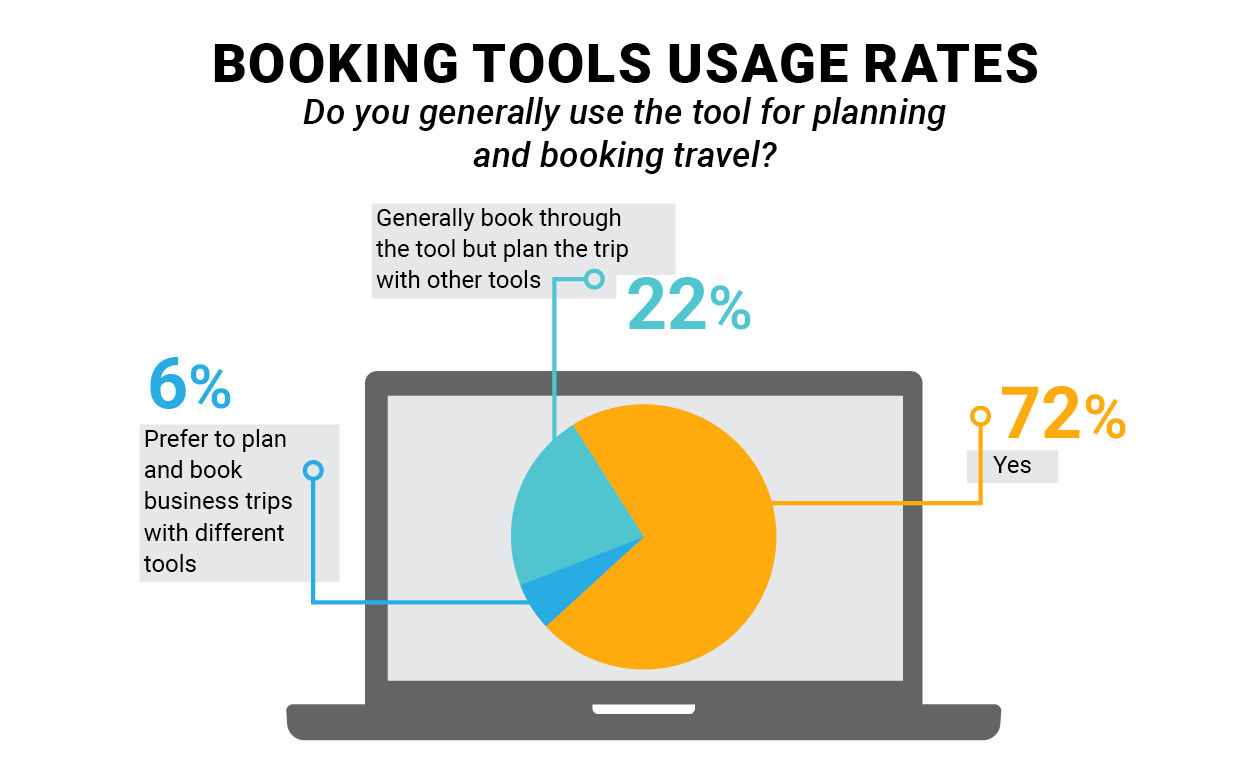 Source: BTN Intelligence survey of 500 business travelers, Aug. 5-28
Among business travelers with access to a corporate online booking tool or mobile app, more than 70 percent said they used them as a rule, suggesting such tools are doing a good-enough job to meet their needs. Thirty-six percent of travelers with access to a company-designated OBT told BTN they prefer the corporate tools to consumer tools. Forty-four percent of travelers weighed out the pros and cons and thought some aspects of corporate tools are better, and some worse.
In terms of benefits, business travelers in BTN’s survey cited easier compliance to policy as a major “pro” of booking through the designated system and, for some, the tools baked in access to the right payment mechanisms to keep certain purchases centralized, rather than having to support them on an individually paid corporate card or personal card. These travelers also valued certain mechanisms in their corporate tools that kept their business trips organized for them via itinerary management functions.
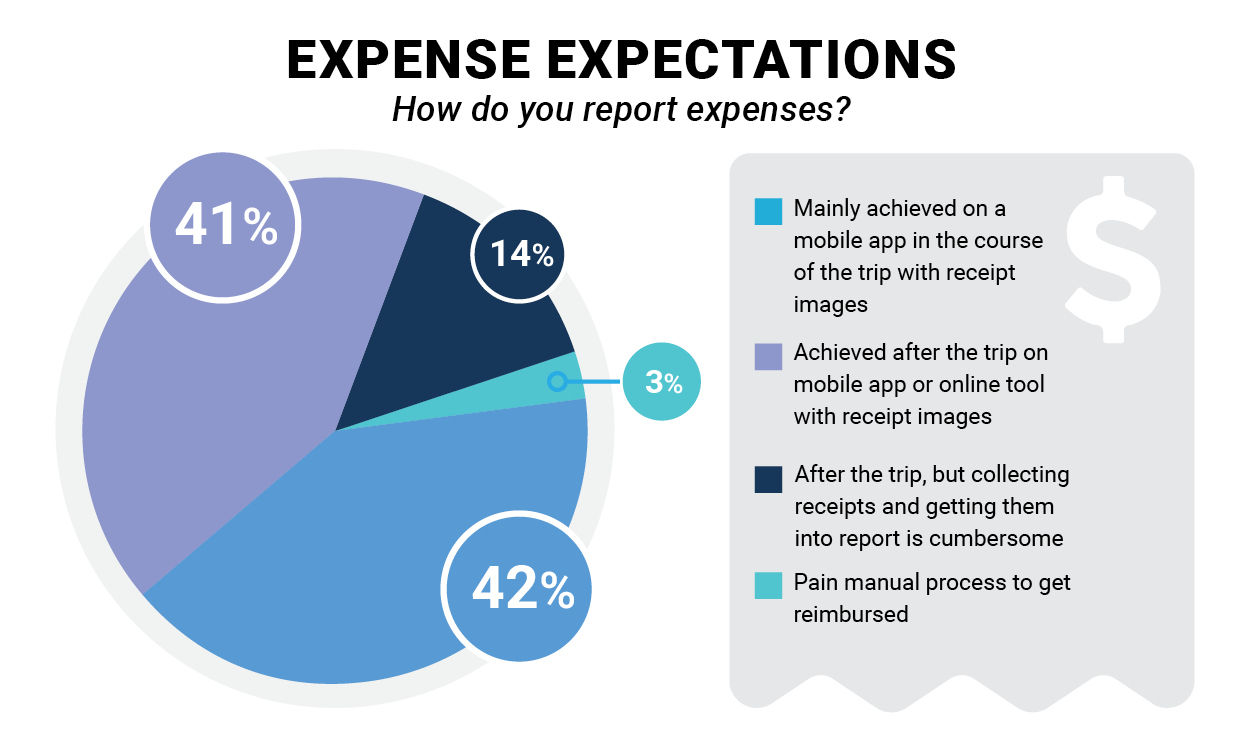 Source: BTN Intelligence survey of 500 business travelers, Aug. 5-28
As part of that organization and compliance, travelers also cited the relative ease of expense reporting when using corporate booking and payment mechanisms. “It’s easier to get reimbursed when you use the corporate [path],” wrote one survey respondent, voicing clearly what other respondents also implied. For better or for worse, the pain of expense reporting when not leveraging corporate tools from the get-go looks like it has a strong influence over booking and payment behaviors.
“Google Helps a Lot”
However, the figures also indicated that business trips cannot always be articulated through corporate booking tools, with 28 percent of travelers using other platforms—at least to plan their business travel. The vast majority, however, said they return to corporate tools for the actual booking—only 6 percent overall said they booked off channel.
One respondent wrote simply, “Google helps a lot.”
Nearly a third of younger workers are at minimum planning business trips outside of recommended tools. That was about a 20 percent higher tendency for younger worker to plan travel off-channel when compared to their 30-to-50-year-old colleagues. In the over-50 set, however, that tendency got more pronounced, perhaps due to seniority levels offering more flexibility or entitlement in the organization. Thirty-five percent of older workers said they planned their travel on alternate tools. This group also had a stronger tendency to book outside of the recommended tools as well.
Flight Centre Travel Group chief experience officer John Morhous, who designs the technology strategy for divisions FCM, Corporate Traveler and Stage and Screen, said the numbers of travelers actually planning and booking their itineraries outside the designated channels are likely higher.
“Travelers, from the beginning of time, switch-shop all the time,” Morhous said. “It doesn’t mean you don’t have a well-run program. People will check the price on Google flights just like I check prices on Amazon for things I may buy in other places.” The trend is growing, he said, for companies to understand this why this happens and, in some cases, to open the gates to it as part of their overall travel programs.
One traveler comment in the survey seemed to articulate sentiment that could actually spell trouble for travel managers, even if such travelers are “technically” compliant. “I could fly cheaper on the open market,” the traveler said. “But I don’t care, as I’m not paying for it and I don’t care about how many options there are. I just want to arrive and return.”
Not having the right content for travelers to choose from, negates this concept of “comparison shopping” that travel managers have relied on for decades, and Takeda’s DeCosta is getting more concerned.
“There’s a lot happening out there with content and it seems to be getting worse,” she said. “Travelers are educated and without the right content coming through our tools, we start to lose trust in the program.”
Morhous agrees that it may be time for TMCs and travel managers to think more broadly about booking channels and how to define program compliance.
“I can tell you that some of the most mature programs… they’ve just expanded their guidelines and programs to allow [direct bookings] and to do things a little differently,” he said. “Like does it really make the most sense to have all the bookings go through one tool or travel management company? You don’t have to have a single gateway anymore; you can still get the data you are looking for—we have the tools—so travel managers can still steward the spend and manage the program.”
___________________________________________
Case in Point: Creating an Omni-Channel Strategy
Company: ZS
Lead: Suzanne Boyan, Global Meetings & Travel Manager
ZS has been an innovator with omni-channel corporate travel booking and servicing since before it could be identified a trend. Global meetings and travel manager for the consulting firm Suzanne Boyan has been building an ecosystem of partners for the last eight years to offer an intuitive travel booking and technology platform that would deliver ZS travelers a positive experience and the travel team the data required to managed spend, safety and suppliers.
Boyan has been through a number of TMC partners in those years. Starting with Luxe Travel Management in 2018, a partner that was willing to absorb a unique strategy that included direct bookings with United as ZS’s main carrier, but which also resulted in a sacrifice of those booking and service fees that a TMC would normally pull in. Luxe was acquired by Frosch in 2021 and the new partner was willing to pick up that unique program model, which Boyan then expanded to other airlines via a partnership with Traverse, which brings in data from ZS bookings made on supplier direct sites for corporate visibility and management. ZS also makes use of Traxo to bring in other supplier-direct bookings.
This year, ZS made the jump to a new TMC, partnering with Direct Travel as the first client on the agency’s Avenir platform. While the cutover has seen its challenges, Boyan told BTN portfolio-mate The Beat last month that the technology is working well on the Spotnana booking platform and Direct Travel’s servicing quality is picking up where there were initially challenges in markets like India. In the meantime, ZS continues to pursue its direct-booking air strategy that will include APIs that will enable Direct Travel to “ingest the bookings and service them,” Boyan told The Beat. That’s a new capability the program had not pursued with previous TMC partners, and Direct Travel is working out the economics on that capability.
How will she know when it’s really working? She’ll be asking ZS travelers for feedback. “It will be a really interesting survey to read through,” she told The Beat.
RELATED: Want more details on the ZS program? Subscribe to The Beat.
__________________________________________________
Roughly a quarter of business travelers surveyed didn’t have an online booking tool or travel app. Of these, just over a third will use an online travel agency like Kayak, Expedia or Booking.com, while another third will book direct on supplier websites. Interestingly, the smallest percentage will call, email or text a travel agency. Unsurprisingly, companies that have travel policies but lack an online booking tool are more likely to book through a dedicated travel agency. At the same time, younger travelers are most likely to use an OTA or self-book.
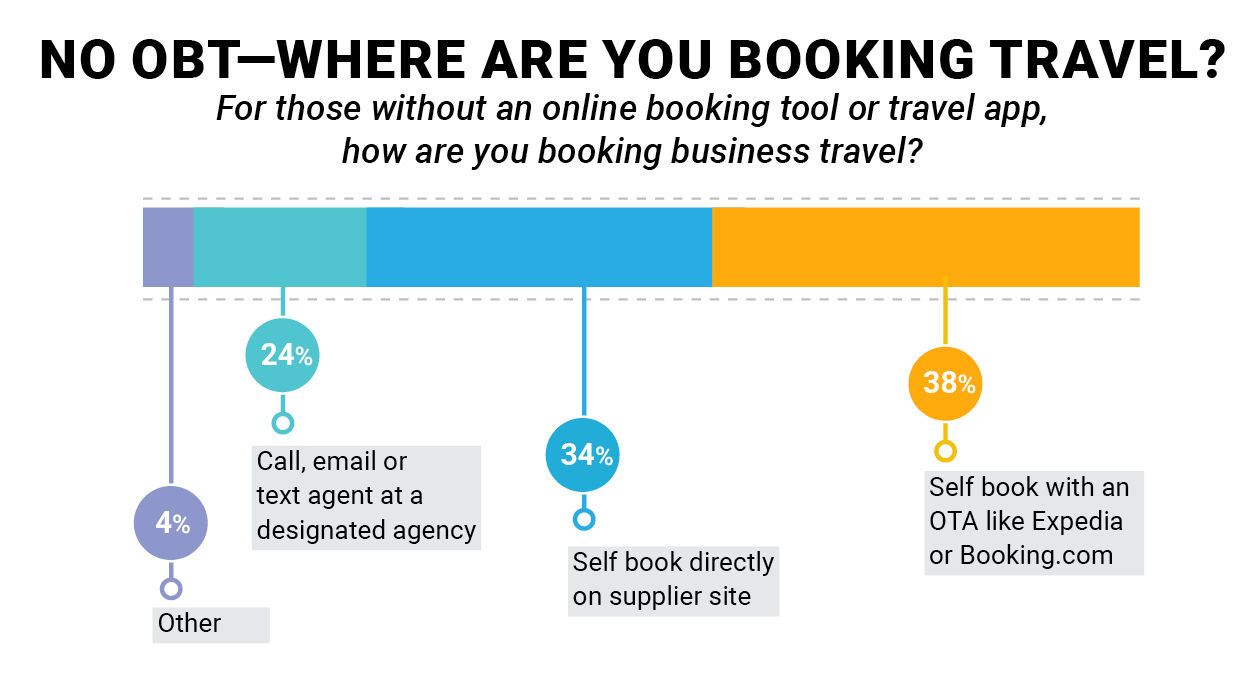 Source: BTN Intelligence survey of 500 business travelers, Aug. 5-28
Take note: Young business travelers’ least favorite option is to get in touch with a travel agent, so providing intuitive self-booking options (yes, possibly multiples) while also accounting for data capture and spend management may be the path forward for a new generation of business travelers.