Preferred supplier contracts are among managed travel’s central value propositions. As companies rationalize their supplier base—whether airlines, hotels or car rental firms—the more volume they can amass with fewer suppliers and, therefore, the more value they can deliver to supplier partners and the better rates the corporate can negotiate.
 Source: BTN Intelligence survey of 500 business travelers, August 5-28
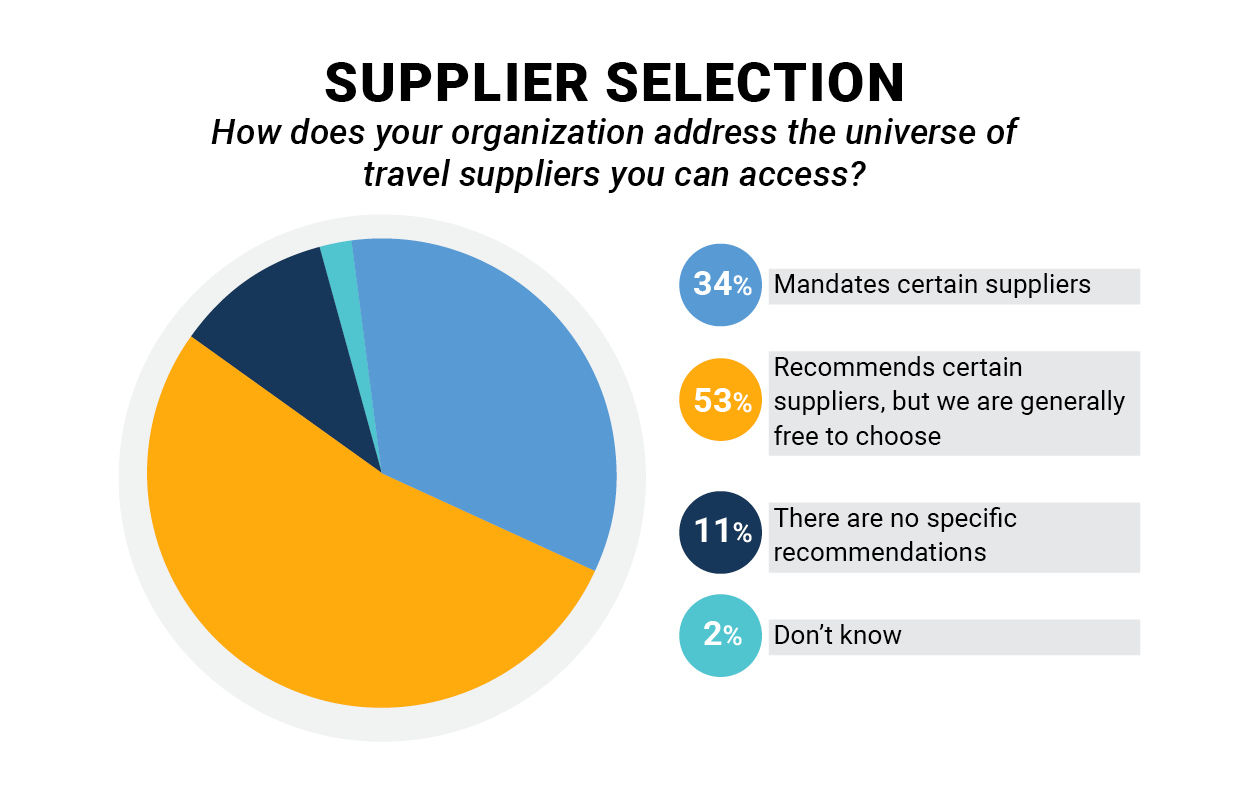
How does your organization address the universe of travel suppliers you can access?
How vehemently preferred suppliers are pushed within travel programs, depends on the program culture. Business travelers with mandated travel programs were twice as likely to be directed to use certain suppliers compared to travelers who had “recommended” travel policies.
Whether preferred suppliers are mandated or recommended may also be subject to how deeply companies can negotiate discounts or the level to which they can deliver other savings and value to their organizations. Indeed, negotiated rates and fares have been a major selling point for managed travel along with traveler safety and risk management, but it’s one that—especially with airlines—has eroded in recent years.
“Big companies used to get 30 percent, 35 percent off airfares. Not just business fares. All of them on some carriers,” said business travel consultant and former Microsoft travel management lead Eric Bailey. “Now, that discount is 1 percent and possibly zero. If an average domestic airfare is $500 and the discount is 1 percent, $495 looks an awful lot like $500. Travel managers have to rethink how they bring value to the table.”
________________________________________
Case in Point: Nudging Travelers Toward Value
Company: Takeda Pharmaceuticals
Travel Manager: Michelle DeCosta, Head of Global Meetings & Travel Center of Excellence
At the Boston-based headquarters of Takeda Pharmaceutical’s U.S. division, Michelle DeCosta is running a number of small experiments on how to deliver more value to the corporation, while also engaging travelers with the managed program.
“We’ve created this area in our travel center of excellence that we call ‘The Pilots Lounge,’” she told BTN. “We’re doing all these tiny pilots with new technologies and one of the things we worked on first was to create a ‘price to beat’ project.”
The team has concentrated on Takeda’s top 20 airline routes to understand the average fares and calibrate at what range above that average price a traveler should be contacted to rebook a lower fare.
“I fly Boston to Zurich all the time,” DeCosta said. “I know the price should be about $5,000 or $6,000. Someone who doesn’t fly often pays $12,000 and might not think anything of it.”
The price to beat initiative is now emailing those travelers with gentle messaging to help educate them about that cost. “They’re not in trouble,” said DeCosta, “But we want to let them know their booking is out of range of average and if they have any flexibility should think about changing the ticket.” Currently the messaging is after-the-fact, but DeCosta is hoping to get it into the booking workflow as one element of delivering value by influencing traveler booking behavior.
Another initiative is underway to help educate travelers about the value of corporate contracts and the amenities and entitlements that come with them.
“We’re working with another company to let travelers know when they book with XYZ car rental or one of our airline partners that they should be sure to take advantage of the negotiated benefits,” she said, like a better boarding group on partner airlines or certain amenities at partner hotels. “We want to get out of emails and get that messaging into Teams where people are always engaged, so it’s more effective. The idea is to do some fun messaging that underscores the value to them of being part of the Takeda program.”
_________________________________________
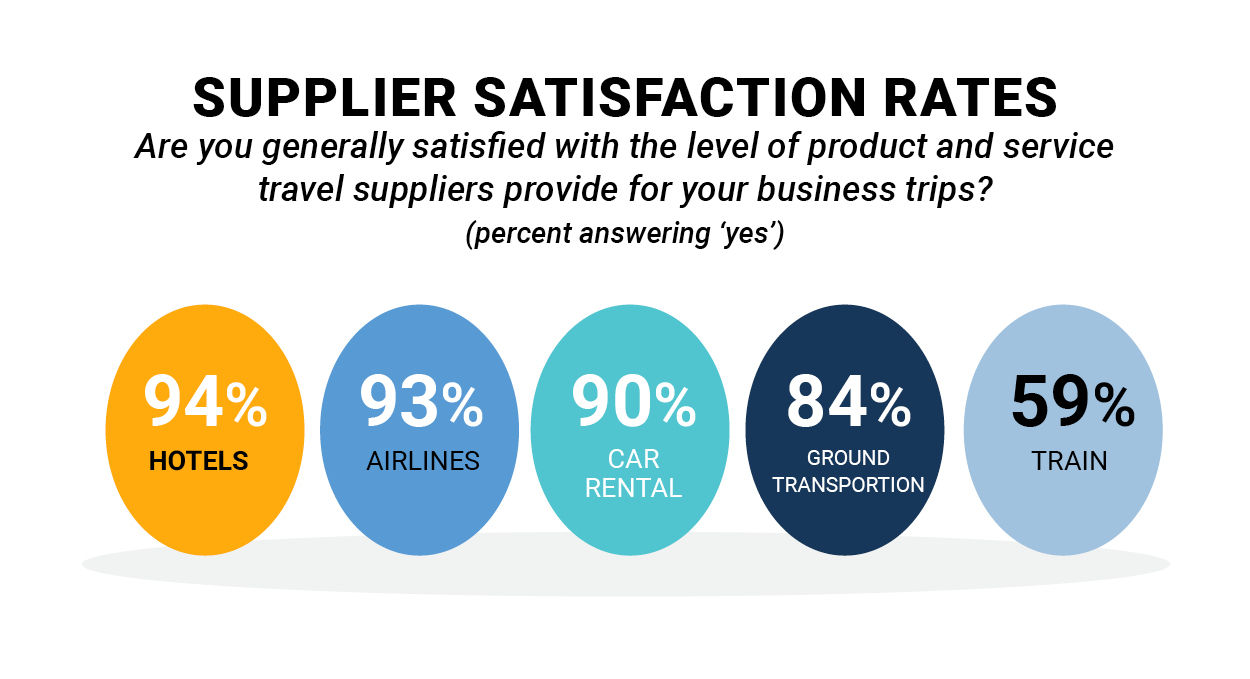
Of course, travel buyers will continue to negotiate and provide program value through supplier partnerships, including discounts. And the vast majority of business travelers surveyed by BTN said they were quite satisfied with the performance of the suppliers offered to them through their programs.
 Source: BTN Intelligence survey of 500 business travelers, August 5-28
Are you satisfied with the level of product and service travel suppliers provide for your business trips?
More frequent users of airlines were slightly less likely to be satisfied with the level of service. This could be due to greater exposure to delays and issues around air transport—a situation that many survey respondents listed as their biggest frustration with travel. But it wasn’t frustrating enough to dissuade most employees from wanting to travel. More than half of surveyed respondents wanted to travel more. And 65 percent of frequent travelers—i.e. those likely exposed to the most frustrations from disruption—were most keen to travel more.
Loyalty Drivers
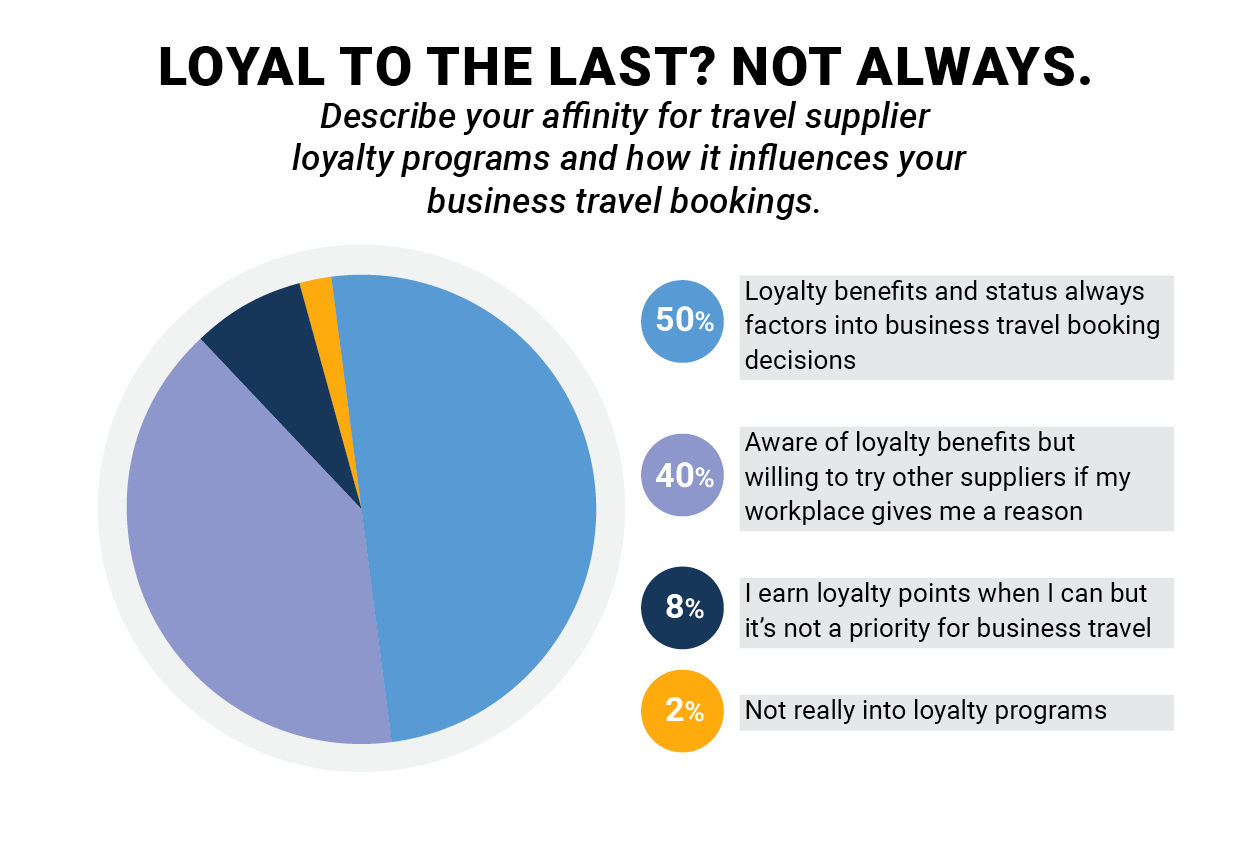
Satisfaction with preferred suppliers may not fully lead to more bookings with them. Half of business travelers told BTN they always factor loyalty status into business travel booking decisions. Forty percent keep loyalty in mind, but are willing to try other suppliers if there is a compelling reason.
 Source: BTN Intelligence survey of 500 business travelers, August 5-28
Describe your affinity for travel supplier loyalty programs and how it influences your business travel bookings?
One traveler sums up the benefits: “Choosing a supplier where I have loyalty status improves my travel experience through perks like priority boarding, seat upgrades, faster check-ins,” all of which enhance productivity. The traveler continued: “It makes [the] trip more comfortable and often helps me earns rewards that I can use in future travel.”
Travelers also noted how loyalty status translates into prioritized customer care—particularly during disruptions—and a more personalized offering. A significant number of travelers mentioned the value of loyalty: with access to lounges, complimentary in-flight meals, free wi-fi and entitlements to seat upgrades that otherwise the traveler or their employer would need to fund.
_____________________________________
Case in Point: Leaning into Loyalty
Company: Adobe
Travel Manager: Kathy Burdge, Senior Manager Global Travel
The travel program at software giant Adobe is spending time in the coming months educating travelers on the benefits of loyalty programs as a way to add value and enhance productivity on business trips.
“We still have groups of people who haven’t really learned the value loyalty benefits,” said senior manager of global travel Kathy Burdge. “They may be early in their careers and just starting to travel. They need to know these programs aren’t just about points for your next vacation. It’s about all these other benefits that serve them now so we are crafting some messaging to help people understand why they should enroll.”
Burdge said that while she gets certain status nominations for Adobe travelers, she sees them leaving benefits on the table. “Upgrades, bags, seat choices… we need to arm our employees with the tools to maximize these programs. So that’s what we working on and doing next in collaboration with our preferred suppliers.”
_________________________________________________
Not surprisingly, road warriors are the most aware of loyalty programs, with 59 percent saying they always factor in benefits when they book business travel. What might be surprising, however, is that 63 percent of those who “always” figure out the loyalty angle are also working within a mandated travel policy, so like Adobe travelers [see above] they are likely aligning their loyalty status with their company’s policies.
The survey also found that 54 percent of travelers have taken an extra business trip or configured more expensive or longer mileage itineraries in order to keep their loyalty status, even if that trip wasn’t critical to their work. This is true of more frequent travelers and those aged 18-30. It suggests that loyalty schemes can cost businesses money—whether the delta of that decision provides value to the organization is hard to discover. It may be a case for better trip justification policies and manager sign-off, but productivity gains of status might also be considered alongside cost.