Travel policies work to put parameters around traveler behaviors and can be wide ranging. Foundationally, they guide travelers toward safe and value-based suppliers, the classes of service allowed for certain types or lengths of trips, and they often attempt to define thresholds around pricing, either by setting spending targets or defining how much leeway a traveler can have when preferencing productivity time and convenience against lower airfares and hotel rates.
 Source: BTN Intelligence survey of 500 business travelers, August 5-28
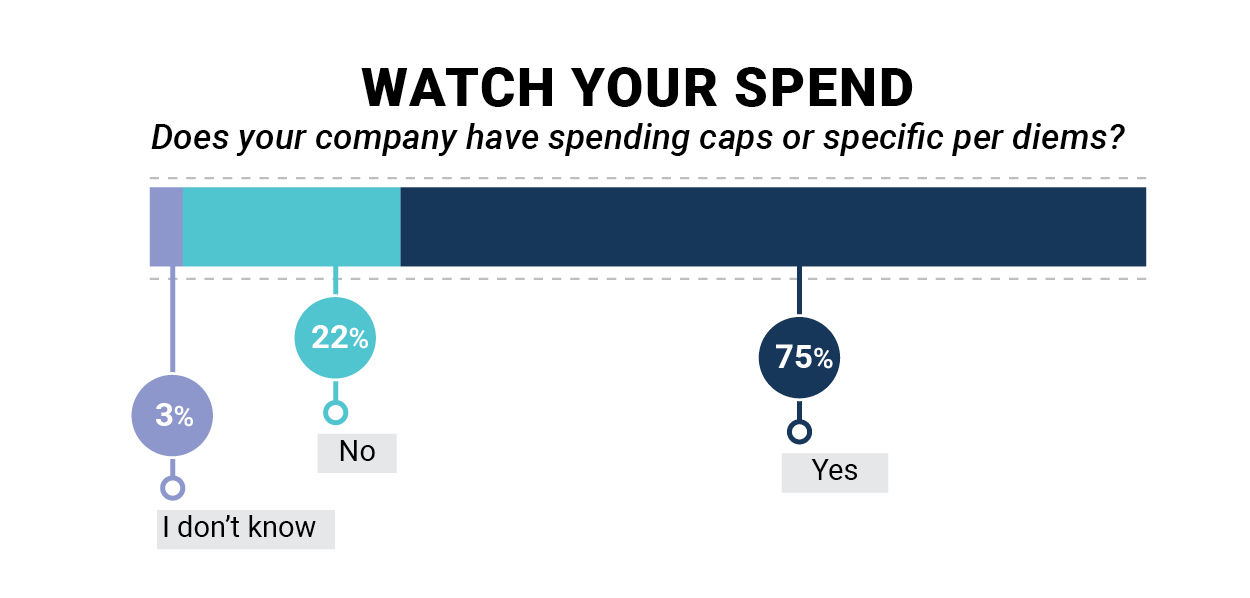
Those companies with mandated and recommended travel policies are significantly more likely to have spending limits in place for business travel, with around 82 percent to 83 percent of companies falling into this category. When looking at those without a travel policy, the percent of companies that have spending caps drops to around 50 percent.
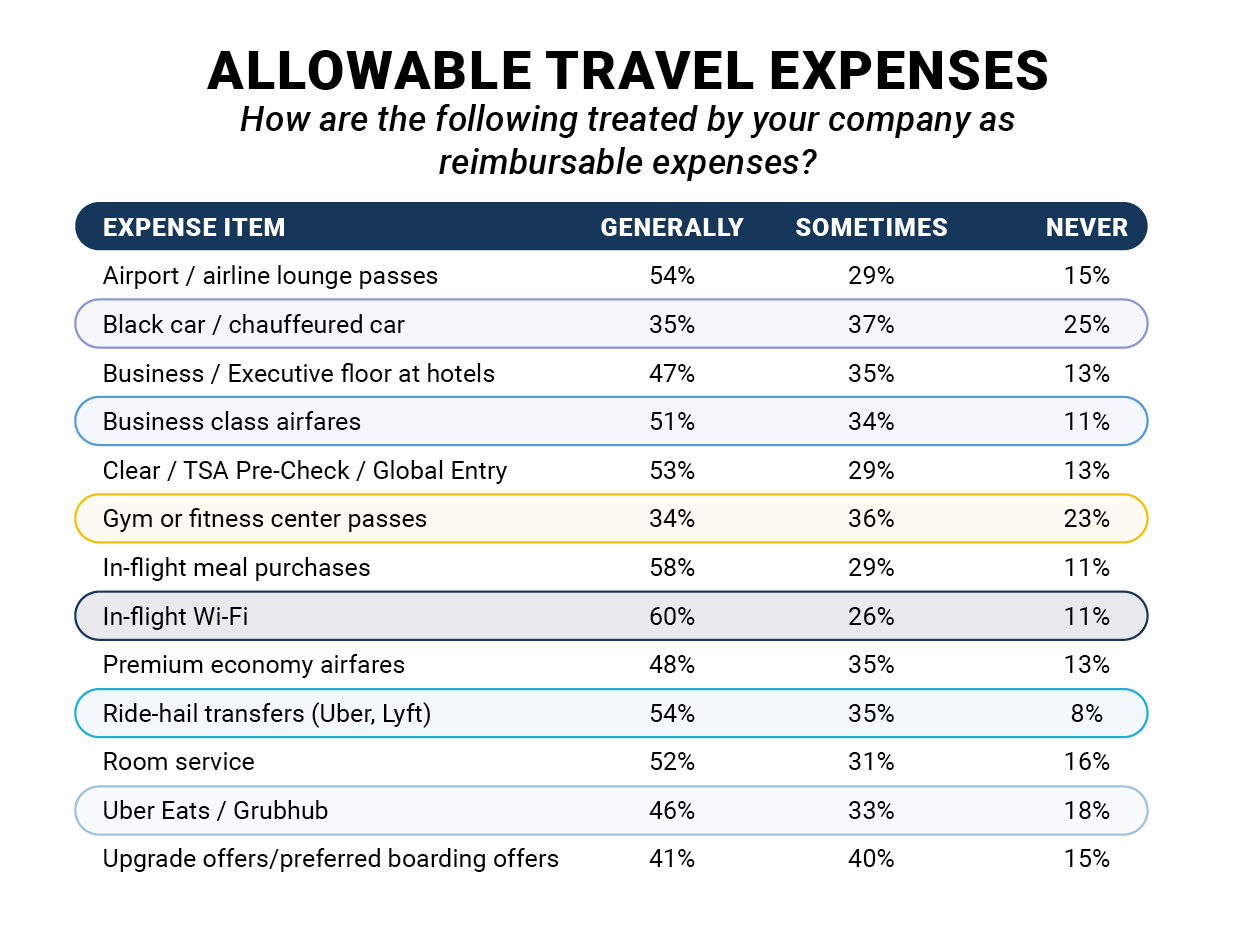
Policy isn’t always about preferred suppliers and financial considerations. Companies also define what amenities can and cannot be expensed when traveling for business; they may put limits on how much an individual can spend on alcohol or client entertainment. They may also look to restrict travelers’ access to risky activities and behaviors when traveling on the company dime and under its duty of care remit.
That said, some policies are more generous than others when it comes to class of service, access to amenities and upgrades and tolerance for individual preferences.
 Source: BTN Intelligence survey of 500 business travelers, August 5-28
“Especially in high-demand industries where you're competing for the same talent, the travel proposition is important,” said Corporate Travel Management chief sales and customer officer Darren Toohey, who also holds a graduate degree in organizational leadership. “Having in-person meetings, having reward and recognition programs, having the ability to collaborate in person… all of those elements are important to a high-value employee who travels. [High-value candidates] will look at the travel policy as something that differentiates the employer in the hiring process.
Communication Skills
As a result, engaging travelers with that policy is critical and communicating the benefits of the program as well as guidelines is key.
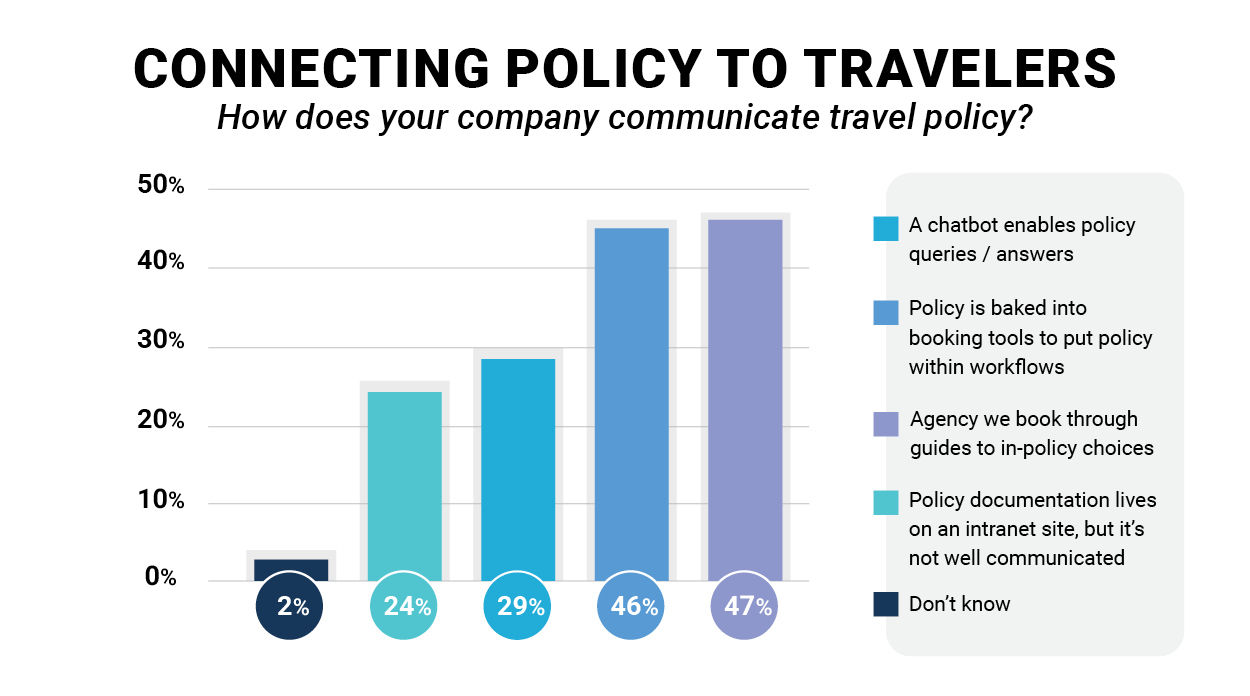
Asked how their companies communicated travel policy, nearly one-third of business travelers in BTN’s Traveler Purpose & Productivity survey said they were turning to a chatbot to have policy questions answered. Some of those bots are likely to be programmed as static responses to frequently asked questions. But some travel chatbots today are getting a more dynamic artificial intelligence makeover, whether travel managers are partnering with their agencies to create them or going solo with internally built technology.
 Source: BTN Intelligence survey of 500 business travelers, August 5-28
_____________________________________
Case in Point: Travel Answers on Demand
Company: Salesforce
Travel Manager: Ryan Pierce, Senior Travel Manager
Working with artificial intelligence takes a lot of validation work, according to Salesforce senior manager Ryan Pierce, who worked this year to establish and rapidly ramp up a new Slack-based travel program policy resource for Salesforce’s XX-strong Roadwarrior community (that’s what the company calls all travelers). He used existing AI templates from Salesforce’s development team, but that mainly provided a foundation. Understanding what information sources to include and weighting the quality of those sources was critical so the bot could dynamically prioritize the most accurate and up-to-date information as conditions and resources change within the program.
Those sources could include written policy, previous slack exchanges between travelers and the human travel team and even community exchanges between travelers.
“The process evolved into scoring travel team sources at a higher level than other people’s responses who are participating in the channel and may be right or wrong,” said Pierce.
Because the chat bot is designed to surface its sources, the travel team can address inaccuracies or clarity issues at the source level and not by “programming” correct answers. With generative AI, synthesizing the answer to any given travel question—not just pre-set questions devised by the travel team—is the job of the bot.
“We have a grading process for the answers the bot is giving—is it right; is it partially right?”
Pierce’s scoring mechanisms and feedback loops for training AI for travel have set forth a replicable model for Salesforce peers to emulate, and they are ongoing. He also has ensured privacy, put up guardrails to keep the AI on track and set clear expectations around its capabilities. The chatbot currently answers hundreds of inquiries on a weekly basis—and that’s just tip of the iceberg at about 30 percent of total inquiries. Importantly, when it cannot answer a question, it responds that it is unable to answer.
RELATED: Want more details on Salesforce’s Ryan Pierce and his recent AI adventures? Check it out here.
______________________________________________
Projects like Salesforce’s hold an exciting glimpse into the future in terms of how companies may deliver policy information to travelers, but AI-powered chatbots are definitely not the norm.
Whether programmatic or AI-enabled, chatbots today remain behind more traditional methods for communicating policy. Nearly half of travelers surveyed by BTN received guidance from their travel agencies; ostensibly an equal number relied on policies getting baked into their online booking tools to show travelers what is in and out of policy as they move through the booking workflow. Those numbers add to much more than 100 percent, so most companies clearly are using multi-channel strategies to engage travelers with policy.
In addition to strategies explicitly listed in the survey, corporate communications through Teams, Slack or old-fashioned emails also come into play as do digital lunch-and-learn webinar sessions, especially if policies and preferred providers are actively changing.
Unfortunately, a quarter of travelers whose companies have travel policies told BTN those policies aren’t actively communicated—making it more difficult for travelers to comply.
Compliance Concerns
Traveler judgment inevitably comes into play when making booking and on-trip purchasing decisions, and lots of factors figure into that decision-making.
Across all travelers surveyed, 85 percent told BTN they “always” or “often” follow the rules. When they don’t comply, business travelers told BTN they often had business or efficiency reasons for not doing so, including that they were unable to find adequate itinerary options within the corporate environment or that pricing was better on the open market.
One traveler sums it up: “When I don’t strictly follow policy, it's usually driven by the need for more convenient flight times or better pricing. In those cases, personal comfort and efficiency outweigh the restricted options in the corporate tool.
On occasion, loyalty affinity drives them out of policy (see Part X. Supplier Satisfaction Rates & Loyalty).
Adobe senior manager of global travel Kathy Burdge is looking at policy changes driven precisely by the impasse that travelers in BTN’s study described.
“Policy is on our radar for next year for some redesign,” she said. “We're thinking about things a little bit differently and trying to look at policy in terms of how suppliers are now selling their products.”
One of the first elements Adobe is looking at is airline seat upgrades, Burdge told BTN. “We're on the verge of updating to allow seat charges. We've never allowed them before. But as we're seeing airlines merchandise more, we need to enable and allow our employees to make those decisions. Currently we allow them to book their airfare within a threshold of $200. If they are choosing the least expensive flight, why wouldn’t we allow them to just go ahead and add the seat upgrade if it fits the existing threshold? That’s the kind of change that gives travelers more autonomy and a better experience—and it shouldn’t impact our existing budget parameters.”
Not every company is thinking about policy in same way as Adobe, but Toohey said more companies are looking at it.
“There are definitely still companies that require travelers to take the lowest cost option,” said Toohey. “But if it’s a choice of a reasonable upgrade or giving a traveler access to their preference because it’s going to allow them to arrive more refreshed and get that additional one or two or three hours more of productivity in, I think you’ll see that a lot of companies have become more traveler focused.”
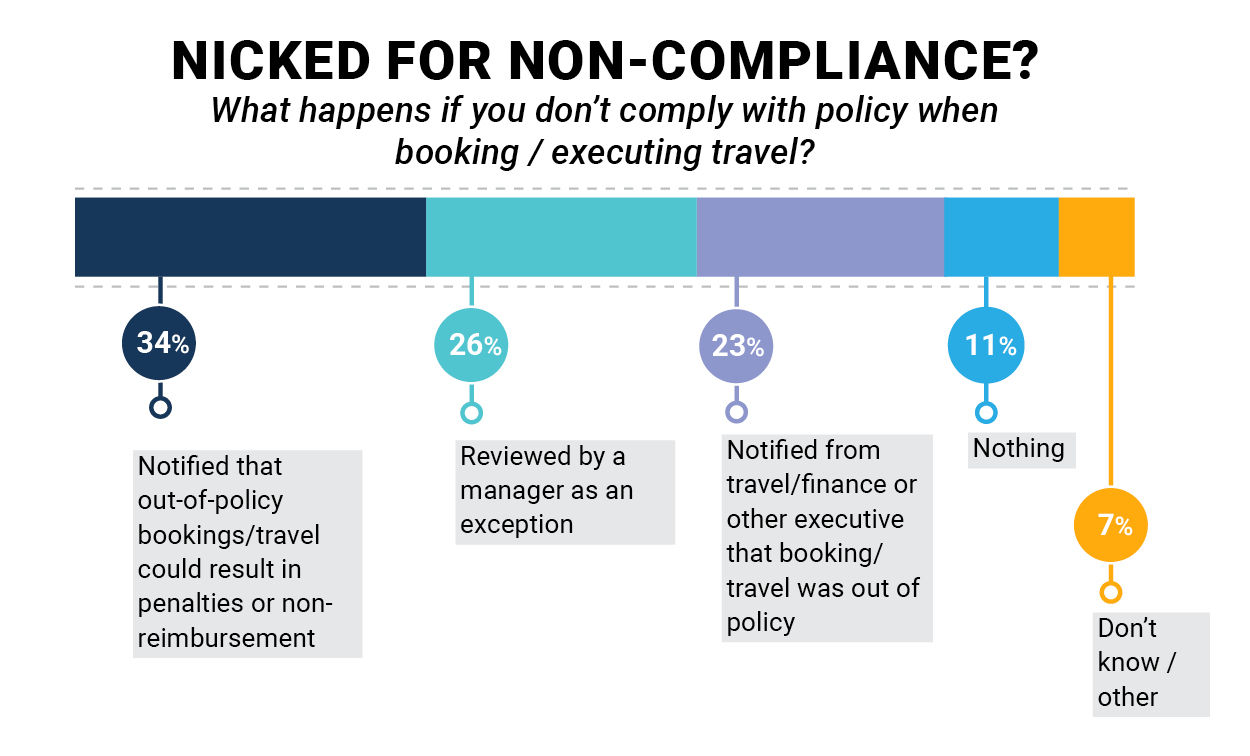
The travelers in BTN’s survey fell fairly evenly across the board when it came to consequences for non-compliant bookings.
 Source: BTN Intelligence survey of 500 business travelers, August 5-28
One-third are notified that out-of-policy bookings could result in non-reimbursement—how many actually faced that consequence would be questionable. But they are warned. Forty-two percent of travelers who have recommended travel policies told BTN they get hit with non-reimbursement warnings; counterintuitively, only 36 percent of travelers in mandated programs are notified about non-reimbursement when they don’t follow policy.
Workers without a travel policy are most likely to have their bookings reviewed by a manager as an exception. Equally, those travelers that have a mandated travel policy are the most likely group to get a note from travel, finance or executive level that a booking is out of policy but without a specified consequence. Eleven percent of travelers had no reaction to non-compliant bookings.
______________________________________________
Case in Point: Making Policy Personal
Company: McKinsey & Co.
Travel Manager: Jamie Stewart, Director of Travel & Events Technology
Consulting giant McKinsey & Co. has one of the largest travel programs in the world. BTN estimated the company spent $228 million on air travel alone in 2024, landing them at No. 6 on the BTN Corporate Travel 100 list of the biggest spenders in business travel.
Spending that much on travel—for a population of consultants that make a living traveling to client engagements—means that driving systemic behavior changes via travel policy can translate into big returns for the company.
How to drive such change without making travelers feel restricted was the challenge presented to director of travel and events technology Jamie Stewart. When he was introduced to large language model-based Skylink, Stewart saw an opportunity.
Skylink as articulated through McKinsey & Co.’s Slack platform uses traveler history and loyalty affiliations to create a dynamic travel profile that builds over time and responds to situational requests from travelers. That’s the personal part. The policy piece is that the Skylink “agent” chatbot is trained to display alternatives to the traveler’s preferences that are better aligned with policy and nudge the traveler to take the policy preferred options as they complete the booking.
“We wanted data to drive the options offered to travelers, and we didn’t want to overwhelm travelers with too many choices,” he said. That said, the reduced set of options had to feel curated for the traveler rather than restrictive.
“We needed to recognize their personal loyalties and travel history, but also the intent they’ve shared in their current prompt," Stewart said. "We sort of knew from the beginning that recognizing all those elements would be critical to our success.”
While it has taken some time to build trust with Skylink’s curation and recommendations, the personal nuances combined with the policy objectives seem to be the sugar that makes the medicine go down. Adoption of Skylink has grown by orders of magnitude and 95 percent of users said they would recommend the policy-forward booking pathway to a colleague.
RELATED: Want to know more about McKinsey's personalized policy control? Check out the BTN feature.
_____________________________________
By no means does the average travel program have a personalization engine driving policy compliance. But cases like McKinsey show there could be a future of more nuanced policy that seamlessly blends with a traveler's personal preferences and needs. And it may not be far off.
Travel managers and their organizations already do a remarkably good job facilitating high-quality and productive business trips for travelers. A significant percentage of travelers—particularly those in the younger generation—told BTN that business travel is at least as personalized as leisure travel and 41 percent of travelers overall said business travel tended to be more personalized, with frequent travelers citing personalization as a key satisfaction driver in their business travel experiences.