A recent study from the Global Business Travel Association estimated that for every dollar spent on business travel, more than $14, on average, is generated for the business. Plus, the study went on, an 8 percent increase in travel spend could deliver a 6 percent return on revenue. That 8 percent was a lower sum than you might imagine—it was equal to only $184 more annually per employee.
While those are blunt calculations that may not fully take into account disparate corporate travel patterns or philosophies, they nevertheless reflect another step the industry's perpetual quest to determine a method to authenticate the return on an investment in business travel.
"Purposeful travel" has become a key phrase since the pandemic, and at its most foundational it denotes that every trip should have a calculable business purpose. What that calculation is, however, also may have been changed by that global event.
With tech-enabled information exchange so readily available with desktop collaboration tools, the missing link of work enablement became the value of the human relationship and the trust between people—whether internal team members or clients. That missing link for many companies has driven the push to return to the office, but the working world has been significantly changed in terms of the types of business interaction that now require a person-to-person exchange.
Do I Really Need to Travel?
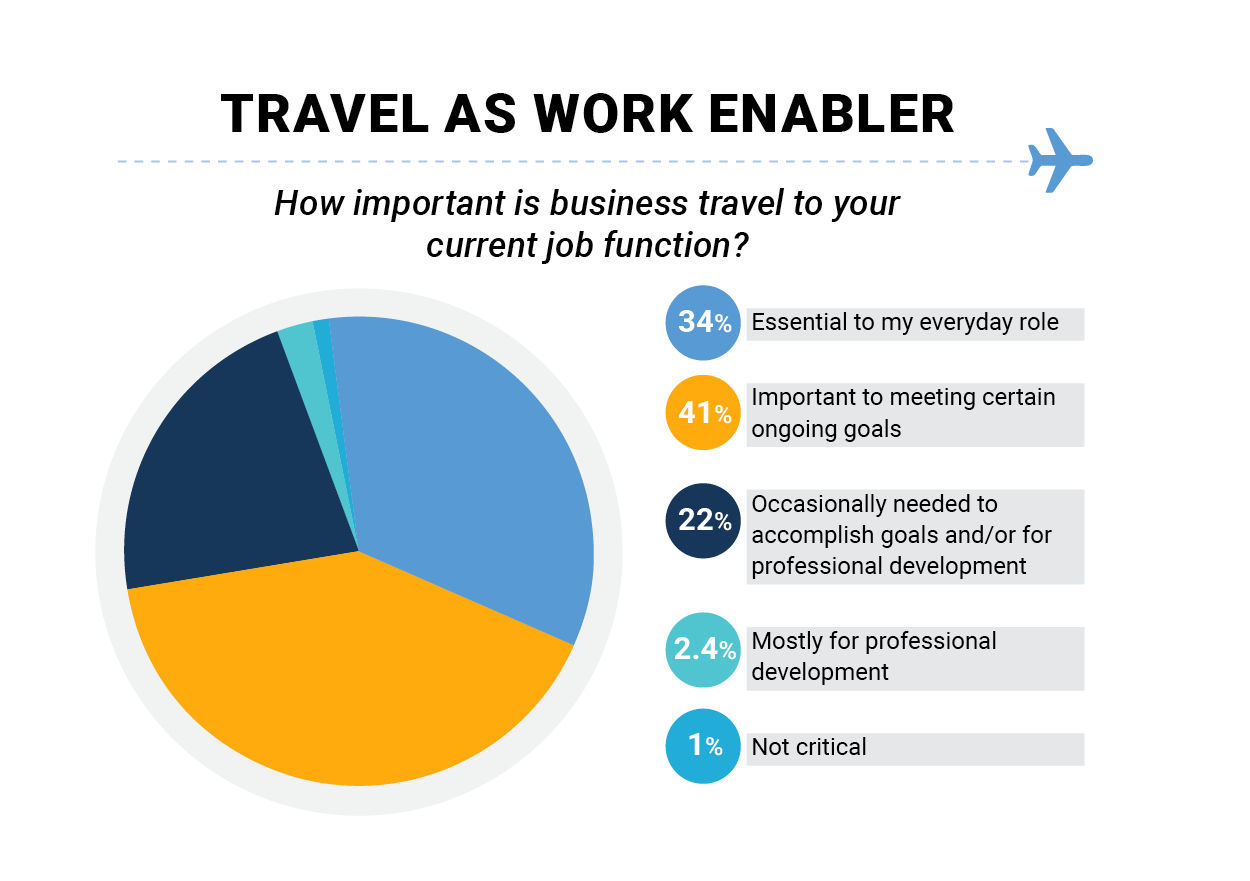
Traveler respondents to BTN’s survey acknowledged such an adjustment and mused in the open comments about the different thresholds that now exist for the need to travel. Yet, three-quarters of the employee-travelers surveyed still considered travel as a vital part of achieving business objectives within their current roles. Moreover, business travel represented a host of other employee and employer value propositions that aren’t necessarily captured in a strict dollars-and-cents analysis. More companies are learning what these are and how to support them in their business travel programs.
"Some trips have to do with talent becoming more talented or getting trained or learning from experts," GBTA CEO Suzanne Neufang told BTN in an interview over the summer. "There’s an investment in a company’s human resources that will indirectly contribute to sales because you are building better teams to support the business. … Those are important business and social science questions.”
 Source: BTN Intelligence survey of 500 business travelers, August 5-28
Three-quarters of employees sampled consider travel as a vital part of their job success—either required for day-to-day work enablement or to achieve specific job goals. On an ascending rating scale of one to five on how important business travel is to their job function, the mean rating was four, which indicates travel often is mission-critical to BTN’s traveler respondent base.
One-third of all 500 respondents use travel to achieve their everyday job goals. That figure is driven up significantly by frequent travelers, which BTN defined as employees who travel 11 or more times annually. Among that group, 42 percent said travel was essential to accomplishing their day-to-day job goals. That said, 37 percent of employees with more moderate travel schedules—which BTN defined as between five and 10 trips per year—also saw travel as central to their day-to-day work enablement tools. More commonly, however, moderate-frequency travelers utilize travel on an ongoing basis to support certain job goals. Infrequent travelers who count just three or four trips annually may be hitting the road more commonly for meetings, training or professional development purposes.
 Source: BTN Intelligence survey of 500 business travelers, August 5-28
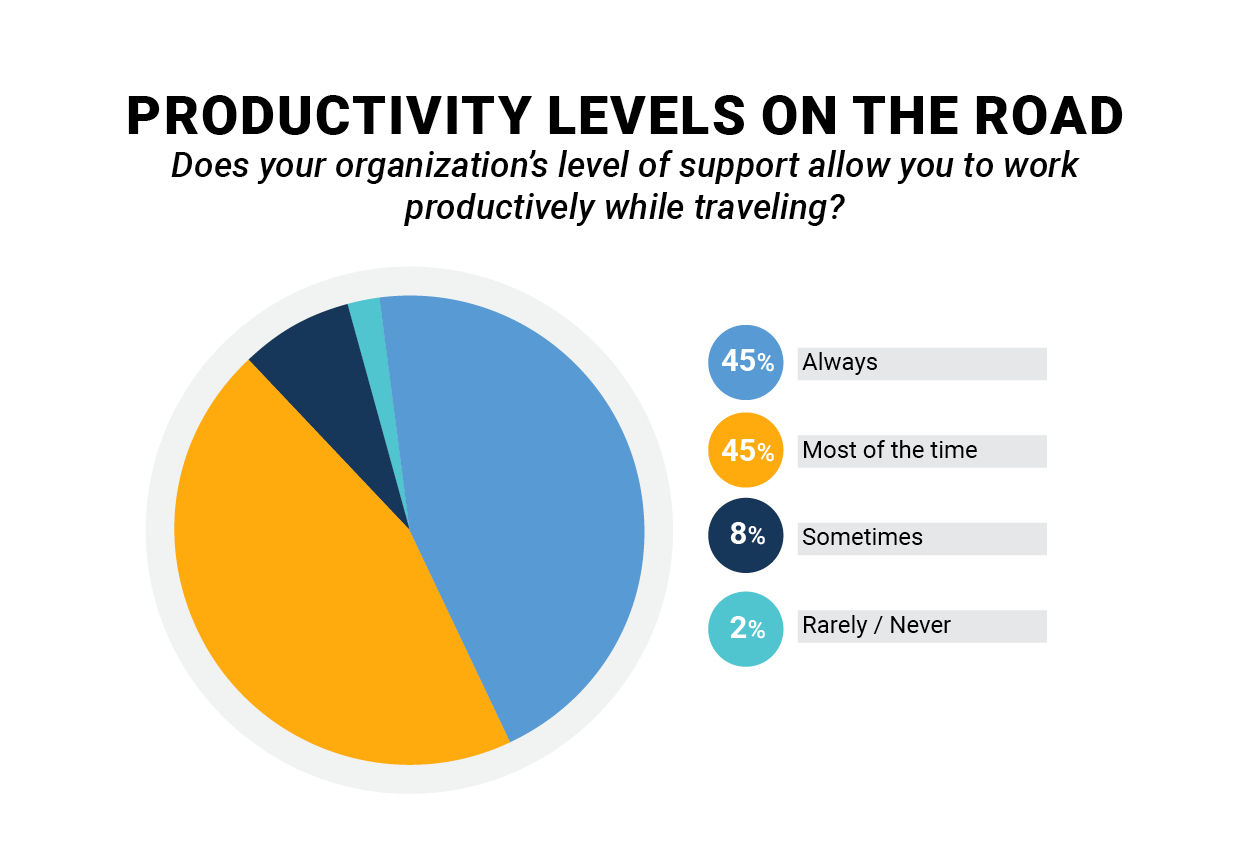
The vast majority of travelers are positive about the level of support their organizations provide for business travel. Interestingly, there was little variation in these figures across managed programs, lightly managed programs and completely unmanaged business travel, signaling that at whatever level business travelers have program structures around them, they will find a way to meet their business objectives.
Conversely, however, open comments revealed frustrations around “productive time lost” due to travel and the “unpredictability” associated with travel delays and disruptions.
"My biggest frustration with business travel is dealing with unexpected delays or cancellations that disrupt tight schedules. It adds stress and can make it hard to stay productive or meet important deadlines,” wrote one traveler, representative of many.
Travelers delineated some mitigating actions they can rely on in such situations. For example, more than half said lounge access was a reimbursable expense for them “in general” and another 29 percent said they could justify it “sometimes.” Frequent travelers, in particular, also relied on loyalty status to provide priority access to supplier attention and support in such situations; few, however, relied on travel agencies to help them out of a disruption jam. So travel managers may need to communicate more intensively around agency support if that is an option they’d like their travelers to utilize.
Another productivity challenge for traveling employees happens upon returning from a business trip. Managing the expense process for a significant percentage of respondents came through in the open comments as a frustration. Given the general positivity around productivity levels while on the road, a stronger focus on streamlining the expense process is an area where time and efficiency gains could have a material impact on traveling employees.
 Source: BTN Intelligence survey of 500 business travelers, August 5-28
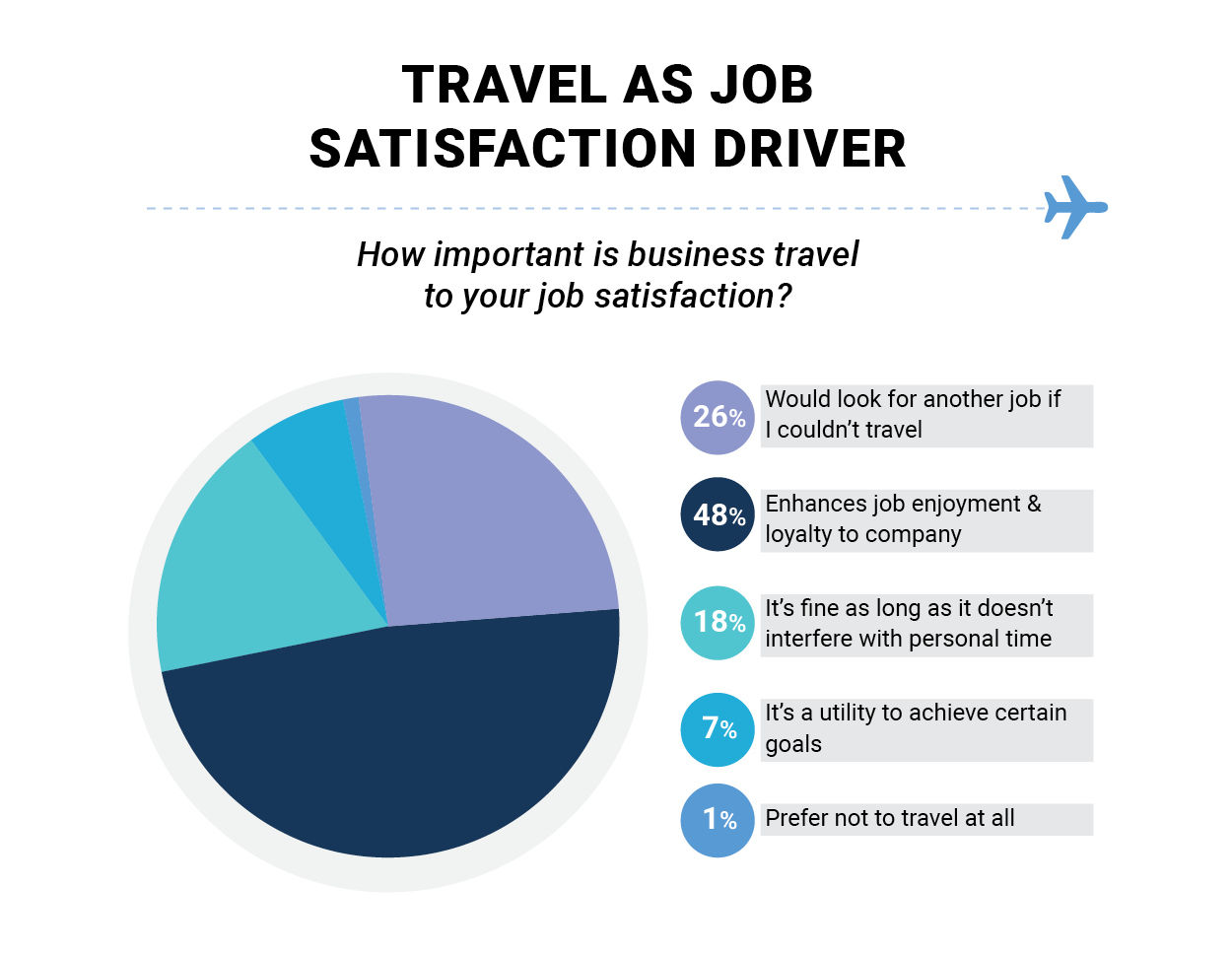
Despite some challenges, business travel promotes satisfaction in employees’ working lives. Indeed, the more employees travel, the more likely they are to say that business trips are important to job satisfaction. This positive correlation between frequent travel, which offers professional development, networking opportunities and increased motivation, as well as a break from the routine, and happiness is significant. It indicates that investing in productive business trips directly influences job success, satisfaction, loyalty to the employing organization and overall talent retention.
 Source: BTN Intelligence survey of 500 business travelers, August 5-28
Another element of that satisfaction, however, is more personal—and it’s the opportunity for business travelers to participate in destination-based activities and experiences that can dovetail with business travel.
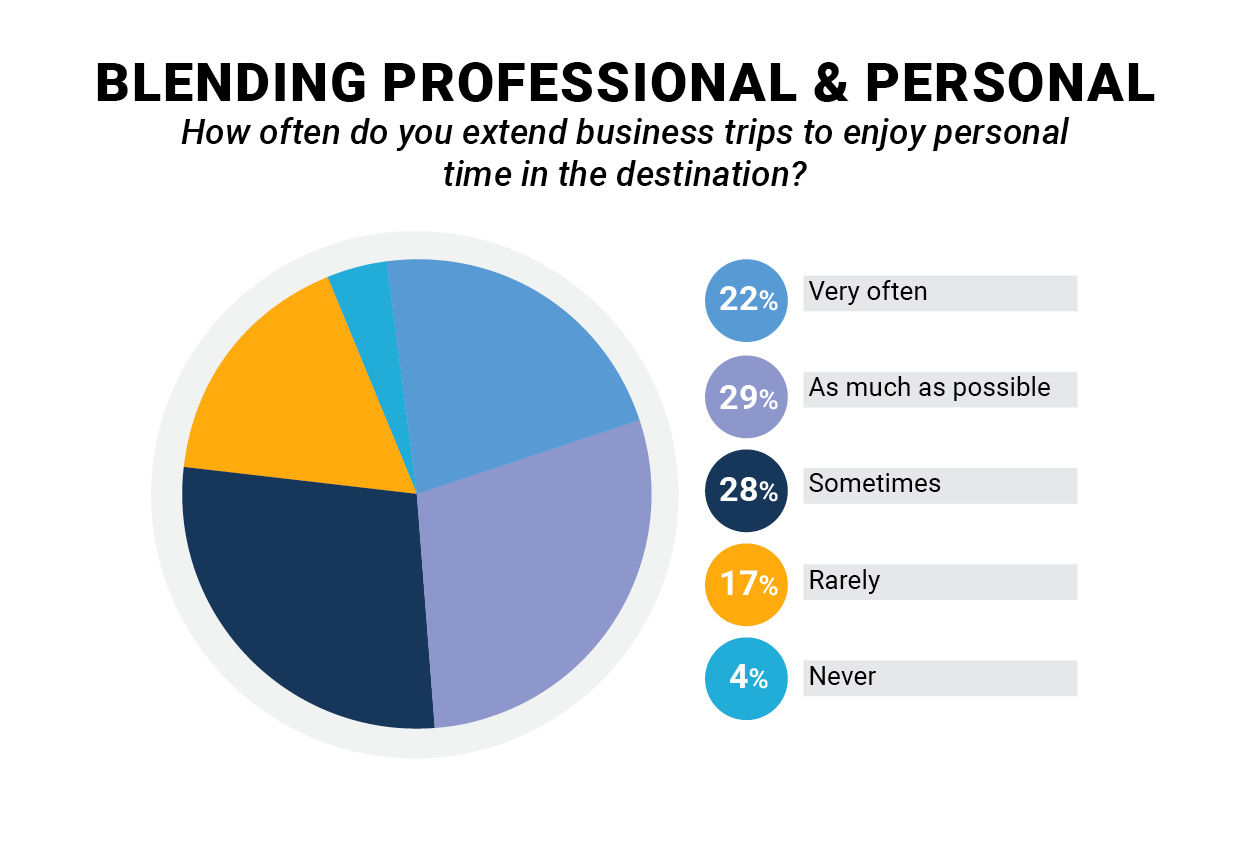
Extending business travel for leisure—the so-called bleisure trip—is a no-brainer for the majority of business travelers.
Just over half of all travelers surveyed extend business trips “as much as possible” or “very often” to take advantage of personally enriching experiences. An additional 28 percent of respondents said they do so occasionally. Those travelers who are on the road the most, are more likely than other frequency groups to lean into bleisure, with 35 percent saying they extend trips very often. Travelers who do more international trips are even more likely to extend their time for personal enjoyment—with 37 percent saying they do so “very often.”
Among age groups, 18- to 30-year-olds are the most likely to extend business trips, with more than 60 percent bolting on personal time as much as possible or very often. It’s a stage of life that often has fewer obligations but also fewer financial resources, so taking such opportunities could be more precious and more loyalty-building to the employing organization. The propensity to enjoy bleisure travel decreases as travelers get older, with 36 percent of the over-50 age group saying they “rarely” or “never” extend business trips. That compares with only about 18 percent in the other age groups combined who said the same.
The upshot here is that bleisure travel is no longer a niche phenomenon, and it can no longer be written off as “reaction” to the Covid-19 pandemic, which concluded with massive pent-up demand for overall travel.
The loyalty-building aspect of travel—particularly for younger workers using it as a gateway to life experiences—may continue to prompt a rethink of what’s on offer to employees through their travel programs. Not to fund personal travel, certainly, but potentially to provide policies or procedures in terms of accessing corporate rates or other perks that can support employee wanderlust and be viewed as a benefit (potentially supporting corporate volume efforts and loyalty activations to present to suppliers, as well).
_____________________________________
Case in Point: Getting Personal with Business Travel
Company: Adobe
Travel Manager: Kathy Burdge, Senior Manager Global Travel
Adobe uses Navan, and the tool has a personal travel mode that all travelers can access for non-business travel. Kathy Burdge, senior manager of global travel for Adobe, said employees avidly use the tool, which can also include special promotions and spot deals for Adobe employees to take advantage of.
"For any of our supplier contracts that allow us to offer rates for leisure or personal travel, we’ve loaded them into the personal mode of the tool. It’s then a seamless experience for employees to use Navan Personal and access our preferred hotels and car rentals—of course, not air, as [the airlines] don’t allow that.”
Burdge doesn't manage any support or services for such travel, but she does say it's a good outlet for program engagement. "Anytime you can have a positive impact on an employee through the travel program, it does make them understand you care about their experience and makes your program feel more like a benefit."
_______________________________________
Take a note of the younger age group, however. It’s not a one-size-fits-all generation. As much as they on the whole are up for business travel and the adventure of a personal journey on top of it, 18- to 30-year-olds also represent the generation that has the largest propensity to shy away from travel. They already represent the age group that travels least for work, but nearly a quarter would like to travel even less. When they do travel, they may need more information and support.