BTN’s 2025 Corporate Travel Index is the business travel industry's definitive resource for business travel costs in 200 cities around the world. Use it to benchmark your current program or to offer insights into rate trends in the markets you care about most. The index is unique in that it tracks corporate booked hotel and car rental rates using data from managed travel sources, not consumer data, to reflect actual managed travel activity as opposed to theoretically available rates.
Q4 2024 Highlights & YOY Comparisons
Hotel, car rental and safety data are updated quarterly in BTN's Corporate Travel Index Calculator, where users can customize and download per diem snapshots based on the class of service allowed by their travel policies for hotel and car rental categories. The below analysis includes index pricing
for upper-upscale, upscale and midscale hotels along with
full-size, intermediate and compact car rentals (U.S. cities only) and
three meals per day. Additional hotel tiers are available in BTN's
CTI Calculator.
Meal costs and taxi rates are updated annually. Six years of data are now available in the calculator, allowing for year-over-year or quarter-over-quarter comparisons.
U.S. Gateways: Total Daily Cost & YOY % Change
 Source: BTN Corporate Travel Index, Q4 2024 & Q4 2023
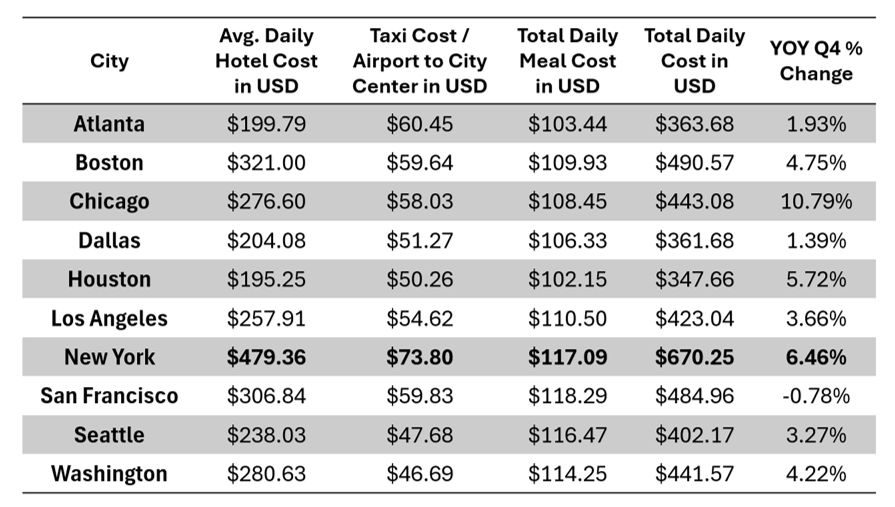
New York City was the most expensive city for business travel in the United States in the fourth quarter of 2024. Seasonal holiday hotel rates spiked by high-end business and leisure travelers perennially drive costs in the city during the final quarter of the year, and this time by nearly 7 percent. But New York wasn't the gateway city with the highest percent increase in Q4 daily costs. That honor went to the Windy City of Chicago, where daily business travel costs increased by nearly 11 percent year over year for the quarter.
Other gateway cities in the U.S. saw more modest increases, with Boston and Washington D.C. reaching more than 4 percent each and Houston with more than a 5 percent increase. Only San Francisco lost ground among major gateways, but it slipped less than 1 percent year over year.
U.S. Cities: Steepest % Decreases
 Source: BTN Corporate Travel Index, Q4 2024 & Q4 2023
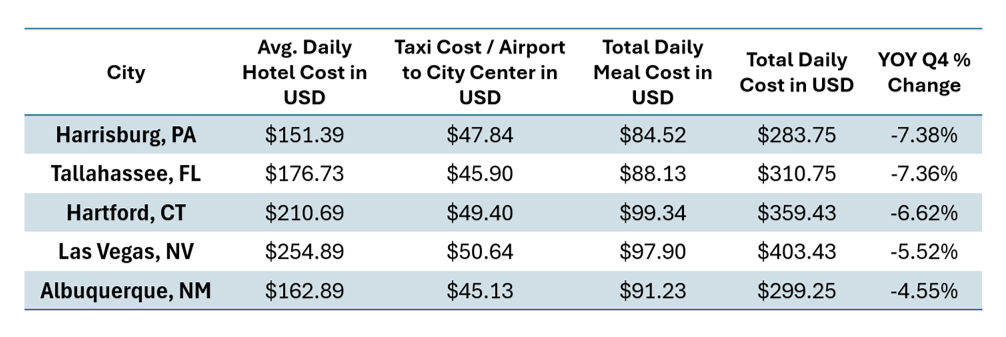
Not all U.S. cities gained pricing ground. Allentown and Tallahassee floundered in the year-over-year comparisons, with each showing more than 7 percent decreases in overall business travel costs. That's good news for buyers with business in these cities. Perhaps better news for buyers—particularly those with conferences and events—was that Las Vegas was looking more affordable in a side-by-side look with same period in 2023. Costs in the city drifted down by more than 5 percent.
U.S. Cities: Highest % Increases
 Source: BTN Corporate Travel Index, Q4 2024 & Q4 2023
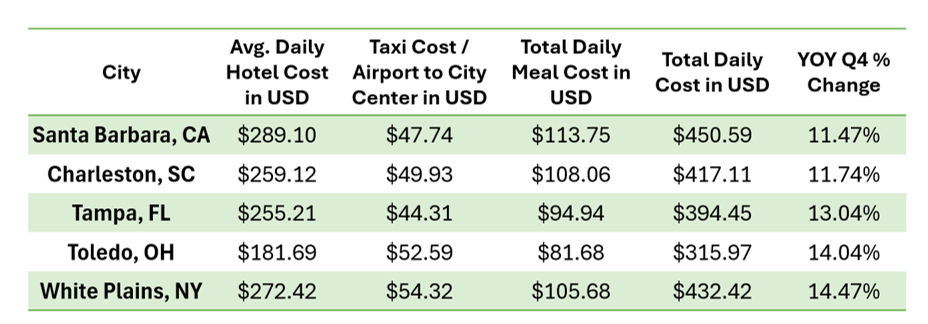
A number of cities performed better than gateways, when looking at percentage increases in the fourth quarter. Only a handful, however, had higher increases than Chicago. Santa Barbara outperformed with a nearly 11.5 percent increase in daily business travel costs, as did Charleston, SC, reaching nearly 12 percent pricing increases, with some sizeable hotel rate increases. Tampa, FL and Toledo, OH came in hot to the fourth quarter, but White Plains, NY topped the list of cities with year-over-year price hikes, with a nearly 15 percent increase in daily business travel costs.
Global Gateways: Total Daily Cost & YOY % Change
 Source: BTN Corporate Travel Index, Q4 2024 & Q4 2023
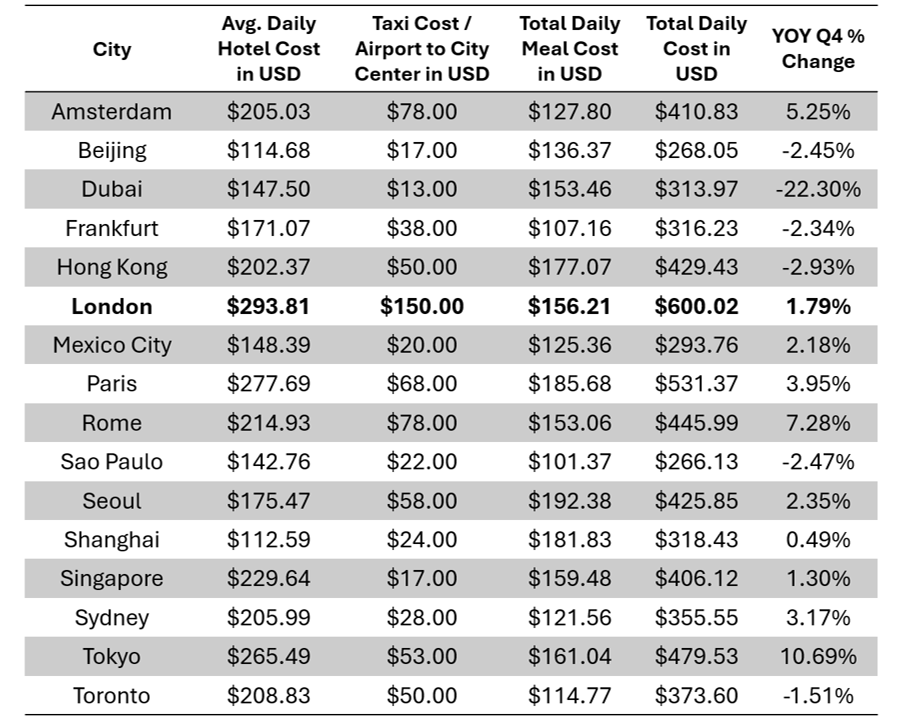
London was the most expensive city for business travel in the fourth quarter of 2024. Among global gateway cities, however, its costs weren't spiking in Q4—they've been riding high for a number of years. Year-over-year growth for London came in at just about 1.5 percent, lower than many other global cities, including global gateways. The highest pricing spikes for gateway cities in BTN's year-over-year comparison were in Tokyo at more than 10 percent and Rome at more than 7 percent, driven primarily by hotel rates in these cities. Amsterdam, Paris and Sydney experienced more modest pricing increases year-over-year for this period and several cities saw modest decreases. Some of the pricing reductions—and some mitigation of certain pricing increases—were due to changing currency exchange rates. Corporate Travel Index prices in U.S. dollars, which has been stronger against global currencies in Q4 2024 and many economists predict that will continue into 2025.
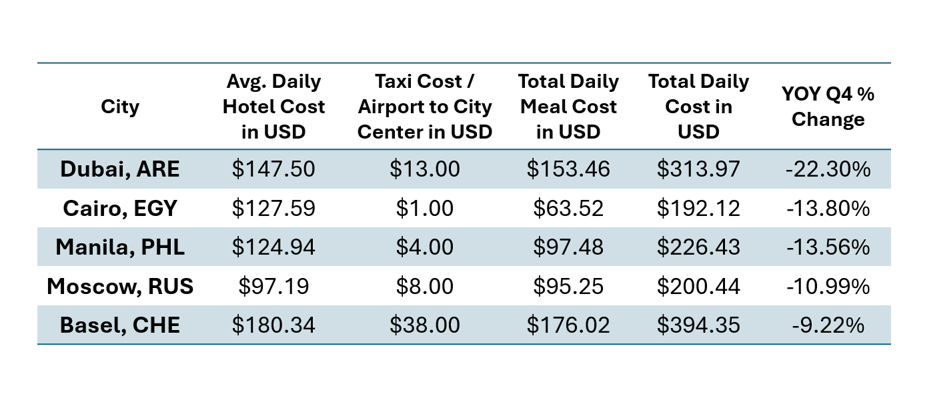
Global Cities: Steepest % Decreases
 Source: BTN Corporate Travel Index, Q4 2024 & Q4 2023
Dubai experienced the steepest percentage drop in business travel costs among global cities in Q4, despite being among the most active gateway cities in the Middle East. Cairo and Manila saw costs drop by more than 13 percent, driven by hotel pricing. Keep in mind that such reductions may also represent fewer bookings in upper-tier properties, but BTN's index partially controls for this by deselecting luxury and economy properties in year-over-year comparisons. Moscow and Basel also made the list of sinking business travel rates, both right around 10 percent in a year-over-year comparison. Moscow, however, was very hard hit in the quarter-over-quarter comparison, also offered by our index. Check the calculator for that view.
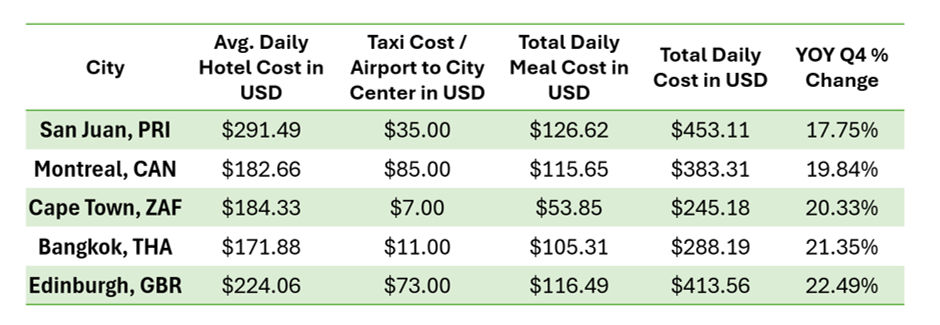
Global Cities: Highest % Increases
 Source: BTN Corporate Travel Index, Q4 2024 & Q4 2023
Finally, percentage growth for a number of global cities increased in the considerable double digits—flirting all around the 20 percent mark. San Juan, Puerto Rico, was up nearly 18 percent. Montreal nearly 20 percent. Cape Town, Bangkok and Edinburgh all surpassed 20 percent increases for business travel in BTN's year-over-year comparisons for the fourth quarter.
Check this page often for updates and new analysis. Plus, you can always do your own analysis with BTN's Corporate Travel Index Calculator.
Methodology
Hotel Rates: Advito and Prime Numbers provide aggregated, anonymized, quarterly U.S. rates booked by corporate clients across five hotel tiers. Advito, HRS and Prime Numbers provide parallel data for non-U.S. cities. BTN provides taxes and fees for U.S. cities on an annual basis.
Car Rental Rates: Advito and Prime Numbers provide quarterly aggregated, anonymized, quarterly U.S. car rental rates booked by corporate clients across three car rental tiers. Advito provides combined local tax and fee data.
Meal Prices: BTN rebuilt its meal and restaurant database in 2023 with research company Videc International. BTN updates meal data annually, using the following methodology.
U.S. Meal Data: Cities with annual GDP above $95 billion: BTN surveyed six independent restaurants and three hotel restaurants for breakfast; for each lunch and dinner, they surveyed six chain and six independent restaurants. For smaller cities, BTN surveyed two independent restaurants and one hotel restaurant for breakfast and three chain and three independent restaurants for each lunch and dinner. Breakfast is based on an egg entree with fruit and coffee or juice. Lunch is an entree-style salad or sandwich, pizza, burrito, etc. with fruit; fries or chips; and nonalcoholic beverage. Dinner is protein-based entree; small salad; cheese tray or dessert; glass of wine. Sample breakfast restaurants include Denny’s, IHOP and Starbucks. Lunch chains include Chili's, Panera and Bonefish Grill. Dinner chains include Cheesecake Factory and Capital Grille.
Non-U.S.Meal Data: Breakfast is based on continental breakfast. For lunch and dinner in each city that has a population of 1.5 million or more, BTN surveyed 12 restaurants; in each smaller city, they called six. BTN converted prices from local currency to U.S. dollars on February 2, 2024. Lunch is based on a sandwich, salad and nonalcoholic drink. Dinner is based on a fish, chicken or beef entree; salad; a dessert or cheese tray; glass of wine.
Taxi Rates: BTN compiles taxi rate data annually primarily using Rome2Rio, but fact checks with numerous sources.
Risk Scores: GeoSure synthesizes near real-time traveler safety data using a proprietary combination of Big Data predictive analytics, artificial intelligence/natural language processing and crowdsourced input. GeoSafeScores incorporate structured and unstructured data from sources like the United Nations, Centers for Disease Control and Prevention, World Health Organization, Interpol, The World Bank, FBI and the U.S. State Department, as well as macro sources like inflation trends, education, income levels, political stability, trending health and disease data, neighborhood-level police presences, healthcare facility proliferation and infrastructure characteristics. BTN updates risk data quarterly.