Corporate onsite remote conferencing systems have become
nearly ubiquitous, according to a new BTN
survey, but integration with managed travel programs remains patchy. Travel
policies that govern their use are not common in the United States, and
mandates even less so, as buyers labor to determine the best methods to direct
especially internal meetings travel to the virtual realm.
According to a February BTN
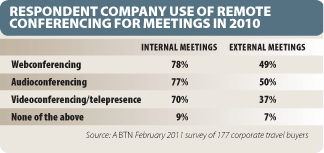
survey of 177 North American business travel buyers, 86 percent currently have
onsite remote conferencing capabilities—audioconferencing, webconferencing,
videoconferencing and telepresence—and 91 percent said their companies' travelers
last year used conferencing tools. Spurred by technological advances and
widespread meetings spending cuts in 2009 that highlighted to senior corporate
executives the benefits, broad use of such tools may have, at least for now,
peaked as the economy and business travel demand slowly improve.
 "It's one
of those things that gets a lot of focus during a downturn in the economy, when
everyone is focused on cost savings and cost reduction," said Carlson
Wagonlit Travel global product manager for emerging products Eric Bausman. "They
want to look for an alternative way to meet business objectives and clients and
stakeholders, but as inexpensively as they can. Then, when the [economy] starts
to come back, it's still something that's there, they're still investigating it
a little bit, but maybe it loses a little of its priority.
"It's one
of those things that gets a lot of focus during a downturn in the economy, when
everyone is focused on cost savings and cost reduction," said Carlson
Wagonlit Travel global product manager for emerging products Eric Bausman. "They
want to look for an alternative way to meet business objectives and clients and
stakeholders, but as inexpensively as they can. Then, when the [economy] starts
to come back, it's still something that's there, they're still investigating it
a little bit, but maybe it loses a little of its priority.
"I haven't seen any companies that are mandating use,"
Bausman added. "It becomes much more of a strong recommendation."
Only a handful—5 percent or less—of BTN survey respondents indicated that their travelers are required
to use remote conferencing in lieu of travel, typically for internal meetings,
especially those without executives in attendance.
Limited system availability is one reason why mandates are
rare. "Mandates have always been tricky to enforce, and you can't mandate
telepresence especially since you might not have the inventory to support the
meetings," said American Express advisory services research director
Christa Degnan Manning. "We saw in 2009 and even 2010, companies were very
strict around no internal face-to-face meetings without very high-level
approval. It's loosened up a little bit, but since telepresence is not an
unlimited asset, people can't mandate the use of it if it's not going to be
available."
Finding Ways To Drive
Use
But where systems are available, there have been success
stories. By strongly encouraging its travelers, Siemens Corp. replaced about 20
percent of its internal meetings travel with desktop videoconferences,
according to Procurement.travel. Ikea
in 2009, after designating point people in individual countries to encourage
adoption, upped its worldwide total of remote meetings, especially
webconferences, to 300,000, according to meeting and travel manager Torbjörn
Erling.
 Some buyers have pushed further than extensive internal
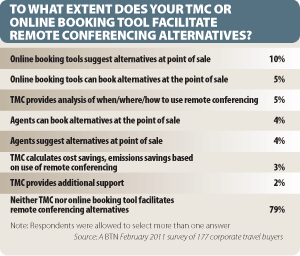
communications by recommending remote conferences at the point of sale. About
21 percent of respondents said their companies do so when employees book
meetings via corporate travel agents or, more likely, online booking tools. A
handful have enabled the booking tool or agents to actually reserve remote
conferencing systems, a move that requires a high level of technological
integration.
Some buyers have pushed further than extensive internal
communications by recommending remote conferences at the point of sale. About
21 percent of respondents said their companies do so when employees book
meetings via corporate travel agents or, more likely, online booking tools. A
handful have enabled the booking tool or agents to actually reserve remote
conferencing systems, a move that requires a high level of technological
integration.
"In the online world, there are some developments to
try to create some very rudimentary tools or intranet request forms, but the
back-office integration for a lot of this just doesn't exist," Manning
said. "Everyone's been focused on cost control and profitability, so it's
not something someone's going to put forth as a mission-critical infrastructure
investment at this time."
Bausman said that CWT has had some clients request that live
agents suggest travel alternatives, "but it's not something that we do
across the board. It does have an impact on the reservation process. In some cases,
it can slow things down and have a productivity impact. That's the trade-off."
Buffalo, N.Y.-based financial services firm M&T Bank has
taken an automated, analytical approach to determine when to replace travel.
The company developed a tool that provides projected costs of potential web-
and videoconferencing alongside the proposed in-person meeting costs, according
to vice president of corporate travel and meetings Paulette Miklas. "M&T's
policy suggests using the lowest-cost option between these, if it fits the goal
and objective of the meeting. As far as the equipment, technology is available
across our footprint for web and videoconferences. The bank's technology
division provides a listing of resources and capabilities and even a cost
calculator to determine what the costs would be between the sites."
Offsite Options
Exercised
Videoconferencing may not always be a feasible solution for
companies with many locations or smaller firms without a steady stream of
meetings, but their interest in remote conferencing has fueled a number of
recent partnerships between travel management companies and videoconferencing
firms. They include CWT's partnership with Tata Communications, BCD Travel's
with Whygo, American Express' with Cisco and Adelman Travel's with IVCi. Such
hotel chains as Marriott International and Starwood Hotels & Resorts
Worldwide, meanwhile, have been installing telepresence rooms at some
properties around the world.
Fifty-two percent of survey respondents indicating they
expect their business travelers this year to use offsite remote conferencing
solutions. "You have to understand very well your own travel patterns as a
company—what are your top five or 10 market pairs?—then map that against where
you have the options to get into these videoconferencing suites," CWT's
Bausman said.
Wherever they are, remote conferencing tools must
immediately prove dependable, according to Blue Coat Systems travel manager
Rick Wakida. "If they don't work the first time, or there's a delay, it's
hard to get people to use that again," he said. "If you are going to
roll this out, or formally reintroduce this broader, enhanced program, you want
to make sure you have broad coverage and good systems that are reliable and
consistent."
Wakida said the Sunnyvale, Calif.-based network security
firm currently is assessing its remote conferencing needs and plans to upgrade
its internal videoconferencing system this year. "We require a trip
purpose code for meeting booking, and we're targeting [internal meetings] as
part of an expense-reduction plan," he explained. "One of the
alternatives we've mentioned is doing X percent by videoconference."
Blue Coat will develop a policy governing the use of a new
system, Wakida added.
Such policies, said Amex's Manning, are key to the success
of any effort to incorporate remote conferencing into a managed travel program.
"You have to put into the context of decision-making around achieving
business goals, just like people are looking today hot how they can most wisely
spend their travel budgets," she said. "Companies have to support
decision-making around alternatives to travel as much as they have been around
business travel."