Kayak co-founder and former chief technology officer Paul English's
travel booking and chat-based traveler assistant tool Lola pivoted last year from a leisure travel
strategy to a focus on the unmanaged business traveler. Today, the company will launch Lola
Works, a managed travel "lite" solution for the small and midmarket that offers administrative tools and dashboards that allow simple policy controls, centralize
a view of a company's travel footprint and track overall travel spend.
Lola's primary platform remains traveler oriented and built
around personal preferences and loyalty program affiliations as
drivers behind business travel bookings. "We spent a bunch of
time with [road warriors] to understand their needs and to figure out what apps
they were using and what does and does not work for them," said English. "Business
travelers care about price, but they are not making decisions based solely on
price. They want their miles and points," he added, and the app is built
to display choices based on past booking history and declared preferences
stored in the user profile.
Lola Works dovetails with the traveler-facing app by
integrating simple company guidelines, controls and rate caps into the loyalty
and personal preference equation. The desktop administrative app allows a company
to identify its top travel markets—for example, Chicago, San Francisco, London
and Singapore—and further identify company preferred hotels in those markets
for travelers to consider when booking their trips. The preferred hotels are prioritized
in the traveler's search with a "preferred" notation, along with a list of properties based on the traveler's historical bookings, amenities and style preferences, crunched through Lola's algorithms that also cluster and organize millions of reviews and hotel sentiment data to make relevant recommendations.
Hotel selection can be further influenced through the Lola Works platform by setting rate caps in each popular market. The app can take some of the work out of
the task by allowing admins to create a rate cap for certain amenities and class of service in Chicago, for example, then an algorithm will take over to provide appropriate
rate caps for San Francisco, London and Singapore to achieve consistency in those cities. Search results also will offer current market guidance
on whether the rate displayed for a given hotel is a good value on the day or whether it is
currently "expensive" according to company guidelines.
The new admin interface offers similarly "lite"
drop-down controls for flight search and booking, allowing companies to
identify how travelers should utilize premium economy, business class and first
class cabins—for example, flights longer than three hours are eligible for premium
economy while flights longer than six hours are eligible for business class, but
first class is never allowed. The tool encourages companies to keep the
travelers in mind, with settings geared toward productivity and fitting into
travelers' personal schedules. The "direct flight" settings allow
admins to identify a cost threshold for travelers to take a direct flight
versus a connecting flight; while the "wiggle room" setting allows
cost flexibility for time of day preferences, rather than forcing travelers to
choose lowest cost options.
English emphasized that Lola Works isn't built to deny
business travelers options but to provide guidelines. The tool cannot be configured
to block bookings. "If you go onto the Concur website, there's a white paper
called 'Leakage' because 50 percent of travelers are cheating and going outside
the tools. When half of your travelers do that, you lose your ability to manage
consistently," said English. "Especially for the small and midmarket business,
which is our target market, it's important to show that road warriors have no
reason to go outside Lola. We want them to get their reward points in Lola and
have all the hotels they want. If you book outside of guidelines, we'll tell
you it's outside of guidelines but you can go ahead and book it." English
added that most business travelers have good reasons to go outside guidelines when they do, and soon Lola will include a system for communicating
those reasons back to the administrative tool at the time of booking.
In addition to simple policy configurations, Lola Works will
offer quick reporting and visual dashboards for admins to track traveler
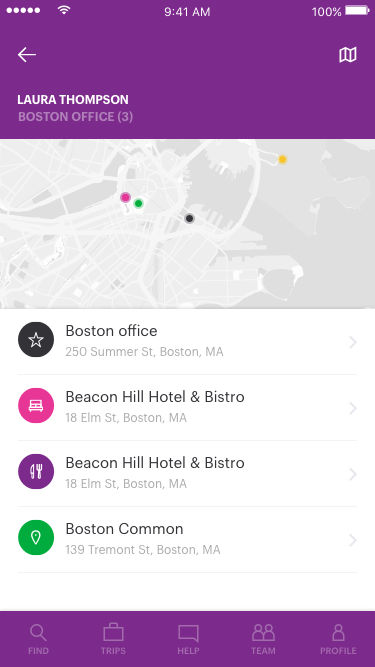
location and spend. A map view shows where travelers are located on the current
day, while trip and spend details can be tracked on the current day, for the
month to date or for the year to date. They are tracked by traveler and by
trip. Flight and hotel costs for each trip are displayed as a bundle on the
overview, and admins can drop down details on the trip to dig deeper into flight
and hotel costs. Currently, compliance notifications are not part of the Lola Works tool, but English said they are in the development
hopper.
Lola Teams
Also in an early rollout, Lola Teams adds a social and recommendation component to the Lola experience. Based on the travel markets or "places" that are loaded in the Lola Works platform, individual travelers can use Lola Teams to recommend hotels and restaurants or other local experiences that colleagues might want to check out when traveling on business in the area. Multiple teams can co-exist inside an organization. A general invite to the Lola app doesn't necessarily add a user to a team, but an invite to a Lola team will onboard a traveler to the app and to the team.
Lola currently operates on $44 million in venture capital from General Catalyst, Accel Partners, Charles River Ventures, GV and Tenaya Ventures. The company has a direct-to-corporate strategy for the SME market, though English previously told BTN Lola would entertain agency partnerships. For now, Lola Works
is free for companies that have travelers as Lola users, but English told BTN the
company will introduce fees for the administrative tool. Regarding the
traveler-facing app, Lola collects hotel commissions "and we get a tiny
bit from airlines," said English. The VIP
service component has been free to date for users and one of the most
valuable aspects of Lola for travelers, according to the company. While Lola
has sophisticated artificial intelligence to produce relevant search results
for travelers, the majority of its chat interface and personal service
relies on human agents supported internally by AI. English said that is by design. Lola is entering a managed SME travel space that has increasingly pursued AI solutions but with many tools defaulting to human agents.