To hear Prism president Michael Whitesage describe it,
corporate airline contracting continues on a steady march toward ubiquity. As
of last summer, the firm counted 23,000 data release authorizations from
corporations that agreed to share data with airlines as part of contract
negotiations. That number was growing at a clip of 600 per month. Because many
of the largest U.S. and foreign airlines now use Prism, it has become as good
an indicator as any of a clear trend toward more corporate airline deals. Yet,
from some corners of the industry, seeds of doubt are being sown.
Does corporate contracting in its current form provide value
to airlines or, as American Airlines' Frank Morogiello has asked, are carriers
just "decrementing revenue"? Is value created for corporations when
they trade market share for discounts, or is there a viable alternative, as
Google seemed to find when it empowered its business travelers to forego
preferred carriers and make their own travel purchasing decisions?
"It's not whether contracting provides value, but does
the premise of the contract—particularly segment-based market share—continue to
make sense?" asked TCG Consulting air practice director Barry Rogers. "There's
an increasing sense that, no, it doesn't really, particularly with those that
use a Prism-based measurement." Rather, Rogers and others argued airlines
would be better off measuring the profitability of client relationships. It's
all about margins, they say, not market share.
Airline CEOs and analysts often maintain the U.S. airline
industry in the past decade has undergone a transformation. The old airlines,
they claim, were empire builders bent on amassing market share. US Airways CEO
Doug Parker and others have argued that airlines today are focused instead on
returns for shareholders.
Just don't tell carrier sales organizations, whose model of
success continues to be based on market share.
"When it's all about market share, that $49 segment
from Chicago to Detroit has the same overall value as an $8,000 business-class
segment from Chicago to Hong Kong," Rogers said. "Everybody who looks
at that says it doesn't make sense."
To be clear, Rogers said that "Prism is a good thing
overall, despite its flaws," as it brings accountability to contracting
and enables "data-based decision making."
Scott Gillespie, author of Gillespie's Guide to Travel and Procurement, called market share "a
necessary but not sufficient variable in the equation."
"When we say profit margin," he continued, "what
the airlines mean or what they should mean is contribution. Contribution is
just the volume times the profit margin. Some airlines might be happy with 5
percent profit margin on a $10 million account, and another airline would
rather have a 50 percent profit margin on a $1 million account. It's the same
profit contribution, just different flavors."
Some buyers question whether their contribution to the
airline is adequately measured and rewarded.
US Foods manager of corporate travel and expense Jennifer
Steinke said her company has airline contracts that she wouldn't necessarily
give up, "but I would like to see the model change. I'd like to see it
focus on the entire value of the relationship and not just market share."
Still, measuring the overall value a corporation brings to
an airline, and vice versa, is difficult. And, in many ways, airlines already
reward clients who create value and drive profits.
"Fare ladders are just proxies for profit margins,"
Gillespie said. "The point at which the buyer buys probably drives the
degree of value they get from contracting. Many companies do a really good job
of buying inexpensive airfares—they buy in advance, they use nonrefundable
fares, they'll take a connection to get the deal. Those companies are not going
to get any significant discount from their preferred airline, so you can
absolutely understand the travelers' perspective when they say, 'Why should I
take Airline A for a 2 percent discount?' For those companies that buy down the
fare ladder, there is precious little advantage to contracting."
In an opinion piece published in The Beat, Gillespie and consultant Evan Konwiser, who co-founded
FlightCaster, wrote that "suppliers are sick of providing price
concessions, then not getting the volume they bargained for. Buyers understand
the profit needs of suppliers, yet there is no arbiter to find the efficient
middle ground.
"Smart suppliers will replace long-term contracts with
dynamically adjusted pricing tied to the account's recently delivered market
share and profit margin," Gillespie and Konwiser continued. "Suppliers
will fight over only those buyers who can move truly profitable business. New
tools will support this collaborative relationship, including direct
distribution's entry into managed travel."
Concur chairman and CEO Steve Singh said people should "take
a giant step back" and determine the goal of preferred arrangements. "The
end goal of corporate contracts is to make sure you're getting a fantastic deal
for your company relative to the dollars you spend," he said. "It
doesn't matter whether that's through corporate contracts or incredibly
personalized content and offers or pricing at the individual level."
THE PROS AND CONS
OF CONTRACTING
PROS
Savings, Savings,
Savings
If contracting didn't save money, would the world's largest
and most successful corporations even bother? Probably not. Indeed, there is
strong evidence that companies, regardless of size, get a hard-dollar return
through preferred agreements, though the travel footprint of the client and the
types of fares they buy greatly impact the magnitude of that savings.
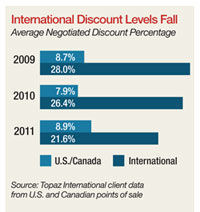 According to Topaz International data on about 100 companies
varying in size and spend, the average domestic discount during the past few
years ranged between 7 percent and 9 percent. That may seem "somewhat low,"
according to Topaz president and CEO Brad Seitz, "but must be looked at in
terms of the value to the program and the corporation determining if it is
worthwhile."
According to Topaz International data on about 100 companies
varying in size and spend, the average domestic discount during the past few
years ranged between 7 percent and 9 percent. That may seem "somewhat low,"
according to Topaz president and CEO Brad Seitz, "but must be looked at in
terms of the value to the program and the corporation determining if it is
worthwhile."
If, for example, a company buys 10,000 fares at $500 apiece,
and if 60 percent of those are eligible for an 8 percent discount, that's
$240,000 in savings. That is meaningful for many companies. Several consultants
and buyers, however, pointed to domestic discounts of 2 percent or 3 percent,
equating to far more modest savings.
The highest discounts and greatest savings opportunities are
for high-yield traffic. Airlines particularly like high-margin fares associated
with international and premium-class tickets, and they discount accordingly.
The average discount on international fares last year was 22 percent, according
to Topaz data.
"Clearly, the value on both sides of the equation is
driven by international premium-class travel," said TCG's Rogers. "Domestically,
it's a challenge."
Soft Dollars Are Real
"It's not just dollars for me," said US Foods'
Steinke. Indeed, there are a slew of other services and perks that airlines
provide to clients.
Delta Air Lines has been particularly up front in showcasing
those. The carrier in the past year began sharing with clients the occurrence
rate and dollar value of frequent-flyer upgrades, waived bag fees, the number
and cost of bags checked by a company's travelers and elite status
designations. Those reports, which also detail the passenger experience (travel
disruptions and such), aim to quantify the value beyond core airfare savings.
Delta senior vice president of global sales Steve Sear said
the airfare discount is just the beginning of the relationship, and non-fare
benefits are increasingly important. "There's going to be increased focus
on building corporate CRM programs, so via technology, via creativity, we want
to continue to find ways to add value for our customers," he said. Those
could include more recognition programs for corporations and their travelers.
Most major carriers that work with corporations similarly
deal in soft dollars. Frequent-flyer status matches garner buy-in from a
company's frequent travelers, upgrades give them creature comforts, and lounge
access makes those delays somewhat productive.
Relationships Matter
When a corporation signs a contract, they're getting more
than a percentage discount and a handful of traveler perks. They're getting a
direct line to the airline in the form of an account manager and special
service desks—actual human beings with names and phone numbers.
"To me, it's so much more about the relationship, the
support in being there for my travelers and being able have a rep to call when
I need help," said Steinke. "For a lot of businesses, if you don't
have a contract with an airline, you don't have anybody to talk to."
Without that relationship, stranded corporate travelers or
frustrated travel buyers may get stuck on hold like everyone else who dialed an
800 number posted on a carrier's website.
The value of relationships manifests in other areas. Who do
airlines turn to when they seek new markets to serve or new services to
provide? From whom do they seek feedback on their next-generation
business-class seat or other product initiatives? Through corporate advisory
boards, business traveler surveys and old-fashioned conversations, the answer
in many cases is the corporate client.
CONS
Contracted Fares Aren't
Always The Best—Or Even Available
Contracted fares aren't always the best fares. Furthermore,
the preferred carrier's fare isn't always available at the time of booking.
"There's always some sort of marketshare target, and
they've been tougher to hit because, as planes are fuller, the lower fares are
selling out," said former Blue Coat Systems global travel manager Rick
Wakida. "Sometimes we're on the nonpreferred carrier because the lowest
logical fare isn't on the preferred carrier, which dilutes the overall market
share. I'm sympathetic to the fact that we have a contract and have targets and
that the airline needs to see results, but on the other hand, when you're sold
out or we have a cheaper option that happens to be on one of your alliance
partners, I'd like a little bit more help on that."
Even for companies with highly performing contracts and
stringent travel policies, it's hard to entirely avoid the spot market.
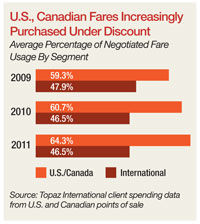 TCG's Rogers said a good "target benchmark" for
corporations is to purchase under contract 60 percent to 65 percent of all
fares booked. The remainder may be with nonpreferred carriers providing a
better schedule, service or price. As such, many buyers grapple with
instructing employees to use a preferred airline when it's not in the traveler's
best interest.
TCG's Rogers said a good "target benchmark" for
corporations is to purchase under contract 60 percent to 65 percent of all
fares booked. The remainder may be with nonpreferred carriers providing a
better schedule, service or price. As such, many buyers grapple with
instructing employees to use a preferred airline when it's not in the traveler's
best interest.
"A lot of companies will support a preferred carrier if
it's $50 or even $100 more expensive, but if it's $400 or $600 or $800 more
expensive, that's pretty tough to do," said Rogers.
Even in cases when there is a price benefit, travelers can
struggle to make the company-approved choice.
"It's hard to push a preferred supplier when it's a few
percentage points discount or the fare difference is $6," Steinke said. "What
the traveler doesn't see is that it's $6 here and $6 there, and if you keep
adding that up, you see an impact. In higher buckets you can see more
significant savings."
Contracting Doesn't
Come Cheap
"The cost of negotiating at the top level is very high,"
according to Konwiser, noting the time and effort required to come to terms
with airlines and "the cost to travelers in booking in specified ways,"
as recommended or perhaps mandated by their employers. "Those costs are
adding up, and the more intelligent buyers are understanding that."
It's worth considering not only the efforts by companies to
undertake the bid process and structure deals, but also the diligence needed to
achieve contractual goals: policies must be set and communicated; booking
channels and travel agents have to be updated; and enforcement actions may be
needed.
Meanwhile, an entire cottage industry has been built on the
premise of airline contracting. There are consultants, lawyers, travel
management companies, software systems, third-party auditors and other players
in this game. They all cost money, and for quite a few successful programs,
they all are integral. Those costs are not always incorporated when calculating
the expense and value of contracting.
"Most travel managers really do put a lot of energy and
effort into managing their commitments," said Rogers. "Most take it
seriously, and it requires a lot of effort. In a lot of cases you can be
battling traveler desire."
CWT Solutions Group vice president Nick Vournakis tapped
into that traveler desire theme in a recent post on the agency's corporate
blog. "The implication for individual travelers can be pretty huge,"
he wrote. "Why should you pay more to follow the rules when it's your
travel budget on the line? Only when you understand the macroeconomic impact of
your individual decision will that ever make sense. That doesn't make the pill
any easier to swallow, it just is what it is."
Battling traveler wills is likely to get more challenging.
According to the results of a survey of 502 U.S. business travelers published
last October by Business Travel News,
46 percent of airfares purchased by travelers under the age of 35 were with
preferred vendors, compared with 76 percent purchased by those over the age of
55. Clearly, the value of contracts is less evident—or less important—to the
newest members of the workforce.
Even so, contracting and a traveler-centric model can
co-exist. Though tech firm Sapient takes a tough stance against program
noncompliance, the company also relies on travelers to guide airline
relationships.
"We have certain carriers who are very popular with our
end users, and because of any number of reasons—customer service, etc.—they
have through our social media discussion strongly recommended that we use those
relationships," said vice president of global procurement and real estate
Stephen Bertolami. "We built the program, to the extent that we can,
around those suppliers."
Bertolami noted that Sapient has some airline contracts, "but
we keep them relatively flexible, so the end users can see what the best
options are among many carriers. There is a fair amount of flexibility in usage
of those. It drives our people to use the carriers that they prefer to use."
Airlines Don't Count
All Air Spend
A sizable chunk of corporate spend on air travel isn't
eligible for discounts. Airline lobbying group Airlines for America frequently
and fervently reminds the public that the tax burden for the "typical $300
round-trip ticket" is around 20 percent. FareCompare CEO Rick Seaney said
it's not uncommon for airline-imposed fuel surcharges to comprise 50 percent of
a ticket cost, particularly on international routes. Meanwhile, checking a bag,
selecting a seat or boarding early are just a few examples of the myriad
ancillary items that can add to air travel's total cost. To wit, checking a
single bag at $15 a pop each way on a roundtrip journey would represent 10
percent of Airlines for America's "typical" ticket.
With few exceptions, these taxes, surcharges and ancillaries
are not negotiable. Here's an extreme example: If taxes eat 20 percent, fuel
surcharges account for as much as 50 percent and ancillaries start around 10
percent, there's not a lot left to negotiate.
— Jay Campbell and
Mary Ann McNulty contributed to this report.
This report
originally appeared in the February 2012 issue of Travel Procurement.