"The rules are changing for travel managers," said Claire Blades, director of travel and meetings for data storage company Veritas Technologies. "I've had to get onboard with that reality. It's more about the numbers and how data helps drive the business. Travel managers need to get
in front of their data in order to advance their programs."
Like Blades, more travel managers have realized that travel program maturity will be driven by data maturity. Organizations want a deeper view of what is driving travel costs and traveler behaviors, and the most advanced travel data strategies are striving to tie travel management goals
directly to business strategy. To achieve that, however, something has to change.
What About Data Quality?
Questionable data quality has been the bane of business
travel intelligence efforts. The timeliness of the data is one concern—it can
lag by 30 to 45 days—but accuracy is another. Consider manual data entry by
agents or discrepancies in vendor names: They can wreak havoc with the numbers.
Whether data quality has improved thanks to the stronger focus on business
intelligence depends on who you ask.
Cornerstone Information Systems CEO Mat Orrego said that transactional
data has improved. "We've gone through getting that transactional data
into a place that is accurate. [We] clean it, apply data policy/normalization—apply
quality control—so that you can trust it. A lot of companies have gotten pretty
good at that, at least with the traditional data."
Michelle De Costa, corporate travel lead for Liberty Mutual,
answered simply, "No." She continued, "That data requires a lot
of scrubbing, and no matter how hard we try, we miss something."
While respondents to BTN's survey gave the highest
data-quality ratings to third-party aggregators, Oracle's global travel
sourcing lead Rita Visser lamented the data quality from her former provider.
She brought Oracle data in house and worked with her IT team to standardize
formats. "[I sat] down with a person from IT and showed them how the data
should look: This is what a stopover should look like, here's what a connection
looks like, here's a through fare, etc. It was really insightful because it was
shocking how bad that data from our aggregator was."
Prime Numbers director of data integration and business
intelligence Kate Saab suggested that it's not so much the quality of the data
that has changed but rather the tolerance threshold and goals of the data user.
"People have gotten used to some inherent
issues with travel data," she said. "Clients in the past have been
more concerned with discrepancies. They can now look at the data with an eye
toward what they can glean from it rather than just that it doesn't match
perfectly."
"When it comes to travel data, we keep looking at the same things and we keep getting the same answers," Coca-Cola director of procurement for global travel, meetings and events Pam McTeer lamented to BTN. "We have to do something different."
Results of a BTN survey fielded in August and September to assess buyer appetite for better travel program intelligence showed that change is emerging on two fronts: data sources and data tools.
Beyond travel management company, corporate card and expense data, travel managers reported looking at broader sets of data to manage their programs, and they are demanding better data from suppliers. Leading-edge buyers are exploring emerging data sets that have the potential to tame
long-standing intelligence frustrations like off-channel bookings and hotel folio details. Buyers have realized that less structured information like traveler surveys and feedback have become a viable set of data, as well.
On the tool side, the vast majority of travel managers continue to work with their data in a manual environment. With the growing number of data sources and better detail from those sources, moving forward with manual reports, static dashboards or basic Excel files has become
untenable. Data analytics tools specifically targeted to travel management were slow to emerge but now are poised to answer demand for better solutions. These tools, which layer data sets, model what-if scenarios and enable deep drill-down across multifacted data sets are opening new dimensions for data
analytics. Most travel buyers, however, are just getting started.
Thinking Holistically
Global travel director for RELX Group Jim Sisco manages a mature global program. Even so, combining multiple data sets to analyze travel is new for the program. He's forging ahead with the support of his leadership team, but the journey hasn't been easy.
"I don't own the accounts payable or the expense process in our organization, but our leadership in finance and procurement are interested in telling a more holistic story around travel," he said. To that end, Sisco is building a view of travel that includes traditional travel
management data sets: TMC, credit card and expense. With five or six sources of expense data, he said, that part of the picture has been particularly challenging. "We're getting pushback from a couple of the businesses about why we want to look at their data," he said. "Plus, we don't have a
giant budget to go out and do this." To bridge the budget gap, Sisco is approaching data aggregators and analytics providers and offering RELX's travel data in partnership for tool development. "We are going down the right path, and this is a topic that as an industry we are going to watch develop for
a long time."
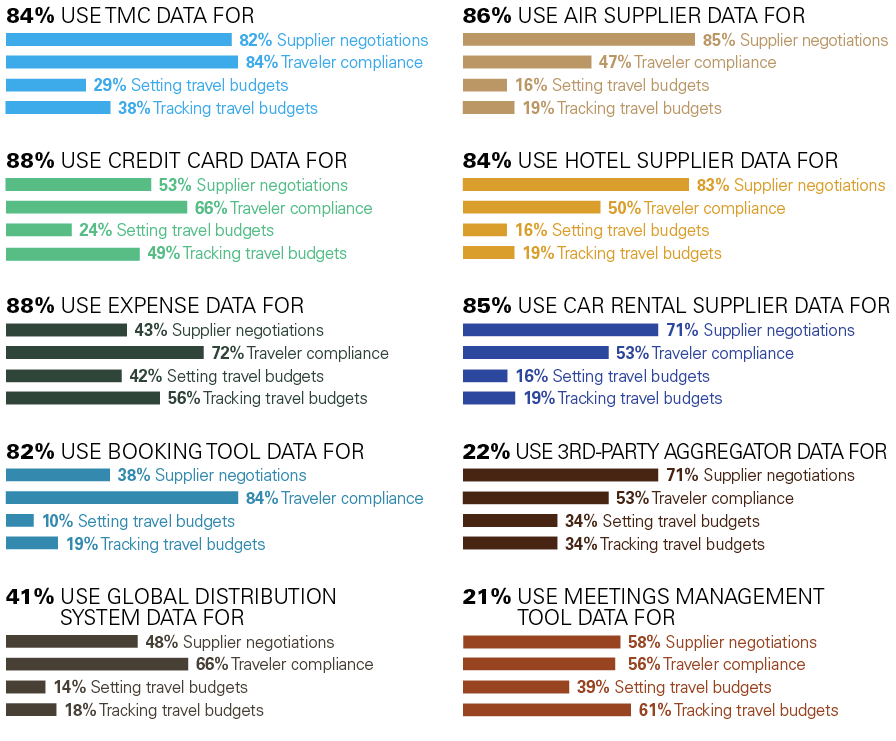
RELX is following a common path with its data expansion. TheBTN survey showed that traditional travel management data sets still rule day. While expense and credit card data each were used by 88 percent of the respondent base, the largest slice of respondents pegged travel management
company data as the most reliable. Yet, it wasn't a majority: 43 percent of travel buyers said TMC data was the most reliable; 26 percent pegged expense data as the most reliable and 13 percent were leaning most heavily on credit card data. Other traditional sources in heavy rotation among travel buyers in
order of usage rates were air, car and hotel suppliers; global distribution systems; third-party aggregators; and meetings management tools.
Methodology
BTN surveyed 172 qualified travel buyers from Aug. 31
through Sept. 29, 2016. Respondents' annual travel spend:
- Less than $2M: 18%
- $2M to $9.9M: 18%
- $10M to $24.9M: 21%
- $25M to $49.9M: 13%
- $50M to $99.9M: 12%
- $100M or more: 19%
How Travel Managers
Use Different Data Sources
Travel managers are using more data sources than ever to gain visbility into their programs. The charts below show usage rates among 172 corporate travel buyers whom BTN surveyed in August and September 2016, plus how buyers apply each set of data to their programs. One caveat, though:
Data quality continues to challenge buyers, as no single set of data stands out among the crowd.
.png "Rate Data Sources")
Going Broader: Expanding Data Sets for Specific Use Cases
While survey respondents identified traditional data sets as the most useful, half of buyers incorporated traveler survey data into their intelligence strategy; 31 percent captured public data like airlines' on-time performance, fuel prices and historical weather conditions at key airports.
More than a quarter enabled and now track supplier-quality ratings from their travelers. Twenty-two percent were applying quality ratings from external sources. About 13 percent were taking action on rogue bookings using itinerary aggregators like TripIt, Worldmate and Traxo or TripLink's direct connect
solutions.
Incorporation of one or two exploratory data sets is often an effort to solve a specific issue. Still, investigations like this can set the stage for larger program change.
That was Cathy Sharpe's experience when she began working with TripLink to capture off-channel hotel bookings. "I was shocked at the results," which not only included cost benefits but also service benefits, the ITW global director of travel and expense told BTN earlier this
year. That initial work on the hotel side has expanded to the airline category. She offered her new use case during a recent buyer roundtable discussion with BTN: unused airline tickets exchanged outside of approved channels.
"Imagine all the exchanges that go to waste," she said. "Maybe [the booking] was done on the website because it was an emergency and the traveler had to book it on the fly. When I think of all the unused tickets, they are significant. They are not owned by the traveler; they
are owned by the company, and we want to get that information back."
Tesla global travel manager Steve Sitto, who is in discovery talks with hotel app provider Conichi, is looking at emerging data set there. He singled out Conichi's hotel folio data that is a byproduct of its hotel virtual payment integration. It's a data set that has eluded hotel and credit
card suppliers. "These companies have all been on different [transaction] platforms, and they don't really talk to one another, and they are not interested in collaborating," said Sitto. "So other companies are coming up and connecting the dots, and the business opportunity is there for
them."
As travel managers wrap one-off data sets like this into the total universe, the data strategy becomes elaborate. Oracle global travel sourcing lead Rita Visser warned that data diversification should not be considered a value itself; the traditional data sets still form the basis of the
program. "When I think about our procurement practices, when I talk about class-of-service purchases, without going directly to the GDS to get that information, I can get it from my TMC," Visser said. "We've built very mature programs on TMC data. There is a lot of value there, and whether
buyers [incorporate] all these other data sets or not, that value isn't going away."
Going Deeper:
Bringing Context to Traditional Data Sets
Data diversification beyond TMC, card and expense is academic for many. First, there is the question of value: A lot of the information conceivably can be gleaned from expense data. Second, there is the question of resources, even if buyers got their hands on the expanded sets, how
would they deal with the data deluge? According to BTN's survey, about 30 percent of buyers are ready to launch their programs into the larger data universe, but 70 percent aren't interested or don't have the resources.
Patrick Fairchild, purchasing manager for Berry Plastics, falls into the latter camp. He's pragmatic with corporate travel data and looks at traveler compliance levels to define his approach. He manually bumps up credit card data with TMC data, and because expense isn't under his purview, he
spot checks those numbers on a monthly basis. "Our company and our philosophy are driving compliance [to the TMC channel], so there's no reason to go to the extra expense of marrying a bunch of data sets if the policy is doing the job."
Liberty Mutual corporate travel lead Michelle De Costa doesn't see much value in expanded data sets either. "Everything pretty much comes through one of those [TMC, card or expense] channels for us," she said, though she did add that Liberty Mutual separately analyzes traveler feedback to
inform traveler policy and negotiations.
Even in the traditional data sets, De Costa said, there are unmined depths that can benefit mature programs. "We are taking a much deeper look at the individual data parts to get clarity for our program," she said.
Arriving at clarity for Liberty Mutual, however, won't happen through manual data comparisons to spot inconsistencies and gaps. The team has built an in-house analytics tool to digest travel data and to apply filters and formulas that allow the company to view the data from a different
perspective.
"We're looking at a lot of different things," said De Costa. "We're looking more closely at meal expenses, we're looking at attachment rates and we're looking at ... who and what business units are booking off channel to understand more about their motivations. We are looking
to the data not just to identify that something happened but also to help answer questions around why travelers are booking and spending this way."
De Costa said one of the most interesting angles the Liberty Mutual tool is delivering to travel management—and also to the CFOs who oversee each business unit—is cost per trip. "That's been very important," she said. "The tool assigns a trip number and brings in all the bookings
and charges related to that trip." With that view, business units can benchmark their own travelers and they can benchmark against other business units, as well. Liberty Mutual's tool brings in current human resources data, as well, so drilling down to the business unit and traveler level is easy and
queries can be changed on the fly.
De Costa said the business units are amazed at the level of data her team can provide, and the dynamic nature of the tool is changing the way she will distribute travel data and reporting going forward. "We are preparing the tool to make it available to end users," she said. "Today,
I have an analyst on my team who pulls reports and sends them out. For 2017, we want to open this tool to the finance contacts in the business units. It was always an end-goal design, but I think we are ready."
To Whom, How &
How Often Travel Managers Report Data
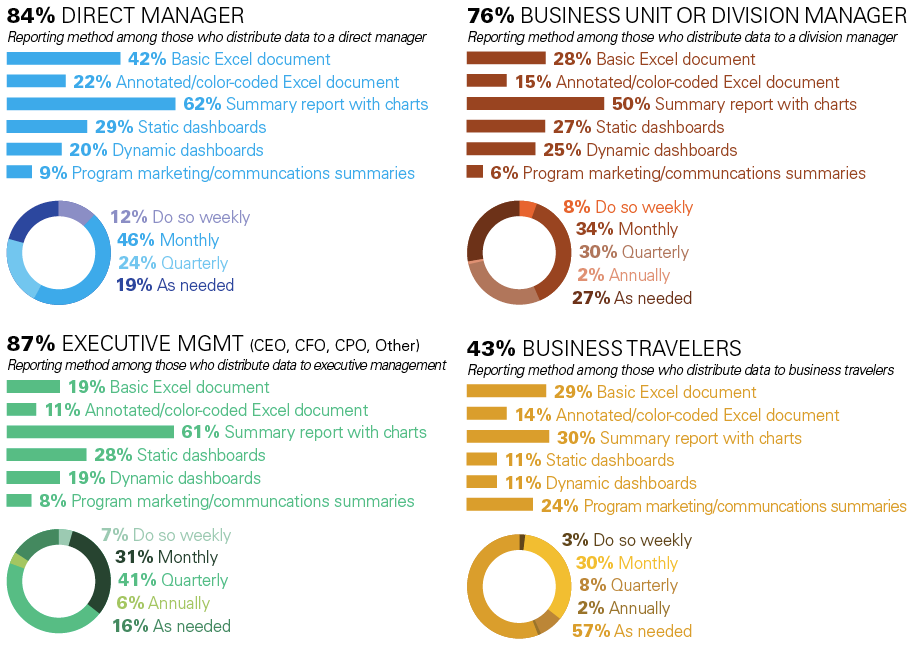
Getting travel data into the hands of stakeholders is key to managing travel programs strategically. While more advanced analytics tools have proliferated, adoption is not yet mainstream. The charts below are based on a BTN survey of 172 corporate travel buyers, fielded in August and
September 2016. Pie charts may not add to 100 percent due to rounding.
Pulling It Together:
Tools & Reporting
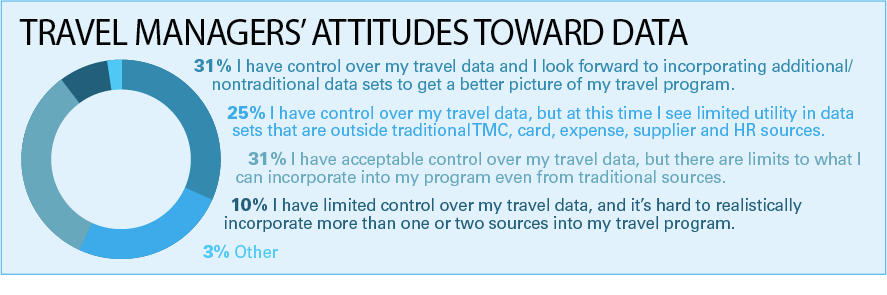
Only 56 percent of travel buyers surveyed by BTN had a good handle on their data; that number includes those who are eager to expand to new data sets and those who are happy with the traditional travel data universe. Thirty-one percent had acceptable control over limited data sets, and
10 percent didn't have the control they wanted.
A July 2015 Global Business Travel Association/Sabre study painted a similar picture, highlighting that nearly half of its 237 travel manager respondents spent too much time manually processing, cleaning and reconciling inaccurate data and that they were challenged by multiple data
sets. Current travel tools and reporting systems fell short of expectations for 36 percent.
Even with limited data sets, the amount of data coming back into a corporate travel program can be intimidating. The majority of BTNsurvey respondents continue to compare data sets manually. When distributing data to corporate travel stakeholders, most buyers turned to summary reports
with charts. That said, a large number of travel managers report out via Excel documents, even basic ones, directly to business units and executive management. That approach seems quaint in the age of Big Data, and it's beginning to change. About one-quarter of buyers worked with dynamic data and dashboard
tools.
"Technology advances have happened rapidly in the past two or three years," said Brian Beard, general manager of strategic initiatives for new Travel and Transport spinoff Data Visualization Intelligence. You see tools like Tableau and Domo, and there
are traditional tools like Oracle and IBM and Information Builders. There's a sea change in how we look at data. Looking at static data and running a report, putting in parameters or running canned reports—that's all going away. People want to see their data visually. You can see 100 times more insightful
information on a visualization or infographic than you can from a report."
As De Costa's data strategy demonstrates, there is momentum among travel managers to access better tools, whether they have the resources to build something internally or are looking for an off-the-shelf technology.
Prime Numbers was among first movers in transitioning travel programs off of static reporting to interactive analytics. At the tail end of 2014, the technology company introduced the first in a series of releases in its Prime Sourcing suite. The first release was an analytics tool, followed by
contract-monitoring tools and finally contract modeling, released in October 2016. This year, Cornerstone Information Systems launched its TravelOptix tool, which harnesses multiple, complex data feeds and brings them into a visual format with interactive dashboards, benchmarking and what-if scenario modeling.
Both companies sell straight to coporates or will partner with TMCs to power channel solutions, but TMCs were eyeing the market, as well.
Several TMCs have entered the analytics space. Most offer data sets that are more limited than a data aggregator, at least out of the gate. In July, for example, American Express Global Business Travel introduced its Premier Insights tool, which incorporates TMC and credit card data, but
card data is only for American Express corporate card clients and does not include procurement cards or business travel accounts. Omega World Travel also has introduced a business intelligence tool. Omegalytics integrates TMC data, as well as Airlines Reporting Corp. data and carbon emissions data, but it is
not bringing in card or expense data.
Carlson Wagonlit's AnalytIQs, which it has widely rolled out to clients, is pushing beyond TMC data to incorporate card and expense. Travel and Transport has gone further. Its Data Visualization Intelligence spinoff will introduce its first product, Vantage Point, this year. The company claims
it can digest any form of data—structured or unstructured—and present it logically and visually for travel insights.
Oracle's Visser suggested that even without the most complex data sets and multiple feeds, TMC analytics tools could set the stage for a larger shift. "Any efforts they can make to improve [data analysis and reporting] and make it more user friendly will help all of us," she said.
What's Next: Actionable Messaging
Cornerstone Information Systems CEO Mat Orrego
envisions a travel management future beyond data analytics tools. Instead of
reporting tools or even visualization, he sees next-generation data tools that
recommend specific actions for travel managers and stakeholders. "We are
entering a time now when we want to contextualize travel data for other
stakeholders within the organization. We are starting to see some interesting
storytelling based on truer data and providing hierarchy data so that it is
properly aligned with how the organization is structured. That's pretty
powerful stuff," he said. "The next step is to look at behavior and
trending so you can message travelers or stakeholders based on event triggers
in certain situations that the company wants to control. We're getting out of
reporting and going beyond visualization to creating enough of a data-based
decision model that allows travel stakeholders to react quickly to a situation."
Thinking Bigger: What
About Corporate Strategy?
With all the data sets available, as well as emerging tools, capabilities are in place to reveal a lot of new perspectives on managed travel. The question, according to tClara founder and managing partner Scott Gillespie, however, is whether the industry will think big enough to make the
most of these data-driven revelations.
"The key performance indicators in our industry have not changed in 20 years," he said. "The main reason for that is that the industry is still stuck, focused on delivering cost-effective travel strategies. We need to change the goal of what it means to manage the travel
program. We need to expand the goals from managing costs to managing toward a business."
Gillespie called run-of-the-mill metrics like average ticket price "meaningless" and considers benchmarking efforts, even against so-called like companies, deeply flawed. Even internal benchmarking between business units doesn't really hold up without context. A sales organization and
training organization travel in very different ways.
He singled out average room rate as a metric that could be meaningful if given some context. "Did anyone look at the quality of the hotels in the program? Has that fallen or increased? If rates are flat and the quality is rising, procurement has succeeded. But few programs are looking at
room rate in this way, so they get the what but they miss the why."
While rate always will be important, Gillespie encouraged travel managers to explore bigger-picture issues with their newfound data powers, issues that could impact their companies as a whole. He rattled off a gamut of ideas from travel risk management-preparedness grades to travel return
on investment. About TRM grades he said, "We need a number that captures how prepared the company is to address traveler risk. Everyone knows it's important, but do we have a number that we can report on a dashboard?"
He applauded travel managers who apply HR data to their travel intelligence, which according to BTN's survey, 54 percent of travel managers do. But he challenged this group not just to look at HR data for compliance tracking and excess spending. He urged them instead to partner
with HR to get more strategic with employee recruitment and retention. "Road warriors are high-revenue employees. They're really valuable to the company, but no one is tracking attrition rates," he said. "If you did, and you found 12 percent attrition rates among your top travelers, this is
something that company leadership should care about. If a 12 percent attrition rate is not OK with them, a travel manager should know what to do to."
He admitted that return on the travel investment was a tough nut to crack. "I don't have all the answers," he said. But as travel managers get a deeper understanding of their data, Gillespie believes there is potential to show how travel management contributes to the
larger corporate strategy. "Right now, we are not measuring a lot of things that really matter."