In 2014 and 2015, select-service rooms accounted for 70
percent of all rooms added to U.S. supply, according to STR. As of February,
select-service comprised 67 percent of the U.S. pipeline.
The industry’s steady trend toward select-service may not be
great news for corporates that rely heavily on large meetings hotels, but for
some programs, the growth of these properties could prove to be a boon,
bringing more diverse, higher-quality products into the marketplace.
Select-service, or limited-service hotels, offer some
full-service amenities like breakfast and a fitness center but do not have
certain features like a dedicated food-and-beverage department or a concierge.
While much of the new select-service product in recent years has been in the
upscale and upper-midscale tiers, hoteliers like Best Western Hotels &
Resorts and Hilton Worldwide are banking on such products in the midscale
tiers, crafting boutique-style hotels aimed at modern travelers. “The boutique
or lifestyle hotel trend is continuing to grow, and you have a lot of boutique
and lifestyle brands in the upper-upscale and upscale segments but none in the
midscale segment,” said Best Western CEO David Kong.
Best Western has introduced two midscale select-service
brands during the past two years: Vib for urban hotels and GLo for suburban
properties. Both feature sleek room design and large, social lobby spaces. Vib offers
a grab-and-go food-and-beverage option, while GLo offers hot breakfast and some
other basic food options. The first two or three Vib hotels are expected to
open in the United States in 2016. Best Western has signed a number of GLo
deals, and Kong said there’s a “tremendous interest” from developers.
In January, Hilton unveiled Tru by Hilton, its own boutique
midscale brand. Its lobby features “zones” for playing, working, lounging and
eating, with a self-service food-and-beverage area. “We listened very carefully
to our customers and to our owners to make sure we got all of the details
exactly right,” Hilton CEO Christopher Nassetta said at the launch. “We truly
believe that Tru could ultimately be our largest brand yet.”
Why Select-Service?
Hotel companies and, more important, hotel owners and
investors like select-service products because they’re easier to develop and
they offer a better return on investment. “If you’re a new builder, it’s just
so much easier to secure the financing for construction of a select-service
hotel today than it is a full-service hotel,” said Interstate Hotels &
Resorts chief investment officer Leslie Ng. “The costs for building
full-service hotels are so high now that lenders are much more comfortable
financing select-service hotels. It’s a proven investment commodity. When it
comes time to renovate, your costs per key are much lower because you don’t
have the public space that a full-service has.”
Ng added that there’s more consistent demand at
select-service hotels, which are less beholden to the group market.
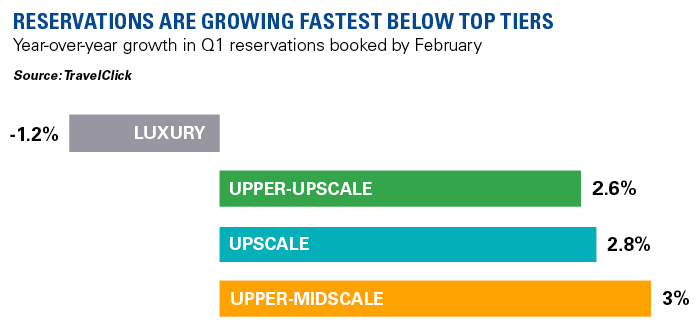
Hospitality solutions firm TravelClick indicated that the
upscale and upper-midscale tiers, where the majority of select-service brands
sit, experienced the healthiest year-over-year bookings growth in North America.
Reservations on the books as of February for the first quarter of 2016 are up 3
percent year over year in the upper-midscale segment and 2.8 percent in
upscale, while upper-upscale bookings grew only 2.6 percent and luxury bookings
declined 1.2 percent.
Another piece of the select-service boom is brand
proliferation. A product like Tru is different enough from a Hampton by Hilton
that Hilton can build a Tru nearby and grow market share without upsetting
Hampton owners. The newer products may even attract a new audience of
travelers.
“You’re going to see more brand proliferation because people
want a customized experience,” said Stephen Jennings, U.S. hospitality sector
leader for Deloitte Consulting. “The problem with the large-scale, mass-market
brands is that they are a bit of a generic experience on the whole.”
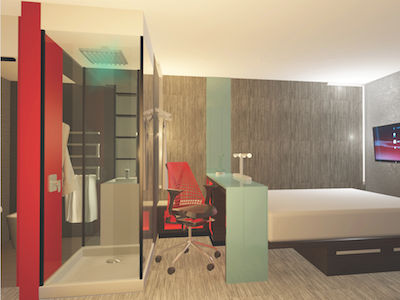 The desk head-board combo in Best Western’s Vib (above) and Tru by Hilton’s open-air closets (below) look like modern, functional design to some travelers and represent a lack of traditional comforts to others.
The Upside
Because the hotel industry cycle has been in its “up” stage
in recent years, corporate travel programs searching for savings have been more
willing to trade down to lower tiers, and the new select-service supply creates
more opportunity to do so.
%202016%20Hilton%20Worldwide.jpg "© 2016 Hilton Worldwide") © 2016 Hilton Worldwide
© 2016 Hilton Worldwide
“Companies are always looking at what else they can do to
keep their costs down and to drive savings year over year,” said Marwan
Batrouni, senior director and Global hotel practice leader at Advito. “One of
the strategies is to tier down, from upper-upscale down to upscale or upscale
down to a more moderate-tier hotel. Some of the larger hotel chains are
realizing that if they have a good, quality product that caters to business
travelers and gives them everything they would be looking for but maybe not at
the high cost of some of the upscale or upper-upscale properties, then they
would be able to win business.”
Many of the select-service products coming into the market
are new build. Tru, GLo and Vib, for instance, all have promised to start as
new-build brands. That offers business travelers a fresher product with
features like high-speed Wi-Fi, clean design and abundant elec-trical outlets
for charging devices but at prices similar to conversion-properties' rates.
Select-service properties also are appearing more in urban
areas. During Hyatt Hotels’ most recent earnings call, CEO Mark Hoplamazian
said half the hotels Hyatt plans to open this year will be select-service,
including the upscale Hyatt Place and extended-stay Hyatt House brands, and
their growth will focus on urban locations, lifestyle centers and university
markets.
The Downside
Select-service products are not a one-size-fits-all
solution. Financial Industry Regulatory Authority corporate travel services
manager Carol McDowell said some lack meeting and conference room space. She
recalled one employee who needed private meeting space for a one-on-one
interview and had no such options.
Some select-service rooms are also smaller, which means
sacrificing traditional design features. The Tru prototype, for example,
doesn’t call for a desk or a full closet. At a recent BTN Group event, travel
managers said they had fielded complaints from employees about boutique-style
hotels’ lack of traditional closets, dressers or desks.
Ultimately, select-service hotels’ most
competitive benefit—cost—could dissipate. Bjorn Hanson, a clinical professor at
the New York University School of Professional Studies’ Tisch Center for
Hospitality and Tourism, said some select-service hotel owners estimate their
rates will equal full-service hotels’ in a few years “because of the newness of
the hotels and concepts and because of older upper-upscale hotels that maybe
don’t reflect the current taste and preferences.