During the fourth
quarter, Marriott International reported a 1 percent year-over-year increase in
sales to the legacy company's largest 300 corporate customers. "Sales to
these customers were flat in the third quarter," Marriott CEO Arne
Sorenson said.
While sales to
energy and financial industry corporate clients continued to wane, sales to the
manufacturing sector picked up 4 percent year over year during the fourth
quarter, Sorenson said. Hilton, too, reported positive corporate demand during
the last quarter of 2016.
Travel Ban Impact
The now-halted Jan.
27 executive order from President Donald Trump that would have banned refugees from
entering the U.S. for 120 days and barred travel to the U.S. by citizens of seven
Muslim-majority countries has not had a "measurable impact" on
Marriott's hotel performance in the U.S., Sorenson said. However, Marriott had
heard that some group bookings may have switched from U.S. Marriotts to
Marriotts in Canada or another non-U.S. market. "I wouldn't expect, by the
way, that it would have much impact on business transient at all because that
tends to be the kind of travel that is most resilient," he said.
Hilton CEO
Christopher Nassetta said Hilton hadn't seen an impact from the travel ban, though inbound
international business does not make up a significant portion of the company's
U.S. demand.
Marriott's earnings
call with investors and analysts marked the first time it reported combined
earnings following the closure of its September acquisition of Starwood Hotels
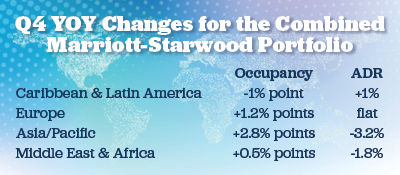
& Resorts. For the combined company, fourth-quarter systemwide occupancy
increased 0.4 percentage points to 69.6 percent and average daily rate grew 0.3
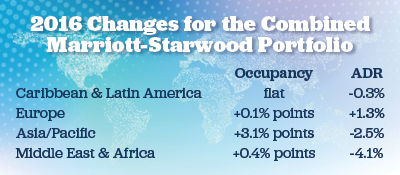
percent to $155.14. For the full year, combined systemwide occupancy rose 0.6
percent to 72.5 percent and ADR increased 1 percent to $156.53.
For its full-year
2017 outlook, Marriott maintained its previous guidance for North American revenue
per available room growth in the 0 percent to 2 percent range. Eighty percent
of negotiated corporate business for 2017 is already priced at a low single-digit
rate increase for comparable customers, Sorenson said, but Marriott also is signing
up more accounts. Full-year group revenue pace at company-operated, full-service
hotels across Marriott's combined portfolio is up about 3 percent year over
year.
"Do we feel
more optimistic about 2017 than we did a quarter ago? The short answer is
yes," Sorenson said. "There is considerable data that shows broad
expectations for stronger GDP growth in 2017." However, he said, hotel
industry metrics and data around group booking trends and special corporate
negotiations don't yet give "clear enough proof that GDP is in fact
growing at a higher rate or that the greater prevailing optimism is impacting
our business."
The company's
fourth-quarter adjusted net income increased 15 percent year over year to $334
million. At year-end, Marriott's global development pipeline was 2,493
properties, totaling 420,000 rooms.