Global travel manager Nicki Leeds is taking a new step for
Hess Corp.: examining corporate housing possibilities for long-term stays in
the company's home market of Houston. The travel program hadn't had a policy
around extended stays, and Leeds said the move has presented significant
savings opportunities.
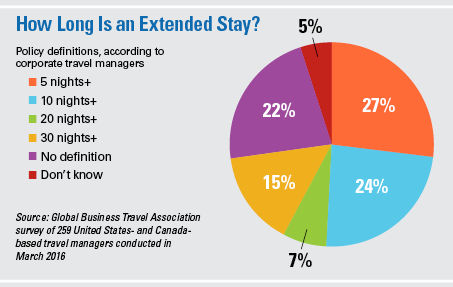
Hess Corp. isn't an outlier, though. Extended stays long
have been a forgotten piece of the lodging puzzle for many companies. "About
a fifth of all travel in the U.S. for hotel room nights are stays that are
longer than five nights," said Extended Stay America chief marketing
officer Thomas Seddon, citing Lodging Econometrics. "And that's more
business than leisure. But I don't know that it gets 20 percent of the average
corporate travel department's mindshare."
Hotels
While hotels that cater specifically to extended stays like
Extended Stay America, Residence Inn and Home2 Suites do work with corporate
clients, they make up only 8 percent of the total hotel supply in the United
States, according to STR. That may be why traditional hotels capture so much of
the long-term-stay business from corporates.
According to Seddon, five out of the six hotels in Extended
Stay America's competitive set are traditional hotels, simply because there
aren't as many extended-stay hotels in their class.
HRS Americas region vice president and managing director of
North America Suzanne Neufang said that while HRS works with extended-stay
hotels, the company also is revamping its hotel platform to allow traditional
hotels to make tiered extended-stay rates available for customers. "We're
being asked about that a lot more than we used to be," Neufang said.
The U.S. hotel industry as a whole is coming off a number of
good years, pushing travel managers and sourcing partners to think creatively.
Even as the current cycle begins to wind down, year-to-date occupancy as of May
2016 was 63.5 percent, according to STR. That's higher than the peak during the
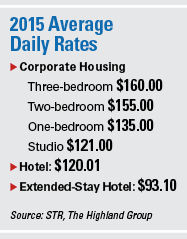
last lodging cycle, which ended in 2008. Average daily rate also continues to
grow, up 3 percent year over year to $122.18. In the U.S. extended-stay hotel
space, ADR grew more during the first quarter, by 5.7 percent year over year,
but the actual rate, $94.05, still remained lower than traditional hotels,
according to lodging research and consulting company The Highland Group.
Carlson Wagonlit Travel director of Americas hotel solutions
Eric Jongeling has been working with clients to dig into hotel data and
leverage spend at traditional properties where travelers are staying for long
periods of time. "We noticed, 'Listen, at this Hilton or at this Marriott,
it may not be a typical extended-stay property, but there are a lot of
travelers in your organization that are utilizing it in that fashion. Instead
of just paying the same negotiated rate as everyone else, why don't we work to
try to get a deeper discount for those extended stays at those typically
non-extended-stay types of properties?"
As for why travelers are staying longer in traditional
hotels, Jongeling suggested it might be as simple as convenience of location or
service amenities.
Advito senior director and global hotel practice leader
Marwan Batrouni said corporates' appetite to negotiate extended-stay rates
varies but that Advito works with clients in the spend-analysis phase to
identify regions or markets where they could benefit from extended-stay rates.
"Oftentimes, we negotiate both transient rates and extended-stay rates at
[individual] properties."
Corporate Housing, Homesharing & More
This past spring, a Hess traveler out of Asia was scheduled
to visit the company's headquarters for a week in April. Though the Houston
hotel market recently has suffered from oversupply and weakened demand, the
traveler's visit overlapped the Division I NCAA men's Final Four basketball
tournament there. "It's nearly impossible to get hotel rooms around that
time," Leeds said. "If you do get one, the rates are so high and the
cancellation policies are nonexistent."
The traveler reached out to Leeds to see if the company had
any corporate apartments available instead. Like many companies, Hess provides
project and relocation housing for its employees, but it does so outside the
corporate travel department. Instead, Leeds looked into using a local corporate
housing provider on an on-demand basis. "We saved $1,500 just by putting
him in a corporate apartment versus a hotel."
The experience was eye opening for Leeds, who's now shaping
an extended-stay travel policy that uses corporate apartments. "I can't
speak for every location globally," Leeds said, "but in Houston, I
can tell you that with the decline in oil price and the city's job market not
being quite as strong as it was and with the overbuilding of apartments
creating a huge supply and less demand, [corporate housing] is very much a way
that we may proceed to manage our costs."
According to The Highland Group's 2016 Corporate Housing
Industry Report, corporate housing unit demand has grown each year since 2012,
including by 2.9 percent in 2015. Corporate housing accounted for 23 percent of
total U.S. extended-stay lodging room revenue in 2015. "Dollar for dollar,
it seems like you can secure lower rates at corporate apartments for 30 days
than you can at extended-stay properties," Leeds said.
She said the travelers who have used corporate apartments
for their stays in Houston have liked the experience. "We've been pretty
good about making sure where they're staying … is where they need to be, is the
same type of standard they would expect in a traditional hotel. Our travel
program has always been predicated on service first, with cost at a very close
second. In these tough economic times for oil companies, that's probably
changed, where we're really looking at cost first with employee experience at a
very close second. Luckily, our travelers understand that, and we're really not
asking them to do anything outside of what they're used to."
Newer players like Airbnb also have broadened travelers'
horizons. "The awareness that there are other options, or should be other
options, is just becoming more prevalent," said Oasis Collections founder
and CEO Parker Stanberry. Oasis, which operates on a "home meets hotel"
model and recently received a $12.5 million investment from AccorHotels, works
with companies like Nike and Google to provide extended-stay options to
travelers.
BridgeStreet Global president and CEO Sean Worker said at
the Serviced Apartment Summit Americas in April that Airbnb has brought "immense
attention to serviced apartments, apartments and alternative accommodations,
which has been a real benefit to our sector in many respects. It's now made a
massive consumer-awareness program accessible to all of us." BridgeStreet
and Airbnb formed an exclusive partnership to share inventory in October 2015.
Airbnb head of business development Lex Bayer said the
company's average length of stay across its business travel program is about
six days, and 15 percent of business stays are for 10 days or longer. "We
are playing really well to longer-term trips and extended stays," Bayer
said.
Regardless of the kind of accommodation, travel
buyers are starting to segment the longer-stay traveler set for negotiations.
According to Jongeling, "A lot of our customers just haven't paid a lot of
attention to those longer-term stays in the past." But, like Hess,
corporates now are examining their longer-term stays and finding opportunities
to save.