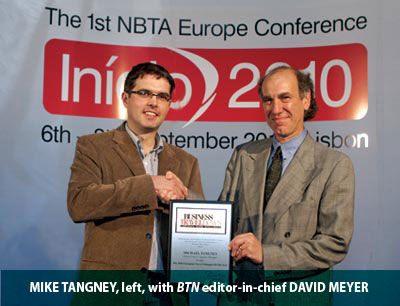
Mike Tangney has a university degree in mechanical
engineering, and perhaps only someone with a background so far removed from
corporate travel could have redesigned his company's travel program with such
radicalism as he has at Google. It is for completely rethinking travel booking,
policy and accountability that Business Travel News has named the Dublin-based
global travel manager as its European Travel Manager of the Year for 2010.
Among the highlights of his industry-changing strategy,
which he introduced in 2008, are a policy that lets travelers book any supplier
through any distribution channel; electronically set caps on traveler spending
that can yield sub-cap savings for future spending or charitable donations; and
a unique database that captures the details of every journey employees make.
Add in his progressive work in reverse e-auctions and use of social media, and
it is no wonder that the bestowing of BTN's
accolade at the NBTA Europe conference in Lisbon last month met with acclaim.
A business trip for a Google employee starts with logging on
to Trips, a system conceived by Tangney and built internally by Google
engineers. The employee enters a route—say, Dublin-San Francisco—and Trips
responds by displaying caps on how much they can pay for their air ticket and
accommodation. The system also informs the traveler about any credit left over
from previous trips that can be used to make a booking that costs more than the
cap.
At this point, the traveler has a choice. Like any ordinary
managed program, Google has preferred supplier deals. These only can be
accessed through Carlson Wagonlit Travel, so the traveler can check negotiated
prices available through CWT or search the Internet for a deal, either directly
from the supplier or through Kayak, Orbitz or any other intermediary.
Once the selection is made, the traveler has to type the
journey details into Trips, including date, class of travel, supplier, the
channel through which the booking was made and the cost. If the price is above
the cap, then it is still permissible, so long as the traveler has existing
credit to cover the difference. If there is insufficient credit, the traveler
can forward a request to a vice president for exception approval.
 If the price is under the cap, then Google splits the
difference with the traveler. For example, if the cap for Dublin-San Francisco
is $1,000 but the traveler finds a fare for $600, then the traveler will
receive a credit of $200. "The next time they travel, or they may want to
save up over a period of time, they can spend the credit to upgrade their air
or hotel accommodation," said Tangney. "It's kind of an indirect
rewards scheme. The phrase we use is, 'Spend when you can, save when you need
to.' Generally, they save when they travel domestically and spend more when
they travel internationally. We don't have any standard rules about using
business class when traveling, such as only 10 hours or more or those based on
your level in the organization. It's more about what you do. The basic tenets
of the policy remain the same, the idea being to be fair and equal to everyone
irrespective of their position."
If the price is under the cap, then Google splits the
difference with the traveler. For example, if the cap for Dublin-San Francisco
is $1,000 but the traveler finds a fare for $600, then the traveler will
receive a credit of $200. "The next time they travel, or they may want to
save up over a period of time, they can spend the credit to upgrade their air
or hotel accommodation," said Tangney. "It's kind of an indirect
rewards scheme. The phrase we use is, 'Spend when you can, save when you need
to.' Generally, they save when they travel domestically and spend more when
they travel internationally. We don't have any standard rules about using
business class when traveling, such as only 10 hours or more or those based on
your level in the organization. It's more about what you do. The basic tenets
of the policy remain the same, the idea being to be fair and equal to everyone
irrespective of their position."
Travelers cannot take the credit as a cash bonus. If they
have not used their credit by the end of a year, they are instead allowed to
donate the money to a specified list of charities.
Although the system may sound laissez-faire, there remains a
strong element of control because travelers need to fill their trip details
into Trips to obtain an identification number. Without the ID number, they
cannot submit an expense report and will not be reimbursed. In fact, Tangney
argues that despite letting travelers book through any distribution channel, he
has a much better view of what travelers are booking than a conventional
managed program can achieve. "Having an open policy is one thing, but
having an open policy where you can track all the data is completely different,"
he said. "That's the real value of the Trips system."
In fact, Tangney said traditional policies dictating what
and where employees must book are rapidly becoming obsolete. "We have an
entirely new generation in the workplace," he said. "They look up
airfares online and then ask their friends about it. There is leakage in almost
every travel program, and that is growing. Travel systems are getting better at
offering deals and rates, and it is very difficult for a corporate environment
to compete with that. Travelers are becoming more likely to say to their travel
managers, this is the way I want to do it, so why can't I?" said Tangney.
As a result, despite Trips' mandatory use, the frustrating
and arguably ineffectual restrictions of travelers to mandatory suppliers and
channels are swept away. Giving travelers flexibility where it does not
ultimately matter to the employer also has proved a great morale booster—and
provided Tangney some excellent anecdotes. "One guy staying at Mountain
View [Google's global headquarters in California], where the hotel cost on
average is $200 a night, was spending $6 a night," he said. "I called
him to ask what he was doing. He said, 'I love camping, so I'm staying in a
campsite in the summer and earning $100 a night in credits so that maybe I can
stay in the Four Seasons in the winter.' "
Tangney's unique approach does raise some obvious
objections, but he rebuts each. The first is that allowing travelers to book
with any supplier they want does not attract sufficient volume to earn good
deals with preferred suppliers or a the travel management company. Yet in
practice, this concern is not sustained. The Google program does not
discriminate against the TMC channel as the company pays its TMC fees centrally
and preferred supplier deals only can be accessed through CWT—and Tangney
estimates that 65 percent of hotel bookings use preferred properties. That
figure is all the more impressive considering that, although Google uses
Cliqbook in the United States, it does not deploy a self-booking tool in
Europe, meaning European travelers have to go outside the program if they want
to book online.
Google employees tend to book airfares with economic
rationality, booking independently for short-haul point-to-point flights on
heavily used routes, when a best-available fare makes most sense, but turning to
CWT for multi-leg or long-haul trips. As a result, the managed channel wins the
day when it is genuinely the better choice.
Another potential objection is the difficulty of assisting
travelers in an emergency if they have not booked through the managed channel.
The first big crisis to test the Google program was the volcanic ash crisis in
April 2010. Tangney was able to e-mail all travelers, asking them to identify
where they were, their status and whether they needed support. CWT provided
travel assistance to all Google employees who required it, regardless of
whether they had booked their trip through the TMC, although it did charge a
fee for this service. However, Tangney noted that the ash crisis boosted
bookings through the TMC after travelers found CWT could rebook their travel
much faster and more effectively than they could. "It did the TMC a lot of
good," he said.
The final potential criticism is that self-determination
could be too time-consuming, both for the traveler and for Google. Tangney has issued
guidelines on how long travelers should spend on do-it-yourself bookings, and
he is confident most employees are sensible about it, which is why they mainly
go it alone only for frequently used point-to-point trips. However, he does
wish to conduct a time and motion study to verify his belief. The other demand
on time is the need to enter travel details into Trips, which takes five
minutes on average. Tangney is looking for ways to automate the process.
As for Tangney's time, one of his tasks is setting and
maintaining the caps. Google has caps on 1,000 air routes, accounting for more
than 90 percent of its air spending. The limits are based on open market
information, with sampling performed automatically over a 10-day period for
both economy and business class. The caps are refreshed every one to three
months. "If the caps are off the mark, employees tell us," he said.
Hotel caps are based on rates achieved through negotiations,
so they vary less throughout the year. Tangney sets them annually but revisits
the caps periodically to test their continuing validity.
Although he has many other responsibilities, one of the most
striking aspects of the Google travel program is that its travel team consists
of no one but Tangney. Another paradox is that although it is not mandatory to
book through the TMC, Tangney outsources very heavily to CWT, including running
the annual hotel request for proposals.
However, the Google travel manager has involved himself in
operating reverse e-auctions for hotels, ground transportation and TMC
selection, a complex process that required contestants to make bids for
managing different Google locations. Travel suppliers frequently have
criticized e-auctions for being too simplistic and price-focused, but Tangney
has found that the best approach is to be as transparent as possible, allowing
suppliers to know whom they are bidding against and the other prices being bid.
Another area where Tangney is doing interesting work is in
social media. Google employees already provide TripAdvisor-style internal
ratings and reviews of hotels, and the company has used the information to
tackle suppliers about poor service, such as unsatisfactory online access.
However, Tangney has visions of going much further with a tool such as TripIt,
using it to build profiles and itineraries for travelers from multiple
channels, then building a warehouse from the data that could be used to
dispense advice internally to travelers and benchmark data externally.
That is for the future, but Tangney already has achieved a
huge amount for someone who only joined the company in 2007 to help create
procurement systems, a specialization he previously had developed in an
internal consulting role at Accenture. Tangney paid tribute for the success of
the Google travel program to several others, including U.S.-based procure to
pay director Terry Kenney, and the engineers who built Trips—a resource few
other travel managers can rival. Unfortunately, it doesn't look like travel
managers outside Google will be able to lay hands on Trips, even at a price. "People
have asked us if we'd like to sell Trips," said BTN's 2010 European travel manager of the year. "I'd love to,
but it is so far down the list of priorities that we won't really ever get to
it."
This report appeared in the Oct. 11, 2010, edition of Business Travel
News.