Mobile technology is here, probably forever, and while
questions of whether and how to apply it in a managed travel program no longer
are new, few have all the answers. Each organization has its own emerging
views, and keeping pace with evolving traveler behaviors and ever-accelerating
tech advancements is no easy task.
Even so, given the near-ubiquity of mobile devices among
professionals and the utility of a rapidly growing number of travel-related
apps, it may be somewhat surprising that most companies don't address them in
travel policies. According to BTN
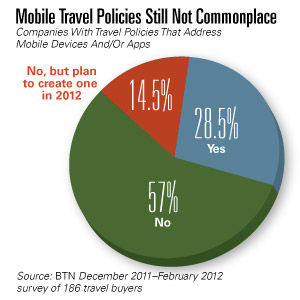
research, 72 percent of 186 travel buyers responding to a December
2011-February 2012 poll said their companies have no policies regarding mobile
devices and/or apps for business travel. About one-fifth of those said their
companies plan to implement such policies this year.
American Express Global Business Travel last year reviewed
100 travel policies and according to its February report found "none"
that "mentioned mobile applications specifically as a means used
officially by the company to provide connectivity for security purposes, such
as tracking travelers during emergencies or communicating travel-related
information." Amex noted that "companies may use separate technology
policy documents to provide information about using mobile devices," but
advocated for travel-related information to be "spelled out within travel
policies as well."
Getting Started
There are many reasons why companies have not written mobile
travel policies. Though new, the challenges have a familiar feel. Who pays for
the devices and apps? Who supports them? Do you want one provider to supply all
technology, or is it more appropriate to stitch together multiple systems? How
is security assured? Are virtual private networks easily accessible? How do you
prevent employees from using smartphones for travel functions in ways that
violate corporate policies? Is it OK for suppliers to market directly to
travelers?
In some cases, travel program managers may want to answer as
many of these questions as possible before formalizing a mobile technology
program. In other cases, an organization's existing providers may have
solutions that can be deployed quickly to provide a sufficient level of
functionality and security.
Travel managers speaking in December at a New York
conference held by The BTN Group provided pointers on how to start constructing
a mobile program: gather feedback from employees about the apps they already
use and what they want and need, discuss apps and related services available
from existing preferred suppliers, involve the IT department at the earliest
stages and determine whether the traveler or company owns the device and pays
for apps and related costs.
"About a year and half ago, we started with an easy
rollout of Concur Mobile, just to get some tools into our travelers' hands,"
said US Foods corporate travel, meetings and expense manager Jennifer Steinke. "We
are building that trust, so they know we are not ignoring them. But that is one
baby step in tackling the big issue of everything in our lives being on these
phones."
Steinke said she conducted research—formally and
informally—to engage her company's roughly 3,000 active travelers and determine
which apps they already were using. She noted that US Foods, rather than
issuing company BlackBerrys, "moved to individual device, individual
liability, individual pay, with a stipend," enabling employees to choose a
device.
Astellas Pharma US, an existing Concur Expense client with
about $46 million in annual T&E expenditures, last year began using Concur
Travel, and as part of that implementation began integrating mobile technology.
The project requires coordination with IT, legal, human resources and, "by
far our biggest user of the devices," sales and marketing, according to
travel and expense manager Mary Alice Hansen. "Prior to our new telephone
program rolling out [in 2012], if you wanted a corporate-liable device, you got
a flip phone with no texting, no data. What sales rep in the field is going to
work off a flip phone when you have smartphone technology out there?"
The company's new program includes BlackBerrys and iPhones
for staff in the field. Owing to privacy concerns, personal phones will not be
used for corporate business, and all apps on corporate phones will be
controlled by program managers. "As a pharma company, we have a lot of
data integrity issues," Hansen said. "If we can't manage those
devices, then we have lost control of our business."
To ensure data protection, Hansen added, Astellas will
monitor devices with MobileIron, a mobile security management system. "You
have to encourage employees to use mobile technology, but to use it through
your approved resources," she said.
The Advisory Board Co. has taken a different approach. "We've
got BlackBerrys, iPhones and Androids. [Employees] own the devices; they put
whatever they want on it," said vice president of information systems
Steven Mandelbaum. A user of the Rearden Commerce booking platform, the company
was an early adopter of Rearden Mobile Assistant.
Mandelbaum noted that mobile technology—aside from the
devices themselves, which his organization does not pay for—is expensive. "Think
about all the data going through," he said. On top of a voice plan and
Wi-Fi connectivity fees at airports, on planes and in hotels, that "adds
up to a lot of money really quickly." Therefore, his company, which fields
about 700 very frequent travelers, is "moving to a program to put mobile
costs all together—pick your device, pick your plan, here is your bucket, and
you can work within that."
Popular Uses And New
Opportunities
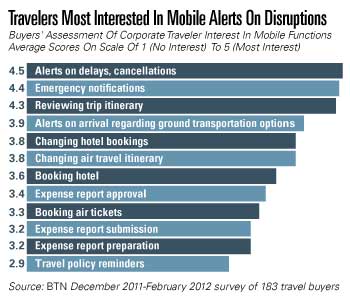
The travel buyers speaking in December corroborated BTN research regarding the mobile
functions that are most important to travelers: alerts of delays and
cancellations, emergency notifications and the ability to review and share trip
itineraries.
"These devices are really good for when you are on the
move and have small bits of time," Mandelbaum said. "The thing that
really made this take off was the gate alerts, the alerts on cancellations and
flight delays ... that was number one. The number two feature is being able to
view the itinerary."
Indeed, all three panelists cited itinerary-sharing TripIt
as one of the most popular apps among their traveling employees. They each also
mentioned dining-related apps. US Foods' Steinke specifically cited restaurant
reviewer Yelp, but also described the Dine With Your Customers app, built
internally by her company to help travelers find and visit customer locations.
Steinke also mentioned airport guide GateGuru and, perhaps "most
surprising," ITA's OnTheFly flight-searching app. "Our travelers can't
use it to book anything, but they use it for flight schedules," she said. "If
I need to change my flight, I'll check ITA to see what the schedules are like,
then call the agency."
Steinke also noted her travelers "love that they can
take pictures of their receipts and upload them. That gets more people excited
about going mobile than anything." New mobile expense capabilities, she
added, have meant lower corporate card delinquency rates and quicker employee
reimbursement.
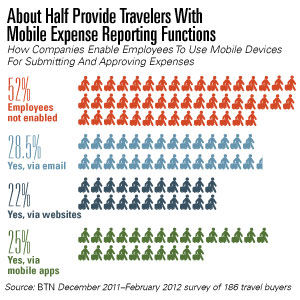
Expense reporting in BTN's
research ranked in the lower half of the most important mobile functions, but
there's plenty of use. Nearly half of all those surveyed indicated employees
can use mobile devices to submit and/or approve expenses through either email,
mobile apps or websites. "My SVP was ecstatic that he could sit at the
airport and approve expense reports while waiting for a flight," said
Astellas' Hansen.
Discussing future mobile opportunities, the travel managers
speaking at the conference touched on safety and security components (very
desirable), the ability to change flights on the fly (also very desirable),
apps provided by travel management companies (they must be better and more
functional than what travelers can find on their own, panelists suggested,
otherwise why bother?) and instant offers like those from Rearden's Homerun
(possibly of interest, if travelers are clear on what is and is not
reimbursable).
"We want to lower costs. It's a key objective always,"
Mandelbaum said. "If there are opportunities to pick up distressed
inventory, whether that be for hotels or restaurants, we are interested. The
best place to interact on that is through mobile devices on the go."
Sidebar: Mobile Corporate Air Bookings Finally Have Landed
As mobile technology's role in managed corporate travel
evolved, the seemingly inevitable next step of enabling air bookings was
hampered by an obvious limitation: the relatively small smartphone screens that
cannot convey to users all the flight options, fare flavors, product variables
and policy components that a full-blown self-booking tool provides. (Tablets,
of course, now are another, perhaps more promising, avenue.) Even so, the
ability to initiate air bookings on mobile devices always seemed a question of
when, not if. After all, the concept is reality in the B-to-C travel world.
Changing hotel and air reservations drew higher interest
among BTN survey respondents than
making bookings, and booking hotel stays was a more popular function than
booking air tickets.
"I don't have a lot of people saying, 'I want to book
flights on my mobile device,' " said travel manager Jennifer Steinke of US
Foods. "For my travelers, it's for everything after they've done that,
from the time they leave their house until the time they get back, filing
expenses along the way."
Asellas Pharma US travel manager Mary Alice Hansen said she's
all for airline bookings on mobile devices, "assuming it was in the
preferred applications to make that booking," rather than booking directly
with suppliers or through other unauthorized channels.
The Advisory Board Co.'s Steven Mandelbaum also does not
object to mobile corporate air bookings, "but I don't see it as big an
opportunity as other applications in the mobile space. If someone comes out
with the right way to do it, and people want to use it, I am fine with it."
Despite some skepticism, Concur, GetThere and KDS separately
claimed they have found the right way to do it. Each has said they now offer
mobile users the ability to initiate policy-compliant air bookings.
Available on iPhone, BlackBerry and Android devices,
GetThere Mobile since April 2011 has accommodated new hotel bookings. In
November, it introduced the capability for "new air reservations within
company policy and preferences for all carriers in the global distribution
system," according to parent company Sabre. By the next month, mobile
users were booking more air than hotel, according to GetThere chief product and
strategy officer Paul Wiley.
The company indicated that additional mobile booking
capabilities would be available "later this year." The mobile product
does not offer ground transportation, but "we have the ability to
integrate," Wiley said.
For such functions as itinerary management and delay and
cancellation alerts, GetThere users can take advantage of Sabre's TripCase.
Wiley said change and cancellation functions are under consideration. "All
GetThere bookings are able to fully integrate into TripCase," he said. "Now
we're working on having GetThere bookings start from TripCase."
KDS in January announced a fully functioning mobile
corporate booking tool, offering negotiated airfares, a policy filter and
content from GDSs, low-cost carriers and rail operators. The Book-on-Mobile app
includes an expense approval facility for line managers and the ability to scan
receipts into expense reports. KDS said the app is available for Android and
BlackBerry devices, and is scheduled for iPhone deployment by summer.
Given the screen-size challenge, KDS opted to restrict
initial search results to three options: best, cheapest and earliest. Travelers
can request additional flight options; any outside policy are highlighted in
red. Once the reservation is made, a fully integrated passenger name record is
created. KDS vice president of product strategy Oliver Quayle said a simplified
mobile display with reduced options encourages compliant and cheaper flight
selections.
Concur in late 2011 also began providing in-policy airline
bookings through its Concur Mobile product for Android, BlackBerry and iOS
devices. "While we just recently launched air booking capability, we're
seeing positive, early-stage usage and feedback from customers who appreciate
the convenience of booking anywhere," according to executive vice
president Mike Hilton. Meanwhile, CEO Steve Singh during a February conference
call noted that TripIt, acquired by Concur in January 2011, now has nearly 4.5
million users.
— Jay Campbell and
Amon Cohen contributed to this report
This report
originally appeared in the March 5, 2012, issue of Business Travel News.