
DE&I Metrics Help to Hold Companies Accountable
More transparent data is needed to set baselines and measure industry progress.
By Donna M. Airoldi


The importance of diversity, equity and inclusion for corporations didn't start with the murder of George Floyd in May 2020, although it was after that incident that demand by employees, customers and other stakeholders for DE&I transparency increased. Several companies began to make DE&I pledges, and many started to share their DE&I data publicly, often as part of their environmental, social and governance reports.
A few companies, including American Airlines, Hilton Worldwide, Marriott International and United Airlines, have tied executive and some manager-level compensation to DE&I results. Hyatt Hotels Corp. began that practice in 2017, but in 2020 "enhanced the weighting of DE&I in the corporate annual incentive plan by asking all incentive-eligible colleagues to create measurable individual goals focused on DE&I," Hyatt global VP of diversity, equity and inclusion Tyronne Stoudemire wrote in an email. In addition, the company linked executive stock compensation to its progress on DE&I, specifically its commitments in terms of who Hyatt hires and promotes.
"The last two years we started to openly talk about data in a disaggregated and transparent way," Delta Air Lines VP and chief diversity, equity and inclusion officer Keyra Lynn Johnson said. "People want to know better the brands they engage with. One best way is to not just share commitment-making but also the real specific actions to meet those commitments. We felt the best way to meet those was to be even more transparent with our data."
There also are business benefits to DE&I information. Attention to DE&I can enhance a company's products and services, its public image and its profits, according to a spring 2022 Harvard Business Review report.
"We see in general as we look at research that more diverse companies perform better, with profitability and customer service scores," American Airlines managing director of global DE&I Kevin Williams said. "For our business, one thing we see is having a more diverse workforce does impact customer sentiments" and can help to reduce friction. "We work with the customer service team to see if there is anything we can do to support them from a DE&I perspective, and to make sure leadership is reflective of team members."
BTN reached out to several travel suppliers to discuss their DE&I data, what buyers are looking for regarding it and how they are addressing gaps in representation. While all those approached have some type of DE&I program, getting them to discuss what is behind their metrics was a challenge, with United—which is being sued by a former diversity manager over discrimination—declining to be interviewed. Others spoke only on a surface level, sharing platitudes like, "DE&I is in our DNA."
Travel Buyer DE&I Demand
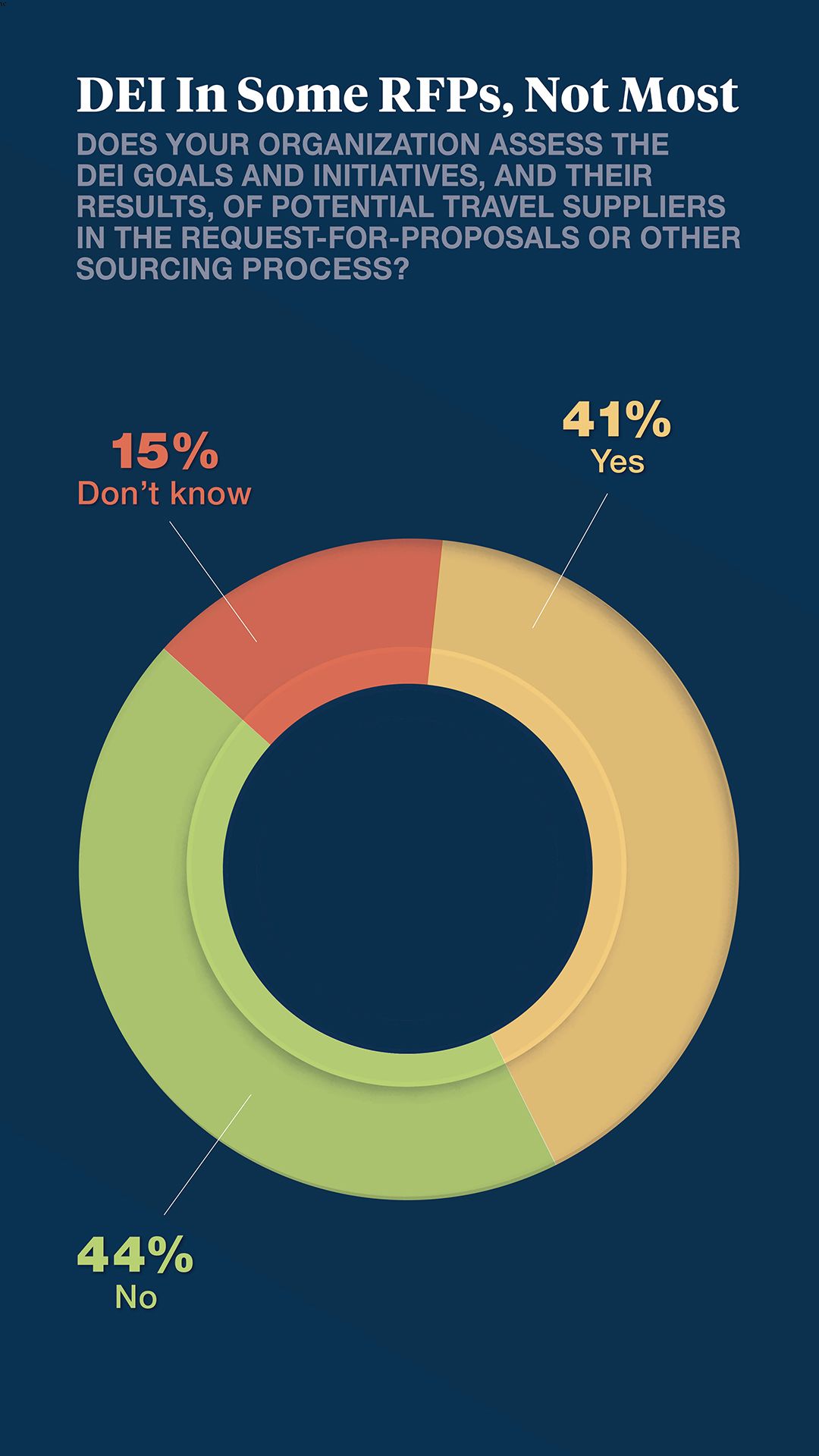
Some suppliers, however, were upfront with where they stood and how much work remains to be done. "DE&I is a journey," said a few. Those are the suppliers that could benefit from their transparency, because in our BTN survey of travel buyers, 41 percent of 163 respondents said their organizations already assess the DE&I goals and initiatives of potential travel suppliers in their sourcing processes. Further, 21 percent of 96 respondents noted their companies planned to do the same starting within the next 12 months.
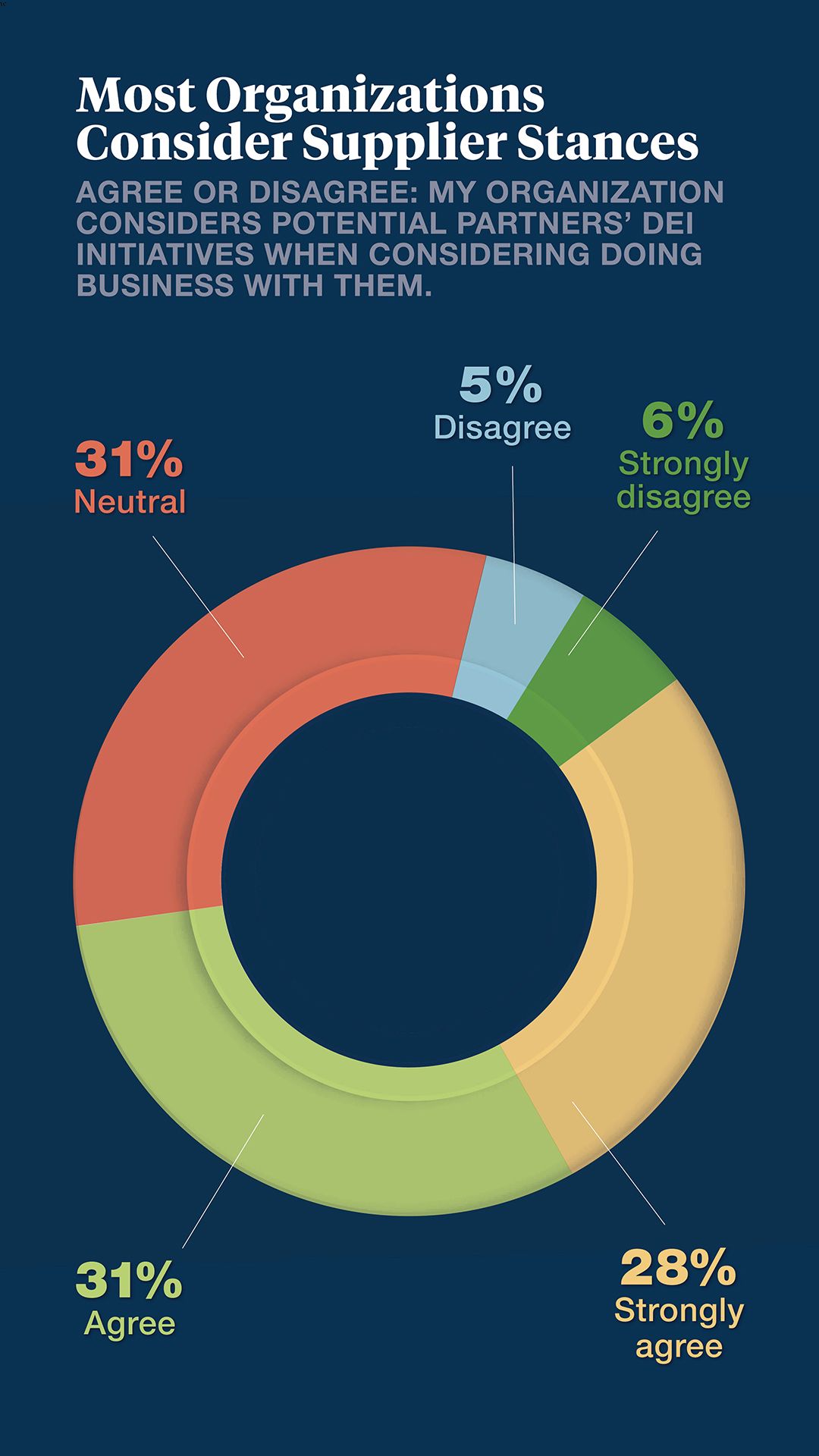
The top three types of suppliers assessed were airlines, hotels and travel management companies. Nearly one in three respondents said they awarded business to suppliers because their DE&I strategies were a differentiator when other offerings were comparable. About 16 percent have ruled out suppliers due to incompatibility with their own organization's DE&I strategies.
Still, nearly one in three respondents did not have any supplier partnership selections based on DE&I efforts.



The importance of diversity, equity and inclusion for corporations didn't start with the murder of George Floyd in May 2020, although it was after that incident that demand by employees, customers and other stakeholders for DE&I transparency increased. Several companies began to make DE&I pledges, and many started to share their DE&I data publicly, often as part of their environmental, social and governance reports.
A few companies, including American Airlines, Hilton Worldwide, Marriott International and United Airlines, have tied executive and some manager-level compensation to DE&I results. Hyatt Hotels Corp. began that practice in 2017, but in 2020 "enhanced the weighting of DE&I in the corporate annual incentive plan by asking all incentive-eligible colleagues to create measurable individual goals focused on DE&I," Hyatt global VP of diversity, equity and inclusion Tyronne Stoudemire wrote in an email. In addition, the company linked executive stock compensation to its progress on DE&I, specifically its commitments in terms of who Hyatt hires and promotes.
"The last two years we started to openly talk about data in a disaggregated and transparent way," Delta Air Lines VP and chief diversity, equity and inclusion officer Keyra Lynn Johnson said. "People want to know better the brands they engage with. One best way is to not just share commitment-making but also the real specific actions to meet those commitments. We felt the best way to meet those was to be even more transparent with our data."
There also are business benefits to DE&I information. Attention to DE&I can enhance a company's products and services, its public image and its profits, according to a spring 2022 Harvard Business Review report.
"We see in general as we look at research that more diverse companies perform better, with profitability and customer service scores," American Airlines managing director of global DE&I Kevin Williams said. "For our business, one thing we see is having a more diverse workforce does impact customer sentiments" and can help to reduce friction. "We work with the customer service team to see if there is anything we can do to support them from a DE&I perspective, and to make sure leadership is reflective of team members."
BTN reached out to several travel suppliers to discuss their DE&I data, what buyers are looking for regarding it and how they are addressing gaps in representation. While all those approached have some type of DE&I program, getting them to discuss what is behind their metrics was a challenge, with United—which is being sued by a former diversity manager over discrimination—declining even to be interviewed. Others spoke only on a surface level, sharing platitudes like, "DE&I is in our DNA."
Travel Buyer DE&I Demand
Some suppliers, however, were upfront with where they stood and how much work remains to be done. "DE&I is a journey," said a few. Those are the suppliers that could benefit from their transparency, because in our BTN survey of travel buyers, 41 percent of 163 respondents said their organizations already assess the DE&I goals and initiatives of potential travel suppliers in their sourcing processes. Further, 21 percent of 96 respondents noted their companies planned to do the same starting within the next 12 months.
The top three types of suppliers assessed were airlines, hotels and travel management companies. Nearly one in three respondents said they awarded business to suppliers because their DE&I strategies were a differentiator when other offerings were comparable. About 16 percent have ruled out suppliers due to incompatibility with their own organization's DE&I strategies.
Still, nearly one in three respondents did not have any supplier partnership selections based on DE&I efforts.
Several suppliers acknowledged that they have seen an increase in questions from travel buyers about their DE&I data and initiatives during the sourcing process.
Southwest Airlines, which shared its first DE&I report in April, recently held a virtual roundtable for corporate partners with more than 300 participants, said Southwest VP of DE&I Juan Suarez. "The entire topic was about community and DE&I. Those corporate partners wanted to understand where we stood from a DE&I perspective and what efforts we were making to advance programs." They also asked about diversity reporting in the supply chain, he added.
Hilton Worldwide, which was named to DiversityInc's Hall of Fame in early May, not only has travel buyers asking about its diversity and inclusion objectives but also "several have invited us to speak on the progress we've made for their own programs," said Hilton global head of diversity, equity, inclusion and recognition DeShaun Wise Porter. "How can they take best practices we've established, and how can we grow from those opportunities."
Metrics Diversity and Best Practices
What DE&I data are shared vary from entity to entity.
"Vanguard companies on data sharing are showing everything," Korn Ferry senior client partner Andrés Tapia told BTN. "Others are more cagey, and are like, 'These are the people of color numbers,' which is a terrible thing to share. It hides so many things. If you have Asian, Black and Latino under 'people of color,' you could be a tech company where 80 percent are Asian, so that's not addressing the Black and Latino underrepresentation. You can tell me in aggregate, but the next sentence should [include the breakdown]. Otherwise, it's a lack of transparency."
Tapia added that putting women and people of color in the same count is another poor choice. Or if a company reports it has 55 percent women make up its workforce, "where is your breakdown by senior executive, manager, etc.?," he said. "If women and people of color are all at the bottom, it's not diversity."
In addition, Tapia said the best data also show how well that talent is moving. "At Korn Ferry, we do talent flow analysis, which is more telling than status," he said. "What is the hiring rate, the promotion rate, the exit rate, the lateral rate? To answer those questions and do the sophisticated analysis requires really good data capture, and too many companies report static data. It's a snapshot, but they have no idea what is happening."
Some travel suppliers follow Tapia's best data practices and even include some statistics on other elements of DE&I beyond race, ethnicity and gender, such as veteran hiring status. Others still focus only on gender, or they'll share the breakdown of their workforce by race and ethnicity, but then won't show the changes from the prior year or won't include statistics on who is filling management roles. For companies based outside the United States, they can be limited by privacy rules dictating how data can be shared.
"Gender is the easiest to do, because across the globe it is generally permitted to report that data," said Yvette Bryant, SVP of diversity and inclusion for BCD Travel, which was recently named to the 2022 Women Impact Tech 100 list. "Although limited by laws in various markets, we have made a significant investment to start to gather additional diversity data to help us identify what gaps we have and to formulate plans to close those gaps." For instance, the company is looking at the mid-management and senior management levels to understand what is happening if women aren't progressing, and to address those gaps before getting to the VP data.
Gradual Progress
All in all, where BTN could compare multiple reports, progress has been slow.
In the U.K., companies with 250 employees or more are required to report gender-based pay comparisons, and certain sectors fare better than others. TMCs, on the whole, perform poorly against the universe of companies reporting data. On average, U.K. companies report a 9.8 percent gap in women's median hourly compensation versus men's. The gaps at major TMCs range from approximately 14 percent at BCD and 17 percent at Reed & Mackay to 20 percent at CWT and 23 percent at Amex GBT. The median hourly wage gap was nearly 26 percent at Clarity and 28 percent at Agiito.
The U.K. reporting does not control for men and women performing the same job. It does, however, show that males dominate the highest paid roles at TMCs while women overwhelmingly fill the lowest paid posts. The pay and seniority situation is worse at airlines, though several industry players pointed to furlough schemes that exacerbated those numbers during the pandemic. The most recent data, however, showed the needle for the BCD, CWT and GBT had improved since data was collected for the 2020/21 report.
In the U.S. DE&I disclosures are not required, but some companies volunteer them. Delta, which includes its DE&I data in its annual ESG report as well as in interim DE&I progress reports, acknowledged that even though its share of Black employees in 2021 increased by four percentage points year over year to 25 percent, its most recent report released earlier this month showed Black officer representation now has fallen below 2020 levels.
However, the percentage of officers from underrepresented racial and ethnic groups has increased to 16 percent in 2022 from 10 percent in 2020, according to the company. In addition, Black external candidates now represent 33 percent of new hires for general manager, director and managing director roles, up from 20 percent in 2020.
One way Delta is trying to improve its progress is with its "skills-first" career growth programs. In 2021, 94 percent of the carrier's non-executive job openings that were filled externally did not require a college degree, according to the company.
"We don't want to see [diversity] only at the lower tiers of the organization. Education [requirements] have been a barrier," Delta's Johnson said. "We are increasingly focused on skills, not just education pedigree and background," adding that the company has programs to grow talent internally as well as the company's Analytics Academy, a three-semester program in partnership with Georgia State University. "A lot of the talent is already here. We want to make sure employees who begin their careers on the frontline—gate agents, flight attendants, people working in loading bays—have career pathways to management. We also think this is an important part to closing wealth gaps."

Several suppliers acknowledged that they have seen an increase in questions from travel buyers about their DE&I data and initiatives during the sourcing process.
Southwest Airlines, which shared its first DE&I report in April, recently held a virtual roundtable for corporate partners with more than 300 participants, said Southwest VP of DE&I Juan Suarez. "The entire topic was about community and DE&I. Those corporate partners wanted to understand where we stood from a DE&I perspective and what efforts we were making to advance programs." They also asked about diversity reporting in the supply chain, he added.
Hilton Worldwide, which was named to DiversityInc's Hall of Fame in early May, not only has travel buyers asking about its diversity and inclusion objectives but also "several have invited us to speak on the progress we've made for their own programs," said Hilton global head of diversity, equity, inclusion and recognition DeShaun Wise Porter. "How can they take best practices we've established, and how can we grow from those opportunities."
Metrics Diversity and Best Practices
What DE&I data are shared vary from entity to entity.
"Vanguard companies on data sharing are showing everything," Korn Ferry senior client partner Andrés Tapia told BTN. "Others are more cagey, and are like, 'These are the people of color numbers,' which is a terrible thing to share. It hides so many things. If you have Asian, Black and Latino under 'people of color,' you could be a tech company where 80 percent are Asian, so that's not addressing the Black and Latino underrepresentation. You can tell me in aggregate, but the next sentence should [include the breakdown]. Otherwise, it's a lack of transparency."
Tapia added that putting women and people of color in the same count is another poor choice. Or if a company reports it has 55 percent women make up its workforce, "where is your breakdown by senior executive, manager, etc.?," he said. "If women and people of color are all at the bottom, it's not diversity."
In addition, Tapia said the best data also show how well that talent is moving. "At Korn Ferry, we do talent flow analysis, which is more telling than status," he said. "What is the hiring rate, the promotion rate, the exit rate, the lateral rate? To answer those questions and do the sophisticated analysis requires really good data capture, and too many companies report static data. It's a snapshot, but they have no idea what is happening."
Some travel suppliers follow Tapia's best data practices and even include some statistics on other elements of DE&I beyond race, ethnicity and gender, such as veteran hiring status. Others still focus only on gender, or they'll share the breakdown of their workforce by race and ethnicity, but then won't show the changes from the prior year or won't include statistics on who is filling management roles. For companies based outside the United States, they can be limited by privacy rules dictating how data can be shared.
"Gender is the easiest to do, because across the globe it is generally permitted to report that data," said Yvette Bryant, SVP of diversity and inclusion for BCD Travel, which was recently named to the 2022 Women Impact Tech 100 list. "Although limited by laws in various markets, we have made a significant investment to start to gather additional diversity data to help us identify what gaps we have and to formulate plans to close those gaps." For instance, the company is looking at the mid-management and senior management levels to understand what is happening if women aren't progressing, and to address those gaps before getting to the VP data.
Gradual Progress
All in all, where BTN could compare multiple reports, progress has been slow.
In the U.K., companies with 250 employees or more are required to report gender-based pay comparisons, and certain sectors fare better than others. TMCs, on the whole, perform poorly against the universe of companies reporting data. On average, U.K. companies report a 9.8 percent gap in women's median hourly compensation versus men's. The gaps at major TMCs range from approximately 14 percent at BCD and 17 percent at Reed & Mackay to 20 percent at CWT and 23 percent at Amex GBT. The median hourly wage gap was nearly 26 percent at Clarity and 28 percent at Agiito.
The U.K. reporting does not control for men and women performing the same job. It does, however, show that males dominate the highest paid roles at TMCs while women overwhelmingly fill the lowest paid posts. The pay and seniority situation is worse at airlines, though several industry players pointed to furlough schemes that exacerbated those numbers during the pandemic. The most recent data, however, showed the needle for the BCD, CWT and GBT had improved since data was collected for the 2020/21 report.
In the U.S. DE&I disclosures are not required, but some companies volunteer them. Delta, which includes its DE&I data in its annual ESG report as well as in interim DE&I progress reports, acknowledged that even though its share of Black employees in 2021 increased by four percentage points year over year to 25 percent, its most recent report released earlier this month showed Black officer representation now has fallen below 2020 levels.
However, the percentage of officers from underrepresented racial and ethnic groups has increased to 16 percent in 2022 from 10 percent in 2020, according to the company. In addition, Black external candidates now represent 33 percent of new hires for general manager, director and managing director roles, up from 20 percent in 2020.
One way Delta is trying to improve its progress is with its "skills-first" career growth programs. In 2021, 94 percent of the carrier's non-executive job openings that were filled externally did not require a college degree, according to the company.
"We don't want to see [diversity] only at the lower tiers of the organization. Education [requirements] have been a barrier," Delta's Johnson said. "We are increasingly focused on skills, not just education pedigree and background," adding that the company has programs to grow talent internally as well as the company's Analytics Academy, a three-semester program in partnership with Georgia State University. "A lot of the talent is already here. We want to make sure employees who begin their careers on the frontline—gate agents, flight attendants, people working in loading bays—have career pathways to management. We also think this is an important part to closing wealth gaps."
“Another piece we need to pay attention to and develop is [ensuring] we are supporting diverse levels at different points in careers. Studies show that one-third of minorities leave senior roles, specifically Black leaders, in the first three years.”
- American Airlines' Kevin Williams


In American's most recent ESG report, the company's gender breakdown of permanent employees dropped from 41 percent in 2019 to 40 percent in 2020. In its 10 employee categories, percentages of women in different roles generally stayed the same or moved up or down by about one percentage point. The company fared similarly when it came to the ethnic composition of its U.S. employees, which it aggregates as "self-identified minority."
However, in January American shared a DE&I progress report on goals it set in early 2021. The company not only met its goal to increase Black representation at the director level and above by 50 percent, "but after one year, we grew that population by 81 percent," Williams said, adding that the company also met its goal of increasing Black representation among senior managers by 20 percent.
American also is "hyper-focused" on retention as well as onboarding, added Williams. "Sponsorship is important. Advocacy is important," he said. "Another piece we need to pay attention to and develop is [ensuring] we are supporting diverse levels at different points in careers. Studies show that one-third of minorities leave senior roles, specifically Black leaders, in the first three years. We don’t want to see that at American."
Pledges and Beyond Numbers
Marriott, which was named to DiversityInc's Hall of Fame last year, has accelerated its objectives to diversify its leadership and business opportunities, including aiming for global gender parity in company leadership by 2023, two years sooner than the original goal, increasing representation of people of color in executive positions from 20.5 percent to 25 percent by 2025, and achieving 3,000 diverse- and women-owned hotels by 2025, Marriott SVP of HR Marisa Milton wrote in an email. In addition, the company is expanding its 12-months-long Emerging Leader Program to "bring an even sharper focus on the career development needs of our diverse leadership pipeline," Milton said.
Hilton has committed to gender parity in leadership roles and ethnic diversity of 25 percent at U.S. leadership levels by the end of 2027. The company is continuing to invest in mentoring and sponsorship programs as well as in its nine "team member resource groups," Wise Porter said. "[The groups] are a phenomenal foundation for cultivating diverse talent," she said. They include not only race and ethnicity categories, but also disability, LGBTQ+, gender, military and generational categories. All are sponsored by Hilton senior leaders.
The company also partnered in January with Guild Education to offer employees the opportunity for debt-free education. The new benefit includes options such as high school completion, English-language learning, digital literacy, professional certifications in areas such as culinary, business, data analytics and technology, and college degrees, according to Hilton.
Southwest's goal is "to represent the communities we serve," Suarez said. In addition to its commitment to double the percentage of racial diversity and increasing gender diversity in its senior management committee by 2025, the company also created its Diversity Recruiting Center of Excellence in July 2021. In 2022, the company launched a diversity counsel for employees. "The plan was to have 80 employees, and have them come to Dallas, learn about DE&I and go out to the locations and share the message," Suarez said. "There was so much interest, we increased it to 135 people. The engagement is high."
Smaller travel companies are adding diversity-related programs, too. Dallas-based Campbell Travel earlier this year launched an internship recruiting program. It partnered with Dallas' Skyline High School, which already had an established internship program with multiple tracks of curriculum, said Campbell president Teri Goins.
"My goal was to work with underserved youth with a focus on diverse candidates and LGBTQ," Goins said, adding that the program serves as a career path for young, diverse kids coming out of high school who may not have the means to attend a four-year university. "Diversity is a focus, but it's also about youth and generating fresh talent into our industry."
Campbell's first intern worked with the company for three months, while the second one is scheduled for an 18-month commitment. The latter is scheduled to start this month and work through the summer up to 25 hours per week, then during senior year will work about eight hours per week, Goins said. As part of the school's program, interested students can earn scholarships for two-year associates degrees, and Goins is looking to see how Campbell can support that as well.
In American's most recent ESG report, the company's gender breakdown of permanent employees dropped from 41 percent in 2019 to 40 percent in 2020. In its 10 employee categories, percentages of women in different roles generally stayed the same or moved up or down by about one percentage point. The company fared similarly when it came to the ethnic composition of its U.S. employees, which it aggregates as "self-identified minority."
However, in January American shared a DE&I progress report on goals it set in early 2021. The company not only met its goal to increase Black representation at the director level and above by 50 percent, "but after one year, we grew that population by 81 percent," Williams said, adding that the company also met its goal of increasing Black representation among senior managers by 20 percent.
American also is "hyper-focused" on retention as well as onboarding, added Williams. "Sponsorship is important. Advocacy is important," he said. "Another piece we need to pay attention to and develop is [ensuring] we are supporting diverse levels at different points in careers. Studies show that one-third of minorities leave senior roles, specifically Black leaders, in the first three years. We don’t want to see that at American."
Pledges and Beyond Numbers
Marriott, which was named to DiversityInc's Hall of Fame last year, has accelerated its objectives to diversify its leadership and business opportunities, including aiming for global gender parity in company leadership by 2023, two years sooner than the original goal, increasing representation of people of color in executive positions from 20.5 percent to 25 percent by 2025, and achieving 3,000 diverse- and women-owned hotels by 2025, Marriott SVP of HR Marisa Milton wrote in an email. In addition, the company is expanding its 12-months-long Emerging Leader Program to "bring an even sharper focus on the career development needs of our diverse leadership pipeline," Milton said.
Hilton has committed to gender parity in leadership roles and ethnic diversity of 25 percent at U.S. leadership levels by the end of 2027. The company is continuing to invest in mentoring and sponsorship programs as well as in its nine "team member resource groups," Wise Porter said. "[The groups] are a phenomenal foundation for cultivating diverse talent," she said. They include not only race and ethnicity categories, but also disability, LGBTQ+, gender, military and generational categories. All are sponsored by Hilton senior leaders.
The company also partnered in January with Guild Education to offer employees the opportunity for debt-free education. The new benefit includes options such as high school completion, English-language learning, digital literacy, professional certifications in areas such as culinary, business, data analytics and technology, and college degrees, according to Hilton.
Southwest's goal is "to represent the communities we serve," Suarez said. In addition to its commitment to double the percentage of racial diversity and increasing gender diversity in its senior management committee by 2025, the company also created its Diversity Recruiting Center of Excellence in July 2021. In 2022, the company launched a diversity counsel for employees. "The plan was to have 80 employees, and have them come to Dallas, learn about DE&I and go out to the locations and share the message," Suarez said. "There was so much interest, we increased it to 135 people. The engagement is high."
Smaller travel companies are adding diversity-related programs, too. Dallas-based Campbell Travel earlier this year launched an internship recruiting program. It partnered with Dallas' Skyline High School, which already had an established internship program with multiple tracks of curriculum, said Campbell president Teri Goins.
"My goal was to work with underserved youth with a focus on diverse candidates and LGBTQ," Goins said, adding that the program serves as a career path for young, diverse kids coming out of high school who may not have the means to attend a four-year university. "Diversity is a focus, but it's also about youth and generating fresh talent into our industry."
Campbell's first intern worked with the company for three months, while the second one is scheduled for an 18-month commitment. The latter is scheduled to start this month and work through the summer up to 25 hours per week, then during senior year will work about eight hours per week, Goins said. As part of the school's program, interested students can earn scholarships for two-year associates degrees, and Goins is looking to see how Campbell can support that as well.
Importance of Inclusion in DE&I Reporting
While many DE&I reports focus more on the diversity of DE&I, inclusion action is a key component as well.
"It's not only who you invite, but that everyone who is here feels like they belong," BCD Travel's Bryant said. "We're raising awareness with leaders on how to lead more inclusively. On conducting meetings, are you allowing different voices to be heard? Who are you allocating projects to? Are you letting bias come into play when assigning to a man versus a woman?"
Hilton conducts an annual global employee survey, Wise Porter said. "Are they perceiving our efforts as they pertain to a feeling of inclusion, a sense of belonging?" she said. "Are they feeling recognized? You can have numbers, and even if they're growing, if people don’t feel a sense of belonging or community or opportunity, the true sentiment might be different. Those two go hand in hand."
All this may seem daunting to travel managers as they begin to assess their suppliers' DE&I reports. Even if a travel company does not publicly share DE&I data, it can't hurt to ask for it during the sourcing process. If they don’t have statistics to share, "ask for stories about what they are doing around diversity, are they addressing disability, LGBTQ, veterans," Korn Ferry's Tapia said. "The qualitative answers will be valuable."
Importance of Inclusion in DE&I Reporting
While many DE&I reports focus more on the diversity of DE&I, inclusion action is a key component as well.
"It's not only who you invite, but that everyone who is here feels like they belong," BCD Travel's Bryant said. "We're raising awareness with leaders on how to lead more inclusively. On conducting meetings, are you allowing different voices to be heard? Who are you allocating projects to? Are you letting bias come into play when assigning to a man versus a woman?"
Hilton conducts an annual global employee survey, Wise Porter said. "Are they perceiving our efforts as they pertain to a feeling of inclusion, a sense of belonging?" she said. "Are they feeling recognized? You can have numbers, and even if they're growing, if people don’t feel a sense of belonging or community or opportunity, the true sentiment might be different. Those two go hand in hand."
All this may seem daunting to travel managers as they begin to assess their suppliers' DE&I reports. Even if a travel company does not publicly share DE&I data, it can't hurt to ask for it during the sourcing process. If they don’t have statistics to share, "ask for stories about what they are doing around diversity, are they addressing disability, LGBTQ, veterans," Korn Ferry's Tapia said. "The qualitative answers will be valuable."
“Are they perceiving our efforts as they pertain to a feeling of inclusion, a sense of belonging? Are they feeling recognized? You can have numbers, and even if they're growing, if people don’t feel a sense of belonging or community or opportunity, the true sentiment might be different.”
- Hilton's DeShaun Wise Porter


 Built with Shorthand