
Corporate Culture Is Changing Travel Culture... Slowly
Travel managers say their companies support DE&I strategies, but implementation in programs is only beginning to gain traction.
By Elizabeth West


Employee communities are becoming more diverse, but according to a McKinsey & Co. study, female, Black, and Hispanic workers during the pandemic felt more pressured and stressed in the workplace than their white male counterparts. At the same time, companies have broadly invested in diversity, equity and inclusion strategies to bolster employee morale, productivity and retention. Many have hired diversity leaders to guide their companies and are doing more to engage employees in diversity and community-based programs. A Glassdoor study from 2020 suggests those companies where investment is effective stand to gain an edge in recruiting and keeping talent in a world where 76 percent of job seekers say workplace diversity is a critical factor in their decision-making.
Whether those strategies are cascading down to travel management—and whether they need to—seems to be an unanswered question at many organizations.
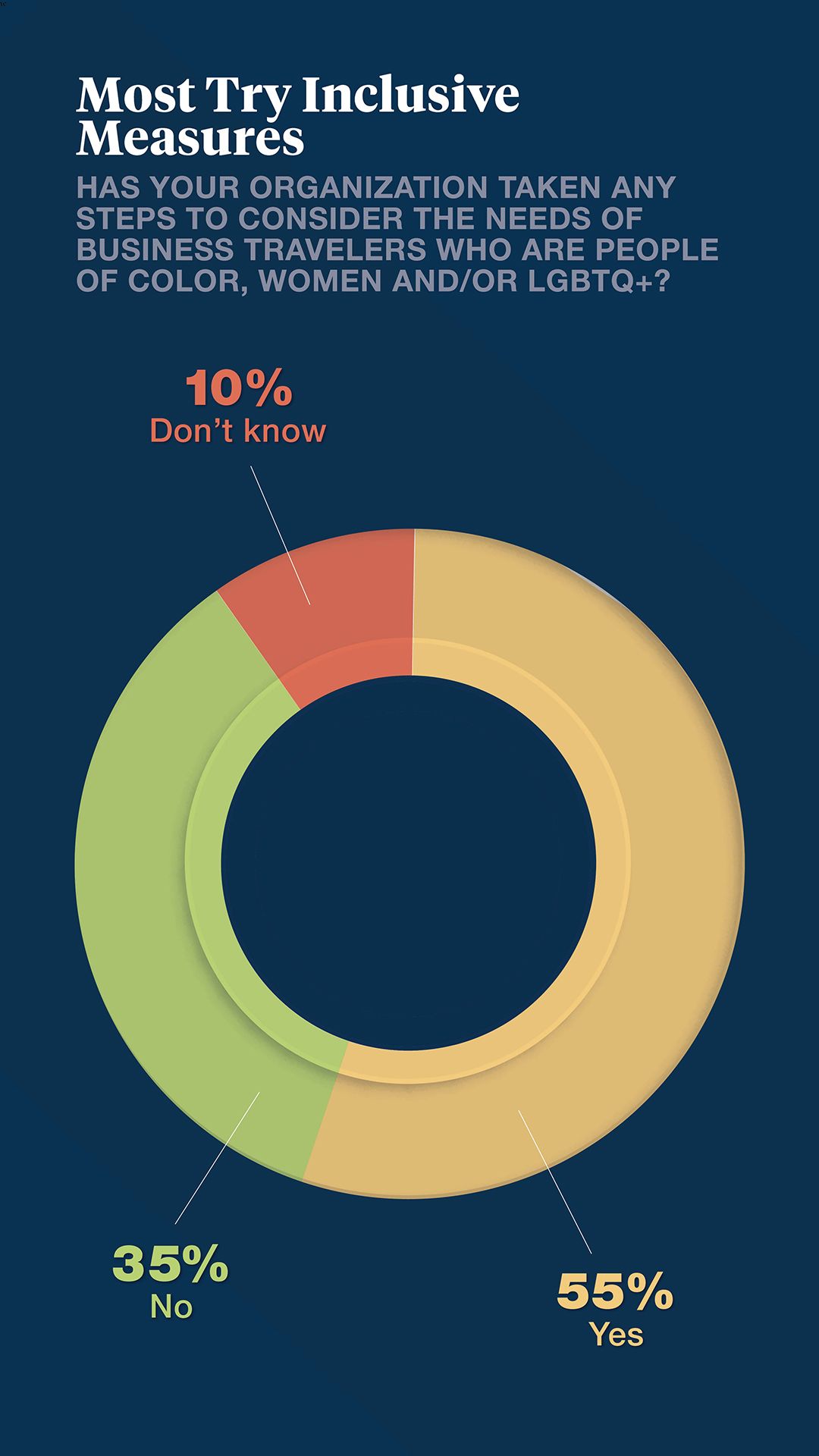
Asked whether their companies had taken any steps to consider the needs of business travelers who are people of color, women, LGBTQ+ and/or other groups considered marginalized, 55 percent of 163 respondents to BTN's 2022 Diversity, Equity & Inclusion in Business Travel Survey said they had.


Employee communities are becoming more diverse, but according to a McKinsey & Co. study, female, Black, and Hispanic workers during the pandemic felt more pressured and stressed in the workplace than their white male counterparts. At the same time, companies have broadly invested in diversity, equity and inclusion strategies to bolster employee morale, productivity and retention. Many have hired diversity leaders to guide their companies and are doing more to engage employees in diversity and community-based programs. A Glassdoor study from 2020 suggests those companies where investment is effective stand to gain an edge in recruiting and keeping talent in a world where 76 percent of job seekers say workplace diversity is a critical factor in their decision-making.
Whether those strategies are cascading down to travel management—and whether they need to—seems to be an unanswered question at many organizations.
Asked whether their companies had taken any steps to consider the needs of business travelers who are people of color, women, LGBTQ+ and/or other groups considered marginalized, 55 percent of 163 respondents to BTN's 2022 Diversity, Equity & Inclusion in Business Travel Survey said they had.

Often the issue of diversity was buried in more general traveler safety, with a risk management provider or an internal safety and security team providing guidance for travelers as a matter of course, particularly for geographies that have a record of discriminatory laws or cultural norms. "We direct all travelers to our travel risk management site, where there is travel advice available depending on travel destination," was an open-ended survey response that illustrated a typical process among respondents who had educational resources in place.
For others, the responsibility fell to the individual to voice their needs and reach out to the travel manager, their direct manager or a corporate safety officer to discuss accommodation for travel concerns. In such companies, said one respondent, "Travel is completed in the same way for all, but if a traveler were to approach with a specific concern, that concern would be taken seriously and changes to the itinerary made as appropriate." Whose judgment determined what might be "appropriate" was not specified.
Still other respondents indicated their companies were focused on offering the same travel policy for everyone, with few exceptions. Those responses varied from a simple, "We treat everyone the same," to the more philosophical, "Our organization's approach towards business travelers is based on mutual respect and not on differentiation on gender or color," and to the dismissive, "People are people, none of this other nonsense."
Discrimination While Traveling on Business
Global travel manager Kate Scully knows firsthand what it feels like to be the target of discrimination on a business trip.
"As a Black woman, I can never go into a hotel in Dubai … without being 'prostitute-checked.' Even if I walk in with three of my colleagues, I will get pulled to the side and asked to show my room key," she said. "I could have been staying there for a week, and I will continue to be pulled aside in front of my white colleagues. And they look away, and I look anywhere—at my shoes, just anywhere—and let them know that I will see them at the lifts or whatever."
Only one time did a colleague intervene on her behalf and decry what was clearly a racist directive from hotel management. "A Brazilian colleague—a compliance guy—actually stepped in and was outraged," she said.
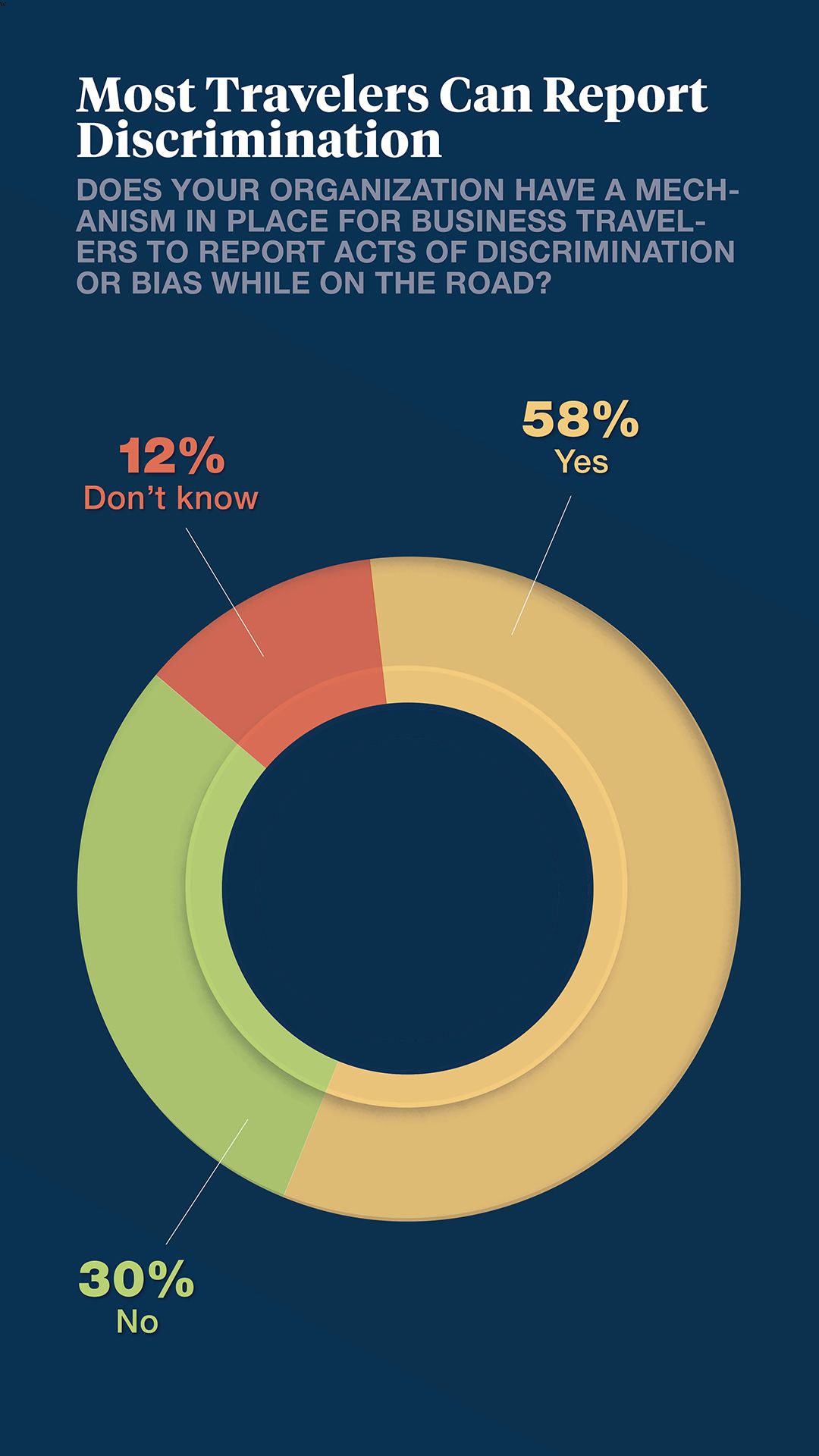
More than half of survey respondents said their companies had mechanisms for reporting discrimination and bias while on the job, including travel. Respondents were split about how that reporting takes place—whether it comes directly back through travel channels or would be handled through more general corporate channels like human resources. Either way, buyers said such reports would be critical for them to receive so they could take up any incidents with suppliers.

Often the issue of diversity was buried in more general traveler safety, with a risk management provider or an internal safety and security team providing guidance for travelers as a matter of course, particularly for geographies that have a record of discriminatory laws or cultural norms. "We direct all travelers to our travel risk management site, where there is travel advice available depending on travel destination," was an open-ended survey response that illustrated a typical process among respondents who had educational resources in place.
For others, the responsibility fell to the individual to voice their needs and reach out to the travel manager, their direct manager or a corporate safety officer to discuss accommodation for travel concerns. In such companies, said one respondent, "Travel is completed in the same way for all, but if a traveler were to approach with a specific concern, that concern would be taken seriously and changes to the itinerary made as appropriate." Whose judgment determined what might be "appropriate" was not specified.
Still other respondents indicated their companies were focused on offering the same travel policy for everyone, with few exceptions. Those responses varied from a simple, "We treat everyone the same," to the more philosophical, "Our organization's approach towards business travelers is based on mutual respect and not on differentiation on gender or color," and to the dismissive, "People are people, none of this other nonsense."
Discrimination While Traveling on Business
Global travel manager Kate Scully knows firsthand what it feels like to be the target of discrimination on a business trip.
"As a Black woman, I can never go into a hotel in Dubai … without being 'prostitute-checked.' Even if I walk in with three of my colleagues, I will get pulled to the side and asked to show my room key," she said. "I could have been staying there for a week, and I will continue to be pulled aside in front of my white colleagues. And they look away, and I look anywhere—at my shoes, just anywhere—and let them know that I will see them at the lifts or whatever."
Only one time did a colleague intervene on her behalf and decry what was clearly a racist directive from hotel management. "A Brazilian colleague—a compliance guy—actually stepped in and was outraged," she said.
More than half of survey respondents said their companies had mechanisms for reporting discrimination and bias while on the job, including travel. Respondents were split about how that reporting takes place—whether it comes directly back through travel channels or would be handled through more general corporate channels like human resources. Either way, buyers said such reports would be critical for them to receive so they could take up any incidents with suppliers.
Whether people actually do that—like Scully's colleague in the moment or report about their own experiences upon their return—is a big question. Calling out racism, sexism or discrimination of any kind can cause anxiety in employees lest they are identified as "problematic" because they are bringing up an unwanted issue to their organization that will require time and resources to address.
"There are so many times that people just shrink back, because identifying something racist is almost seen as worse than being racist—or discrimination of any kind," said Scully. "It must be the same for the LGBTQ community and others, whether it's religion or gender. It's not just about race, and the issues are different depending on where you go in the world. I'm not here just for people of color. I'm here for everyone—I want everyone to feel comfortable traveling."
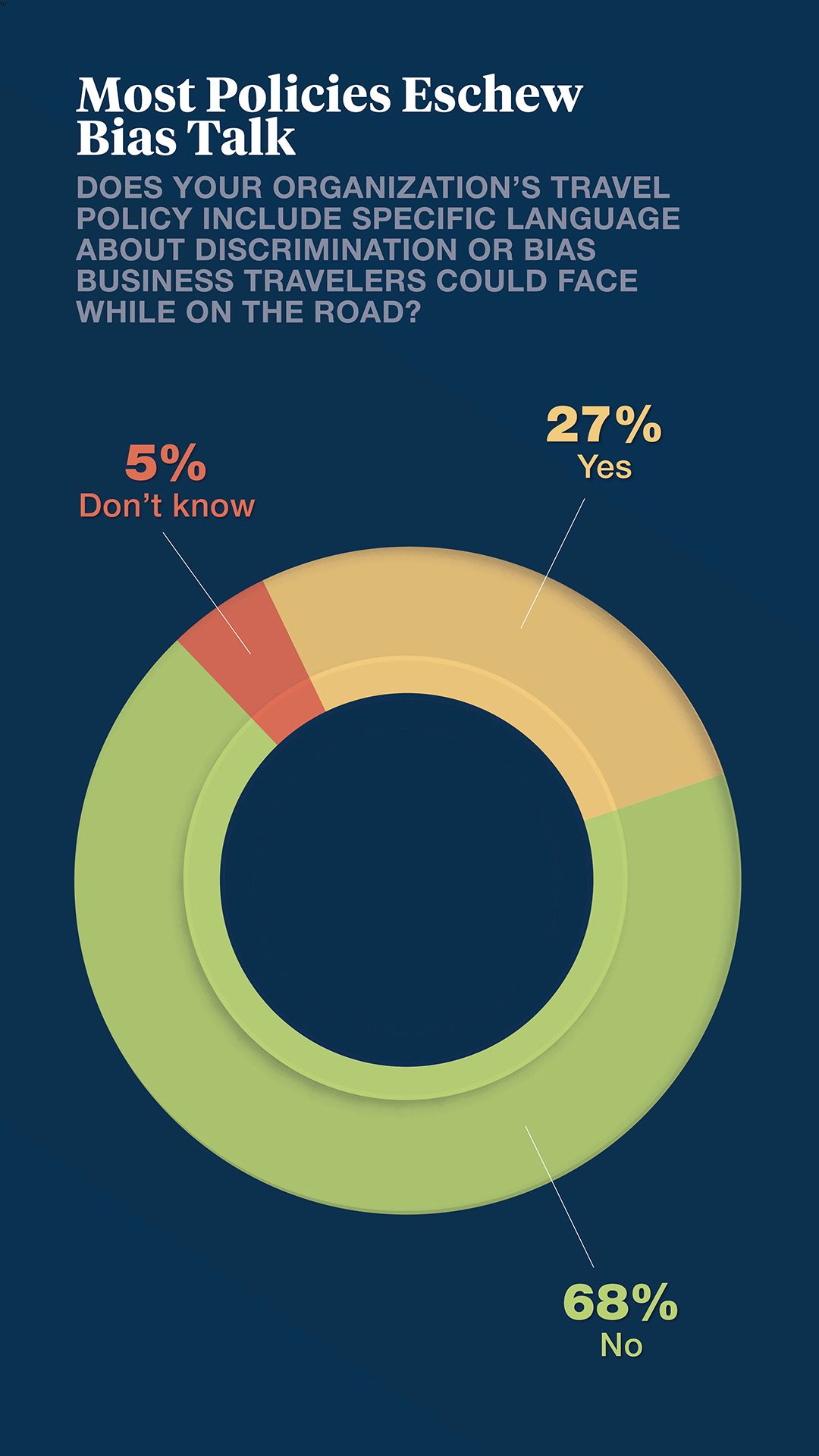
BTN asked in its survey whether there was any language regarding bias, harassment or discrimination in respondents' corporate travel policies, only 27 percent could confirm the issue was addressed head on.
Equity & Inclusion Must Expand Beyond Discrimination
Scully recently took a new global travel manager position at London-based insurance company Howden Group Holdings. She is working on incorporating diversity, equity and inclusion strategies into the travel program. Asked whether Howden's travel program has a specific mechanism for employees to report back to the travel department about discriminatory incidents they might experience while traveling on business, she said it didn't. But she also said that to think about DE&I only in terms of responding to discrimination would set a very low bar.
"Of course, we want to respond to these types of problems, particularly if they are happening at specific suppliers, but we can put more in our programs to support diverse travelers," Scully said.

Whether people actually do that—like Scully's colleague in the moment or report about their own experiences upon their return—is a big question. Calling out racism, sexism or discrimination of any kind can cause anxiety in employees lest they are identified as "problematic" because they are bringing up an unwanted issue to their organization that will require time and resources to address.
"There are so many times that people just shrink back, because identifying something racist is almost seen as worse than being racist—or discrimination of any kind," said Scully. "It must be the same for the LGBTQ community and others, whether it's religion or gender. It's not just about race, and the issues are different depending on where you go in the world. I'm not here just for people of color. I'm here for everyone—I want everyone to feel comfortable traveling."
BTN asked in its survey whether there was any language regarding bias, harassment or discrimination in respondents' corporate travel policies, only 27 percent could confirm the issue was addressed head on.
Equity & Inclusion Must Expand Beyond Discrimination
Scully recently took a new global travel manager position at London-based insurance company Howden Group Holdings. She is working on incorporating diversity, equity and inclusion strategies into the travel program. Asked whether Howden's travel program has a specific mechanism for employees to report back to the travel department about discriminatory incidents they might experience while traveling on business, she said it didn't. But she also said that to think about DE&I only in terms of responding to discrimination would set a very low bar.
"Of course, we want to respond to these types of problems, particularly if they are happening at specific suppliers, but we can put more in our programs to support diverse travelers," Scully said.
“[Travel DE&I] may have to be a conversation led by travel management between procurement and HR, and where does the company want to put its priorities—strictly on cost or investing in people?”
- Coverys' Ariel Crohn

Coverys travel manager Ariel Crohn agreed and has been working with her company's DE&I lead on taking a more comprehensive approach that also includes better support for physical and neurodiverse travelers who may need additional logistical consideration while traveling on business.
"It's about creating safety around the concept of disclosing personal needs and letting our travelers know we are here to support them," she said. "Of course, if we make that statement, we have to stand behind it, whether it's someone who just had a baby and isn't comfortable traveling or needs a specific accommodation, or someone with a personal health issue or disability who requires an extra assist from the TMC or supplier."
Crohn said companies will need to be ready to invest in efforts that will level the playing field for diverse travelers, just like they do for other DE&I initiatives in the organization. "That may have to be a conversation led by travel management between procurement and HR, and where the company wants to put its priorities—strictly on cost or investing in people?" she said. "Companies that show up and do it, they're going to get the employees that are going to work hard and that are going to go above and beyond for their employers."
Making that commitment, Coverys is bringing in a third-party vendor to offer a refresher on business travel safety, and within that environment, the company will organize focus groups to represent perspectives on business travel across racial diversity, abilities, age, gender and geographic location throughout the United States.
"We're going to talk about the challenges each person has faced, but I've definitely thought about how there might be things people don't want to share publicly. I will create an anonymous link for them to provide any feedback they want, so we make sure we address their concerns within our trainings," she said. "Because traveler safety is much more than making sure your bag doesn't get stolen. What if someone yells a racial slur at you? What if you are approached in a parking lot? The training is for every employee to make sure they feel as safe as possible whenever they are traveling—either for business or personally."
Coverys travel manager Ariel Crohn agreed and has been working with her company's DE&I lead on taking a more comprehensive approach that also includes better support for physical and neurodiverse travelers who may need additional logistical consideration while traveling on business.
"It's about creating safety around the concept of disclosing personal needs and letting our travelers know we are here to support them," she said. "Of course, if we make that statement, we have to stand behind it, whether it's someone who just had a baby and isn't comfortable traveling or needs a specific accommodation, or someone with a personal health issue or disability who requires an extra assist from the TMC or supplier."
Crohn said companies will need to be ready to invest in efforts that will level the playing field for diverse travelers, just like they do for other DE&I initiatives in the organization. "That may have to be a conversation led by travel management between procurement and HR, and where the company wants to put its priorities—strictly on cost or investing in people?" she said. "Companies that show up and do it, they're going to get the employees that are going to work hard and that are going to go above and beyond for their employers."
Making that commitment, Coverys is bringing in a third-party vendor to offer a refresher on business travel safety, and within that environment, the company will organize focus groups to represent perspectives on business travel across racial diversity, abilities, age, gender and geographic location throughout the United States.
"We're going to talk about the challenges each person has faced, but I've definitely thought about how there might be things people don't want to share publicly. I will create an anonymous link for them to provide any feedback they want, so we make sure we address their concerns within our trainings," she said. "Because traveler safety is much more than making sure your bag doesn't get stolen. What if someone yells a racial slur at you? What if you are approached in a parking lot? The training is for every employee to make sure they feel as safe as possible whenever they are traveling—either for business or personally."
“There's a lot of power that comes from asking the questions, so we can't be afraid to take that first step.”
- Howden Group Holdings' Kate Scully
Like so many respondents BTN surveyed online, Scully's travel DE&I efforts at Howdens are in the early stages. But for the first time, she said, she feels the culture around her supporting diversity at a more fundamental level.
"This is the first time I've worked in a company and seen women who look like me holding senior positions, and just in general, when I look around at the people in the company, it looks similar to the city of London. I don't have to look for those 4 percent of people who look like me, and that's fantastic," she said. "I want to take some of the DE&I practices already in place and integrate them into the travel program."
A few BTN survey respondents indicated their changing company cultures were driving changes to the travel management as well. Some indicated broader efforts than travel were at play, with comments like, "We have a DE&I committee reviewing company practices to be sure consideration and inclusion are being recognized and supported," and "We recently created a position for a DE&I manager, and they are taking the necessary steps to make us more inclusive." One respondent indicated a more active collaboration, "We have just started a large team in our HR department that focuses on this initiative. We'll be partnering with them closer in Q4 to achieve a lot of these objectives," they wrote.
Like so many respondents BTN surveyed online, Scully's travel DE&I efforts at Howden are in the early stages. But for the first time, she said, she feels the culture around her supporting diversity at a more fundamental level.
"This is the first time I've worked in a company and seen women who look like me holding senior positions, and just in general, when I look around at the people in the company, it looks similar to the city of London. I don't have to look for those 4 percent of people who look like me, and that's fantastic," she said. "I want to take some of the DE&I practices already in place and integrate them into the travel program."
A few BTN survey respondents indicated their changing company cultures were driving changes to the travel management as well. Some indicated broader efforts than travel were at play, with comments like, "We have a DE&I committee reviewing company practices to be sure consideration and inclusion are being recognized and supported," and "We recently created a position for a DE&I manager, and they are taking the necessary steps to make us more inclusive." One respondent indicated a more active collaboration, "We have just started a large team in our HR department that focuses on this initiative. We'll be partnering with them closer in Q4 to achieve a lot of these objectives," they wrote.
Scully and Crohn were heartened by the shift in corporate culture they see happening in certain organization. And Scully, for one, is working to capitalize on it. "If we can take these ideas and collaborate with other major companies, we can make a much bigger impact than just one company working alone."
She referenced a project she is working on with a number of other companies that "isn't yet ready for public announcement" but that would standardize some sourcing requirements and align other business travel DE&I best practices across multiple organizations to impact the larger travel management community.
But, she said, the first move may be the hardest in a world where an organization's shortcomings often get more focus than longer-term goals.
"The cancel culture sometimes makes it really hard," she said. "Companies and individuals may be scared to approach the subject because it shines a light on imperfections and what can be a brand-destroying hot potato—so, therefore, nothing gets done about it all. But there's a lot of power that comes from asking the questions, so we can't be afraid to take that first step."
Scully and Crohn were heartened by the shift in corporate culture they see happening in certain organization. And Scully, for one, is working to capitalize on it. "If we can take these ideas and collaborate with other major companies, we can make a much bigger impact than just one company working alone."
She referenced a project she is working on with a number of other companies that "isn't yet ready for public announcement" but that would standardize some sourcing requirements and align other business travel DE&I best practices across multiple organizations to impact the larger travel management community.
But, she said, the first move may be the hardest in a world where an organization's shortcomings often get more focus than longer-term goals.
"The cancel culture sometimes makes it really hard," she said. "Companies and individuals may be scared to approach the subject because it shines a light on imperfections and what can be a brand-destroying hot potato—so, therefore, nothing gets done about it all. But there's a lot of power that comes from asking the questions, so we can't be afraid to take that first step."
 Built with Shorthand