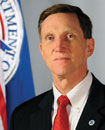
 John Pistole
Denver - Transportation
Security Administration administrator John Pistole here at the Global Business
Travel Association's annual conference shared some details about the agency's
proposed trusted traveler program, scheduled to commence this autumn. Noting the
possibility of allowing trusted travelers to keep their shoes on and their
laptop in a carry-on in airport security lanes, Pistole said the TSA's main
objective is to provide a free-of-charge program available to the country's top
travelers in order to remove the hassle of travel. However, TSA still plans to
continue to conduct random searches, from which trusted travelers would not be
excluded. Pistole discussed with BTN editorial
director Jay Campbell changes frequent travelers who participate in the program
could expect and the ways in which current trusted traveler memberships could be
incorporated into the new program. An edited transcript follows.
If you are a member of the program, is it still not possible
for you to go to the airport knowing that you are always going to get the
expedited measure?
Not 100 percent. There's a possibility and a probability as
the system matures, but it won't be a guarantee because I don't want terrorists
to start flying a lot and being able to game the system. That is the downside
for those who want and recognize the benefits.
Is there any analysis on how much time will be saved?
We have done quite a bit on that, but I don't want to go
into detail. Clearly, if someone doesn't have to take their shoes off, you
could assign a specific time to that in terms the X-ray viewing and putting
their shoes back on. We have some metrics with that, and with the laptop and
briefcase. The idea is to expedite the physical screening because we have done
the intelligence screening.
Is it more about eliminating the headache factor of travel
rather than time?
For the individual passenger, it may be more the hassle
factor. For example, last year a travel association did a survey of travel
complaints, and the number one complaint was the high cost of tickets—fortunately,
it wasn't a security issue. The second was the hassle of taking your shoes off.
It wasn't body scans; it wasn't pat-downs—it was taking your shoes off and the
hassle of it. We have had over 5.5 [billion] people travel since Richard Reid,
the shoe bomber, and there have been no shoe bombs because we have people take
their shoes off. But from a risk-based perspective, if we know more about
people at the front end, we can make sure that we can make some judgments and
assessments to know that this person is likely not [a terrorist]. Here in
Denver and some other places if they big cowboy boots on, that is more likely.
From a risk perspective, it is easier to conceal greater amounts of explosives
in bigger shoes or boots. I say cowboy boots, but I mean any type of boot.
Is there a general testing program planned where certain
frequent travelers are invited to join, and would they have to already be a
member of Nexus, Sentri or Global Entry to be invited?
No, they don't have to be. If you are in Global Entry or one
of those programs then obviously we know more about them then simply that they
are an elite frequent flyer, but it's not required they be a part of that.
Global Entry, of course, is for international re-entry and if you are a simply
a domestic traveler. We do anticipate that some people will join Global Entry
or Nexus or Sentri simply to be considered for this possible benefit in terms
of the expedited screening program, but it's not required.
It's the first entry point into the program, if you will, if
you are already a member of those programs, but we are currently working with
the airlines to have the IT systems ready to go on the trial basis starting
early mid-fall.
Are there any other criteria for those who want to
participate in the program?
They have to be invited by their airline, and then it will
be piloted at just a few airports starting off. Even with Global Entry, that
will not be universal starting off. This will be a longer-term bill, and it's
not just making a policy decision. There are a lot of moving parts to making
this all happen while not reducing security. Everything that we are doing in
terms of risk-based has to at least maintain if not improve security.
Will there be a fee for those to participate?
There will not be for those in the frequent flyer programs.
There is obviously a fee for those in Global Entry, Nexus and Sentri, and of
course you do an interview and a background check, and that is what the fee is
for to pay for: to make sure you don't have a criminal history and you are
doing biometrics and all that. For the frequent flyer portion, there is no fee
associated with it. Now, the airlines are incurring a cost to reengineer their
IT systems so we have interoperability with them. It's not without cost, but
not to the passenger.
Do the Global Entry and Nexus programs provide a good guide
for the information the passengers will need to give?
No, not necessarily. That requires a background check, a
criminal history check, fingerprints and perhaps other biometrics, and an-in
person interview. At least what we are starting with for the elite levels for
the airlines, based on what we know about terrorists and their travel history
patterns and what we know about frequent flyers of U.S. carriers. It's all U.S.-based
starting off. We want to make sure that we get it right here before we expand
it globally or internationally.
The airlines are in the process of sending out emails in
their elite tiers saying: 'Do you want to participate in this? If so, then we
need your consent.' No data mining. If someone doesn't want to be considered,
and you don't want to share any information, that's fine.
If you're not a member of Global Entry or Nexus or Sentri,
you are just going to stand in line like everyone else.
You called the trusted traveler program a potential game-changer.
Do you think that description applies if it comprises just a dedicated lane, or
is that a future description of things you can't discuss?
Clearly it's for the future, and there are other things that
we are doing that may not be apparent to the traveling public.
Can you discuss how the airlines are modifying their IT
systems?
It's for the connectivity with us. Under our Secure Flight system,
where everyone has to have their name, date of birth and gender before they can
fly as part of the reservation, the concept that we are using is to take the
information from the airline that would indicate that their elite traveler has
made a reservation, and then we embed that information on a barcode for the
boarding pass. The airlines control the barcode for the boarding pass, so they
have to modify some of their systems so they can make that, and then we run it
through Secure Flight to make sure they are not on a watchlist. For example, for
someone who is on the watchlist now, it shows up on their boarding pass that
they are a selectee and they have to go through additional screening. We want
to have the equivalent for the trusted traveler. Part of my approach to all
this is, let's have no fee for this—to certain passengers, anyway, who we have
some confidence in—so does not require rulemaking and so that we would [not] have
to go to Congress and say that we will have to charge people X amount of money and
we are going to need all this technology and everything else. What we did was
approach the airlines and say, "Are you willing to work with us on this
and incur the cost?" The airports have to change their airport
configuration to allow for a dedicated lane, and that may cost them some money.
We worked with the Airport Council and the American Association of Airport
Executives. They recognize the benefit of providing a benefit of better
customer service for especially the highest paying passengers. It's the same
thing that we are doing with pilots under our known-crewmember [program], which
is truly an identity-based system.
How is the risk-based training going in Boston Logan, and
will it be expanded?
Everything that we have seen so far it's going well from a
data-gathering perspective but not from what people are saying [during the
interview], but what is their reaction to it. It's been almost universally
received, and people are willing to answer the basic questions. Thousands of
people have done this, and literally a very small number said they did not want
to answer the questions, and that's fine. This is a pilot concept to see how we
move forward. So far, it is working well.
We want to make sure that we get it right. There is a recent
study that was done that validated the [ethics] of behavior detection. It's a classified
report but suffice to say it's multiple times more effective than randomness in
trying to detect people who are trying to hide something. These officers have
to do some training so that they can make some judgments and assessments. Again,
it's just one layer; I would not rely on that exclusively. People will still go
through additional physical screening, perhaps expedited.
Even though somebody answers a question, we may ask them
some more questions. It's just to keep it random. While we are doing that, we
may do some explosive-trace detection on their hands to see if they were around
explosives.
—Lauren Darson
assisted with this interview