Two years after many corporations gutted their chauffeured
transportation programs, leaving them a permitted choice only for their most
senior executives—if anybody—anecdotal reports from buyers and suppliers
suggest such constraints have peaked, with some companies allowing more
employees to use such services more frequently, although not nearly to the
scale they did before the economic recession.
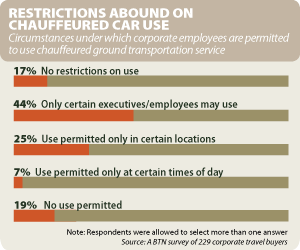 Still, a solid minority of companies continues to allow no
use of chauffeured transportation for business purposes at all, according to a
survey of 229 corporate travel buyers by Business
Travel News. About 19 percent of respondents hold that line, as opposed to
about 17 percent who allow all employees to avail themselves of chauffeured
providers.
Still, a solid minority of companies continues to allow no
use of chauffeured transportation for business purposes at all, according to a
survey of 229 corporate travel buyers by Business
Travel News. About 19 percent of respondents hold that line, as opposed to
about 17 percent who allow all employees to avail themselves of chauffeured
providers.
The remainder fall somewhere in between. Most companies
permit some chauffeured use, allowing, for example, senior executives alone to
expense such services or letting employees flying to unfamiliar cities late at
night do so.
"We've found that policies fall into two categories:
those aimed at limiting which providers travelers can use and those that
determine which travelers can use specific levels of car service, or use the
service at all," said Larry Moulter, president and CEO of chauffeured
transportation provider BostonCoach in an e-mail to BTN. "Our own survey of clients indicates that 55 percent of
organizations have policies in place governing who can or cannot use car
service. Meanwhile, 50 percent of respondents indicate that their organization
directs travelers to use only providers who are on a list of approved or
preferred vendors. Those findings, I think, are much higher than we would have
seen just two or three years ago."
In BTN's survey,
in which respondents could place themselves in more than one category, about 44
percent said their companies allow only certain executives to use chauffeured
cars, with one-quarter permitting use in certain locations and about 7 percent
allowing use only at specific times of day.
"If a car service is the lowest-cost means, they are
welcome to use it," said Yasuo Sonoda, global manager of travel and
employee services for Mountain View, Calif.-based technology firm VeriSign. "Otherwise,
it falls under an approval process. Our policy hasn't changed, but its
visibility has. We're nonmandated, but it might not be the right message to the
company when we're cutting back."
On the other hand, Washington D.C.-based research and
consulting firm The Advisory Board Co. allows no chauffeured transportation use
in its long-standing travel policy. "It's from the top all the way down,"
said travel buyer Steven Mandelbaum, managing director of information systems. "We
use taxis."
Such bans appear to be relaxing at some companies. "It's
kind of like the economic turnaround: It's slow, it is happening and it is
coming back. It was shut off tremendously, like all things were, but it is
certainly coming back," said Dave Kilduff, Carlson Wagonlit Travel's CWT
Solutions Group senior director of ground transportation consulting. "It's
easing off because there are times and places when a black car is as
cost-effective or more than a taxi. There are some perception issues, but that
segment of the business is very competitive, and those suppliers know they have
to compete. Also, reliability and safety can sometimes be questionable in a
cab."
Those sentiments are key to chauffeured providers' pitches,
and suppliers are finding buyers more open to finding solutions. "At the
end of 2008 and into 2009, we saw overall usage by our clients decrease, but we
actually saw very, very few stop using chauffeured transportation. Within our
clients, the volume decreased because the number of people who qualified to
take Carey decreased. We saw a change in policy," said Gary Kessler,
president and CEO of chauffeured firm Carey International, adding that Carey
had widened the scope of corporate rates and services it would negotiate,
including transfer rates, to prevent such cutbacks.
"Some people have said that chauffeured was out of
policy for the past two years; nobody was allowed to use it," said Scott
Solombrino, president and CEO of Dav El Chauffeured Transportation Network. "People
are now getting back on the road. They're not economically efficient without
it. A lot of people are telling us that they've never had a chauffeured policy
before, but they want to rein their employees in for liability control. That's
been a huge change this year.
"They are opening up the silos of who can use a
chauffeured car," Solombrino said. "That's a good sign. People say,
we threw the baby out with the bathwater, so let's get back to efficiency."
This report appeared in the Oct. 11, 2010, edition of Business Travel
News.