The 36 slots Southwest Airlines gained at Newark Liberty
International Airport as a result of a permanent lease agreement that paved the
way for federal approval of the merger between Continental Airlines and United Airlines will not only drive some Newark pricing down, but might alter
Southwest's strategy on the other side of the Hudson River.
The agreement will allow Southwest to significantly increase
its footprint in the New York metropolitan area, currently limited to eight
nonstops from one LaGuardia Airport gate to Baltimore and Chicago's Midway
Airport, service the carrier inaugurated in 2009.
Southwest at press time hadn't said which destinations it
will serve from Newark when it takes control of the slots in March 2011. "We
think service to Chicago, Phoenix, Las Vegas and Fort Lauderdale are likely
alternatives," said airline analyst Helane Becker, senior vice president of
Dahlman Rose & Co., in an e-mail to BTN.
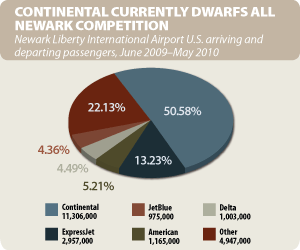 Wherever Southwest chooses to fly from Newark might change
its plans for LaGuardia, said airline industry consultant Robert Mann,
president of R.W. Mann & Co. "It will be interesting to see whether
there will be changes in Southwest's patterns at LaGuardia in response to
Newark, in terms of the nonstop destinations they serve," said Mann,
adding that it might consider Denver for possible Newark service.
Wherever Southwest chooses to fly from Newark might change
its plans for LaGuardia, said airline industry consultant Robert Mann,
president of R.W. Mann & Co. "It will be interesting to see whether
there will be changes in Southwest's patterns at LaGuardia in response to
Newark, in terms of the nonstop destinations they serve," said Mann,
adding that it might consider Denver for possible Newark service.
While Newark is not Southwest's typical secondary airport
with few congestion issues, the carrier should be able to pursue a low-fare
strategy, Mann said. "The way majors price at Newark, there's a high
umbrella under which Southwest can undercut on price," he said. "Clearly,
the DOJ thinks they'll discipline pricing."
The U.S. Department of Justice approved the
Continental/United merger hours after Continental and Southwest announced the
Newark agreement on Aug. 27. With the European Commission's July approval, the
carriers expect the new United Airlines to emerge by Oct. 1, awaiting only
shareholder approval and examination by a handful of U.S. state attorneys
general.
DOJ in its approval called the current Continental and
United networks "largely complementary" and said the Southwest deal "resolves
the department's principal competition concerns and will likely significantly
benefit consumers on overlap routes as well as on many other routes."
Despite reducing Continental's presence at its Newark hub,
not everyone was pleased. "There must be consideration of whether a merger
will inevitably trigger others, ultimately reducing the industry to a few large
carriers, each of which is unwilling to compete seriously in markets dominated
by one of the others," said U.S. Rep. James Oberstar (D-Minn.), who chairs
the House Committee on Transportation and Infrastructure.
"When Congress deregulated the airlines in 1978, we
were promised better service, added competition and more choices for consumers.
With the United-Continental merger, our domestic carrier fleet will have shrunk
to four network carriers," Oberstar said. "Can a US Airways-American
Airlines merger be far behind?"
Nevertheless, the new United is poised to take its place as
the world's largest carrier in but a few weeks, spawning perhaps a more
competitive Newark as a byproduct. "For Manhattan," Mann said, "people
below Canal St., and in northern New Jersey, this will open it up."
This report originally
appeared in the Sept. 6, 2010, issue of Business Travel News.